Ivy Elite
Vanderbilt University

Vanderbilt University currently comprises 10 schools and colleges. Vanderbilt University is dedicated to sparking and nurturing interdisciplinary research that advances discoveries with global impact. Committed to "strengthening the ties that unite all parts of the nation," the university has built a tradition of academic excellence infused with a distinctive spirit of collaboration and collegiality. Vanderbilt University's mission is to pursue the best of humanity—pushing new ideas to the frontiers of discovery, challenging the limits of what is possible, and striving to serve others.

About the university

School data is compiled from public sources and may change. Confirm current tuition, deadlines and requirements with the university before applying.

At a glance

Acceptance rate 6%
Tuition and fees $22,054
SAT range 1510-1560
Application deadline Jan. 1
Undergraduate enrollment 7,057
Student-faculty ratio 7:1
Location 2201 West End Ave, Nashville, TN 37235
School type Private research university
In-state tuition
$498
Out-of-state tuition
$22,054
Room and board
$22,054
Graduation rate
89%
Student-faculty ratio
7:1
Gender ratio
48:53

Alumni starting salaries

Biological and Biomedical Sciences
+
Business, Management, Marketing, and Related Disciplines
+
Engineering
+
Mathematics and Statistics
+
Social Sciences
+
Psychology
+
Philosophy and Religious Studies
+
History
+

Student body

First-year diversity
White
39%
Hispanic
12%
Asian
19%
Black
10%

Inside the school

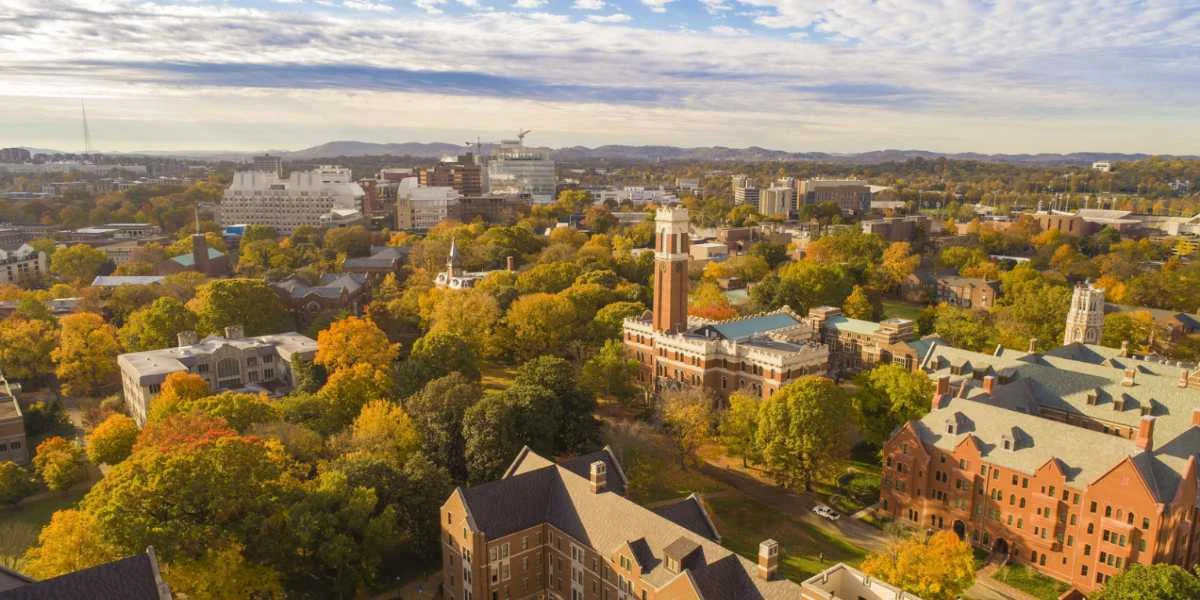
Vanderbilt University sits in Nashville, the "Music City" capital of country music, and is known for its beautiful campus and outstanding academics, earning it the nickname "Harvard of the South." Campus life is rich and varied, and the friendly atmosphere along with high-quality residence halls and dining facilities places the university near the top of national rankings of the "happiest colleges." Vanderbilt's Peabody College of Education and its School of Engineering, among other programs, enjoy a strong national reputation, and the university's location next to centers of health care, finance, and technology gives students abundant research and career resources. Combining a long history, elite education, and a free and flexible academic atmosphere, Vanderbilt University offers students an ideal environment in which to grow.

We will examine the distinctive appeal of Washington University from several angles, highlighting the school's core features and its academic achievements and cultural character. Click the button below to view the full introduction to the school.

01. The Most Beautiful Campus

02. America's Happiest University

03. The Birthplace of American Country Music

04. Vanderbilt University, Home to Generations of Talent

05. Founding History

06. A World-Class School of Education and Human Development: Peabody College of Education and Human Development

07. Peabody Library: A Beautiful Building of Great Historical Significance

08. Applying Early Decision Is Key to Admission

09. Extensive Public Facilities

10. A Commitment to the Philosophy of “Focusing on Reality and Grounding Work in Reality”

Most popular majors

Social Sciences
30%
Multi/Interdisciplinary Studies
14%
Engineering
9%
Biological and Biomedical Sciences
8%
Computer, Information Sciences, and Support Services
8%
Mathematics and Statistics
6%
Psychology
6%
Visual and Performing Arts
4%
Education
2%
Foreign Languages, Literatures, and Linguistics
2%

Graduate programs

Data Science

Data Science

Program Overview

Data Science at Vanderbilt University is a multidisciplinary field that typically intersects with computer science, mathematics, and statistics. Its primary goal is to extract knowledge and enable discovery from complex data. In the Data Science program, principles from statistics and computer science are combined and applied to specific domains to solve real-world problems.

Degree Type

Masters in Data Science

Program Length

4 semesters of full-time coursework

Source: VU Program Overview

Application Requirements

English Proficiency

If you are an international applicant, please demonstrate that you hold a degree from an English-language institution of higher education.

TOEFL: minimum score of 100, with no subscore below 21.

IELTS: minimum overall band of 7, with a minimum section score of 6.5 to apply.

Duolingo English Test: minimum score of 130.

GPA Requirement

Minimum GPA of 3.0

Applicant Eligibility

Vanderbilt University encourages students with strong academic backgrounds to apply.

Students must demonstrate programming skills through university achievements, online courses, or professional experience.

Students must hold a four-year bachelor's degree (equivalent to a U.S. bachelor's degree).

For students who have not received formal training in quantitative coursework (programming, calculus, linear algebra, and/or statistics), the program offers a boot camp to help students prepare for their courses. Although the boot camp is available to all students, most attendees are selected students seeking to strengthen their skills and help them succeed in Vanderbilt's core courses.

Statement of Purpose

Answer the following 2-3 questions:

In one to two pages, describe your interest in data science and the areas in which you hope to apply your skills.

In one page or less, describe your background and experience in programming, computing, and data analysis.

In addition to the program-specific application requirements above, the complete application requirements can be found in the [Application Requirements] section of our website.

Source: VU Admissions

Graduation Requirements

Credit Requirement:

Students must complete 48 credits (16 courses).

Source: VU Curriculum

Curriculum Overview

The Vanderbilt University Master's in Data Science curriculum is organized into three core sequences:

Computation: focuses on programming, data structures, computer systems, and methods.

Data Analysis: focuses on data exploration, analysis, prediction, inference, and algorithms.

Practice: designed to impart workplace skills, ethical standards, and an understanding of data science.

Students receive training across the three core sequences, gain hands-on experience, and develop workplace skills (teamwork, communication, leadership). Below is a sample course sequence:

Year

One

Fall

Spring

DS 5220: AI Assisted Programming

DS 5640: Modeling and Machine Learning I

DS 5620: Probability and Statistical Inference

DS 5340: Data Science Rights and Responsibilities (or spring of the second year)

DS 5610: Exploratory Data Analysis

DS 5380: Data Science Teamwork in Practice (Team)

DS 5320: Survey of Data Science Applications

DS 5420: Data Management Systems

Summer

DS 5700: Data Science Internship

Students may register for 0-3 credits: 0 credits, paying only student fees; 3 credits, paying tuition and student fees but allowing them to take one fewer course in the second year.

Students must log their internship in 12Twenty.

Year

Two

Fall

Spring

DS 5440: Data Science Algorithms

DS 5460: Big Data Scaling

DS 5660: Deep Learning

DS 5999: Capstone Development

DS 5690: Transformers in Theory and Practice (fall or spring)

Elective 2

Elective 1

Elective 3

Note: Waivers of electives and required courses require approval from the Director of Graduate Studies. Source: VU Curriculum

Career Development

Master's students in Data Science at Vanderbilt University become well-grounded data scientists through their academic studies, and upon graduation they contribute by:

● Designing computational pipelines for high-dimensional and large-scale complex data

● Acquiring and managing large datasets

● Generating effective data displays and visualizations

● Building and interpreting statistical models for large-scale data

● Implementing machine learning algorithms to make predictions and optimize decisions

● Understanding the strengths and limitations of competing models

● Communicating results effectively to experts and non-experts

● Working in reproducible and open-source environments

● Recognizing the ethical, policy, and privacy implications of data science research

The school partners with the Owen Graduate School of Management Career Management Center, which provides personalized services from the moment students are admitted through graduation and their post-DSI careers.

Career coach Brook Meissner works directly with Master of Science in Data Science students to help them navigate their careers after college. In addition to Brook, Srinidhi Panchapakesan specifically assists students with the initial refinement of their resumes and cover letters.

Heather Yockey is dedicated to building strong relationships with employers, understanding their needs, and identifying opportunities to connect them with the program's talented data science students. She ensures students have access to a variety of employment opportunities and are fully prepared to achieve career success.

Source:

VU Program Overview

VU Career Resources

Finance

Finance

Program Overview

The core curriculum of the Vanderbilt University Master of Science in Finance program was created and developed by globally recognized industry leaders. Its courses cover not only the core theoretical knowledge of finance but also explore practical application and industry trends in depth. Unlike other institutions, the defining feature of Vanderbilt's Master of Science in Finance program is that students can customize 50% of their coursework according to their own preferences, giving students greater autonomy and choice and enabling deeper collaboration and exploration. The program provides students with comprehensive financial knowledge and professional skills, laying a solid foundation for their future career development in finance.

Degree Type

MS in Finance (MSF)

Program Length

Two semesters of full-time study

Source: VU MS Finance

Application Requirements

Language test requirements:

Most international students must take a language test and submit TOEFL, IELTS, or Duolingo scores. However, international applicants may request a waiver of the language test if they meet the following requirements:

The applicant earned a bachelor's degree in a country where English is an official language;

The applicant has lived and worked in a country where English is an official language for the past two or more years;

The applicant scored 90% or higher on the Verbal section of the GMAT or GRE.

Vanderbilt University's institution code for IELTS, TOEFL, and Duolingo is 1871. When selecting the school, be sure to report your scores to Vanderbilt University and select "graduate" rather than "undergraduate" as the type of test you are taking. The drop-down menu will then ask you to select a "department." Select the last option in the drop-down menu and click "Any department not listed."

GRE/GMAT:

Vanderbilt University reviews the highest total test score obtained by adding together the individual section scores from each test a student has taken. Candidates may take the test multiple times to achieve a higher score. Students with a GPA of 3.5/4.0 or higher may request a waiver of the GMAT or GRE requirement.

Video essay

The video essay can highlight your communication skills and personality. Before answering the selected prompt, practice self-description several times. The video essay should ideally be kept to within two minutes.

Essay

Your essay gives us insight into your personality and other unique qualities.

We generally ask you to be as specific as possible about your short-term (immediately after graduating from the Master of Science in Finance program) and long-term career plans. Log in to the application to see the specific questions you will need to answer in this year's application.

The essay must not exceed 500 words.

Interview

If you are selected for an interview, we will notify you of the interview time by email. Interviews may be conducted virtually, and we will provide more information by email. You may need to interview within 3 days to 4 weeks after submitting your application. Virtual interviews take place after the application is submitted and passes an initial review.

In addition to the program-specific application requirements above, full application requirements can be found in the corresponding [Application Requirements] section of our website.

Source: VU HOW TO APPLY

Graduation Requirements

Credit requirements

Complete at least 33 credits, including 18 credits of elective courses, and complete at least 12 credits each semester.

Grade requirements

Cumulative grade point average of 3.0

Source: VU Master of Science in Finance (MSF) Program Academic Policies

Curriculum

Required Courses

Course | Course Number Financial Economics I | MGT 6401 Professional Development and Communication | MGT 6406 Financial Reporting I | MGT 6410 Financial Economics II | MGT 6402 Econometrics I | MGT 6403 Financial Modeling | MGT 6405 Financial Reporting II | MGT 6411 Corporate Valuation | MGT 6431 Electives

Electives consist of primary electives and secondary electives.

Primary Electives

Course | Course Number Corporate Financial Policy | MGT 6432 International Financial Markets and Instruments | MGT 6433 Applied Investment Management | MGT 6435 Bond Markets | MGT 6436 Advanced Corporate Valuation | MGT 6443 Mergers and Acquisitions | MGT 6530 Private Equity and Leveraged Buyouts | MGT 6531 Derivatives Markets | MGT 6533 Financial Data Analysis | MGT 6534 Corporate Restructuring for Distressed Firms | MGT 6537 Machine Learning in Business | MGT 6632 Financial Institutions | MGT 6636 Corporate Restructuring for Non-Distressed Firms | MGT 6637 Entrepreneurial Finance | MGT 6639 Secondary Electives

Course | Course Number Introduction to Financial Accounting | MGT 6311 Introduction to Managerial Accounting | MGT 6312 Managerial Economics | MGT 6322 Advanced Cost Accounting | MGT 6416 Game Theory and Business Strategy | MGT 6425 Real Estate Financial Analysis | MGT 6437 Accounting for Mergers and Acquisitions | MGT 6514 The above is a partial list of secondary electives. For the complete curriculum, see: Master of Science in Finance Program (MSF) Course Schema

Sources:

VU Master of Science in Finance (MSF) Program Academic Policies

VU MS FINANCE CURRICULUM

Career Development

A Vanderbilt University Master of Science in Finance degree is a ticket to Wall Street and to the world of finance around the globe, and it is the key to a wide range of career opportunities. Your great career path is about to begin. Below are several career paths you might choose:

Investment banking: Helping client companies raise capital by creating and issuing debt and equity securities. Playing a key role in facilitating financial restructurings, mergers, and acquisitions.

Investment research: Examining and evaluating companies' financial statements and economic trends. Producing reports and models that banks or large investors use to make portfolio recommendations and decisions.

Private wealth management: Serving high-net-worth clients by providing comprehensive and personalized financial planning services such as investment and risk management strategies.

Real estate finance: Generating information that helps companies or clients position, purchase, develop, and sell buildings and properties.

Corporate finance: Ensuring a company's financial well-being by preparing financial statements, developing forecasts, creating models, researching potential acquisitions, and developing capital expenditure plans.

Advisory services and consulting: Providing expert and independent analysis on matters such as asset valuations or financial issues needed for litigation.

Source: VU MS FINANCE CAREER PATHS & SUPPORT

Biostatistics

MS in Biostatistics

Program Overview

Vanderbilt University's biostatistics program focuses primarily on statistical analysis and its practical application in the health sciences, providing students with a solid theoretical and practical foundation. The program aims to equip students with the tools and professional skills needed to carry out critical research projects, design clinical trials, and conduct epidemiological studies. The curriculum covers rigorous theoretical study, practical training, the application of computational techniques, and individualized mentoring, with particular attention to the theory and methods of biostatistics and their practical use in the biomedical field. The courses highlight the core ideas of contemporary statistics and explore in depth the fundamental principles of statistical inference, which are essential for translating data into scientific evidence.

Degree Type

MS in Biostatistics

Program Length

2 years

Source: Vanderbilt University MSB

Application Requirements

English Proficiency

Proficiency in written and spoken English is required for participation in academic courses. This can be demonstrated by submitting scores from one of the following tests:

Test of English as a Foreign Language (TOEFL)

International English Language Testing System (IELTS)

Duolingo English Test (not accepted by all programs; please contact the department)

Graduate school applicants, regardless of nationality, must meet Vanderbilt University's exemption criteria (below) or submit proof of English language proficiency. If you meet the exemption criteria, the online application will not require you to submit language scores: you (will) hold an equivalent degree from an English-language university in the United Kingdom, Ireland, Australia, New Zealand, or Canada (except Quebec).

This policy applies to all graduate programs; the score level required for admission varies by program. Please note:

If your native language is not English, U.S. citizenship does not mean you are exempt from language testing.

International students transferring from incomplete degree programs at other U.S. universities should present language test scores.

Minimum Acceptable Scores

The minimum acceptable score for the TOEFL (Internet-based test) is 89. Some departments list minimum recommended or required scores on their department websites and may require higher proficiency. Please contact the program you are interested in to confirm.

For IELTS, the minimum acceptable score varies by program. In many cases, a score of at least 7.0 is desirable.

International applicants may be exempt from submitting English proficiency scores only in the following cases. If none of the above conditions apply, the appropriate scores must be submitted. Please do not contact the program or the graduate school directly to request an exemption.

You hold a degree from Vanderbilt University (bachelor's, master's, or doctoral) or are currently enrolled in a degree program at Vanderbilt University.

You have completed a full bachelor's degree in the United States, or a degree equivalent to a U.S. bachelor's degree awarded in a qualifying country/region. The bachelor's degree should be from a regionally accredited U.S. university or an officially recognized university in another country/region where English is the language of instruction and the only officially recognized language. This applies to institutions in the United Kingdom, Ireland, Australia, New Zealand, and Canada (except Quebec). The entire program must be completed (or will be completed) in a qualifying country/region. Dual-degree holders who have completed only part of their degree in the United States or another qualifying country/region, and students who have transferred credits from a non-English-speaking country/region, do not qualify for this exemption.

You have earned a master's or doctoral degree in a country/region where English is both the language of instruction and the only official language. You must have obtained this degree at the time of submitting your Vanderbilt application. Applicants who have not yet completed a qualifying master's or doctoral program at the time of application must still submit English proficiency scores.

Your native language is English. This applies to native English speakers from the United Kingdom, Ireland, Australia, New Zealand, and Canada (except Quebec).

The language of instruction for your entire bachelor's degree program was English, and the country has multiple official languages, including English. You will be prompted in the application to provide proof that English is an official language of your institution. All documents will be reviewed after you submit your complete application. Acceptable documentation must be one of the following: an official or certified letter from the undergraduate college, university registrar, or examinations officer's office.

If English is the language of instruction, unofficial transcripts, certified transcripts, or degree statements may also be accepted.

Your academic program may not override these policies, but if the graduate school has not required you to take a test, they may choose to require one.

The Vanderbilt University Graduate School does not waive the English proficiency requirement for other factors such as work experience, ESL enrollment, or time spent in the United States. In addition, programs taught in English in non-English-speaking countries do not exempt you from the English proficiency requirement.

Any exemption will be reviewed only after the application is submitted and all supporting documents (including the necessary application fee) are complete.

Statement of Purpose

In one essay, tell the school why you want to study biostatistics. If you wish, briefly describe how your personal background contributes to Vanderbilt University's mission of equity, diversity, and inclusion. The essay should be 1-2 pages; the font must be 11 point or larger.

GRE

All applicants must provide Graduate Record Examination (GRE) scores, which must be from the past five years. You may obtain financial assistance through the GRE Fee Reduction Program. Official scores are required; however, unofficial score copies are sufficient until official scores are received. Your scores should be sent to institution code 1871.

Admission Background

Three semesters of college calculus (through multivariable calculus), one semester of linear algebra, and one introductory statistics course.

In addition to the program-specific application requirements above, complete application requirements can be found in the corresponding [Application Requirements] section on Vanderbilt University's official website.

Sources:

Vanderbilt University MSB English Proficiency

Vanderbilt University MSB Application Requirements

Graduation Requirements

Credit Requirements

Students must earn 30 credits of coursework.

Grade Requirements

Students must maintain an overall grade point average of 3.0 or higher.

Thesis Requirements

Students must enroll in BIOS 7999 Master's Thesis Research. Students must submit a master's thesis detailing original work in theory or application and present the thesis to a thesis committee, usually in a closed forum.

Independent research in biostatistics must be a creative and substantive original contribution to the field of biostatistics, involving the development and evaluation of biostatistical methods and application to important biomedical problems. The thesis or dissertation typically includes some combination of the following: development of new biostatistical methods; extension, innovative application, and/or comparison of existing statistical methods in biomedical research; conduct of empirical simulation studies; dissemination of open-source statistical software to facilitate broad implementation. Past students' theses and dissertations can be found in the Vanderbilt University institutional repository. Students are encouraged, but not required, to apply for internal and/or external funding to support their research.

Sources:

Vanderbilt University MSB Graduation Requirements

Vanderbilt University MSB Thesis Requirements

Curriculum

Research

Course (Chinese) Course (English) Course Number Credits Master's Thesis Research BIOS 7999 0-6 Core Courses

Course (Chinese) Course (English) Course Number Credits Introduction to Statistical Computing BIOS 6301 2 Introduction to Study Design BIOS 6306 3 Principles of Modern Biostatistics BIOS 6311 3 Principles of Modern Biostatistics Lab BIOS 6311L 1 Modern Regression Analysis BIOS 6312 3 Modern Regression Analysis Lab BIOS 6312L 1 Fundamentals of Probability BIOS 6341 3 Fundamentals of Probability Lab BIOS 6341L 1 Contemporary Statistical Inference BIOS 6342 3 Contemporary Statistical Inference Lab BIOS 6342L 1 Statistical Collaboration in Health Sciences I BIOS 7351 3 Statistical Collaboration in Health Sciences II BIOS 7352 3 Elective Courses

Course (Chinese) Course (English) Course Number Credits Clinical Trials and Experimental Design BIOS 6321 3 Applied Survival Analysis BIOS 7323 3 Applied Survival Analysis Lab BIOS 7323L 1 Regression Modeling Strategies BIOS 7330 3 Advanced Regression Analysis I BIOS 7345 3 Advanced Regression Analysis I Lab BIOS 7345L 1 Advanced Regression Analysis II BIOS 7346 3 Advanced Regression Analysis II Lab BIOS 7346L 1 Advanced Concepts in Probability and Real Analysis for Biostatisticians BIOS 7361 3 Advanced Statistical Learning and Inference BIOS 7362 3 Advanced Statistical Computing BIOS 8366 3 Bayesian Methods BIOS 8372 3 Causal Inference BIOS 8375 3 Source: Vanderbilt University MSB Curriculum

Career Development

Graduates of Vanderbilt University's biostatistics program have strong employment prospects in the healthcare and pharmaceutical industries, government agencies, and research institutions. Graduates are in high demand because they play a key role in analyzing complex health data, helping to make better decisions, improve patient outcomes, and advance public health practice.

Source: Vanderbilt University MSB Career Development

Campus life

Transportation

Nearby Airport

Nashville International Airport (code: BNA)

Distance from campus: 7.6 miles

Getting from campus to the airport:

By car/rideshare:

Typically takes about 11 minutes. It may take longer during heavy traffic.

Public transit:

Take bus routes 3/75 and transfer to route 18 to reach the airport; the trip takes about 1 hour.

City Public Transit

Buses: The Nashville Metropolitan Transit Authority provides a range of bus routes covering Nashville and the surrounding area. Students can use the bus system to reach campus and destinations throughout the city.

Campus Shuttle: Vanderbilt University provides students with on-campus shuttle service for convenient travel around campus.

Safety

Vanderbilt University is a very safe campus, but no place is immune to crime. Always take extra care and stay alert to your safety when walking on campus.

Campus Emergency Phones:

There are multiple emergency phones across the Vanderbilt campus. Refer to the map for locations.

Walking Escort Service:

VUPD also offers a walking escort service for students, faculty and staff traveling to and from any location on campus at night. No matter how short the distance, if you cannot find someone to walk with, use the on-campus escort service.

SaveVU app:

SafeVU is a mobile safety app for iOS and Android smartphones. The app allows users to connect directly to the Vanderbilt University Police Department from their phone.

Housing

Housing and Residential Experience provides residents with safe, secure, comfortable, convenient and healthy housing. The programs designed for residents build community and meet students' social needs for belonging, friendship, recognition, respect and dignity. These communities promote learning, personal development and academic achievement for first-year and graduating students. All residence halls are equipped with card-swipe building access, central air conditioning, Xfinity Campus IPTV service, campus wireless internet, carpeted hallways, camera monitoring at all exterior doors, and custodial service for common-area bathrooms and hallways. Each resident has a bed, desk, desk chair, chest, wardrobe, towel bar/hooks, blinds, overhead lighting, trash can and recycling bin. Building-specific amenities are listed on each building's page.

Residential Colleges

First-Year Housing

First-year students may live in THE MARTHA RIVERS INGRAM COMMONS, specifically: Crawford House, East House, Gillette House, Hank Ingram House, Memorial House, Murray House, North House, Stambaugh House, Sutherland House, and West House

Upper-Division Housing

Upper-division students may choose Traditional Housing, Residential Colleges, or Living Learning Communities. Specifically:

Traditional Housing: Blakemore House, Chaffin Place, Cole Hall, Lewis House, Lupton House, Morgan House, Scales House, Stapleton House, Tolman Hall, Vaughn House, Village at Vanderbilt - South Tower, Village at Vanderbilt Townhouses

Residential Colleges: E. Bronson Ingram College, Moore College, Rothschild, Warren College, Nicholas S. Zeppos College

Living Learning Communities: Mayfield Place, McGill House

On-Campus Housing Application Steps

Housing Registration

Except for graduating students, all returning students must register for the housing assignment process. After completing housing registration, students can participate in future housing assignment processes.

Seniority and Lottery Points

All housing assignment processes (except the Living Learning Community (LLC) process and the unassigned student process) use seniority-driven random selection (a lottery). Throughout the process, rising seniors and above receive 4 points, rising juniors 3 points, and rising sophomores 2 points. Random selection is used to break ties in points.

Points are determined by entry term. All first-year students currently living in Ingram Commons are considered rising sophomores. All group living processes (doubles, suites and apartments) use seniority-driven random selection, taking the average score of all members of the roommate group and breaking ties in average scores through random selection. As a result, groups with higher average scores have a greater chance of success in each process. For groups that succeed in a given process, groups with higher average scores choose their spaces before groups with lower average scores.

In the single-room application process, students are welcome to apply as individual applicants, or they may form a roommate group with up to 3 additional single-room applicants. Average scores are used for roommate groups. Students/groups with higher scores/average scores have a greater chance of success in this process. For successful students/groups, students with higher scores/average scores choose rooms before students with lower scores/average scores.

Gender-Inclusive/Mixed-Gender Housing Options

To meet students' needs and recognize the complexity of gender and gender identity, students may form roommate groups with other students of their choosing, regardless of legal sex or gender identity, in the residential college suite process and all apartment processes. Students choose their own roommates. No student will be assigned to a room with a roommate of a different gender unless both parties agree.

In the residential colleges (E. Bronson Ingram College, Moore College, Nicholas S. Zeppos College, Residential College C, Rothschild College and Warren College), floors and suites are not gender-designated. That is, students of all gender identities will live on the same floor and, if they wish, may live in the same suite. Traditional double rooms are single-gender only. Community bathrooms without fully enclosed stalls will be designated, and students will be required to use the bathroom corresponding to their gender.

Many floors in Lupton and Stapleton Houses will offer double rooms for women and men. Bathrooms will be designated, and students will be required to use the bathroom corresponding to their gender. The second and third floors of Blakemore House will offer double rooms for women and men. All double rooms have their own private bathroom. The second floor of McGill Hall will offer rooms for women and men. Bathrooms will be designated, and students will be required to use the bathroom corresponding to their gender. The third and fourth floors of McGill Hall will offer rooms for women and men with all-gender bathrooms. McTyeire House floors will offer rooms for women and men. Bathrooms will be designated, and students will be required to use the bathroom corresponding to their gender.

Dining

Vanderbilt University students can choose among four dining halls, four retail dining locations, six cafes, and five convenience stores. Under the direction of Chef Brian Cochrane, the dining halls offer the widest variety of full-service meals, a range of dishes, and service on your own schedule. Meal components vary by cuisine, but all include a main dish, side dishes and a beverage.

Dining Halls

Commons

Students can now enjoy continuous service in the state-of-the-art dining facility at The Commons Center. Enjoy favorite foods, including breakfast, Chef's Table, Magnolia & Co. sandwiches, Mongolian dishes, and pasta with a salad bar and pastries.

E. Bronson Ingram

Students can enjoy breakfast, Chef's Table, pho, a salad bar and pastries.

Nicholas S. Zeppos

Zeppos dining hall offers continental breakfast options, fresh sandwiches at lunch, and artisan breads at dinner.

Rothschild Dining Hall

Rothschild Dining Hall is Vanderbilt University's newest dining hall, serving breakfast, lunch and dinner, plus brunch on weekends. Options include a variety of campus cuisines, including Italian, South Asian, Gourmet Grille and Home Grown - featuring fresh local ingredients.

For more information, see the dining halls.

Meal Plan

All Vanderbilt students living on campus must participate in a meal plan based on their class year. Meal plans are available to all undergraduate and graduate students as well as faculty and staff. Meal plans are loaded onto your Commodore Card or mobile wallet and include a fixed meal allowance plus flexible dining dollars each semester. Undergraduate meal plans are based on class year.

Simply swipe your card or phone at a dining location, and the meal or dining dollars are automatically deducted from your account. Most dining locations offer buffet service, while others offer meals that include a main dish, side dishes and a beverage. These options include residential dining halls, retail markets and cafes, as well as Munchie Marts offering grab-and-go options, snacks and convenience items.

Meal Plan Options for On-Campus Students

Applies toMealsDining DollarsPriceFreshmen335/semester225/semester3785/semesterSophomores305/semester275/semester3747/semesterJuniors305/semester275/semester3747/semesterSeniors225/semester325/semester3336/semesterStudents living off campus will be able to purchase any meal plan but will not be required to do so. In addition, non-residential students, faculty and staff may choose to purchase Flex Meals, which are prepaid meals redeemable at any campus dining location.

Meal Plan Options for Off-Campus Students

Applies toMealsDining DollarsPriceOff-campus230/semesterNone3024/semesterOff-campus80/semesterNone1250/semester

Admissions

Acceptance rate
6%
Average GPA
3.9
SAT range
1510-1560
ACT range
34-35
SAT / ACT
SAT reading and writing, 25th–75th percentile: 740-770
SAT math, 25th–75th percentile: 770-790
SAT median: 1540
ACT composite, 25th–75th percentile: 34-36
ACT English, 25th–75th percentile: 35-36
ACT math, 25th–75th percentile: 32-35
ACT median: 35

Admissions data

Admission to Vanderbilt University is highly competitive, with an acceptance rate of 7%.
Half of the applicants admitted to Vanderbilt University have an SAT score between 1480 and 1570 or an ACT score between 34 and 35.
The application deadline for Vanderbilt University is January 1, and the application fee is $50.
Vanderbilt University admissions officials consider a student's GPA to be an important academic factor. Vanderbilt University admissions officials will consider an applicant's high school class rank, but the quality of letters of recommendation is also a very important consideration.
Applicants
Admitted
Female applicants
Male applicants
Female admits
Male admits
Waitlist offered
Yes
Admitted from waitlist
140

Application requirements

01.
Vanderbilt University accepts the Coalition for Access, the Common Application, QuestBridge*, and the Universal College Application—four application methods. For Vanderbilt University, there is no difference among the application systems; students only need to choose the one that best suits them for their U.S. college application.
02.
Early Decision I and Early Decision II are binding application plans; if students are admitted, they may be required to enroll at Vanderbilt University. The applicant, parent or guardian, and high school counselor must sign the Early Decision agreement, indicating the student's commitment to attend Vanderbilt University if admitted in either of these two rounds. If a student is admitted to Vanderbilt University, he or she must immediately withdraw all other applications to colleges and universities.

Application checklist

01.
Completed Common Application or Coalition, powered by Scoir application, including the Personal Essay and Short Answer
02.
$50 application fee
03.
Official high school transcript
04.
Counselor recommendation letter
05.
Two academic teacher recommendation letters
06.
For students entering in fall 2023/2024, SAT and ACT scores are optional
07.
International applicants must submit TOEFL, IELTS, or Duolingo English test scores
Applicants with an SAT Reading score above 33 or an ACT English score above 26 are not required to submit English proficiency test scores
08.
Additional Blair School of Music requirements
In addition to the Common Application, Coalition Application (powered by Scoir), or QuestBridge application, all Blair applicants must complete the Blair School of Music application. Please visit blair.vanderbilt.edu/admissions/apply for all details and the latest information on application requirements for Blair applicants.
Materials required for the Blair School of Music application: 1) One arts-related recommendation 2) Headshot or photo (for identification purposes; professional quality not required) 3) Music resume 4) Repertoire list 5) Prescreening video

Application deadlines

Deadline
Date
Early Decision I
Nov. 1
Early Decision II
Jan. 1
Regular Decision
Jan. 1
ED I notification
Dec. 15
ED II notification
Mid-Feb
RD notification
April 1

Transfer requirements

01.
Vanderbilt University accepts transfer students into the following four undergraduate colleges: the College of Arts and Science, the School of Engineering, Peabody College of education and human development, and the Blair School of Music.
02.
Typically, admitted transfer students have a GPA of B+ or higher, competitive test scores, active involvement in their current community, and a compelling explanation of why they want to join Vanderbilt University. The student's application essay is also a way for the school to learn the student's reasons for transferring and why the student feels Vanderbilt would be a good place to achieve their academic goals.
03.
Students must have completed at least 12 semesters hours of credit after graduating from high school to be eligible to transfer. Admitted students must complete 4 semesters (60 credits) of study at Vanderbilt to receive a Vanderbilt University diploma.
04.
In the admission process, the school gives priority to students who are full-time participants and full-time enrollees on their current campus. All parts of the application (academics, test scores, extracurricular activities, essays, letters of recommendation, etc.) will help the school make its decision. No interviews are offered to transfer applicants.

Transfer checklist

01.
Complete all required sections of the Common Application Transfer Application or the Coalition Application, which Scoir supports for transfer applications, including the personal essay and short answers
02.
$50 nonrefundable application fee
03.
Official high school transcript (must show graduation date)
04.
Official college transcripts (from every institution attended)
05.
Transfer report (from the institution you are transferring from)
06.
Two letters of recommendation from academic teachers (at least one from a college instructor/lecturer is strongly recommended)
07.
Optional SAT or ACT scores for students applying for Fall 2023 and Fall 2024
08.
The Application Checklist must be completed
09.
International applicants must submit TOEFL, IELTS, or Duolingo English Test scores
Applicants with an SAT Reading score above 33 or an ACT English score above 26 are not required to submit English proficiency test scores

Transfer deadlines

Deadline
Date
Spring application deadline
Rolling Based
Fall application deadline
May. 1 (Recommended)
Spring materials deadline
Rolling Based
Fall materials deadline
May. 1 (Recommended)

Similar universities

Admissions FAQ

What is the acceptance rate at Vanderbilt University?

The reported acceptance rate is 6%. Acceptance rates vary by applicant pool and application cycle; confirm the current figure with Vanderbilt University.

What SAT scores does Vanderbilt University expect?

The reported SAT range is 1510-1560. Test-optional and score-reporting policies can change by application cycle; check the university's official admissions page before applying.

When is the application deadline at Vanderbilt University?

The listed Regular Decision deadline is Jan. 1. Deadlines can vary by program and application cycle; confirm the exact date with the university.

How much does Vanderbilt University cost?

The listed tuition and fee figure is $22,054. Costs vary by residency, programme and academic year; confirm current costs with the university.

Where is Vanderbilt University located?

Vanderbilt University is located at 2201 West End Ave, Nashville, TN 37235.

Planning your application?

Build a school list around your profile.

Ivy Elite advisors help students compare programs, plan coursework and prepare applications for U.S. universities.