Ivy Elite
Cornell University

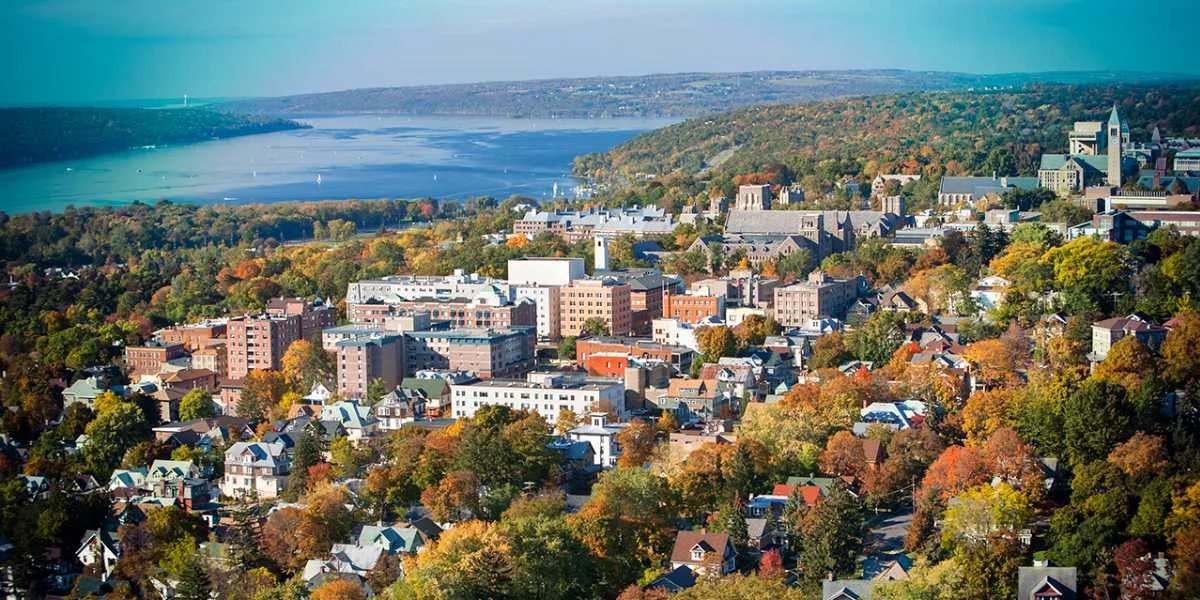
Cornell University, located in Ithaca, New York, is a renowned private research university. The university comprises 13 colleges—7 graduate and professional colleges and 4 undergraduate colleges—and is highly regarded in fields such as engineering, computer science, medicine, agriculture, and the humanities and social sciences. Cornell University emphasizes interdisciplinary research and international collaboration, advancing knowledge innovation and social progress. Campus culture at Cornell is rich and varied, offering a wide range of student organizations, cultural activities, and athletic events that give students ample room to grow and to build social connections. As a world-class research university, Cornell University is dedicated to developing global leaders and innovators who make positive contributions to society and to human development.

About the university

School data is compiled from public sources and may change. Confirm current tuition, deadlines and requirements with the university before applying.

At a glance

Acceptance rate 8%
Tuition and fees $19,428
SAT range 1480-1560
Application deadline Jan. 2
Undergraduate enrollment 14,743
Student-faculty ratio 9:1
Location 300 Day Hall, Ithaca, NY, 14853
School type Private research university
In-state tuition
$314
Out-of-state tuition
$19,428
Room and board
$19,428
Graduation rate
87%
Student-faculty ratio
9:1
Gender ratio
46:55

Alumni starting salaries

Biological and Biomedical Sciences
+
Business, Management, Marketing and Related Fields
+
Engineering
+
Mathematics and Statistics
+
Social Sciences
+
Psychology
+
History
+
Public Administration and Social Service
+

Student body

First-year diversity
White
31%
Hispanic
15%
Asian
25%
Black
7%

Inside the school

Cornell University is located in Ithaca, New York, and is known for its expansive campus, top-tier academic programs, and multicultural community. As the "easiest Ivy to get into," it offers world-leading programs in hotel management, computer science, and architecture, and cultivates industry leaders through practice-oriented coursework. The university's Cornell Tech campus drives technological innovation, and the school works closely with Chinese universities to expand international educational resources. Campus life is rich as well, with distinctive traditions such as Slope Day and Dragon Day, and its libraries and residential environments evoke a "Hogwarts" atmosphere, offering students a unique and memorable college experience.

We will examine the distinctive appeal of the University of Washington from several angles, showcase the school's core features, and explore its academic achievements and cultural character. Click the button below to view the school's full introduction.

01. An excellent location

02. The "easiest Ivy to get into"

03. The best hotel management program in the United States

04. A top-tier computer science program in the United States

05. The No. 1 undergraduate architecture program in the United States

06. A real-life "Hogwarts library"

07. Cornell University's Deep Ties to China

08. Cornell University's Partnerships with Chinese Universities

09. Many One-of-a-Kind, Interesting Courses

10. A Rich and Varied Array of Campus Activities

Most popular majors

Computer and Information Sciences and Support Services
17%
Business, Management, Marketing, and Related Support Services
15%
Engineering
14%
Agriculture/Animal/Plant/Veterinary Science and Related Fields
12%
Biological and Biomedical Sciences
12%
Social Sciences
7%
Family and Consumer Sciences/Human Sciences
3%
Physical Sciences
3%
Architecture and Related Services
3%
Mathematics and Statistics
2%

Graduate programs

Computer Science

Computer Science

Program Overview

Computer Science M.S.

The Cornell University Master of Science in Computer Science is a small program for students who want to deepen their knowledge of computer science through advanced coursework, research, writing, and teaching. It is well suited to proactive students who communicate well, enjoy a research environment, and like working with undergraduates in introductory courses.

Computer Science M.Eng.

The Cornell University Master of Engineering in Computer Science is aimed primarily at students interested in both the theoretical and practical aspects of computing. The program is offered at two campuses — Cornell's main campus in Ithaca and Cornell NYC Tech in New York City. Students enroll at a specific campus and take all of their courses there.

Degree Types

Computer Science M.S.

Computer Science M.Eng.

Program Length

Computer Science M.S.: 4 semesters

Computer Science M.Eng.: 2 semesters

Research Areas: Research areas in computer science at Cornell University include architecture, artificial intelligence, computational biology, database systems, graphics, human-computer interaction, machine learning, natural language processing, programming languages, robotics, scientific computing, security, systems and networking, theory of computation, and vision.

Sources:

Cornell Computer Science

Cornell Computer Science M.Eng.

Cornell Master of Engineering Program

Cornell MS CS Overview

Application Requirements

Computer Science M.S.

Admission Requirements

Applicants should hold a bachelor's degree in computer science. Applicants who majored in another field and minored in computer science will also receive full consideration.

In addition, applicants must have served as an excellent undergraduate grader/TA in a computer science course (we strongly recommend that applicants have undergraduate research experience).

Letters of Recommendation

Applicants must submit three letters of recommendation, at least one of which addresses the applicant's ability to write and argue and to work in a classroom environment.

Essay

Applicants must submit an essay explaining how the degree program and intended thesis area connect to their career plans.

English Proficiency: All applicants must meet the English language proficiency requirement.

TOEFL: Writing, Listening, and Reading scores must be 24 or above, and the Speaking score must be 28 or above.

IELTS: Overall score must be 7.0 or above.

Computer Science M.Eng.:

You can review the application requirements for the related M.Eng. program.

In addition to the program-specific requirements above, the full application requirements can be found in the Application Requirements section of our website.

Sources:

Cornell MS CS Application Requirements

Cornell M.Eng Application Requirements

Graduation Requirements

Credit Requirements

Computer Science M.S.: Students must complete at least 34 credits.

Computer Science M.Eng.: Students must complete 30 credits.

Grade Requirements

Computer Science M.S.

Students must maintain a cumulative grade point average (GPA) of at least 3.0.

No course grade may be below C.

No grade in thesis research (CS 7999) may be below B; otherwise the student risks being dismissed from the program.

Students must remain in good academic standing after the end of the first, second, and third semesters and must have completed at least 8, 16, and 24 credits, respectively.

In courses where you serve as a teaching assistant, you must be considered an excellent TA. This is evaluated at the end of each semester.

Computer Science M.Eng.

Students must complete at least 28 credits, all of which must be taken for a letter grade.

All credits related to the program must be at grade B or above.

Courses with a grade below C- may not count toward M.Eng. credits.

Students must have a cumulative grade point average (GPA) of at least 2.5 to continue in the program.

Thesis Requirements

Computer Science M.S.

Students must write a thesis and give an oral presentation.

Students must choose a thesis advisor; the scope of the thesis work is determined by the thesis advisor, and a thesis is generally about 20-50 pages long. In addition, students must give a 30-50 minute oral presentation of the thesis results.

Computer Science M.Eng.

For all project courses, students must submit a written report by the last day of final exams.

Sources:

Cornell M.Eng Degree Requirements

Cornell MS CS Degree Requirements

Curriculum

Computer Science M.S.

Required Courses:

Students must complete 6-12 credits of coursework related to thesis research (CS 7999).

Elective Courses:

Students may complete the remaining credit requirements by taking 6-8 graduate-level courses.

At least four of these courses must be CS courses at the 5000 level (or higher), and at least one course must be at the 6000 level. In addition, students must complete an outside minor, usually consisting of two to three graduate-level courses. Students must also write a thesis and give an oral presentation.

Minor Courses

Students must complete an outside minor, and at least one member of the thesis committee must be a specialist in the minor field.

The outside minor requirement usually involves 2-3 courses, as determined by the outside minor field.

Courses outside the Computer Science department and courses unrelated to the outside minor may also be used to meet the 34-credit minimum. However, these courses must be approved by the Director; graduate-level courses in almost any field are generally acceptable if they are relevant to the student's educational goals.

Computer Science M.Eng.

All non-project credits must be earned in "technical" and "advanced" courses.

"Advanced" courses include most upper-level and graduate courses (5000 level and above).

Many (though not all) 5000- and 6000-level courses offered by the College of Engineering and by the "Information Systems" programs in the Department of Mathematics, the Department of Physics, the Department of Chemistry, and the Johnson Graduate School of Management may be considered "advanced" courses. The M.Eng. program committee determines whether a course is considered technical.

For computer science courses, "advanced" courses are numbered 5000 and above.

Courses at the 4000 level are not accepted.*

For courses offered jointly at the 4000 and 5000 levels, M.Eng. students must take the 5000-level version.

5000-level courses offered jointly with 4000-level courses will have different requirements.

Project Credit

Of the 30 total credits, students must complete 3-6 project credits, and all projects must be submitted as a written report by the last day of final exams. In addition, project credits do not count toward the required 15 credits of CS coursework.

For more information about projects, see: CS M.Eng. Project Requirement

Computer Science Courses

Of the 30 total credits, students must earn at least 15 credits in computer science courses.

These credits exclude seminars, independent study (CS 5999/7999), and CS 5199, which do not count toward computer science course credits.

For the list of relevant courses and information, please read: List of Computer Science Course Offerings

Sources:

Cornell MS CS Degree Requirements

Cornell M.Eng Degree Requirements

Career Development

Cornell University's career services office is dedicated to supporting students at every stage of their career development. It offers a wide range of resources and services to help students better understand themselves, explore career options, and prepare to enter the workforce. Below are some of the support and opportunities Cornell career services may offer:

Career Planning: Support to help students understand their interests, skills, and values so they can make more informed career decisions.

Career Fairs: Various types of career fairs that give students the chance to meet employers from many industries and learn about internship and full-time positions.

Job Search Skills Development: Resources and training to help students develop the job search skills they need, including resume writing and interview techniques.

Career Counseling: One-on-one career counseling to help students create personalized career development plans.

Graduate and Professional School Applications: Support for students preparing applications to graduate and professional schools, including writing personal statements and preparing for interviews.

Sources:

Cornell Career Fairs and Events

Cornell Career Services for Students

Electrical and Computer Engineering

Electrical and Computer Engineering

Program Overview

The Master of Engineering in Electrical and Computer Engineering at Cornell University is designed to provide students with abundant academic resources and hands-on opportunities, helping them explore advanced technologies in the field in depth. The program attracts students from a range of backgrounds who share a common goal: applying theoretical knowledge to solve real-world problems and actively advancing technology. Students have the opportunity, through theoretical study and practical experience, to contribute to innovation and technological progress and to address real-world engineering challenges.

Degree Type

Master in Electrical and Computer Engineering

Program Length

1 year

Research Areas

Master of Engineering students in Electrical and Computer Engineering at Cornell University may choose from multiple areas, including power and energy, bioelectrical engineering, computer architecture, imaging, nanotechnology, photonics, neuroscience, and computing.

Source: Cornell Master in Electrical and Computer Engineering

Application Requirements

Statement of Academic Purpose

Students must write a 1,000-word statement that includes:

(1) Your academic interests

(2) Your academic background, preparation, and training, including any relevant professional experience

(3) Your reasons for pursuing graduate study in this field

(4) Your professional goals. Please highlight your unique contribution to the intellectual diversity of the class, including your approach to problem solving, perspectives, skill set, regional knowledge, understanding of professional work culture, and/or lessons learned.

Personal Statement

Students must write a statement of no more than 1,000 words.

This statement describes how your personal experiences have influenced your decision to pursue a Master of Engineering degree and how you have prepared to contribute to Cornell's collaborative problem-solving environment. It should also highlight any life experiences or interactions that have significantly influenced or exemplified your problem solving, communication, collaboration and teamwork, leadership, maturity and self-awareness, perseverance, and/or resilience, including successes, failures, conflicts, injustices, or journeys of self-discovery.

English Proficiency Requirements

TOEFL: For international students or students from non-English-speaking countries — the IBT version of the TOEFL exam

Cornell University's TOEFL institution code is 2098; no department code is required.

IELTS: Overall band score of 7.0 required.

Letters of Recommendation

Students must submit 2 letters of recommendation.

It is strongly recommended that both letters be written by faculty. Cornell University's online application system by default allows only two letters of recommendation to be submitted; if you wish to submit a third letter, your recommender may send it directly by email in PDF format to the M.Eng. student services office.

The student services office email address is ece-meng@cornell.edu.

GPA Requirement

The minimum GPA requirement is 3.5/4.0.

In addition to the program-specific requirements above, the complete application requirements can be found in the [Application Requirements] section of our website.

Source: Cornell M.Eng. Admissions Requirements

Graduation Requirements

Credit Requirements

Students must earn 30 credits to graduate.

Without the approval of the course director, students may not take more than 18 credits in a single semester.

All ECE master's students must register for at least 12 credits each semester to be considered a "full-time student" and to maintain valid F-1 student visa status.

Grade Requirements

GPA may not fall below 2.5.

No grade may be below C-.

All students must earn a grade of B or higher in TECH 5900 or TECH 5910/TECH 5920/TECH 5930.

Students may count a maximum of 2 credits graded S/U toward the degree requirements. If a student changes more than 2 credits of coursework to "S/U," the entire course will not count.

Thesis Requirement

Students enrolled in ECE 5999 must write and submit an 8-10 page paper documenting their internship experience.

Internship Requirement

Completing an internship is not required to successfully complete the ECE M.Eng.

Students are responsible for finding their own internship opportunities, but this is not a required task. However, students who voluntarily extend the M.Eng. program to a third semester are eligible to pursue an internship during the summer between the second and third semesters.

If an internship is lengthy and takes place during the academic year, students may be eligible for a leave of absence.

International students participating in an internship must consult in advance with the Office of Global Learning to confirm all details. If international students participate in a paid internship, they must apply for Curricular Practical Training (CPT). In addition, to meet the CPT requirement, international students must earn 1 credit in ECE 5999 - M.Eng. Technical Internship.

Source:

Cornell M.Eng. Degree Requirements

Cornell MEng in Electrical and Computer Engineering Courses

Curriculum Overview

The Cornell University Master of Engineering in Electrical and Computer Engineering curriculum is centered on four technical courses; students may choose from the core courses those that best help them achieve their personal goals.

Required Technical Courses: 18 credits

Course | Course Number | CreditsApplied Machine Learning

OR

Machine Learning Engineering

Applied Machine Learning

OR

Machine Learning Engineering

ECE 5414

OR

CS 578

3Applied Digital Signal Processing and Communications

OR

Digital ASIC Design

OR

Computer Systems & Architecture

Applied Digital Signal Processing

OR

Digital ASIC Design

OR

Computer Systems & Architecture

ECE 5415

OR

ECE 5746

OR

ECE 5755

36 credits of ECE Electives

6 credits of technical electives (chosen from any ECE, CS, ORIE, or INFO course)

Required Studio Course: 8 credits

Course | Course Number | CreditsProduct StudioTECH 5900 4Startup Studio

OR

BigCo Studio

OR

PiTech Studio

Startup Studio

OR

BigCo Studio

OR

PiTech Studio

TECH 5910

OR

TECH 5920

OR

TECH 5930

TECH Studio Elective 1Note: TECHiE 5300, TECHIE 5310, and TECHIE 5320 cannot be used as studio electives.

General Elective: 4 credits

Students may choose any course offered on campus.

Note: TECHIE 5310: Business Fundamentals must be taken as a prerequisite for all business courses.

For more detailed course information, see: M.Eng. Degree Requirements

Source: Cornell MEng in Electrical and Computer Engineering Courses

Career Development

The average starting salary for an M.Eng. degree is approximately 6% higher than for a bachelor's degree. Cornell University's M.Eng. degree is competitive nationwide, exceeding bachelor's degrees of equivalent standing by 18% and the national average by 38%. This means a relatively short return on investment and the ability to enjoy compounding economic benefits throughout a career.

However, the value of an M.Eng. degree is not limited to salary. The degree is designed to develop engineering professionals, reinforcing design and analysis skills through advanced coursework and cultivating teamwork, communication, and leadership abilities. These are the key skills future engineers need, enabling students to pursue valuable work across a wide range of fields, from hardware design to financial software, and from communications technology to energy.

Six steps to your M.Eng. professional development:

STEP 1: Use the Canvas career development toolkit to access professional materials and resources for developing skills.

STEP 2: Schedule a resume review, cover letter review, or mock interview with an M.Eng. peer advisor.

STEP 3: Optimize your LinkedIn profile and send your LinkedIn connections to our team.

STEP 4: Create your Handshake profile to connect with employers — complete the required campus recruiting tutorial to participate in employer interviews on campus.

STEP 5: Create your CUeLINKS profile to connect with Cornell alumni.

STEP 6: Schedule an appointment with an M.Eng. career advisor to customize your job search strategy, improve your interview skills, or discuss offers.

Source:

Cornell Post-Grad Activities/Career Information

Cornell M.Eng. Career Resources

Public Administration

Public Administration

Program Overview

The Public Administration program at Cornell University's Brooks School of Public Policy is designed to develop students' understanding of political and administrative processes so that they can use these processes to set agendas, solve problems, and make policy. The program also aims to build students' understanding of the economic and financial foundations of government action in a market economy, equipping them with the tools to design and evaluate programs and analyze policy impacts. In addition, the program develops students' insight into the behavior and management of public, private, and nonprofit organizations so that they can manage and lead effectively in a variety of organizational settings.

Degree Type

Master of Public Administration

Program Length

2 years

Sources:

Cornell Public Administration M.P.A.

Cornell Master of Public Administration

Cornell Master of public administration Home

Application Requirements

Transcripts

Applicants to Cornell's Public Administration program must submit unofficial copies of transcripts from the colleges and universities they attended, but should not send these transcripts to the MPA program. After admission, all successful students must submit official transcripts to the Graduate School before enrolling.

Language Requirements

All applicants whose first language is not English must meet the minimum score requirements on the TOEFL or IELTS exam.

TOEFL: Minimum score requirements are Writing 20, Listening 15, Reading 20, and Speaking 22.

IELTS: Overall score of at least 7.0.

Statement of Purpose

Maximum 500 words

All applicants must explain in detail why they are applying to the program. Include the personal and/or professional experiences that led to your interest in the Cornell Brooks School MPA program; describe your future goals and explain how you will use the MPA graduate education; also include examples of your volunteer work, positions of responsibility, and any other life experiences that sparked your interest in public affairs.

Essay

Maximum 1,000 words

Students must briefly describe the area of public affairs in which they hope to contribute and discuss what they hope to achieve in that area;

explain how you will initiate, support, and sustain change in that area to improve public well-being and public service.

In addition to the program-specific application requirements above, the full application requirements can be found in the corresponding Application Requirements section of our website.

Sources: Cornell MPA How to Apply

Graduation Requirements

Credit Requirements

MPA students must successfully complete at least 16 full-semester courses, totaling 48 credits.

Two courses of 1.5 credits or 2 credits each, taken together, count as one full-semester course.

Grade Requirements

To maintain good academic standing, MPA students must maintain a grade point average (GPA) of at least 2.0.

No failing grades are permitted in any course counted toward the degree, and no more than 2 incomplete grades are permitted.

Professional Writing/Analysis Qualification

In public affairs, you need a high level of expertise in analysis and written communication. Cornell offers students several pathways to strengthen their skills and professional capabilities in these areas:

Capstone Project: Students may take part in a rigorous, unpaid, semester-long group consulting project serving a real client at a public agency or nonprofit organization, culminating in a written report.

Professional Report: Some students extend their experience through a summer internship, a semester of independent study, or a directed reading course, culminating in a professional report.

Thesis: Writing a master's thesis is an option, especially suited to students planning to pursue a doctorate. Through broad and focused research, they can address a particular topical issue in public affairs.

Internship Requirement

Professional work experience in public affairs is an important component of the MPA curriculum.

Students have three options for meeting this requirement:

Internship: Students can gain practical work experience through an internship in a field related to their area of study.

Off-campus study/internship program: Students can participate in an off-campus study or internship program to apply what they have learned in practice.

Graduate certificate programs: Students may also choose to participate in graduate certificate programs such as the Environmental Finance and Impact Investing (EFII) Fellows program, Infrastructure Project Management and Finance (IPMF), and the Systems Thinking, Modeling, and Leadership (STML) certificate to further broaden their professional horizons.

Sources:

Cornell MPA curriculum

Cornell MPA

Curriculum Overview

Foundational Coursework

A total of 8 courses, providing at least 24 credits.

This includes the following courses, which are required for MPA students in the fall of their first year:

Course Course Number Credits Career Management for Public Affairs PADM 5009 1 Credit Public Administration PADM 5110 3 Credits Intermediate Microeconomics for Public Affairs PADM 5210 3 Credits Applied Multivariate Statistics for Public Affairs PADM 5310 4 Credits Project Management PADM 5414 3 Credits In addition to the required courses, students must take one course from each of the following three foundation areas:

Administrative, Political and Policy Processes

Students must complete at least 6 credits in this area:

One course on leadership and management in public affairs

One course on analyzing political and policy implementation processes

Economic Analysis and Public Sector Economics

Students must complete at least 3 credits in this area:

One course on the microeconomics of government policy

Quantitative Methods and Analytics

Students must complete at least 3 credits in this area:

One course on analytical methods for public affairs decision-making

Additional Foundation Course

Students must complete at least 3 credits:

One additional full-semester course, which may be chosen from any foundation area or from the pre-approved list of additional foundation courses in the MPA course catalog.

Concentration Course Work

Eight concentration areas are offered for students to choose from.

MPA students must take five courses in their chosen concentration area, totaling at least 15 credits, including a course known as the field seminar, the Concentration Gateway course.

Areas of Concentration Economic and Financial Policy Environmental Policy Government, Politics and Policy Studies Human Rights and Social Justice International Development Studies Public and Nonprofit Management Science, Technology, and Infrastructure Policy Social Policy More detailed information on each concentration is available on the corresponding website.

Colloquium Coursework

The MPA colloquium is a series of courses:

Course Course Number Timing Career Management for Public Affairs PADM 5009 Fall of the first year Professional Development for Public Affairs PADM 5012 Each spring, open to both first- and second-year MPA students Sources:

Cornell MPA curriculum

Cornell MPA

Career Development

The career center at Cornell University's Brooks School of Public Policy offers students the following services:

Career planning:

Students provide Cornell with the information needed to develop a career plan. Cornell uses a variety of tools, including self-assessment and career exploration guides, career interest inventories, a second-year personal development plan, and the Five Strengths exercise.

Resume:

Cornell helps you take your resume from good to outstanding and tailor different versions to the requirements of different jobs.

Networking:

Building a broad network is the best way to find your ideal job. The MPA program regularly hosts career networking events in Washington, D.C., and New York City, introducing positions in different fields. In addition, Cornell has created an official LinkedIn site for current students, alumni, faculty and staff, and friends of the MPA program. Cornell encourages students to attend the Cornell Career Services Fair, the Ivy League Environmental Sustainability Career Fair, and the Cornell Nonprofit and Government Career Fair.

Getting interviews:

Although sometimes you have done your best and still cannot get an interview, building relationships through informal interviews is the solution.

Sources: Cornell MPA Career Management

Applied Statistics

Applied Statistics

Program Overview

The Master of Professional Studies (MPS) in Applied Statistics at Cornell University is designed to train individuals who intend to pursue professional work in business, industry, government, or scientific research. The program is recognized by the Council of Graduate Schools as a Professional Science Master's (PSM) program, which means it is closely tied to industry needs and gives students practical, career-oriented learning experience. In addition, Cornell University is the only Ivy League school offering this type of program, underscoring its leading position in applied statistics.

Degree Type

Master of Professional Studies (MPS) in Applied Statistics

Program Length

1 year

Program Options

The MPS in Applied Statistics offers two options:

Option I is the "traditional" MPS program, focused on statistical analysis techniques.

Option II is the data science option, which places more emphasis on computer science than Option I, including high-performance computing, databases, middleware, and scripting.

Option II includes all the requirements of Option I and adds training in computer science so that students can more effectively meet the new challenges created by the explosion of data resources.

Applicants to Option II are ideally computer science majors, but students with substantial exposure to computer science-related fields will also be considered. Most students in Option I choose some or all of the core courses designed for Option II.

Source:

Cornell MPS

Cornell Program Options

Application Requirements

Degree Requirement

The bachelor's degree students hold should be in a quantitative field and may come from a variety of areas, such as statistics, mathematics, engineering, physics, agriculture, biology, the social sciences, or computer science. In addition, coursework must appear on an official transcript from an accredited college or university.

Coursework Background

Two semesters of calculus.

One introductory non-calculus-based statistics course.

One matrix algebra course.

GRE

Applicants' official GRE scores should be sent directly to Cornell University.

The GRE institution code is 2098; no department code is required.

English Language Proficiency Requirements

International applicants must demonstrate their English proficiency through the TOEFL or IELTS exam.

TOEFL: The minimum score requirements for international students' official TOEFL scores are: Listening 15, Writing 20, Reading 20, Speaking 22. Each minimum score must be met.

For more information on English language proficiency, please refer to: English Language Proficiency Requirement

Statement of Purpose

Each applicant must submit an academic statement of purpose

which should include

introducing yourself and your academic interests

describing your academic background, preparation, and training

showing them that you are making an informed decision

For more detailed requirements for the academic statement of purpose, please refer to: Academic Statement of Purpose

In addition to the program-specific application requirements above, the complete application requirements can be found in the [Application Requirements] section of our website.

Source: Cornell MPS Apply

Graduation Requirements

Credit Requirements

Both options require students to earn 30 credits in required and elective courses.

These 30 credits must be earned while the student is enrolled in the MPS program; transfer credit from undergraduate study or other graduate programs is not permitted.

Two courses at the same level covering similar content may not both count toward the 30 credits for the MPS degree.

Grade Requirements

All courses used to satisfy MPS requirements must be completed with a grade of C- or higher (or S in an S/U course).

The GPA must be 2.5 or higher.

At most one elective per semester may be taken on an S/U basis.

Source: Cornell MPS Degree Requirements and Regulations

Curriculum Overview

The MPS program has three main components:

Required common core courses and option-specific core courses.

An in-depth statistical analysis MPS project supported by the core courses.

Required courses, including a two-semester sequence in mathematical probability and statistics, plus electives chosen from courses offered by the Department of Statistics and Data Science and other Cornell departments.

Core Required Courses

Course Course Number Credits Term Linear Models with Matrices STSCI 5030 4 Credits Fall Probability Models and Inference STSCI 5080 4 Credits Fall/Spring MPS Career Management STSCI 5953 5 Credits Fall Project Development & Professional Communication STSCI 5954 2 Credits Fall Realtime Project Management STSCI 5955 1 Credit Spring Applied Statistics MPS Data Analysis Project STSCI 5999 4 Credits Spring Additional Required Courses for Option II

Course Course Number Credits Term Python Programming and its Applications in Statistics STSCI 5045 4 Credits Spring Database Management and SAS High Performance Computing with DBMS STSCI 5060 4 Credits Fall Big Data Management and Analysis STSCI 5065 3 Credits Spring Statistical Science Electives

Students in Option I must take at least 12 credits of Statistical Science electives from a specified course list.

Students in Option II must take at least 4 credits of Statistical Science electives from a specified course list. Option II students may not use STSCI 5045, 5060, or 5065 as Statistical Science electives, because these courses are core requirements for Option II.

Other Approved MPS Electives

Students may also choose relevant courses from the approved list of MPS electives to meet credit requirements.

In addition, students should note:

Except for STSCI 5953, which is S/U only, all required courses must be taken for a letter grade; STSCI 5954 may be taken for a letter grade or S/U.

Option I students may take STSCI 5045, STSCI 5060, and STSCI 5065 as electives and therefore may take these courses S/U. For Option II students, these courses are required and must be taken for a letter grade.

Career Development

Cornell University offers a wide range of career development resources across the university to help students through every stage of the job search.

Resource Description CIS MPS Career webpage Provides practical information to help MPS students in Computer and Information Science prepare for the job search.

Includes information needed to prepare a resume, refine a presentation, improve a portfolio, and interview.

Provides useful information for international students seeking employment. Engineering's Career Center A strong career center for graduate students in Information Science, offering help in all aspects of career development.

Information Science graduate students are encouraged to take full advantage of this resource. Handshake An online recruiting platform connecting employers and students.

Students can view and apply for jobs or internships and learn which companies plan to visit Cornell. Student Associations within Info Sci Join student associations for student mentoring, corporate recruiting, social gatherings, and more.

Groups such as the Information Science Student Association, Women in Computing at Cornell (WICC), and the Underrepresented Minorities in Computing at Cornell (URMC) also hold events, tech talks, and workshops. Info Sci MPS Facebook group A Facebook group run by students and alumni, offering a platform to connect with classmates and alumni. CU ELinks A university-wide platform that helps students connect with Cornell alumni or friends to share knowledge and experience. Source:

Cornell resources for students

Cornell Career Resources

Data Science

Data Science

Program Overview

The Data Science program at Stevens Institute of Technology combines theoretical knowledge with practical skills. The program trains students to analyze complex data and apply advanced modeling and visualization techniques to support data-driven decision-making across a wide range of organizations. The Data Science program offers a flexible curriculum with an interdisciplinary character and four optional specialization tracks: Fundamentals of Data Science, Data Acquisition and Management, Data Security, and Business Applications. Students may choose either a thesis or non-thesis option.

Degree Type

MS in Data Science

Source: Stevens Institute of Technology MSDS

Application Requirements

Language Scores

Depending on your native language and academic background, you may be required to submit English language proficiency test scores, such as TOEFL, IELTS, or DuoLingo, to demonstrate your English proficiency. Students must achieve at least 74 on the TOEFL iBT, at least 547 on the TOEFL PBT, at least 6 on the IELTS, or at least 100 on the DuoLingo test to be admitted to Stevens graduate programs. Beginning in Fall 2024, the minimum DuoLingo score requirement will be 110. The institution code is 2819.

Essays

Students should write a personal statement on the following topic: "Why did you choose Stevens and the program to which you are applying?"

Personal statement specifications - Font - Times New Roman, size: 12pt, line spacing: double-spaced; length: maximum one page

Admission Background

Applicants must hold a bachelor's degree in any major and satisfy several mathematics prerequisites. An overall grade point average of 3.0 is required.

In addition to the program-specific admission requirements above, the complete application requirements can be found in the [Application Requirements] section of our website.

Source:

Stevens Institute of Technology MSDS Application Requirements

Stevens Institute of Technology Application Requirements

Stevens Institute of Technology Language Scores

Graduation Requirements

Credit Requirements

Students must complete 30 credits of coursework, including 15 credits of core courses and 15 credits of elective courses.

Thesis Requirement

Students may choose to complete 6 credits of thesis coursework.

Source: Stevens Institute of Technology MSDS Graduation Requirements

Course Overview

Students must complete 30 credits of coursework, including 5 core courses and 5 elective courses. Choosing a specialization track is not required; students who choose a track must take at least 9 credits from the corresponding 15 elective courses.

Core Courses

Course Course Number Credits Statistical Methods MA541 3 Applied Machine Learning CPE695 3 Deep Learning CS583 3 Optimization for Data Science/Advanced Optimization Methods MA576/MA630 3 Numerical Linear Algebra for Big Data/Time Series Analysis I/Dynamic Programming and Reinforcement Learning MA544/MA641/MA661 3 Elective Courses

FUNDAMENTALS OF DATA SCIENCE

Course Course Number Credits Numerical Linear Algebra for Big Data MA544 3 Statistical Network Analysis MA577 3 Spatial and Spatio-Temporal Statistical Modeling MA613 3 Tensor Methods for Data Analysis MA617 3 Intro Network & Graph Theory MA620 3 DATA ACQUISITION AND MANAGEMENT

Course Course Number Credits Enterprise and Cloud Computing CS526 3 Distributed Systems and Cloud Computing CS549 3 Database Management Systems I CS561 3 Database Management Systems II CS562 3 Data Management and Exploration on the Web CS609 3 DATA SECURITY

Course Course Number Credits Privacy in a Networked World CS578 3 Enterprise and Cloud Security CS594 3 Information Security and the Law CS595 3 Database Security CS696 3 Information Systems Security CPE691 3 BUSINESS APPLICATIONS

Course Course Number Credits Web Mining BIA660 3 Augmented Intelligence and Generative AI BIA662 3 Marketing Analytics BIA672 3 Supply Chain Analytics BIA674 3 Data Stream Analytics BIA676 3 For more information, please read the course catalog for the Data Science program at Stevens Institute of Technology.

Career Development

The Master's in Data Science program builds in-demand knowledge and skills to help you succeed in a variety of roles, such as:

Data Scientist

Data Analyst

Data Engineer

Statistician

Network Engineer

AI Research Scientist

Data Analytics Specialist

Companies hiring data scientists: Amazon, Bank of America, New York University, Cityblock Health, Disney Streaming Services, Two Sigma Investments, LLC.

Source: Stevens Institute of Technology MSDS Career Development

Campus life

Transportation

Nearby Airports

Ithaca Tompkins Regional Airport (ITH)

Distance from campus: 2.5 miles

Campus to airport travel:

Driving/rideshare:

Typically takes about 10 minutes. It may take longer during heavy traffic.

Public transit:

There is no nearby bus stop; the closest bus stop is at Humphreys Service Building, about 1.5 miles from campus. Students can take Route 32 directly to the airport from the bus stop, which takes 32 minutes. Walking to campus takes 56 minutes.

Syracuse Hancock International Airport (SYR)

Distance from campus: 58.3 miles

Campus to airport travel:

Driving/rideshare:

Typically takes about 1 hour 5 minutes. It may take longer during heavy traffic.

Public transit:

Not recommended; requires taking Bus 32, transferring to FlixBus 2683, then to Greyhound US0205 train to Syracuse, then sy16, then 84.

Nearby Train Station

Ithaca Station

Campus to train station travel:

Driving/rideshare:

Distance 1.7 miles; typically takes 10 minutes. However, it may take longer during heavy traffic.

Public transit:

You can take Bus 30/32/37/90 and then walk to the station, but the distance is short. You can also walk 30 minutes to reach the train station.

City Public Transportation

Buses: Ithaca has a comprehensive bus system operated by TCAT (Tompkins Consolidated Area Transit). Students and residents can take TCAT buses to various places in Ithaca, including shopping centers, commercial areas, and hospitals. Commonly used bus routes include Route 1, 30, and 32, covering the Cornell University campus and surrounding areas.

On-campus transportation services: Cornell University provides on-campus transportation services, including campus buses and walking paths. The campus bus service covers major areas of the campus, providing convenient on-campus travel for students and staff. In addition, there are dedicated walking paths and bike lanes on campus, and students can choose to walk or bike around the campus.

Safety

Cornell University prioritizes student safety. In case of emergencies, as well as malfunctioning access control systems, are considered safety and security issues, and students can report them immediately. The university provides comprehensive safety and security services for students.

Personal Safety

For emergencies, call 911. For non-emergencies, contact the Cornell University Police Department at 607-255-5111.

Blue Light and Emergency Phones

The Cornell campus currently has over 950 blue light and emergency phones. To contact the Cornell Police directly, simply lift the receiver or press the button. Once the connection is activated, the phone's location will be displayed on the Cornell Police console. If the caller cannot speak or is unable to speak, officers will be dispatched immediately to the phone's location.

Blue Light Virtual Escort

Cornell's pioneering Blue Light program promotes and ensures personal safety and well-being on campus, especially at night. As part of the university safety department's response to COVID-19, the Blue Light escort has been virtualized. Connect to a guardian via the Rave Guardian App to enjoy a virtual escort day or night.

Set Safety Timer

If students feel unsafe, they can set a timer that marks their current location, their destination, and expected arrival time. If they fail to arrive on time and deactivate the timer, their contact or campus safety will be alerted immediately.

Blue Light and TCAT Buses

The Blue Light bus operates nightly on TCAT Route 92, running on campus year-round from 6:30 PM to 2:30 AM. Registered students can ride all TCAT buses without limit by using their Cornell student ID at the fare box after 6 PM on weekdays and all day on Saturdays and Sundays. Route and schedule information is available at tcatbus.com.

Housing

At Cornell University, there is a close connection between living and learning. More than 55% of undergraduates live on campus, learning from and growing with people of diverse experiences, perspectives, and interests. Students at any stage at Cornell can find a suitable and supportive community.

Residence Halls

First-Year Residence Halls:

Except for Balch Hall, which is a women's hall for first-year students, all halls are co-ed.

Balch Hall: (North Balch Hall will open in Fall 2024. South Balch Hall is currently under renovation and will open in Spring 2025.)

Clara Dickson Hall: (Half of Dickson Hall will be for first-year students and the other half for sophomores.)

Court-Kay-Bauer Hall

Ruth Bader Ginsburg Hall

High Rise #5

Hu Shih Hall

Jameson Hall

Low Rise #6

Low Rise #7

Mary Donlon Hall

Barbara McClintock Hall

Mews Hall

New Transfer and Upper-Level Students:

South Campus Residence Halls

Cascadilla Hall

112 Edgemoor

109 McGraw Place

Schuyler House

Sheldon Court

West Campus House System

Alice Cook House

Carl Becker House

Flora Rose House

Hans Bethe House

William Keeton House

Graduate Students:

Hasbrouck Apartments

Cooperative housing

On-Campus Housing Application Steps

First-Year Undergraduate Housing Process:

Log in to the housing portal.

Select your housing preference: program house or general residence hall.

Choose your preferred room type: single, double, triple, or quad.

Provide your roommate preferences: fill out a short questionnaire or provide specific roommate names.

Wait for housing assignment results.

Upon receiving your assignment, sign the housing license immediately.

Select your move-in time slot.

Move into the residence hall.

Graduate Student Application Process:

Log in to the housing portal. (No internet access: call 607-255-9764)

Complete the online application, including ranking preferences for buildings and room/apartment types. (Family/partner units can accommodate 2 to 4 people, with a maximum of two adults per unit.)

Single students applying for shared apartments should complete a lifestyle questionnaire to match with compatible roommates.

Housing assignments: Most assignments and notifications are completed in the first week of April, based on the order applications are received and your preferences.

After receiving your housing assignment, accept the housing contract electronically within two weeks to confirm your housing.

The application deadline is typically late February.

For general questions, contact gradhousing@cornell.edu

Dining

Enjoy the convenience of cashless dining and save money with the Cornell Dining plan! By simply swiping your Cornell ID card, students can access Cornell dining rooms at discounted prices and purchase tax-free food at the university's cafes, food courts, coffee shops, and convenience stores.

Dining Halls

North Campus

Morrison Dining

The menu includes a fruit and yogurt bar, salads, flatbread grill, global cuisine, teppanyaki, homemade pasta, pizza, kosher and halal options, stir-fry, specialty foods, beverages, and desserts.

North Star Dining Room

The green menu offers a rich selection of dishes, including fresh fruit, various salads, grilled and fried foods, pasta, baked pizza, and a variety of hot drinks and desserts.

South Campus

104West

The menu includes hot oatmeal, various salads, chef's specials, and a variety of hot drinks and Cornell ice cream.

Becker House Dining Room

The menu offers a variety of options, including creamy tomato soup, fruit and yogurt bar, various salads, chef's specials and sides, barbecue, specialty snacks, beverages, and desserts to satisfy different tastes.

Meal Plan

Meal Plan Requirements:

All undergraduates living in on-campus housing are required to participate in a meal plan. This requirement applies to all undergraduates entering Cornell University in the 2021-2022 academic year and later.

Eligible students will be automatically enrolled in the Unlimited Plan or the House Meal Plan.

First-year undergraduates require the Unlimited Plan. All students living in the West Campus House System (WCHS) must participate in the House Meal Plan.

Except for students living in WCHS, upper-level and transfer undergraduates can choose the Bear Traditional Plan or the South Campus Meal Plan based on their residence. The SFL Supplemental Plan is another option for members of certain fraternity and sorority life (SFL) organizations.

*On-campus housing that meets meal plan requirements includes: North Campus residence halls and South Campus residence halls, West Campus House System, program houses, McGraw Place residences, and townhouse apartments.

Meal Plan Prices:

Undergraduate Meal Plans

Meal Plan

Price per Semester

Price per Year

Services Provided

Big Red Bucks (BRB)

Bonus Meals

Unlimited $3,566 $7,132 10 residential dining rooms $400/semester 8 meals

Bear Classic $3,309 $6,618 10 residential dining rooms $400/semester 4 meals

Bear Choice $2,864 $5,728 10 residential dining rooms $400/semester 4 meals

Bear Basic $2,448 $4,896 10 residential dining rooms $500/semester 4 meals

Graduate Plans:

Meal Plan

Price per Semester

Price per Year

Services Provided

Big Red Bucks (BRB)

Bonus Meals

Unlimited Bear All Access $3,471 $6,942 10 residential dining rooms $400/semester 8 meals

Bear Classic $3,220 $6,440 10 residential dining rooms $400/semester 4 meals

Bear Choice $2,787 $5,574 10 residential dining rooms $400/semester 4 meals

Bear Basic $2,382 $4,764 10 residential dining rooms $500/semester 4 meals

Admissions

Acceptance rate
8%
SAT range
1480-1560
ACT range
33-35
SAT / ACT
SAT reading and writing, 25th–75th percentile: 720-770
SAT math, 25th–75th percentile: 760-790
SAT median: 1520
ACT median: 34

Admissions data

Admission to Cornell University is highly competitive, with an acceptance rate of 9%.
Half of the applicants admitted to Cornell University have an SAT score between 1450 and 1560 or an ACT score between 33 and 35.
The Cornell University application deadline is January 2, and the application fee is $80.
Cornell University admissions officials consider a student's GPA to be an important academic factor.
Cornell University admissions officials consider an applicant's high school class rank, but the quality of letters of recommendation is also a very important consideration.
Applicants
Admitted
Female applicants
Male applicants
Female admits
Male admits
Waitlist offered
Yes
Students on waitlist
6,166
Students accepting a place
8,282
Admitted from waitlist
362

Application requirements

01.
The student has completed high school coursework
02.
Or the student has graduated from high school and earned fewer than 12 credits from a college or university
03.
Cornell requires that applicants' high school grades be sent directly by the high school they attended. When admissions officers review an applicant's materials, they may randomly select some applicants and contact them directly to verify the authenticity of their grades.
04.
Applicants who studied at a school where instruction is in English but the school's country does not have English as an official language are not exempt from the English proficiency requirement.
05.
International students who meet one of the following specific requirements may be exempt from the English proficiency requirement: a score of 670 or above on the Critical Reading section of the old SAT; a score of 35 or above on the Reading section of the new SAT; or more than four years of study in the United States or in a country where English is an official language.

Application checklist

01.
Complete the Common Application
02.
School Report
The school or counselor must upload the transcript and forms on the student's behalf
03.
Counselor Recommendation
04.
Two Teacher Evaluations
05.
Mid-Year Report
If the student's mid-year grades are available
06.
6. Official High School Transcript
07.
$80 application fee
08.
Cornell Questions and Writing Supplement
09.
Some colleges have specific interview and portfolio requirements
10.
International students must submit English proficiency test scores
• 100 and above on the TOEFL iBT and TOEFL iBT Special Home Edition • 5.5 and above on the iTEP • 120 and above on the Duolingo English Test • 7.5 and above on the IELTS Academic • 70 and above on the PTE Academic • 191 and above on the Cambridge English Scale

Application deadlines

Deadline
Date
Early Decision I
Nov. 1
Regular Decision
Jan. 2
ED I notification
Dec. 15
RD notification
By early April

Transfer requirements

01.
If you have already graduated from high school and earned 12 or more credits at another college or university (excluding exams such as Advanced Placement), you must apply to Cornell University as a transfer student.
02.
You are also considered a transfer applicant if you are enrolled as a full-time student at another institution.
03.
If you have taken dual enrollment or early college courses and have not yet graduated from high school, you will apply as a first-year applicant.
04.
International students who meet one of the following specific requirements may be exempt from the language proficiency score: a Critical Reading score of 670 or above on the old SAT; a Reading score of 35 or above on the new SAT; or more than four years of study in the United States or in a country where English is the official language.

Transfer checklist

01.
Common Transfer Application (covering four main components)
Academic Evaluation
College Report
Mid-Term Report
Cornell transfer questions and supplemental essays
02.
Official high school transcript and all college transcripts
03.
$80 application fee
04.
Special material requirements for the specific Cornell college you are applying to

Transfer deadlines

Deadline
Date
Spring materials deadline
Oct. 15
Fall materials deadline
Mar. 15

Similar universities

Admissions FAQ

What is the acceptance rate at Cornell University?

The reported acceptance rate is 8%. Acceptance rates vary by applicant pool and application cycle; confirm the current figure with Cornell University.

What SAT scores does Cornell University expect?

The reported SAT range is 1480-1560. Test-optional and score-reporting policies can change by application cycle; check the university's official admissions page before applying.

When is the application deadline at Cornell University?

The listed Regular Decision deadline is Jan. 2. Deadlines can vary by program and application cycle; confirm the exact date with the university.

How much does Cornell University cost?

The listed tuition and fee figure is $19,428. Costs vary by residency, programme and academic year; confirm current costs with the university.

Where is Cornell University located?

Cornell University is located at 300 Day Hall, Ithaca, NY, 14853.

Planning your application?

Build a school list around your profile.

Ivy Elite advisors help students compare programs, plan coursework and prepare applications for U.S. universities.