


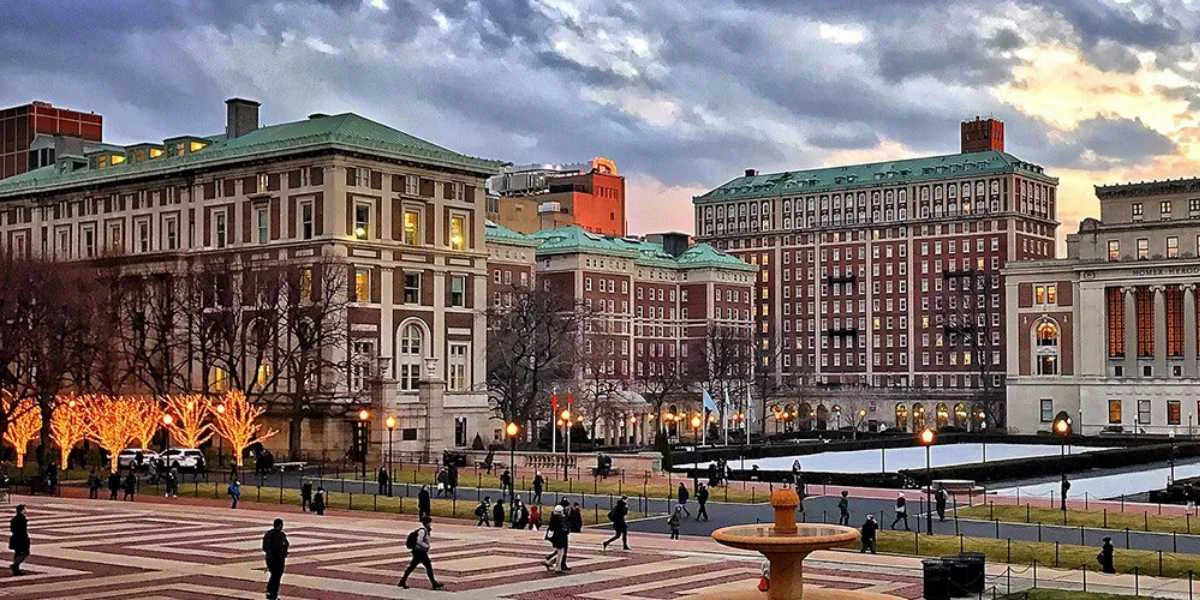
Columbia University currently has 20 schools, including 4 undergraduate colleges and 16 graduate schools. As one of the Ivy League universities in the United States, Columbia University is one of the world's most important centers of research, offering a distinctive learning environment for undergraduate and graduate students in many academic and professional fields. The university enjoys a worldwide reputation in finance and economics, political science and international relations, journalism and communications, medicine and public health, and literature and the humanities.
About the university
School data is compiled from public sources and may change. Confirm current tuition, deadlines and requirements with the university before applying.
At a glance
Alumni starting salaries
Student body
Graduate programs
Communication and Education
Communication and Education
Program Overview
The graduate program in Communication and Education at Columbia University uses social science methods, including qualitative and quantitative approaches, to study communication and education. It focuses on how education and other social systems change under the influence of new media. Over the course of the degree, students examine both material communication systems, where technology is the primary interest, and the dynamics of direct interpersonal communication, where face-to-face, unmediated interaction is the object of study.
Degree Types
Master of Arts (M.A.) in Communication and Education
Master of Education (Ed.M.) in Communication and Education
Source:
Columbia University Master of Arts in Communication and Education
Columbia University Master of Education in Communication & Education
Application Requirements
English Proficiency
If your native language is not English and you have not earned a bachelor's degree from an institution where English is the sole official language of instruction, you must submit official scores from an English proficiency examination.
Columbia University Teachers College institution code: 2905.
Columbia University Teachers College accepts the following examinations:
TOEFL (Test of English as a Foreign Language): minimum score requirement: 100, internet-based test (IBT)
IELTS (International English Language Testing System): minimum score requirement: 7.0
Transcripts
Applicants who have completed or are in the process of completing a bachelor's and/or graduate degree at an institution outside the United States must submit a full course-by-course evaluation, including a verified U.S. degree equivalency transcript.
Teachers College, Columbia University accepts evaluations from the following agencies:
World Education Services (WES)
Educational Credential Evaluators (ECE)
Applicants must submit their transcript evaluation to Teachers College; students should select "Teachers College - Columbia University" (for WES) and "Teachers College, Columbia University" (for ECE).
Note: Teachers College, Columbia University will not receive transcripts that applicants submit to Columbia University.
The evaluation report must clearly state that you have earned, or will earn upon completion of your program, a credential equivalent to a U.S. bachelor's degree. If you are admitted and your WES or ECE course-by-course evaluation does not clearly show that you will earn a credential equivalent to a U.S. bachelor's degree, you will be required to submit a second WES or ECE course-by-course evaluation report at the time the degree is awarded to confirm that you have obtained a credential equivalent to a U.S. bachelor's degree. If this requirement is not met, you will not be able to register for courses at Teachers College.
In addition to the program-specific application requirements described above, complete application requirements can be found in the corresponding "Application Requirements" section of our official website.
Source: Columbia University International Applicants
Graduation Requirements
Credit Requirements
M.A. in Communication and Education:
Degree students must complete 32 points of coursework and an integrative project.
Ed.M. in Communication and Education:
Students must complete 60 credits of coursework to graduate.
Students entering the program from other majors must, in addition to completing the minimum course requirements and developing one professional skill, complete a research or development project submitted to the faculty as Ed.M. candidates.
Program Requirements
Students enrolled in the M.A. in Communication and Education program must complete an Integrative M.A. Project in order to graduate.
Students may choose their project freely; projects typically have the following characteristics:
They are experience-based and grounded in the research literature.
They address a problem or phenomenon in an area of interest and research to the student.
They offer a solution to the problem.
Students enrolled in the Ed.M. in Communication and Education program must complete an Integrative Ed.M. Project. This is the equivalent of a 3-credit course, and students must independently complete a research or development project.
Source: Columbia Academic Catalog
Course Overview
M.A. in Communication and Education
The Master of Arts degree in the CMLTD program is regarded as an entry-level professional qualification for entering related fields. It serves to introduce students to a specific field and to provide essential professional knowledge and skills, and is suited to those who are new to the field or who wish to pursue a career in it. In addition, the degree lays a foundation for students who wish to achieve more advanced specialization in the field.
Students must complete a minimum of 32 points of coursework in total. The required courses are listed below.
Core Requirement: 1 credit
MSTU 4000 requires 1 credit to be completed in the first semester.
MSTU 4900 IP Seminar requires 0 credits to be completed in the final semester.
Foundations: must include at least three domains (9 credits)
Cognitive Issues and Technology
Courses and course numbers: Cognition and Computers MSTU 4133; Introduction to Learning Sciences and Educational Technology MSTU 4088; Social Issues and Technology
Courses and course numbers: Equity, Ethical, and Social Issues in Educational Technology MSTU 4005; Social and Communicative Aspects of the Internet MSTU 4020; Cultural Issues and Technology
Courses and course numbers: Technology and Culture MSTU 4028; Culture, Media, and Education MSTU 5002; Educational Practice and Design
Courses and course numbers: Technology and School Change MSTU 4001; Online Schools and Online Schooling K-12 MSTU 4050; Instructional Design of Educational Technology MSTU 4083; Breadth Requirement: 6 credits
All students (master's and doctoral) must complete 6 credits in courses outside Communication, Media, and Learning Technologies Design (that is, outside MTSU) within the College of Education
Additional requirements: for master's students in the Communication and Education (TECM) M.A. program
MSTU 4016: The History of Communication
13 additional credits of MSTU coursework
Additional courses selected in consultation with an advisor
Ed.M. in Communication and Education:
For students who have already earned a master's degree at Teachers College or another institution, the Ed.M. marks a step in their academic career toward the doctorate. This indicates that the degree may be viewed as a higher-level professional qualification that lays the foundation for pursuing a more advanced degree, such as a doctorate.
Core Requirement: 1 credit
MSTU 4000 requires 1 credit in the first semester.
MSTU 4900 IP Seminar requires 0 credits in the final semester.
Foundations: must include at least three domains (9 credits)
Cognitive Issues and Technology
Course Course Number Cognition and Computers MSTU 4133 Introduction to Learning Sciences and Educational Technology MSTU 4088 Social Issues and Technology
Course Course Number Equity, Ethical, and Social Issues in Educational Technology MSTU 4005 Social and Communicative Aspects of the Internet MSTU 4020 Cultural Issues and Technology
Course Course Number Technology and Culture MSTU 4028 Culture, Media, and Education MSTU 5002 Educational Practice and Design
Course Course Number Technology and School Change MSTU 4001 Online Schools and Online Schooling K-12 MSTU 4050 Instructional Design of Educational Technology MSTU 4083 Research Methods and Design: 3 credits
Students must complete one research methods or research design course offered within or outside CMLTD; the following courses are recommended
Course Course Number Probability and Statistical Inference HUDM 4122 Methods of Inquiry: Ethnography and Participant Observation ITSF 5000 Researching Technology in Educational Environments MSTU 5025 Assessing the Impact of Technology in Schools MSTU 5001 Breadth Requirement: 6 credits
All students (master's and doctoral) must complete 6 credits in communication, media, and learning technology design coursework outside their program in the School of Education (that is, at MTSU).
Additional requirements: for M.A. students in the Communication and Education (TECM) program
MSTU 4016: The History of Communication
MSTU 5606: Readings in Communication Theory and Social Thought I
35 credits of additional MSTU coursework
Other courses selected in consultation with the advisor
Source:
Columbia M.A. in Communication and Education course overview
Columbia Ed.M. in Communication & Education
Career Development
The Teachers College Career Center is an innovative team of career services professionals dedicated to helping all students and alumni achieve their personal and professional goals.
Step 1: Explore
Help students gain self-awareness of their identities, preferences, strengths, and interests.
Step 2: Prepare
Through tailoring resumes and cover letters for each student, practicing interview skills, building a professional online presence, researching employers, and developing a job search action plan.
Step 3: Connect
Build a supportive network with peers, faculty, alumni, and other industry professionals to gather information and advice. We support you in making these connections through the following:
Step 4: Experience
Use opportunities such as student clubs, internships, jobs, research, volunteering, and/or activities to develop skills, build connections, and gain a deeper understanding of your preferences, workplace etiquette, and potential career options.
Sources:
Columbia Career Education — About
Columbia Career Education — Our Process
Financial Economics
Financial Economics
Program Overview
Students in the MSFE (Master of Science in Financial Economics) program take PhD and MBA courses designed by Columbia Business School. Although there is substantial overlap with the finance PhD program, the MSFE program is designed to offer a more flexible academic path for students who prefer a shorter, industry-oriented course of study.
Degree Type
Master of Science in Financial Economics (MSFE)
Program Length
2 years, four semesters (fall and spring)
STEM Eligibility
The program meets the STEM (Science, Technology, Engineering, and Mathematics) eligibility criteria, which means students are eligible to apply for the STEM OPT (Optional Practical Training) extension after completing their studies.
Source: Columbia Master of Science in Financial Economics
Application Requirements
Essays
Essay 1
In 250-500 words, describe your educational goals and the academic and/or professional achievements that have contributed most to your development.
Essay 2
In 250-500 words, describe your intended career direction (including but not limited to consulting, banking, asset management, research and modeling, risk management, etc.) and explain how the Master of Science in Financial Economics program will help you achieve your career goals. Please be specific.
English Proficiency Scores
International students must submit an English proficiency test score, which may be the TOEFL, PTE (Pearson Test of English), or IELTS exam, unless they have earned a bachelor's, master's, or doctoral degree taught in English, in which case they are exempt.
In addition to the program-specific application requirements above, the complete application requirements can be found in the [Application Requirements] section of our website.
Source: Columbia MSFE Application Requirements
Graduation Requirements
Credit Requirements
Students must complete at least 16 full-term graduate-level courses (48 credits) to graduate.
Grade Requirements
A minimum GPA of 2.5
Thesis Requirements
Students must submit a thesis and complete the related course before the end of the fourth semester.
Thesis Seminar (B9398): The purpose of this course is to give students practical experience in quantitative finance research.
MS Thesis: All MSFE students are required to complete a substantial research project under the guidance of a faculty member. Students choose a topic of interest for original research and design, execute, write, and present a thesis.
Internship Requirement
Students must complete at least a six-week summer internship, either as an internship at a company or as research assistance for a faculty member. The internship should ideally be closely tied to the student's thesis.
Sources:
Columbia MSFE Academics
Columbia MSFE degree requirements and satisfactory progress
Curriculum Overview
Each semester, students take a rigorous set of PhD-level courses, supplemented by MBA and other graduate-level courses. In the second, third, and fourth semesters, students take at least one and possibly two PhD or MBA electives.
Students must choose one of two tracks: the Academia Track or the Industry Track.
First Year, Fall
Course Course Number Introduction to Econometrics and Statistical Inference II B9324 Finance Theory I B9302 Computing for Business Research B9122 Strongly recommended for the Academia Track
Course Course Number Microeconomic Analysis I B9206, half-term Microeconomic Analysis II B9208, half-term Industry Track
Course Course Number Introduction to Continuous Time Finance B9336, half-term Advanced Derivatives B9337, half-term First Year, Spring
Course Course Number Financial Econometrics: Time Series B9325, half-term Financial Econometrics: Panel Data B9326, half-term Microstructure Theory B9330, half-term Big Data in Finance B9334 Empirical Asset Pricing B9319, half-term Academia Track
Course Course Number Microeconomic Analysis III B9209, half-term Microeconomic Analysis IV B9211, half-term Typical Electives
Course Course Number Real Estate Finance B8331 Debt Markets B8308 Asset Management B8323 Valuation and Financial Statement Analysis B9010 Research on Investing with Fundamental Analysis B9029 Second Year
Generally, there are no required courses in the second year of the MSFE program, but students must take additional PhD-level courses to meet the requirement of 10 PhD-level degree courses.
Most qualifying courses are offered by the Finance Division, and students typically take PhD-level courses in other divisions of the business school (such as Operations Research and Accounting) or in other departments of the university (such as Computer Science, Statistics, and the Law School). Most students also take no more than 6 advanced MBA courses.
Typical PhD Electives
Course Course Number Text Data in Finance B9342 Empirical Asset Pricing II B9320 Behavioral Finance B9310 Corporate Finance Theory B9317 Financial Intermediation B9333, half-term Information in Financial Markets B9335, half-term Typical MS Electives
Course Course Number Real Estate Analytic B9339 Quantitative Hedge Fund Strategies B8474 Source: Columbia MSFE Academics
Career Development
As quantitative finance applications continue to evolve, the Columbia Business School MSFE degree gives students a strong competitive advantage, enabling them to connect with the world's top employers in financial services in the heart of New York City's business center.
Internship and Full-Time Opportunities
The MSFE team helps students find internship opportunities and full-time jobs that match their skills, and recruiting events are regularly held both on campus and at employer offices in New York City.
Career Management Center Support
Students receive guidance from the Career Management Center and gradually prepare for the recruiting, networking, and interview process in order to successfully build a career in financial services.
Career Prospects
The MSFE degree positions students as competitive candidates in investment banking, commercial banking, asset management firms, hedge funds, financial technology companies, and other fields.
Graduates of this Columbia degree have found full-time and internship positions with international employers such as Blackrock, Vanguard, Goldman Sachs, J.P. Morgan, Citi, CITIC, PIMCO, Millenium, AQR, Nomura, and many other well-known companies.
Career Management Center of the Business School
Works with students to help them build lifelong career management skills and provides MSFE students with job search resources and one-on-one personalized career guidance. Because the program is small, the CMC can tailor its job search resources to the experience and specific needs of MSFE students.
The Pre-MSFE career curriculum, which students can complete during the summer before the program begins, provides an introduction to the fundamentals of career strategy.
Practical training, including development of resumes, cover letters, LinkedIn, and networking/effective communication, as well as mock interview preparation.
One-on-one personalized career guidance
Access to customized resources in COIN, Columbia Business School's online career management portal
Source: Columbia MSFE Career
Business Analytics
Business Analytics
Program Overview
The Business Analytics program at Columbia University was designed jointly by Columbia Engineering and Columbia Business School for students who want to develop deep expertise in modeling techniques and data science tools. Through theoretical coursework and hands-on projects, students build the skills needed to solve real business problems. A key component of the degree is the capstone project, which uses real datasets to provide highly specialized consulting services that help clients address actual business challenges.
Degree Type
Master of Science in Business Analytics (MSBA)
Program Length
Three semesters
STEM Designation
Yes
Source: Columbia University Business Analytics (MSBA)
Application Requirements
Language Proficiency
International applicants, or applicants whose undergraduate degree was earned in a country where English is not the official and widely spoken language, must submit the following additional requirements at the time of application:
TOEFL (including the TOEFL iBT Home Edition), IELTS, Pearson Test of English Academic (PTE), or Duolingo English Test (DET). Columbia Engineering's ETS school code is 2111.
Essays
Essays must address the following topics:
Describe how your background has prepared you to pursue an advanced degree in engineering or applied science at Columbia University.
Describe why you are interested in this program and discuss your relevant past experiences.
If you have relevant work or research experience, explain how those experiences helped you decide on your career path.
What are your plans after graduation, or what are your career goals?
What do you hope to gain from this program?
What excites you about this program?
Video Interview
The video interview is a required step in the Master of Science application. The video interview can only be completed after you submit your application and pay the application fee. The video interview helps the admissions committee assess your communication skills and your ability to think quickly and effectively. You will be given three randomly selected questions, 90 seconds to consider your responses, and three minutes to record your answers to all three questions. The questions are behavioral, and you do not need to prepare anything in advance.
In addition to the program-specific requirements above, full application requirements can be found in the Application Requirements section of our website.
Source: Columbia University Application Requirements
Graduation Requirements
Credit Requirements
Students must complete the equivalent of 12 three-credit courses (36 credits), including:
At least 18 credits (typically 6 courses) in elective coursework in the IEOR department of Columbia Engineering
At least 12 credits (typically 4-6 courses) in elective coursework at Columbia Business School
Grade Requirements
Students must earn a grade of no lower than B- in each core course and maintain a cumulative grade point average (GPA) of 2.67 (a B- average) or higher each semester.
Students who fail to meet the required academic standards will be placed on academic review. This may result in dismissal, a mandatory measure applied to a student's academic performance.
Source: Columbia University Application Requirements
Curriculum Overview
Students enter in the fall semester and can complete the program as early as August of the following year, or they may take a summer internship and finish by the end of the following fall.
Fall Semester (Term 1) - 12 Credits
Course / Course Number: Python for Analytics Bootcamp (0-credit) IEOR E4502; MSBA Quantitative Bootcamp (0-credit) IEOR E4599; Probability, Statistics and Simulation IEOR E4101; Data Analytics IEOR E4523; Business Analytics IEOR E4650; Marketing Analytics MRKT B9651; Professional Development Leadership (0-credit) ENG IE4000. Spring Semester (Term 2) - 12 Credits
Core Courses - 6 Credits
Course / Course Number: Optimization Models and Methods IEOR E4004; Analytics in Practice IEOR E4524. In addition, students must choose 2 electives (6 credits) from the CBS pre-approved list or from courses offered by IEOR...
Summer or Fall (Term 3) - 12 Credits
Course: 1 Business School Elective, course code: DROM or MRKT; Remaining Electives. Students must also complete 1 or 2 concentrations to fulfill the remaining credits of the degree. For more on concentration course options, see: Columbia University MSBA Curriculum: Courses, Electives & Concentrations
Career Development
Columbia University's IEOR (Industrial Engineering and Operations Research) department offers comprehensive career development support designed to meet each student's unique career needs. Below are some of the career development resources and activities the department provides:
Individual Career Advising: Students can receive individual career advising. From enrollment through graduation and after graduation, career officers work with students to provide personalized career development advice and support.
Department Events: The IEOR department organizes a range of department events, including employer meet-and-greets, employer site visits and internship opportunities, training sessions, informational interviews, and alumni roundtables. These events give students opportunities to interact with industry professionals and alumni.
Professional Development Resources: Students can access professional development resources through the Columbia Engineering Professional Development and Leadership team to strengthen and broaden the skills they need in their careers.
These resources and activities are designed to help students successfully take their first career steps and provide opportunities to connect with industry professionals and alumni. Through this support and these opportunities, students can better understand career fields, expand their networks, and prepare for future career development.
Source: Columbia University Careers: Master of Science Programs
Computer Engineering
Computer Engineering
Program Overview
Columbia University's Computer Engineering program provides students with fundamental knowledge of circuits, systems, and software related to the design of programmable systems for general computing, communications, control, or signal processing. Computer Engineering students gain broad skills in both hardware and software, making them highly sought after in the job market after graduation. In addition to direct employment, Computer Engineering students have the opportunity to pursue graduate studies in related fields such as computer science or electrical engineering, further deepening their expertise and research capabilities. This offers students diverse career and academic development paths, enabling them to better adapt to challenges and opportunities in different fields.
Degree Type
Master of Science in Computer Engineering
Source:
Columbia University Master of Science Computer Engineering
Columbia University Computer Engineering
Application Requirements
Degree Requirement
Applicants should generally hold a bachelor's degree in computer engineering, computer science, or electrical engineering.
GPA Requirement
A GPA of at least 3.2 in technical courses.
Language Requirement
International applicants or applicants whose undergraduate degree was earned in a country where English is not the official and widely spoken language must submit the following additional requirements at the time of application:
TOEFL (including TOEFL iBT Home Edition), IELTS, Pearson Test of English Academic (PTE), or Duolingo English Test (DET). The Fu Foundation School of Engineering and Applied Science's ETS school code is 2111.
Test Score Requirement
All applicants must take the Graduate Record Examination (GRE), General Test only.
In addition to the above program-specific application requirements, complete application requirements can be found in the [Application Requirements] section on our website.
Source:
Columbia University Graduate Program
Columbia University Application Requirements
Graduation Requirements
Credit Requirement
Students must take at least 30 credits of courses at the 4000 level or above at Columbia University, of which at least 15 credits must come from relevant Computer Engineering core courses. In addition, the Professional Development and Leadership Course (ENGI E4000) must be completed.
The entire program must include at least 12 credits of 6000-level ELEN, EECS, CSEE, or COMS courses (excluding seminars); research credits may not exceed 9; nontechnical electives (4000 level or above and approved by the advisor) may not exceed 3 credits.
Grade Requirement
Students must maintain a minimum grade point average of 2.7 and must complete all degree requirements within five years of starting the first course counted toward the degree.
No P or R grades.
Source:
Columbia University Graduate Program
Columbia University computer engineering master of science degree program checklist
Curriculum Overview
Core Courses
Students must select at least 15 credits from the following Computer Engineering core courses.
Elective Courses
Students must take at least 30 credits of courses at the 4000 level or above at Columbia University. With advisor approval, students may choose other Computer Engineering-related courses to fulfill the remaining elective credits. This provides students with flexibility to pursue in-depth study aligned with their personal interests and career goals.
Course Course Number Computer networks CSEE W4119 Networking laboratory CSEE W4140 Digital VLSI circuits EECS E4321 Hybrid comp. for sig. & data proc. EECS E4750 Iot-intelligent & connected sys. EECS E4764 Advanced logic design CSEE W4823 Computer architecture CSEE W4824 Embedded systems CSEE W4840 Systems-on-chip platforms CSEE W4868 Wireless networks & systems EECS E4951 Modeling and performance evaluation EECS E6180 Advanced digital electronic circuits EECS E6321 Hardware security COMS E6424 Formal verification of hardware/software systems CSEE E6863 Embedded scalable platforms CSEE E6868 Advanced computer networks EECS E6890 Distributed storage systems EECS E6897 Topics in computer science: Data center networks COMS W6998 Source: Columbia University Graduate Program
Career Development
Recruiting Scope: The career fair aims to attract outstanding talent in engineering and applied science, covering 18 different master's programs and 13 doctoral programs. Columbia University's career fair is designed to recruit engineers with diverse professional backgrounds.
Audience: Recruiting is aimed at graduating students and seeks candidates for internships and full-time positions. In addition, the career fair provides networking opportunities, whether for recruitment or building future collaborations.
Excellent Opportunity: The career fair is described as an excellent opportunity to connect with future talent. The event also provides employers with a unique platform to connect with potential employees, while giving students the chance to build relationships with potential employers.
Source: Career Fairs at Columbia Engineering
Public Administration
Public Administration
Program Overview
The Public Administration program at Columbia University focuses on comparative domestic policy approaches. It is designed to prepare students to address national policy challenges and to manage global organizations. Its curriculum emphasizes science, technology, engineering, mathematics, and technology, exploring innovative approaches to policymaking and management. Students build the skills to solve complex policy challenges and carry out management practice around the world, preparing them to meet today's complex public administration challenges.
Degree Type
Master of Public Administration
Program Length
21 months
STEM Eligibility
Yes
Source: Columbia University Master of Public Administration
Application Requirements
Eligibility
Young professionals who hold a bachelor's degree and have 3–5 years of relevant work experience or substantive internship experience
Letters of Recommendation
Applicants to the MPA program must submit 3 letters of recommendation
GRE/GMAT
Columbia University does not accept at-home versions of these exams.
GRE school code: 2161 (no department code)
GMAT school code: QF8-64-56 for MIA courses and QF8-64-99 for all MPA courses
English proficiency scores
International students whose native language is not English and whose entire undergraduate degree was not taught in English must submit relevant English proficiency scores to demonstrate their English ability. Likewise, Columbia University does not accept at-home versions of the relevant English proficiency exams.
TOEFL iBT: preferred 110, minimum 100
IELTS: preferred 7.5, minimum 7.0
Cambridge English C1 Advanced / C2 Proficiency: C1 Advanced, preferred 191, minimum 185
Video essay
Applicants must submit a 90-second video recorded after submitting their application. The recording consists of an answer to a randomly assigned personal or policy question.
In addition to the program-specific application requirements above, complete application requirements can be found in the corresponding Application Requirements section of our website.
Source: Columbia University MPA Application Portal
Graduation requirements
Credit requirements
Complete 55.5–55.8 credits at the School of International and Public Affairs, including 4 residency units.
Grade requirements
A GPA of 3.0 or higher
No pending grades. All grades must be final grades. Before graduation, any symbol indicating a pending grade must be converted to a final grade. These markers include "IN" (incomplete), "CP" (credit pending), and "YC" (year-long course).
Source: Columbia University MPA Graduation Requirements
Course Overview
The MPA core curriculum allows students to choose from multiple specializations, including International Security Policy, International Finance and Economic Policy, Economic and Political Development, Human Rights and Humanitarian Policy, and Urban and Social Policy. These include the most diverse top-tier seminar courses in the field, designed to equip graduates with advanced analytical capabilities and career-oriented professional knowledge and skills.
MPA Core Curriculum
The purpose of the core curriculum is to ensure that every student in the MPA program receives rigorous, broad-based, interdisciplinary training in public affairs.
Politics of Policymaking: 4 credits
You may choose one course from the following:
Course | Course Number Politics of Policymaking: Global Perspectives on Policy Analysis & Design | PUAF U6100 Politics of Policymaking: Issues in Comparative Politics - Discussion | PUAF U6102 Politics of Policymaking: American Institutions in Comparative Perspective | PUAF U6110 Politics of Policymaking: American Institutions in Comparative Perspective - Discussion | PUAF U6112 Politics of Policymaking: Developing Countries in Comparative Perspective | PUAF U6120 Politics of Policymaking: Comparative Politics - Discussion | PUAF U6122 Economics: 6 credits
You may choose one course from the following:
Course | Course Number Microeconomics for International and Public Affairs | SIPA U6300 Macroeconomics for International and Public Affairs | SIPA U6301 Microeconomic Analysis for International and Public Affairs | SIPA U6400 Macroeconomic Analysis for International and Public Affairs | SIPA U6401 Quantitative Analysis: 3 credits
Course | Course Number Quantitative Analysis I for International and Public Affairs | SIPA U6500 Management: 3 credits
You may choose one course from the following:
Course | Course Number Analysis of Public Sector Organizations | SIPA U6003 Effective Management in the Public Service | SIPA U6005 Strategic Management of Nonprofit Organizations | SIPA U6011 Strategic and Entrepreneurial Management | SIPA U6014 Sustainability Management | SIPA U6015 Leading & Managing in Moments of Adversity & Opportunity | SIPA U6016 Effective Management in the Public Service | SIPA U6017 Financial Management: 3 credits
You may choose one course from the following:
Courses Course Number International and Public Affairs Accounting Accounting for International and Public Affairs SIPA U6200 Nonprofit Financial Management Nonprofit Financial Management SIPA U6310 Budgeting and Government Financial Management Budgeting & Financial Management for Government SIPA U6320 Economics of Finance Economics of Finance INAF U6022 Professional Development Professional Development 0.5 credits; students must complete the required course and 1 elective
Required course: Professional Development Professional Development SIPA U4040
The following are electives:
Courses Course Number Professional Development Professional Development SIPA U4041 Professional Development Professional Development SIPA U4042 Professional Development Professional Development SIPA U4043 Professional Development Professional Development SIPA U4044 Professional Development Professional Development SIPA U4045 Capstone Workshop Capstone Workshop 3 credits:
You may choose one course from the following
Courses Course Number Capstone Workshop Capstone Workshop SIPA U9000 Capstone Workshop in Sustainable Development Practice Capstone Workshop in Sustainable Development Practice SIPA U9001 Internship Internship 0–3 Credits, course number: SIPA U9013
Policy Concentration
All students may choose one of the following specializations: that is, the policy field of focused study at SIPA
Concentrations: Economic and Political Development (EPD), Energy and Environment (EE), Human Rights and Humanitarian Policy (HRHP), International Finance and Economic Policy (IFEP), International Security Policy (ISP), Urban and Social Policy (USP). Note: Students pursuing the EPD concentration must meet the language proficiency requirement associated with that concentration.
For detailed course information for each concentration, please consult the relevant official website.
Specialization
All students may also choose a Specialization consisting of 3 courses: a skill or a specialized area of knowledge that complements their policy concentration.
Specializations: Data Analytics & Quantitative Analysis (DAQA), Gender and Public Policy (GPP), International Organization & United Nations Studies (IO/UN), International Conflict Resolution (ICR), Leadership, Innovation, & Design (LID), Regional Specializations, Technology, Media, and Communications (TMaC). For detailed course information for each specialization, please consult the relevant website: Sample Columbia University student schedules.
Source: Columbia University MPA Curriculum
Career Development
The Career Advancement Center at Columbia University's School of International and Public Affairs (SIPA) provides career services to current students and alumni:
Career counseling: Personalized career counseling helps students and alumni create and carry out career development plans.
Career development courses: Courses focused on career development strengthen students' career competitiveness and skill levels.
Career events: A range of career events, including job fairs, lectures, and workshops, promotes interaction between students and employers.
Recruitment and employer outreach programs: Connections with world-renowned employers give students extensive recruitment and employer outreach opportunities.
Networking opportunities: Students can take part in a variety of networking activities to expand their professional networks.
Lifelong service: CAC's services are not limited to current students; the center also provides lifelong service to alumni, supporting their development needs throughout their careers.
Source: Columbia University Career Advance Center
Campus life
Transportation
Nearby Airports
LaGuardia Airport
Distance from campus: 7.8 miles
Trip from campus to the airport:
By car/taxi:
Typically, this takes about 16–26 minutes. It may take longer during heavy traffic.
Public transportation:
You can walk to Amsterdam Ave/W 120 St and take the M60 bus to LaGuardia Airport.
John F. Kennedy International Airport (JFK)
Distance from campus: 20.9–26.7 miles
Trip from campus to the airport:
By car/taxi:
Typically, this takes about 25–40 minutes. It may take longer during heavy traffic.
Public transportation:
Walk from Columbia University to 110 St and take the subway (Red Line 1) southbound to 59 St - Columbus Circle Subway Station. At 59 St - Columbus Circle Subway Station, transfer to the subway (Blue Line A) toward Queens and ride to Howard Beach-JFK Airport Subway Station. Get off at Howard Beach-JFK Airport Subway Station and transfer to AirTrain JFK. AirTrain JFK is the internal train system at John F. Kennedy International Airport, connecting the subway station with the airport terminals. Take AirTrain JFK directly to the terminal you need to reach John F. Kennedy International Airport.
Newark Liberty International Airport
Distance from campus: 20–24.9 miles
Trip from campus to the airport:
By car/taxi:
Typically, this takes about 28–45 minutes. It may take longer during heavy traffic.
Public transportation:
Take the subway (Red Line 1) southbound from the subway station near Columbia University (116 St Subway Station) to 34 St - Penn Station Subway Station. Get off at 34 St - Penn Station Subway Station and walk to Pennsylvania Station. At Pennsylvania Station, take an NJ Transit train to Newark Airport. Upon arrival at the airport, take AirTrain Newark to the terminal you need.
Nearby Train Stations
Pennsylvania Station (Penn Station)
Trip from campus to the train station: 6 miles
By car/taxi:
Typically, this takes 15–30 minutes. However, it may take longer during heavy traffic.
Public transportation:
Take the subway (Red Line 1) southbound from the subway station near Columbia University (116 St Subway Station) to 34 St - Penn Station Subway Station. Get off at 34 St - Penn Station Subway Station and, following the signs in the subway station, walk to Pennsylvania Station. The walk from the subway station to the station usually takes only a few minutes; follow the signs or ask staff for directions.
City Public Transportation
There are many public transportation options around Columbia University. Below are some common public transportation options:
Subway: The most commonly used subway lines near Columbia University are the 1 train (red line) and the 2 train (red line). The 1 train runs along Broadway, while the 2 train runs along 7th Avenue. These two lines connect the northern and southern parts of Manhattan, making it easy to reach various parts of the city.
Bus: There are many bus stops around Columbia University, providing service to Manhattan and other areas. Some common bus routes include M4, M5, M11, and M60.
Bicycle: New York City offers many bicycle rental services, and there are also bicycle rental stations around Columbia University, suitable for short trips.
Safety
Columbia University is located in Morningside Heights on Manhattan's Upper West Side in New York City, an area that is relatively safe. However, as in any large city, New York City has some safety issues. For this reason, Columbia University places great importance on campus safety and has adopted a number of measures to ensure the safety of students, faculty, staff, and visitors. These measures include:
Blue Light Emergency Call Boxes
The Department of Public Safety has installed numerous emergency call boxes topped with blue lights throughout the Columbia University campus. If you need help or feel threatened in any way, these call boxes can provide immediate assistance.
Building Access
All University buildings require identity authentication, and students must use their Columbia University ID card (CUID) to enter these facilities. All visitors entering residence halls must be sponsored by a resident student and register through the visitor management system at the security desk of the relevant residence hall. Overnight visitors must obtain a visitor pass at the Hartley Hall reception desk.
Card Reader Repair
Students with campus card security or card reader function issues can submit a request to the Department of Public Safety.
Columbia University EMS
Columbia University EMS (CU EMS) is a New York State-certified, free, volunteer ambulance corps that provides basic life support, pre-hospital emergency medical care, and ambulance transport to appropriate hospitals for students, faculty, and staff, and can assist with rapid referrals to other Columbia University resources.
Device Engraving - Operation ID
The Department of Public Safety can engrave a unique code on your laptop, mobile device, or other property to make it easier to identify if it is stolen or lost.
Emergency Notifications
The Department of Public Safety manages the University's emergency notification system and sends real-time notifications when emergencies occur. When an ongoing incident poses a direct threat or has a major impact, the department uses text message notifications.
Fingerprinting
The University's Public Safety Center can take your fingerprints and add them to a national database for identity authentication.
Guard Booth Locations
The Department of Public Safety operates 24-hour guard booths around the Columbia University campus. These booths are important resources for obtaining information, seeking help, reporting crimes or suspicious activity, or reporting dangerous conditions. Students are encouraged to familiarize themselves with these locations.
Guard Service
Columbia University's Department of Public Safety can provide an appropriate level of security for University-authorized or sponsored events at the organizer's request or depending on the type of event.
ID Card Access
All students must use their University ID card to gain authorized access to secure University locations, including all classroom buildings, gymnasiums, libraries, and residence halls (where applicable).
ID Center
All Columbia University students must obtain a student ID card, and students can receive their card only after presenting proof of registration.
Lion Safe App
All Columbia University Public Safety resources are conveniently accessible through Lion Safe, a user-friendly app for smartphones or tablets. Through the Public Safety Lion Safe app, users can request emergency services with the tap of a button and also access other useful quick links, including maps, shuttle schedules, crime alerts, emergency protocols, campus safety notifications, and non-emergency phone numbers for each campus.
Lost and Found
Lost items from the Morningside campus, the Medical Center campus, and the Manhattanville campus that have been turned in to the Department of Public Safety can be claimed at the respective Public Safety operations desks, which are open 24 hours a day, 7 days a week. The Public Safety Center maintains a lost item database, and you can search for lost items using the RepoApp Form.
Maps & Schedules
Whether planning a visit to Columbia University or already living on campus, students can view University maps and related information on the official website according to their needs.
On-Demand Evening Shuttle
Columbia Transportation, in partnership with the Department of Public Safety and Via, offers an on-demand evening shuttle service. This service is not free.
Safety Escort Program
The University offers students a free safety escort program. Walking escorts are available on the Morningside campus seven days a week from 7:00 p.m. to 3:00 a.m. The Medical Center offers walking escorts from 6:00 p.m. to 6:00 a.m. Evening escort service on the Manhattanville Campus runs from 6:00 p.m. to 4:00 a.m.
Situational Awareness Training
The Department of Public Safety facilitates Situational Awareness training, which is intended to focus attention on personal safety and remain alert to potential threats to health and safety.
Transportation service
The University provides shuttle bus service. Other means of transportation available on campus include bicycles and ride-sharing.
Housing
Columbia University provides a safe and comfortable living environment for undergraduate residents. The residence areas include the First-Year Area, the Upper Class Area, and Special Living Communities, comprising more than 30 undergraduate residence halls in total. Housing offers a variety of living options, including single or double rooms, suites, and apartment-style group housing. Students may also choose to join special-interest communities or fraternity and sorority organizations, both of which have dedicated spaces in brownstone-style buildings near campus.
Residential Colleges
The First-Year Area includes Carman Hall, Furnald Hall, John Jay Hall, and Wallach Hall.
The Upper Class Area includes Wien Hall, Watt Hall, Harmony Hall, Hogan Hall, River Hall, and others.
More information on residence halls is available on the official explore residency website.
On-Campus Housing Application Steps
Access the housing application form using your Columbia ID number.
The housing application is completed through the Columbia Housing Portal. When you begin the application, you do not yet have a university-assigned UNI. To log in and start the application, you will use your Columbia ID number. This 9-digit number can be found in the upper right corner of the admission portal.
Login Steps
Go to the Columbia Housing Portal.
Click "Login" in the upper left corner of the portal homepage.
Select "Log in with Columbia ID" from the drop-down menu.
Enter your Columbia ID number and password.
Your Columbia ID number begins with C and is 9 digits long.
Your password is your date of birth in MMDDYYYY format (for example, 04242004).
First-Year Housing Application Tips
Access the application page through the Columbia Housing Portal. All application steps in the intent statement must be completed by 11:59 p.m. Eastern Time on May 15.
Review the residence hall options carefully and select your housing preferences. Note that a preference for single-gender housing takes priority over a building preference. Furnald Hall is the only residence hall that offers single-gender floors (on the second floor); Carman, John Jay, Wallach, and Hartley Halls do not offer single-gender floors. Review the first-year residence hall options.
Understand your roommate selection options
If you have a preferred roommate, you can apply to be assigned together. The application must be submitted jointly by both parties. A roommate application consists of a group of two people (yourself and one other person). Designate one person as the group leader.
The group leader should search for the other roommate by UNI or name and click the "Add to Group" option. When you invite someone to join the group, a unique group name will be created for you.
Your desired roommate must have a housing application on file.
The requested roommate must revisit the roommate application section and click "Join/Accept Roommate Request."
The group leader needs to log in again and accept the join request in the roommate application section.
The group leader should check that the group has been verified. This happens automatically after the second member joins the group.
If you do not have a specific roommate, you can use the roommate matching tool to find potential matches. The application can recommend roommates based on your answers to personal preference questions, and you can also search for roommates based on their profile answers.
Applying for a roommate is optional, not required.
The application "status" will show as "Incomplete." It is not complete until the occupancy agreement is signed, which will be signed after you receive your room assignment. Housing notifications will be sent by email before July. You will be prompted to log in, sign the occupancy agreement, and then click the "Complete Application" button at the bottom to finish the application. At this point, your login will be your Columbia UNI and password.
2. Room assignments will be sent to students by email before July.
3. Prepare for check-in.
International student check-in and luggage storage is on August 24, and general check-in is on August 25. Click here for more information.
Dining
The university has a comprehensive dining system, including 9 dining halls, 5 cafés, and numerous convenience stores and vending machines. The university also offers students a variety of dining options.
Campus Dining Halls
Ferris Booth Commons
This is the most popular dining hall among students, located on the third floor of Alfred Lerner Hall. It serves three meals a day, including pasta, pizza, sandwiches, wraps, and delicious desserts.
JJ's Place
JJ's Place is located on the lower level of John Jay Hall. The restaurant features Angus steak burgers and other specialty sandwiches, along with fries, chicken wings, smoothies, and more.
John Jay Dining Hall
Located on the first floor of John Jay, this dining hall offers freshly prepared home-style dishes, as well as barbecue, specialty dishes, sushi, grain bowls, and a full salad bar. A kosher takeout counter is located at the main entrance.
More information on dining halls and restaurants is available on the Columbia University Dining website.
Meal Plan
Meal Plan requirements:
All first-year students in Columbia College and SEAS must participate in the first-year dining plan.
Meal Plan prices:
All new students must choose one of the following three plans:
Plan | Meals per week per semester | Meal cost per semester | Flex per semester | Cost per semester (plan enrollment applies for the full year) | Plan 1 | 19 meals per week, of which 15 are floating meals and 6 are guest meals | 75 | None | $3290 | Plan 2 | 15 meals per week, of which 10 are floating meals and 6 are guest meals | 125 | None | $3290 | Plan 3+Flex | 19 meals per week, of which 15 are floating meals and 6 are guest meals | 25 | 50 | $3290 | Flexible Meal Options
15 or 19 meals per week, redeemable at John Jay Dining Hall, Ferris Booth Commons, JJ's Place, Chef Mike's Sub Shop, Chef Don's Pizza Pi, or Faculty House. These meals expire each week and reset every Sunday.
10-15 floating meals per semester usable at dining halls. When your meal usage exceeds the weekly quota, floating meals can be used at any time during the semester.
6 guest meals per semester for when family and friends visit.
Dining Dollars
Most plans include "Dining Dollars," which can be used like cash at any on-campus dining location. Dining Dollars are tax-free, roll over from year to year, and expire at graduation.
All plans include 25-125 Dining Dollars per semester.
Flex
Some plans offer "Flex" in addition to "Dining Dollars." Flex allows you to deposit money into an account and then use your university ID card at all Columbia University dining locations, at certain other merchants on and off campus, and for online delivery services.
Plan 3 Flex is the only first-year dining plan that includes Flex.
Plan 3 Flex includes the minimum amount of Dining Dollars but also includes $50 in Flex points per semester, which roll over from year to year if unused.
Admissions
Admissions data
Application requirements
Application checklist

Transfer requirements
Transfer checklist
Transfer deadlines
Similar universities
Admissions FAQ
What is the acceptance rate at Columbia University?
The reported acceptance rate is 4%. Acceptance rates vary by applicant pool and application cycle; confirm the current figure with Columbia University.
What SAT scores does Columbia University expect?
The reported SAT range is 1490-1580. Test-optional and score-reporting policies can change by application cycle; check the university's official admissions page before applying.
How much does Columbia University cost?
The listed tuition and fee figure is $790. Costs vary by residency, programme and academic year; confirm current costs with the university.
Where is Columbia University located?
Columbia University is located at West 116 St and Broadway, New York, NY, 10027.
Planning your application?
Build a school list around your profile.
Ivy Elite advisors help students compare programs, plan coursework and prepare applications for U.S. universities.