


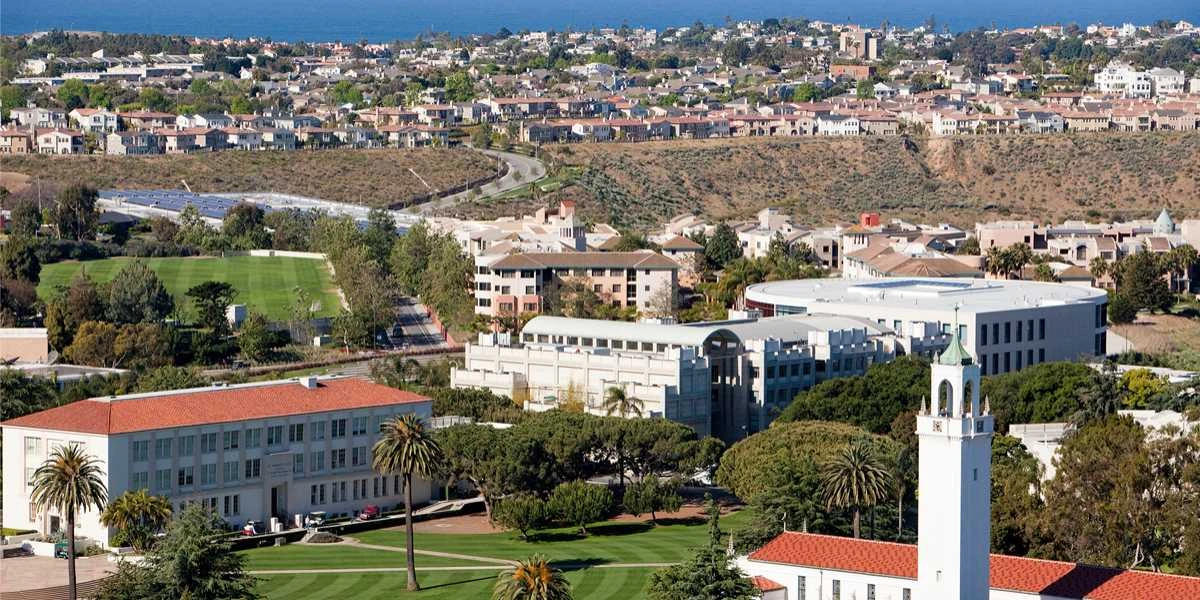
Loyola Marymount University (LMU) currently has 6 undergraduate colleges and 3 graduate colleges. The university is known for its film and television production, business, and law programs. LMU's film school ranks among the top in the nation and has produced many professionals for the film and television industry. The university emphasizes Catholic Jesuit values, combining academic excellence with community service to offer a distinctive educational experience and a diverse campus culture.
About the university
School data is compiled from public sources and may change. Confirm current tuition, deadlines and requirements with the university before applying.
At a glance
Alumni starting salaries
Student body
Most popular majors
Graduate programs
Business Analytics
Business Analytics
Program Overview
The Master of Science in Business Analytics program at Loyola Marymount University is designed to develop students' ability to understand, analyze, and interpret large volumes of data and information so they can turn it into clear, actionable insights that strongly support business growth. At the heart of the curriculum is the signature capstone, which gives students a valuable opportunity to engage hands-on in a real project, from data collection through to presenting findings and recommendations to decision-makers. This practical experience not only gives students theoretical knowledge but also builds their ability to solve real-world problems. The program aims to prepare students to become indispensable team members who bring teamwork, communication, and innovation to teams in any professional field. Graduates stand out with a solid professional background and practical experience, laying a strong foundation for their future careers.
Degree Type
Master of Science in Business Analytics
Program Length
12 months
STEM Designation
The Master of Science in Business Analytics program at Loyola Marymount University is a STEM program.
Sources:
Loyola Marymount University Business Analytics Program Overview
MSBA Experience
Application Requirements
What Applicants Need
A undergraduate GPA of 3.0 or above.
Completion of a college-level statistics course within the past 6 years with a grade of B or better; if you have never taken a statistics course, you should take one before completing your application.
Writing Requirement
You must upload a personal statement of no more than 2 pages (12-point font, double-spaced) explaining why you are pursuing a master's degree in business analytics, why you are applying to Loyola Marymount University, and the unique strengths and background you will bring to the program.
Interview
Applicants may be asked to interview with a member of the admissions committee.
Language Requirements
Applicants whose native language is not English and who have not earned a high school diploma or postsecondary degree from a university in the United States or another country where English is the primary language must submit TOEFL, IELTS, or Duolingo scores:
The admission requirement is a TOEFL score of 100 or above (iBT only), an IELTS score of 7.0 or above, or a Duolingo English Test score of 130 or above.
The school code is 4403.
In addition to the program-specific application requirements above, full application requirements can be found in the [Application Requirements] section of our website.
Sources:
Loyola Marymount University Business Analytics Application Requirements
Loyola Marymount University Business Analytics Application Requirements
Loyola Marymount University Business Analytics Language Requirements
Graduation Requirements
Credit Requirements
Students must complete a total of 30-36 credits, including:
8 core courses;
2 elective courses;
two 3-credit capstone courses;
With approval from the program director, students may waive the core courses Fundamentals of Business - Accounting, Finance & Operations (BSAN 6010) and/or Marketing for Managers (BSAN 6020) based on previous business coursework.
Grade Requirements
Students must earn a grade of B- or better in Programming for Data Management (BSAN 6030) to take Data Management for Business Intelligence (BSAN 6060) and Introduction to Machine Learning (BSAN 6070).
Students must earn a grade of B- or better in Programming for Data Management (BSAN 6030) and Data, Models and Decisions for Analytics (BSAN 6040) to take Text-Mining and Social Media Analytics (BSAN 6200).
Students must earn a grade of B- or better in Data, Models and Decisions for Analytics (BSAN 6040) and Customer Relationship Management Analytics (BSAN 6050) to take Marketing Analytics (BSAN 6070).
Capstone
All students participate in a summer capstone project completed by student teams together with faculty advisors. Teams develop business analytics solutions for challenges posed by real business clients. For more information about the capstone, see: Capstone Project
Source: Loyola Marymount University Business Analytics Graduation Requirements
Course Information
Core Courses
CourseCourse NumberCreditsFundamentals of Business - Accounting, Finance & OperationsBSAN 6010 3Marketing for ManagersBSAN 60203Programming for Data ManagementBSAN 60303Data, Models and Decisions for AnalyticsBSAN 60403Customer Relationship Management AnalyticsBSAN 60503Data Management for Business IntelligenceBSAN 60603Introduction to Machine LearningBSAN 6070 3Strategic Analytics IntegrationBSAN 6080 3Elective Courses, choose two
CourseCourse NumberCreditsData Visualization and Geographic Information SystemsBSAN 61003Text-Mining and Social Media AnalyticsBSAN 62003Marketing AnalyticsBSAN 63003Healthcare AnalyticsBSAN 64003Sources:
Loyola Marymount University Business Analytics Course Information
Course Descriptions
Career Development
Loyola Marymount University offers Business Analytics students extensive information and learning opportunities that help them achieve success in their careers. The team is dedicated to providing students with comprehensive, highly personalized services, including career counseling, employer relations services, recruiting events, on-campus and off-campus interviews, career development workshops, and alumni networking events that help students connect with companies and recruiters, further broaden their career horizons, and improve their job-search success.
This comprehensive support system is designed to enable each student to enter the workforce with greater confidence and competitiveness after graduation. Business analytics professionals have a variety of positions to choose from, such as data scientist, analytics modeler, or business intelligence analyst on the technical side, and marketing analyst, logistics specialist, or consumer insights researcher on the business strategy side.
Source: Loyola Marymount University Business Analytics Career Development
Computer Science
Computer Science
Program Overview
Loyola Marymount University's Computer Science program is distinguished by its interdisciplinary character and its foundation in open-source culture. The program emphasizes multi-platform computing and open-source software development; in their courses, students collaborate in groups, work across multiple operating systems and devices, and successfully publish their work on repositories such as GitHub and CodePen. The curriculum balances theory and practice, covering the theoretical requirements of the Master of Science in Computer Science degree while also providing practical preparation for future industry or academic work. Students may choose from a range of courses, including but not limited to programming language semantics, artificial intelligence, data science, software architecture, database and knowledge-base systems, cybersecurity, and machine learning. In addition, the program regularly introduces new courses, such as quantum computing and bioinformatics, to meet student demand.
Degree Type
Master of Science in Computer Science
Program Length
3 semesters
Sources:
Loyola Marymount University Computer Science Program Overview
Loyola Marymount University Computer Science Overview
Application Requirements
Conditions applicants must meet
All applicants must hold a bachelor's degree in computer science, mathematics, or another closely related field.
All undergraduate courses taken in preparation for graduate study, whether or not a degree was previously earned, should include the following subject areas:
Computer Programming and Laboratory (CMSI 1010 Computer Programming and Laboratory)
Data Structures and Algorithms (CMSI 2120 Data Structures and Algorithms)
Computer Systems Organization (CMSI 2210 Computer Systems Organization)
and at least one of the following courses:
Microprocessors and Microcontroller Systems (EECE 3140 Microprocessors and Microcontroller Systems)
Operating Systems (CMSI 3510 Operating Systems)
Programming Languages (CMSI 3801 Programming Languages)
Writing Requirement
A personal statement (1-2 pages) explaining how the Master of Science in Computer Science program aligns with your career development.
Language Requirements
International applicants must take the TOEFL, IELTS, or Duolingo English Test unless they earned a high school diploma or bachelor's degree in the United States:
The minimum admission scores for most graduate programs are TOEFL 100, IELTS overall band 7, or Duolingo 130.
The Frank R. Seaver College of Science and Engineering requires a minimum TOEFL iBT score of 79, an IELTS overall band of 6.5, or a Duolingo score of 120.
The school code is 4403.
In addition to the program-specific admission requirements above, full application requirements can be found in the Application Requirements section of our website.
Sources:
Loyola Marymount University Computer Science Application Requirements
Loyola Marymount University Computer Science Language Requirements
Graduation Requirements
Credit Requirements
Students must complete a total of 30 semester credits, including:
3 credits of Computability and Complexity (CMSI 583 Computability and Complexity) and 3 credits of Programming Language Semantics (CMSI 585 Programming Language Semantics)
and one of the following options:
3 credits of a capstone design project and 21 credits of elective courses
3 credits of Master's Thesis I, 3 credits of Master's Thesis II, and 18 credits of elective courses
3 credits of Master's Thesis I, 3 credits of Master's Thesis II, 3 credits of Master's Thesis III, and 15 credits of elective courses.
Students may take at most 3 credits of master's thesis coursework in any one semester.
At least 15 credits (5 courses) must come from 600-level courses.
Demonstrated competency equivalent to an undergraduate semester's length in two of the following three areas: Data Structures and Algorithms; Systems Programming/Machine Organization; Operating Systems; and Database Systems. The above undergraduate courses may be taken after admission to the master's program, but those credits will not count toward the 30-unit degree requirement.
Grade Requirements
A grade of B or better in all 500-level courses
A GPA of 3.0 (grade of B) or better.
Thesis Requirement
The master's thesis is an elective in computer science education. Students who choose the thesis option conduct a research project under close faculty supervision and guidance. The student and faculty member jointly agree on a research topic and publish the results in peer-reviewed conferences and journals. For more information on thesis requirements, see: Loyola Marymount University Thesis Requirements
Sources: Loyola Marymount University Computer Science Graduation Requirements
Course Information
Required Courses
CourseCourse NumberCreditsComputability and ComplexityComputability and ComplexityCMSI 583 3Programming Language SemanticsProgramming Language Semantics CMSI 585 3Elective Courses
CourseCourse NumberCreditsMicroprocessorsMicroprocessorsCMSI 511 3Probability and Random ProcessesProbability and Random ProcessesCMSI 532 3Software ArchitectureSoftware ArchitectureCMSI 540 3Introduction to CybersecurityIntroduction to CybersecurityCMSI 560 3Enterprise Security and Cyber OperationsEnterprise Security and Cyber OperationsCMSI 563 3For more elective courses, see: Loyola Marymount University Computer Science Course Information
Career Development
Loyola Marymount University actively builds connections with the neighboring Silicon Valley and aerospace and defense industry regions. It offers flexible and diverse professional courses that keep pace with technology trends, giving students a variety of flexible study options. The university is committed to supporting and meeting each student's individual goals and career development needs so they can thrive in a dynamic technology hub.
The Loyola Marymount University career center website offers extensive resources, covering resume reviews, interview preparation, job search techniques, and more. Students can connect with employers by participating in workshops, career fairs, and on-campus recruiting events. The website also provides industry research, career planning, and development advice, and is dedicated to helping students achieve their career goals.
Sources:
Loyola Marymount University Computer Science Career Development
Careers
Teaching English to Speakers of Other Languages
Teaching English to Speakers of Other Languages
Program Overview
The Teaching English to Speakers of Other Languages (TESOL), M.A. program at Loyola Marymount University prepares professionals with the comprehensive knowledge and skills needed to educate students in non-English-speaking countries. The master's program focuses on developing leaders and emphasizes connecting theory with research and practice. Through an integrated curriculum, students learn methods grounded in Loyola Marymount University's mission and vision and in best practices for educating English learners. Coursework addresses cultural concepts, student backgrounds, acculturation, multi-level instructional planning, and assessment methods, with the goal of providing concrete, practical teaching techniques. Students also build partnerships with colleagues and the community to advance the field of teaching English as a second language.
Degree Type
Teaching English to Speakers of Other Languages (TESOL), M.A.
Source: Loyola Marymount University, Teaching English to Speakers of Other Languages, Program Overview
Application Requirements
Requirements applicants must meet
Documentation that the applicant has completed 20 hours of work with young people from diverse cultural backgrounds in the age group the applicant plans to teach.
A cumulative undergraduate GPA of 3.0, or a GPA of 3.05 in the most recent 60 undergraduate units, or a GPA of 3.0 in at least 9 graduate units.
Writing Requirements
Statement of Intent;
A 3-5 page essay describing how the applicant's experiences, qualities, and goals reflect the School of Education's conceptual framework: REAL (Respect, Educate, Advocate, Lead).
Interview Requirement
An interview with the program director.
Language Requirements
International applicants must take the TOEFL, IELTS, or Duolingo English Test unless they earned a high school diploma or bachelor's degree in the United States:
The minimum admission scores for most graduate programs are TOEFL 100, IELTS overall 7, or Duolingo 130;
For students in the School of Education, a waiver may be granted at the discretion of the dean of the school;
The school code is 4403. For more language requirements, see: International Graduate Students.
In addition to the program-specific admission conditions above, the complete application requirements can be found in the corresponding Application Requirements section of our website.
Source: Loyola Marymount University, Teaching English to Speakers of Other Languages, Application Requirements
Graduation Requirements
Credit Requirements
A total of 31 credits is required, including:
22 credits of required courses;
9 credits of elective courses.
Grade Requirements
Students must achieve a cumulative grade point average (GPA) of 3.0.
All students completing the Master of Arts degree must pass a comprehensive examination, a graduate practicum, or successfully complete a thesis in their field of study.
Comprehensive Examination
Students must take the comprehensive examination and earn credit in order to complete the Master of Arts degree program. It assesses the candidate's ability to apply the knowledge and experience gained to solve a range of practical problems within their field of specialization. The comprehensive examination may be written and/or oral.
Sources:
Loyola Marymount University, Teaching English to Speakers of Other Languages, Graduation Requirements
Loyola Marymount University, Teaching English to Speakers of Other Languages, Graduation
Course Information
Required Courses
Course | Course Number | Credits | Theories and Policies of Second Language Acquisition | EDES 5003 | 3 | Curriculum and Instructional Leadership in a Bilingual Setting | EDES 5325 | 3 | Methodology in English Language Development (ELD) and Specially Designed Academic Instruction in English (SDAIE) for Elementary, Secondary, and Adult Educators | EDUR 6221 | 3 | Research in Urban Education | EDUR 5018 | 3 | Research Project in Urban Education | EDUR 5020 | 1 | Anthropological Analysis of Cultural Diversity | EDUR 6100 | 3 | Applied Linguistics: a Second Language Acquisition/Bilingual Instructional Perspective | EDUR 6222 | 3 | Technology in Multilingual Settings | EDUR 6324 | 3 | Elective Courses
Course | Course Number | Credits | Bilingualism and Biliteracy | EDES 5324 | 3 | Cognition and Language | EDES 5403 | 3 | Linguistics and Reading | EDES 6350 | 3 | Teaching Culturally/Linguistically Diverse Students with Exceptional Needs | EDSP 6001 | 3 | Lifespan Development | EDSP 6390 | 3 | Learning and Teaching with Technology | EDUR 6327 | 3 | Source: Loyola Marymount University, Teaching English to Speakers of Other Languages, Course Information
Career Development
The master's program in Teaching English to Speakers of Other Languages at Loyola Marymount University provides advanced skills and expertise not only for experienced teachers of English learners but also for foreign teachers seeking opportunities to teach English in their home countries. The program supports students' career development, and the university's career development center offers job-search assistance covering resume revision, interview preparation, and job-search tips. Through these services, students can strengthen their overall professionalism, lay a solid foundation for future success in the workplace, and pursue more influential career development in the field of education.
Sources:
Loyola Marymount University, Teaching English to Speakers of Other Languages, Career Development
Careers
Electrical and Computer Engineering
Engineering in Computer Engineering
Program Overview
The Master of Science in Engineering in Computer Engineering at Loyola Marymount University is designed to develop students' theoretical knowledge and practical application skills in areas such as computer architecture, embedded systems, computer networks, artificial intelligence, and system design. The curriculum covers industry-relevant topics ranging from machine learning to digital design, giving students comprehensive technical literacy. The program is advised by a committee of experts, ensuring teaching quality. Students gain opportunities to interact with industry leaders and broaden their perspectives. The program emphasizes both theoretical foundations and practical application, offering a rich learning and networking platform for those seeking to advance further in the field of computer engineering.
Degree Type
Master of Science in Engineering in Computer Engineering
Source: Loyola Marymount University, Electrical and Computer Engineering, Program Overview
Application Requirements
Applicant Qualifications
Applicants should hold a bachelor's degree in computer engineering, electrical engineering, computer science, or another closely related field. Applicants without sufficient computer engineering background may need to take additional undergraduate courses.
Loyola Marymount University encourages students with a GPA of at least 3.0 to apply. However, the admissions committee will consider the applicant's overall profile, including criteria such as work experience, test scores, and letters of recommendation, when evaluating eligibility.
Writing Requirement
A personal statement (1-2 pages) explaining how the Master of Science in Computer Science program aligns with your career development.
Language Requirements
International applicants must take the TOEFL, IELTS, or Duolingo English Test unless they earned a high school diploma or bachelor's degree in the United States:
The minimum TOEFL score for most graduate programs is 100, IELTS overall band 7, or Duolingo 130.
The Frank R. Seaver College of Science and Engineering requires a minimum TOEFL iBT score of 79, IELTS overall band 6.5, or Duolingo 120.
The school code is 4403.
In addition to the program-specific requirements above, full application requirements can be found in the Application Requirements section of our website.
Sources:
Loyola Marymount University, Electrical and Computer Engineering, Application Requirements
Loyola Marymount University, Electrical and Computer Engineering, Frequently Asked Questions
Loyola Marymount University, Electrical and Computer Engineering, Language Requirements
Graduation Requirements
Credit Requirements
Complete 30 semester credits of graduate-level coursework (i.e., 5000-level or 6000-level courses), of which:
At least 24 credits must be in courses with the EECE prefix, including:
3 required core courses of 4 credits each;
1 elective course of 4 credits at the EECE-5000 or EECE-6000 level;
The remaining 8 credits: non-thesis students must take 4 credits of 6000-level EECE electives and 4 credits of a capstone project; thesis students must complete 8 credits of thesis coursework.
Up to 6 credits may consist of EECE-prefixed courses offered by the department or appropriate courses from other disciplines in the Frank R. Seaver College of Science and Engineering or the College of Business Administration, of which:
The EECE course option requires 4 credits of one EECE-5000-level or EECE-6000-level elective and 2 credits of EECE-5999 or EECE-6999 Independent Studies.
The EECE and non-EECE mixed course option requires 3 credits of one non-EECE 500-level or non-EECE 600-level elective and 3 credits of EECE-5999 or EECE-6999 Independent Studies.
The non-EECE course option requires two 3-credit non-EECE 500-level or non-EECE 600-level electives.
At least 8 of the 30 credits must be 6000-level courses.
Grade Requirements
A GPA of 3.0 (B or higher).
A grade of "B" or higher in all 5000-level courses.
Thesis Requirement
The master's thesis is optional in the Master of Science in Computer Engineering program. Students who choose the thesis option conduct a research project under close faculty supervision and guidance. The student and faculty member jointly agree on a research topic and publish the results in peer-reviewed conferences and journals. For more information about the thesis, see: Loyola Marymount University Thesis Requirement.
Sources: Loyola Marymount University, Electrical and Computer Engineering, Graduation Requirements
Course Information
Required Courses
Course | Course Number | Credits
Computer Architecture with VHDL | EECE 5140 | 4
Wireless Networks | EECE 5270 | 4
Embedded Systems | EECE 5141 | 4
Non-Thesis Option
Graduate Capstone Project I | EECE 6901 | 2
Graduate Capstone Project II | EECE 6902 | 2
Thesis Option
Thesis I | EECE 6994 | 2
Thesis II | EECE 6995 | 2
Thesis III | EECE 6996 | 2
Thesis IV | EECE 6997 | 2
Elective Courses
Course | Course Number | Credits
EECE courses only option (choose one of the following)
Independent Studies | EECE 5999 | 2
Independent Studies | EECE 6999 | 2
EECE and Non-EECE mixed courses option (choose one of the following)
Independent Studies | EECE 5999 | 3
Independent Studies | EECE-6999 | 3
Non-EECE courses only option
Two non-EECE 500-level or non-EECE 600-level elective courses (3 semester credits each, 6 semester credits total)
For more elective courses, see: Courses
Sources: Loyola Marymount University, Electrical and Computer Engineering, Course Information
Career Development
The Electrical and Computer Engineering program at Loyola Marymount University prepares graduates with deep professional knowledge to enter the engineering field successfully and meet future challenges. Students can apply advanced mathematics, science, and engineering knowledge to solve complex problems in computer engineering. The university's career development center offers extensive career resources to comprehensively enhance job seekers' professional skills and lay a solid foundation for future workplace success. Services include resume review, mock interviews, and job search tips.
Sources:
Loyola Marymount University, Electrical and Computer Engineering, Career Development
Careers
Campus life
Transportation
Nearby Airports
Los Angeles International Airport (LAX)
Distance from campus: 3.4 miles
Getting from campus to the airport:
By car or rideshare:
Typically about 10–15 minutes. It may take longer during heavy traffic.
Public transit:
Take Bus 3 directly, or take Bus 3 and transfer to Bus 232/40.
Hollywood Burbank Airport (BUR)
Distance from campus: 26.3 miles
Getting from campus to the airport:
By car or rideshare:
Typically about 30–40 minutes. It may take longer during heavy traffic.
Public transit:
Take Bus 3, transfer to Bus R10/33, and finally transfer to the Metrolink Ventura County Line.
Long Beach Airport (LGB)
Distance from campus: 24.3 miles
Getting from campus to the airport:
By car or rideshare:
Typically about 30–35 minutes. It may take longer during heavy traffic.
Public transit:
Take Bus 3, transfer to the Metro C Line, then transfer to the Metro A Line or Bus 266, and finally transfer to Bus 104/111.
Nearby Train Stations
Union Station
Getting from campus to the train station:
By car or rideshare:
Typically 24–35 minutes. It may take longer during heavy traffic.
Public transit:
Take Bus 3, transfer to Bus 102, and transfer to Bus 40; or take Bus 3 and transfer to Bus 33.
City Public Transit
Public transit around Loyola Marymount University (LMU) is provided mainly by the Los Angeles County Metropolitan Transportation Authority (LA Metro) and includes the following options:
Bus: LA Metro bus routes: Several bus routes serve LMU and the surrounding area, connecting to major destinations across Los Angeles. Key routes include Lines 3, R3 and 115, which give students, faculty and staff convenient travel options.
Light Rail: Culver City Station (E Line): About 6 miles (roughly 10 km) from LMU, connecting downtown Los Angeles and Santa Monica. Students can reach the station by bus or bicycle and then take the light rail to other areas.
Campus Shuttle: LMU Shuttle Services: Operated by the university, serving students, faculty and staff and covering the campus and nearby areas, making it easy to get around on and off campus.
Bicycling and Walking: There are several bike lanes and pedestrian paths around LMU, making it convenient for students, faculty and staff to travel by bicycle or on foot.
These public transit options give Loyola Marymount University students, faculty, staff and visitors convenient ways to get around Los Angeles and the surrounding area.
Safety
The university safeguards student campus safety through a range of services.
Emergency Management
Building a more resilient LMU is a shared responsibility of all students, faculty and staff. Emergency management is a comprehensive tool that provides campus emergency information, LMU's disaster preparedness activities, and tips on how to prepare for and respond to various emergencies. Use the resources provided by emergency management to make sure you and LMU are prepared. Together, strengthen the university's ability to respond to and recover from emergencies.
Environmental Health & Safety
EHS works closely with LMU's Campus Safety Services, Human Resources, Student Health Services, academic departments and other groups to ensure the university complies with evolving local, state and federal environmental health and safety regulations.
Security Technology & Access Control
Security Technology & Access Control (STAC) is a newly formed team that combines the former security technology team and the Facilities Management lock shop into one department. STAC is responsible for all security infrastructure and access control for the LMU community. The new STAC team focuses on two main areas: efficiently implementing security infrastructure that meets the university's safety and investigative needs. This includes designing, installing, monitoring and maintaining LMU's security cameras, video viewing and storage software, intrusion alarms, duress systems and license plate recognition systems. Proper function and configuration of access control devices. The STAC team currently maintains more than 7,000 access control points across the Westchester and Playa Vista campuses. In addition to routine maintenance, the STAC team is responsible for adding, modifying and removing access permissions to maintain appropriate security levels.
Housing
Because Loyola is located in the city center, students have the opportunity to live downtown or in various suburbs of Los Angeles. Although Loyola does not offer on-campus student housing, most students live in Downtown Los Angeles, West Hollywood and the Miracle Mile area. You should decide where to live based on your budget and commute time. As in any major city, rental prices vary by location, size and amenities.
Residential Colleges
Burbank
Culver City
Downtown L.A.
Glendale
Hollywood & West Hollywood
For more information, please read the residence hall list.
On-Campus Housing Application Steps
Personal, Medical and Profile Information
Here you will provide your personal contact information, medical information and emergency contact information. You will also have the opportunity to answer questions about your personal living preferences to assist with the roommate matching process.
Renter's Insurance
As stated in your housing contract, Loyola Marymount University assumes no financial responsibility for students' personal property. All students should purchase renter's insurance before moving in. Loyola Marymount University partners with GradGuard™ Renter's Insurance, which offers a college renter's insurance plan designed specifically for students.
Building and Room Preferences
New transfer students and all continuing students: You must rank your room type preferences in order of interest. Before entering preferences, you can update your preferences prior to room assignment.
First-year students: You must rank eight building preferences in order of interest. You can update your preferences prior to room assignment.
Roommate Process
Find roommates and meet other residents through the roommate finder tool. You can use this tool to search for and match with other students whose answers to the profile questions in the housing application are similar. If you do not have a specific roommate and do not have the opportunity to match with anyone, the university will match you based on your answers to the profile questions in the application. The housing application allows students to create potential roommate groups. You can use your roommate pairing number to start sending and accepting roommate requests. All students must join a roommate group. A roommate group can consist of one to two students. Roommate requests must be mutual, and each roommate's housing preferences must be the same. Please note that roommate requests are not guaranteed.
License Agreement and Deposit
The license agreement is a legally binding document covering the terms and conditions of residence in LMU student housing. The agreement is binding for the entire academic year and must be electronically signed by the student and guardian (if the student is under 18) on the application form. Please read the license agreement in full and save a copy for your records. Electronically sign your acceptance of the license agreement before submitting your application.
Housing deposit: You must first pay a $450 non-refundable housing deposit before you can submit a housing application. This deposit will be applied toward fall housing charges, but will be forfeited if you cancel your application for any reason.
Dining
Dining at LMU is more than great food; it is a community experience centered on culinary expertise, fresh ingredients, healthy choices, and shared environmental and social responsibility. The team is committed to creating the best possible dining experience. It is committed to providing the highest quality food and service at a great value.
Meal Plan
Dining Services offers five prepaid, non-refundable meal plans. Each plan includes LION Dollars, a declining-balance account. Easy to access with your OneCard, your plan can be used to buy food for yourself, friends and guests at any of the many excellent on-campus dining locations. Meal plans remain valid until the end of the academic year (the end of the spring semester). All students living on campus must purchase one of these five plans. Students living in apartments must purchase at least Plan A, but may apply online to purchase any plan. Students living in residence halls (including suite-style buildings) must purchase at least Plan N.
Meal Plan | Meals (approximate) | Cost | L - Plan | 18/week | $3,211/semester | I - Plan | 16/week | $2,831/semester | O - Plan | 14/week | $2,486/semester | N - Plan | 12/week | $2,361/semester | A - Plan | None | $600/semester
Admissions
Admissions data
Application requirements

Application checklist
Application deadlines
Transfer requirements
Transfer checklist
Transfer deadlines
Similar universities
Admissions FAQ
What is the acceptance rate at Loyola Marymount University?
The reported acceptance rate is 40%. Acceptance rates vary by applicant pool and application cycle; confirm the current figure with Loyola Marymount University.
What SAT scores does Loyola Marymount University expect?
The reported SAT range is 1300-1460. Test-optional and score-reporting policies can change by application cycle; check the university's official admissions page before applying.
When is the application deadline at Loyola Marymount University?
The listed Regular Decision deadline is Jan. 15. Deadlines can vary by program and application cycle; confirm the exact date with the university.
How much does Loyola Marymount University cost?
The listed tuition and fee figure is $20,702. Costs vary by residency, programme and academic year; confirm current costs with the university.
Where is Loyola Marymount University located?
Loyola Marymount University is located at One Lmu Drive, Los Angeles, CA, 90045-2659.
Planning your application?
Build a school list around your profile.
Ivy Elite advisors help students compare programs, plan coursework and prepare applications for U.S. universities.