
The University currently offers 52 undergraduate majors, and one of its distinctive programs, the Digital Marketing major, was ranked in the TOP 25 in the 2021 rankings published by Value College. The University of Chicago's inclusive and open spirit allowed it to quickly rise to become a first-class institution in the United States and the world, and it is known as "the first American university." It has produced 96 Nobel laureates, 6 of whom are still on the faculty. The University of Chicago has made achievements in academic research across many fields, founding the renowned "Chicago School," discovering the link between cancer and genetics, and establishing revolutionary economic theories. The University of Chicago offers non-degree courses and diploma education. Under the leadership of Enrico Fermi, "the father of atomic energy," the University of Chicago built the world's first controlled nuclear reactor, Chicago Pile-1, ushering in the atomic age for humanity. The University of Chicago's "Chicago School" plays an important role in fields such as economics, sociology, and law, and the law and economics movement that originated there has had a tremendous influence on economic research worldwide. The University of Chicago pioneered the quarter system, dividing the academic year into four quarters so that students can freely arrange their own pace of study.


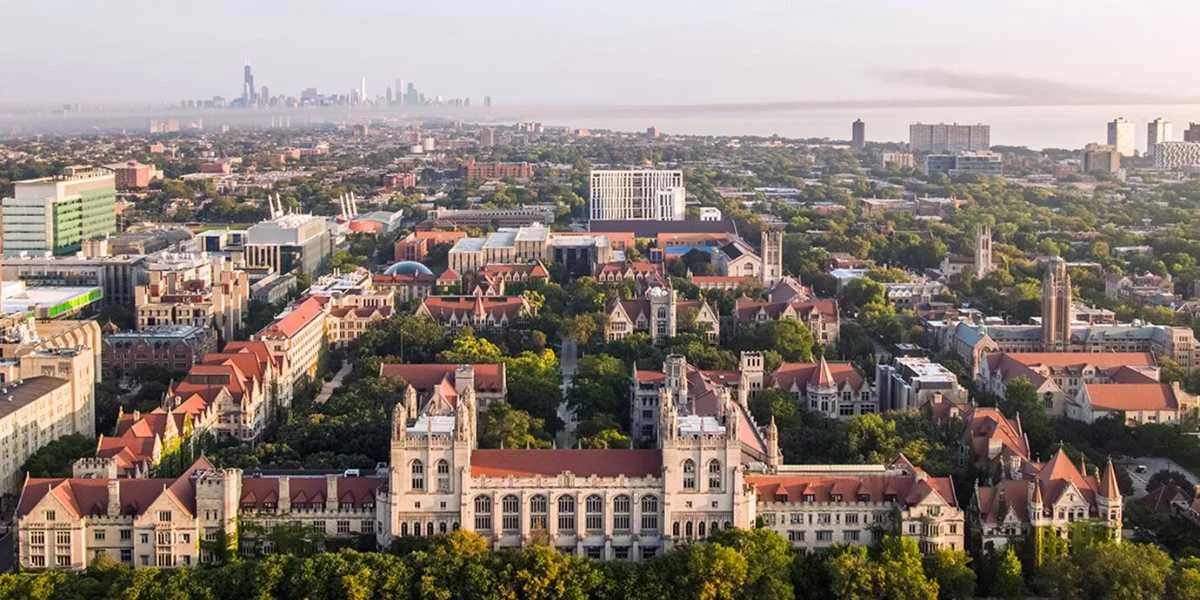
The University of Chicago was founded in 1890 and is a world-renowned private research university located in Chicago, Illinois. It consistently ranks among the top ten universities in the world in major college rankings. The campus architecture was historically dominated by the Gothic style, and in recent years it has added many modern elements. Student life is vibrant, with more than 400 student organizations and clubs.
About the university
School data is compiled from public sources and may change. Confirm current tuition, deadlines and requirements with the university before applying.
At a glance
Alumni starting salaries
Student body
Inside the school
The University of Chicago is known worldwide for its academic excellence, deep research tradition, and distinctive campus culture. Located in Hyde Park on the South Side of Chicago, the campus blends Gothic and modern architectural styles and is often described as one of the most beautiful urban campuses in the United States. The university holds exceptional influence in fields such as economics, law, and business, and both Chicago Booth and the Law School rank among the top in the nation. The University of Chicago is also the birthplace of the world's first nuclear reactor and continues to make breakthroughs in medicine, technology, and other frontier fields. Its rigorous academic atmosphere and challenging curriculum make it a training ground for academic elites from around the world.
We will examine the distinctive appeal of the University of Washington from several perspectives, highlighting the school's core features and its academic achievements and cultural character. Click the button below to view the full introduction to the school.
01. One of the most beautiful urban campuses in the United States
02. A school renowned for producing Nobel laureates
03. The world's first nuclear reactor
04. One of the most beautiful libraries in the United States: Harper Memorial Library
05. One of the hardest universities to get into in the United States
06. One of the best business schools in the United States
07. One of the top T14 law schools in the United States
08. The first living-donor liver transplant in human history
09. A medical center offering a green channel for Chinese patients
10. The University of Chicago coat of arms
Most popular majors
Graduate programs
Computer Science
Computer Science
Program Overview
The University of Chicago's Master's Program in Computer Science offers students a comprehensive, professionally oriented computer science education that combines the foundations of computer science with the applied and in-demand skills needed for careers in technology. It is particularly well suited to students interested in application development, data analytics, high-performance computing, and software engineering.
Degree Type
Masters Program in Computer Science (MPCS)
Program Length
Full-time students take 3 courses per quarter.
Students may choose to complete the 9-course program within one academic year or the 12-course specialization program within 15 months.
Program Features
Personalized curriculum:
The University of Chicago's Master's Program in Computer Science provides each student with a personalized curriculum tailored to their career goals and background. This means students can choose courses that fit their needs and interests, making them more competitive in their future careers.
Math and programming prerequisite courses:
For students without a background in math or programming, the program offers dedicated math and programming prerequisite courses. These prerequisite courses are designed to introduce students to computational concepts and help them build the foundational and introductory skills needed to begin the master's program successfully.
Students with advanced backgrounds:
For students with more advanced backgrounds, the curriculum allows them to begin with more advanced courses. This flexibility ensures that every student can learn in a way that suits their level of knowledge and better meet their academic and career goals.
Through these differentiated course arrangements, students receive a more personalized and targeted academic experience.
Sources:
University of Chicago Master of Science Program in Computer Science
University of Chicago Masters Program in Computer Science (MPCS)
Application Requirements
GRE/GMAT scores
Full-time 9-Course MS in Computer Science Program and Full-time 12-Course MS in Computer Science Specialization Program: All applicants must submit official GRE/GMAT scores.
GRE: The University of Chicago's school code is 1832.
GMAT: The University of Chicago's code for the Master's Program in Computer Science is H9x-WG-56.
For more GRE/GMAT information, see: GRE/GMAT Requirement
TOEFL or IELTS scores
TOEFL: Students must send official scores to the University of Chicago. Institution code: 1832
IELTS: Students must send official scores to the following electronic address
University of Chicago – Graduate Enrollment
970 East 58th Street, Third Floor
Chicago, IL 60637
For more information about TOEFL or IELTS, see: Proof of English Proficiency
In addition to the program-specific application requirements above, the complete application requirements can be found in the corresponding Application Requirements section of our website.
Sources: University of Chicago MPCS Application Requirements
Graduation Requirements
Credit requirements
Determined by the chosen study plan (9-course or 12-course).
Grade requirements
A grade of no lower than C+ in each course
Thesis requirement: None
Internship requirements
9-Course MS in Computer Science Program: None
12-Course MS in Computer Science Specialization Program: Students must complete the internship required for the degree.
Students fulfill this requirement through a technology-oriented summer internship off campus. This internship qualifies for degree-based CPT. In addition, the school accepts other alternatives, such as research with faculty, on-campus part-time work, or supervised project work.
For more information about internships, see: 12-Course Internship Requirements
Sources:
12-Course Internship Requirements
Curriculum Overview
The University of Chicago's Master's Program in Computer Science offers the following 2 study plans to meet the needs of students with different backgrounds and interests.
9-Course MS in Computer Science Program
This program balances the foundations of computer science with the skills needed for careers in technology.
5 Core Courses:
1 Algorithms course
1 Programming course (students may not take more than 1 core programming course)
3 Computer Systems, Networks and Architectures courses
For details on the core courses, see: MPCS Course Catalog
4 Elective Courses
Students can find courses in the course catalog that meet the requirements of each core and elective area.
In addition, students should note: students in the 9-course program cannot participate in CPT. If you are a current student who has already completed an internship through CPT, you cannot change your study plan to the 9-course plan. If you choose to use CPT, you must choose the 12-course degree plan.
12-Course MS in Computer Science Specialization Program
This program is aimed primarily at students who seek deeper specialization beyond the regular 9 courses.
Students may choose one of the following specializations:
Specializations: Application Development, Data Analytics, High Performance Computing, Software Engineering
6 Core Courses (or 5 Core Courses + 4 specialization courses in one specialization area)
Algorithms course
Programming course (students may not take more than 1 core programming course)
Computer Systems, Networks and Architectures courses
An additional Algorithms or Computer Systems, Networks and Architectures core course, or a practicum course
Complete 3 specialization courses in one specialization area (or 5 core courses + 4 specialization courses in one specialization area)
Complete 3 Elective Courses
Information on courses that meet the core and elective area requirements can be found in: MPCS Course Catalog
Sources:
University of Chicago Programs of Study
University of Chicago 9-Course MS Program
University of Chicago 12-Course MS Specialization Program
Career Development
The University of Chicago's computer science program offers students the following career resources:
Popular careers overview
Resources for learning about popular careers for Master's in Computer Science students.
Software developer requirements overview
Information on the requirements and qualifications needed to become a software developer.
Learning to code and changing careers:
Information on learning to code and changing careers.
Technical interview series:
Recommended reading on preparing for technical interviews, including how to prepare a technical resume and portfolio, mastering technical tests and phone interviews, and making a strong impression in face-to-face technical interviews.
LinkedIn group:
Suggestions for joining the school's LinkedIn group, which may serve as a networking platform for alumni of the University of Chicago's Master's Program in Computer Science and can help students connect with students, alumni, and faculty.
Career development workshops:
Announcements of upcoming career development workshops for the Master's Program in Computer Science, tailored specifically for current MPCS students and organized by the MPCS program and UChicagoGRAD.
Source: University of Chicago Career Resources
Public Policy
Public Policy
Program Overview
The University of Chicago's Master of Public Policy program is designed primarily for students who already hold an advanced degree and wish to gain an in-depth understanding of the public policy field through full-time study. It is also open to students enrolled in other graduate programs at the University. Its courses give students a foundational understanding of public policy and analysis to complement their existing academic and professional experience.
Degree Types
Master of Public Policy (MPP)
MA in Public Policy (MA)
Program Length
Master of Public Policy: 2 years
MA in Public Policy: 1 year
Interdisciplinary Content
The core curriculum spans multiple disciplines and fields, including economics, sociology, political science, statistics, econometrics, political economy, organization theory, and program evaluation, making it well suited to students seeking a multidisciplinary approach to public policy.
STEM Designation
This master's degree is designated by the Department of Homeland Security as a STEM (Science, Technology, Engineering, and Mathematics) degree, giving F-1 visa students eligibility to apply for a 24-month extension of Optional Practical Training (OPT) after completing their studies.
Sources:
University of Chicago Master of Public Policy (MPP)
University of Chicago MA in Public Policy (MA)
Application Requirements
Motivation Statement
Approximately 300 words
Prepare a short, clearly organized response to the prompt explaining your motivation for pursuing a graduate program in public policy.
Short Essay (Optional)
MPP applicants who wish to be considered for the Pearson Fellowship must complete the Pearson essay when submitting their application. The essay has no standard prompt framework; it is simply an opportunity to demonstrate your writing, analytical, and critical thinking skills. Note that only MPP applicants may apply for the Pearson Fellowship.
GRE Scores
The Harris School of Public Policy's institution codes are 1849 or 1832.
Unless you meet one of the following waiver conditions:
Qualifying professional experience: At the time of application, the applicant must show in their work history and resume that they have completed five or more years of full-time, relevant professional work.
Completed relevant coursework: Completion of a college-level, credit-bearing Calculus I and/or higher course with a grade of B or better. Applicants who completed Calculus I under a different grading system may demonstrate that they earned the equivalent of a B or better. If Advanced Placement (AP) Calculus appears on the undergraduate transcript as college credit, this requirement is satisfied.
See MATH 15100 Calculus I in the University of Chicago course catalog for examples of the concepts covered.
Qualifying educational background: The applicant is a University of Chicago undergraduate alum.
Approved GRE alternatives:
Applicants to the full-time master's programs—MPP, MA (full-time), MSCAPP, and MACRM—may submit a GMAT score.
Language Requirements
Applicants who do not meet the waiver requirements must submit TOEFL or IELTS scores to demonstrate English proficiency.
TOEFL: code 1849
IELTS: Send scores to
University of Chicago – Graduate Enrollment
970 East 58th Street, Third Floor
Chicago, IL 60637
Minimum Score Requirements
The University of Chicago will consider TOEFL/IELTS scores below the minimum requirements, including both total and section scores, but students scoring below the required scores will receive conditional admissions until they reach the required scores.
For detailed requirements on waiving language scores, see: University of Chicago Proof of English Proficiency
In addition to the program-specific application conditions above, the complete application requirements can be found in the corresponding [Application Requirements] section of our website.
Sources: University of Chicago Requirements & Deadlines
Graduation Requirements
Credit Requirements
Master of Public Policy
Students must complete 18 courses.
Courses with grades of F, I, W, or no grade do not count toward the program's 18-course requirement.
MA in Public Policy
Students must complete 9 courses.
Courses with grades of F, I, W, or unreported grades do not count toward the program's 9-course requirement.
Grade Requirements
Master of Public Policy:
A cumulative GPA of 2.7 or higher across all courses on a 4.0 scale
A grade of C- or higher in the 6 core courses
No more than 2 Pass/Fail courses (core courses may not be taken Pass/Fail)
MA in Public Policy
A cumulative GPA of 2.7 or higher across all courses on a 4.0 scale
A grade of C- or higher in the 6 core courses
No more than 1 Pass/Fail course (core courses may not be taken Pass/Fail)
Thesis Requirement: None
Internship Requirement: None
Sources:
University of Chicago Master of Public Policy (MPP)
University of Chicago MA in Public Policy (MA)
Curriculum Overview
Master of Public Policy
Students must complete 18 graduate-level courses, at least 12 of which must be public policy (PPHA) courses.
Core Courses
Students must complete 6 core courses. These core courses provide the foundation for critical analysis and emphasize the ability to think deeply about and analyze problems.
Elective Options
MPP students can explore special academic interests and fields and take part in internships and independent research to enrich their academic experience and apply what they learn to real-world problems.
Students may choose to focus on a particular public policy field, studying relevant courses in depth, enrolling in courses across the University's departments, and using experiential opportunities to apply classroom learning to real-world problems.
MA in Public Policy
Students may take any five of the six core courses plus four electives, for a total of nine courses, at least 7 of which must be public policy (PPHA) courses.
If you plan to combine this degree with another one-year master's degree at the University, both degrees must be awarded in the same quarter. Students interested in the public policy studies curriculum should consult with the formal arrangement when applying to their major program.
Core Courses
Students must choose 5 courses from the Harris School.
The following are the core course options:
Analytical Politics I:
Course Course NumberAnalytical Politics I: Strategic FoundationsPPHA 30800PhD Game TheoryPPHA 41501Analytical Politics II:
Course Course NumberAnalytical Politics II: Political Institutions PPHA 31610Statistics Sequence I:
Course Course NumberStatistics for Data Analysis IPPHA 31002Advanced Statistics for Data Analysis IPPHA 31202Any course in the PhD econometrics sequence (requires instructor approval and is subject to seat availability): PPHA 42000 or PPHA 42100 or PPHA 42200
Statistics Sequence II:
Course Course NumberStatistics for Data Analysis II: RegressionsPPHA 31102Advanced Statistics for Data Analysis IIPPHA 31302Any course in the PhD econometrics sequence (requires instructor approval and is subject to seat availability): PPHA 42000 or PPHA 42100 or PPHA 42200
Microeconomics Sequence I:
Course Course NumberPrinciples of Microeconomics and Public Policy IPPHA 32300PhD Advanced Microeconomics for Policy Analysis IPPHA 44100 Microeconomics Sequence II:
Course Course NumberPrinciples of Microeconomics and Public Policy IIPPHA 32400PhD Advanced Microeconomics for Policy Analysis II PPHA 44200
Sources:
University of Chicago Master of Public Policy (MPP)
University of Chicago MA in Public Policy (MA)
Career Development
University of Chicago Harris career development provides students with the following help and support:
Career Exploration:
Career exploration begins on your first day, reflecting the school's focus on career development from the moment students enroll. Whether you are an experienced professional or new to the workforce, the school provides personalized support to meet the needs of different students.
Portfolio Enhancement
Students can use the school's portfolio enhancement resources (resume, cover letter, LinkedIn profile, or other portfolio tools) to learn how to market themselves to employers, highlight their skills and experience, and best match employer needs.
Professional Development
Students are encouraged to build meaningful professional relationships that help expand their networks, gain support and opportunities, and foster personal and professional growth. Students also need to identify and use career development resources and opportunities, which may include job opportunities, training, and learning opportunities, to support their growth and development.
Interview Preparation
We prepare candidates thoroughly through in-person and virtual mock interviews, helping them become familiar with the interview setting, build confidence, and answer questions effectively.
Sources:
University of Chicago Career Development
University of Chicago Career Resources
Applied Data Science Program
Applied Data Science
Program Overview
The Master of Science in Applied Data Science program at the University of Chicago focuses on applied statistics, mathematics, and programming, and is designed to provide students with advanced analytics training so they can draw deep insights from big data. The curriculum covers a range of areas, including machine learning and predictive analytics, deep learning, reinforcement learning, data engineering platforms, time series analysis, linear and non-linear models, statistical methods, and other cutting-edge techniques for analyzing complex data. This means students learn to apply a variety of advanced techniques and methods to process and analyze big data, enabling them to succeed and make meaningful decisions across a wide range of fields.
Degree Type
MS in Applied Data Science
Program Length
12-18 months
Source: University of Chicago Master of Science Program in Applied Data Science
Application Requirements
Candidate Statement
The statement should not exceed 750 words.
The statement should include: an explanation of why the University of Chicago's MS in Applied Data Science program is a good fit for you, including the university's unique resources, teaching approach, or other aspects that attract you; a detailed description of your short-term and long-term plans for the MS in Applied Data Science program and the career goals you hope to achieve through the program; and a highlight of the unique perspective, education, and/or professional experience you will bring to the program.
Programming Supplement
Submit a PDF of no more than two pages demonstrating your current programming language skills.
Your application materials should include a section on programming skills. Although applicants with limited R or Python skills may still be admitted, the admissions committee places great weight on prior programming experience.
Virtual Portfolio
Applicants are required to record short videos during the application process based on given prompts.
One video prompt is required and the other is optional. Each video is approximately 1:30 minutes long. These short videos give applicants another way to outline why they are a strong fit for the MS in Applied Data Science program.
Language Requirements
Applicants to the MS in Applied Data Science program who do not meet the English language proficiency standards must submit proof of English language proficiency.
Minimum Score Requirements
TOEFL: 102 (no subsection requirements)
IELTS: 7 (no subsection requirements)
In addition to the program-specific requirements above, the full application requirements can be found in the Application Requirements section of our website.
Source: University of Chicago MS in Applied Data Science How to Apply
Graduation Requirements
Credit Requirements
Students must complete 12 courses before graduating, including 7 core courses, 3 elective courses, and 2 capstone project courses.
Grade Requirements
No course grade may be below B-.
GPA may not be below 3.0.
Source: University of Chicago Master of Science Program in Applied Data Science
Curriculum
Foundational Skills Courses (non-credit)
The non-credit foundational skills courses offered by the MS in Applied Data Science program are designed to give students the foundational knowledge and skills in applied data science. These required courses cover theory, strategy, and practice in data science research, providing a solid foundation for deeper study in subsequent courses. After admission, students have the opportunity to take an online foundational skills assessment. These assessments help determine students' skill levels and guide faculty and advisors in providing the best support for students.
Students must take the assessment unless they score 80% or higher on the assessment for the corresponding course. Otherwise, they must register for the following four foundational courses.
Course | Course Number | Timing: Introduction to Statistical Concepts, ADSP 31000, offered pre-quarter; R for Data Science, ADSP 37020, offered pre-quarter; Python for Data Science, ADSP 37021, offered during the first 5 weeks of the first admitted quarter; Advanced Linear Algebra for Machine Learning, ADSP 37016, offered during the second 5 weeks of the first admitted quarter. All foundational courses are completed virtually, regardless of whether students are enrolled in the in-person or online program.
Core Courses
Students must complete the following 7 core courses:
Course | Course Number: Time Series Analysis and Forecasting, ADSP 31006; Statistical Analysis, ADSP 31007; Data Mining Principles, ADSP 31008; Machine Learning & Predictive Analytics, ADSP 31009; Linear and Non-Linear Models, ADSP 31010; Leadership & Consulting in Data Science, ADSP 31016.
Elective Courses
Students must complete 3 elective courses from the following:
Course | Course Number: Financial Analytics, ADSP 32001; Marketing Analytics, ADSP 32003; Data Visualization Techniques, ADSP 32007; Data Science in Healthcare, ADSP 32009; Optimization and Simulation Methods for Analytics, ADSP 32013; Bayesian Methods, ADSP 32014; Digital Marketing Analytics in Theory and Practice, ADSP 32015; Advanced Machine Learning & Artificial Intelligence, ADSP 32017; Natural Language Processing and Cognitive Computing, ADSP 32018; Real-Time Intelligent Systems, ADSP 32019; Reinforcement Learning, ADSP 32020; Machine Learning Operations, ADSP 32021; Advanced Computer Vision with Deep Learning, ADSP 32023.
Capstone Project
The capstone project is a required component of the MS in Applied Data Science degree and is completed over two quarters. Its main components include research design, implementation, and writing. Full-time students typically begin the capstone project in their third quarter.
Course | Course Number: Capstone I, ADSP 34002; Capstone II, ADSP 34003.
Source:
University of Chicago Master of Science Program in Applied Data Science
University of Chicago In-Person Program
Career Development
Meet with a career advisor:
Students can schedule meetings with career advisors through the GRAD Gargoyle platform to receive personalized career advice.
Search for job opportunities:
Students can find employment information by checking the biweekly README newsletter in their email or searching the job board on GRAD Gargoyle.
Attend events:
Students are encouraged to attend the University of Chicago Fall Career Fair and the Spring Data Science and Analytics Career Fair, and to sign up for various workshops, information sessions, conferences, and other events.
Take career courses:
Career courses designed specifically for MS in Applied Data Science students are offered through the Canvas platform; students can regularly check assignments and resources for career development guidance.
Source: University of Chicago MS in Applied Data Science Career Services
Biomedical Sciences Program
Master of Science in Biomedical Sciences
Program Overview
The Master of Science in Biomedical Sciences program at the University of Chicago focuses on equipping students with solid foundational scientific research skills, problem analysis and problem-solving abilities, and effective oral and written communication skills. Through this curriculum, students build a strong foundation for careers in the biomedical health field and stand out in a highly competitive industry. As one of the University of Chicago's most popular graduate programs, the program opens diverse pathways for students aspiring to enter the biomedical field and provides strong support for their career goals.
Degree Type
Master of Science in Biomedical Sciences
Program Length
1 year
Source: University of Chicago BMS Overview
Application Requirements
Language Requirements
International students who do not qualify for an exemption must submit TOEFL iBT or IELTS scores.
TOEFL iBT: minimum score of 100 or above, with Reading, Writing, and Listening no lower than 26 and Speaking no lower than 22
; institution code 1832
IELTS: overall band score of 7.0, with no subsection below 7.0
Exemption criteria:
English has been your primary language of communication and instruction since childhood; or you have been enrolled full-time for at least one academic year in a program at an accredited English-medium institution of higher education in one of the following countries or regions within the past ten years: Antigua and Barbuda, Australia, the Bahamas, Barbados, Canada, Dominica, Grenada, Guyana, Hong Kong, Ireland, Jamaica, New Zealand, Saint Kitts and Nevis, Saint Lucia, Saint Vincent and the Grenadines, Singapore, South Africa, Trinidad and Tobago, the United Kingdom, the United States.
Education at English-medium institutions in other countries or regions does not qualify for an exemption.
Candidate Statement
Applicants must submit a statement discussing their academic and career goals and describing why they believe the University of Chicago Master of Science in Biomedical Sciences program is a good fit for them. The statement should discuss how your academic training, prior experience, and personal qualities have prepared you for the program and make you a qualified candidate. The statement should be limited to no more than 2 single-spaced pages.
Academic Background
All students must have earned a bachelor's degree or equivalent from an accredited college or university before enrolling in the BMS program. At the time of application, students must have completed at least one course each in general biology and general chemistry. A science background is recommended (but not required), and applicants must also demonstrate the motivation, academic potential, and ability to succeed in the program.
GRE
Optional. If you have taken the GRE within the past five years and would like your scores considered as part of your application, you may submit them to the institution, code 1832.
In addition to the program-specific application requirements above, full application requirements can be found in the corresponding [Application Requirements] section of our website
Sources:
University of Chicago BMS Application Requirements
University of Chicago Graduate Language Requirements
Graduation Requirements
Credit Requirements
Students must complete 6 core courses + 3 elective courses + an Independent study
Thesis Requirement
Students must complete an Independent study, which may require students to present their research findings as a presentation or paper.
Sources:
University of Chicago BMS Course Requirements
University of Chicago BMS Independent Program
Curriculum Overview
Students must complete
6 core courses + 3 elective courses + an Independent study
Core Courses
Foundations I-II-III (3-course sequence)
Methods requirement
Bioethics
Health Systems
Concentration-Elective Courses
Please note that the courses listed below are not the full set of courses. Course offerings may change from year to year.
Science Communication
Course (Chinese) | Course (English)
Science Communication: Writing a Digital Science Story
Give a Dynamic Scientific Talk That Doesn’t Put Your Audience to Sleep
Improving Scientific Communication and Addressing Misinformation
Biomedical Data Science
Course (Chinese) | Course (English)
Machine Learning in Biology and Medicine
Machine Learning and Advanced Learning for Biomedicine
Computational Biology: A Machine Learning Approach
Health Systems Science
Course (Chinese) | Course (English)
Topics in Healthcare Delivery Science (track-required course)
Fundamentals of Quality Improvement and Patient Safety
Healthcare Entrepreneurship
Launching a Bioscience Venture
Biomedical Innovation
Course (Chinese) | Course (English)
Medical Product Development
Healthcare Entrepreneurship
Launching a Bioscience Venture
Biological Sciences
Course (Chinese) | Course (English)
Research in Biological Sciences – Primary Literature Analysis
Biological Sciences – Basic Research Writing and Grant Proposal
Independent Program
This research project is designed to help students explore in depth a biomedical field of interest while applying classroom knowledge to real-world problems.
Core requirements:
Research direction: Students must choose a topic related to their Concentration. These directions may involve biomedical data science, health systems science, biological sciences, or science communication, among others.
Mentorship: Each student works with a mentor to design and carry out the research project. Mentors are typically senior scholars or industry experts in fields related to the program and provide students with specific research guidance.
Final deliverable: The project is typically submitted as a written report or academic paper and may require an oral presentation. The research findings must demonstrate the student's in-depth understanding of the chosen topic and analytical ability.
Timeline: The research project must be completed within the program's one-year curriculum, so the schedule is tight and requires students to have strong independent learning and time management skills.
Sources:
University of Chicago BMS Course Requirements
University of Chicago BMS Independent Program
Career Development
Graduates of the Master of Science in Biomedical Sciences program may be interested in the following career opportunities.
Chicago Biomedical Consortium Entrepreneurial Fellows Program
This program supports promising early-career life science researchers in translating their laboratory research into commercial projects, potentially even Chicago-based biotechnology startups. By providing real-world industry experience, the program connects students with the Chicago biomedical community and helps them develop the necessary skills and experience.
University of Chicago myCHOICE Program
The myCHOICE program is designed to provide students with career development support through internships, workshops, and career mentoring. Focus areas include Science Communication, Healthcare and Medicine,
Data Science, Business and Commercialization, and Industry Research. These opportunities can help students apply their research skills in different fields and prepare for careers in industry or academia.
MATTER, a nonprofit organization
MATTER is a nonprofit organization that supports healthcare innovation and provides resources and network connections for startups and healthcare technology innovators. Students can access entrepreneurial support through MATTER and use its resources to connect with cross-sector healthcare organizations.
These programs and resources reflect the University of Chicago's emphasis on career development and its strong support for students' future success in academia or industry.
Source: University of Chicago BME Career Resources
Statistics
MS Degree in Statistics
Program Overview
The University of Chicago's Master of Science in Statistics program is designed to build students' comprehensive abilities in statistical theory, data analysis, and practical application. As data-driven technologies become widely used in finance, marketing, the internet, and other fields, statistics has become a core tool for driving decision-making and innovation. The program offers a flexible curriculum that meets the needs of career development while laying a solid foundation for future doctoral study. Students study core areas such as statistical methods, machine learning, and biostatistics, and have opportunities to participate in interdisciplinary research such as genetics, financial econometrics, and computational neuroscience. Through close interaction with top faculty and diverse academic resources, the program builds a learning platform that combines theory and practice, helping students achieve professional accomplishment and broad prospects in statistics.
Degree Type
MS Degree in Statistics
Program Length
1 year
Source: University of Chicago MS in Statistics
Application Requirements
Language Requirements
All applicants who do not meet the exemption criteria must submit proof of English language proficiency. The division accepts only the TOEFL iBT or IELTS Academic.
Exemption criteria:
If English has been your primary language of communication and study since childhood, you may demonstrate this in your application.
If, within the past ten years, you were enrolled as a full-time degree-seeking student for at least one complete academic year at a recognized English-medium institution of higher education in one of the following countries or regions:
Antigua and Barbuda, Australia, the Bahamas, Barbados, Canada, Dominica, Grenada, Guyana, Hong Kong, Ireland, Jamaica, New Zealand, Saint Kitts and Nevis, Saint Lucia, Saint Vincent and the Grenadines, Singapore, South Africa, Trinidad and Tobago, the United Kingdom, the United States.
Education at English-medium institutions in any country or region not listed here does not qualify for an exemption.
TOEFL: minimum total score of 90; institution code: 1832
IELTS: minimum total score of 7.0
GRE
The division strongly recommends that all applicants take the GRE. University of Chicago ETS code: 1832. Department of Statistics code: 0705.
Although the division does not require a minimum GRE score for admission, the GRE is the only common measure applied to all applicants; therefore, a low GRE score that cannot be offset by demonstrated strength in other areas makes admission unlikely. Most successful applicants score above the 90th percentile on the Quantitative section of the GRE General Test.
Candidate Statement
This short essay gives you the opportunity to state your interest in statistics, what your goals are, and what you hope to achieve in graduate study. There is no need to tell the division more about your grades and coursework in the essay; your transcripts and other supporting materials will provide that information. Instead, you should use the candidate statement as an opportunity to tell the division about aspects of yourself not reflected in your transcript, such as extracurricular projects you have completed, your work experience, and so on. If you have completed graduate work elsewhere, your statement should include your reasons for wanting to change institutions or degree programs. If you have already completed more than two years of graduate study at another institution, this part of your statement is essential.
In addition to the program-specific requirements above, the complete application requirements can be found in the corresponding Application Requirements section of our website.
Source: University of Chicago Apply to MS in Statistics
Graduation Requirements
Credit Requirements
Students must complete at least 9 courses in accordance with the division's requirements.
Grade Requirements
All courses other than research training courses must receive a letter grade.
If a student takes at least 12 courses beyond the research training course (2d4), one course may be taken pass/fail.
All PhD-level courses specified in section (d) must receive a grade in the C range or above to count toward the degree.
All other courses counting toward the degree must receive a grade of B or above.
For grading purposes, a course may be considered PhD-level when one of the following conditions is met:
Statistics, Mathematics, or Computer Science at the 300 level or above;
Business School graduate courses at the 400 level or above approved by the DMA as PhD-level courses;
Courses at the 300 level or above in any department or school approved by the DMA.
Thesis Requirements
Yes. Students must complete a thesis before the end of the summer quarter of their second year. The specific requirements and process are as follows:
Thesis advisor selection:
Students must identify a thesis advisor before the end of the autumn quarter of their second year and notify the Director of the Master's Program in Statistics (DMA) and the student affairs administrator of the advisor information.
The advisor may be any faculty member in the Department of Statistics, with the advising relationship established by mutual agreement.
If a faculty member outside the department is chosen as advisor, approval from the DMA is required, and the Department of Statistics must designate a co-advisor who signs the final thesis.
Thesis preparation and process:
Students are advised to communicate with potential advisors as early as possible; advisors may require students to complete specific courses or read relevant materials as research preparation.
After the thesis is completed, the advisor or the DMA must sign the thesis, and a faculty member submits it to the student affairs administrator, at which point the thesis is considered passed.
Each quarter has a thesis approval deadline; the specific dates are provided by the student affairs administrator, and students must obtain this information proactively.
Thesis presentation and defense:
Students must give a 30-minute master's seminar presenting and reporting on the thesis before the end of the quarter in which they graduate.
To present at a specific time, students must notify the advisor (or the DMA) two weeks in advance, and after approval, the DMA schedules the seminar time. The seminar is open to everyone.
Source: University of Chicago MS in Statistics Graduation Requirements
Course Information
The course requirements for the University of Chicago MS in Statistics program are as follows:
1. Core Course Requirements
Required course sequences:
In the first year, students must complete the following sequence: the theoretical statistics sequence STAT 30030-30040-[32950 or 34800].
The following sequence may be completed in the first or second year, depending on the student's background: the applied statistics sequence STAT 34300-34700-[32950 or 34800].
Students with a strong foundation are advised to complete this sequence in the first year; the specific choice requires approval from the Director of the Master's Program in Statistics (DMA).
Substitute courses:
With the DMA's permission, the PhD-level theoretical statistics courses STAT 30400-30100-(302X0) may substitute for the 300X0 portion of the core sequence.
Core Course List
Course (Chinese) | Course (English) | Course Code: Statistical Theory and Methods I | STAT 30030; Statistical Theory and Methods II | STAT 30040; Multivariate Statistical Analysis: Applications and Techniques | STAT 32950; Modern Methods in Applied Statistics | STAT 34800; Applied Linear Stat Methods | STAT 34300; Generalized Linear Models | STAT 34700.
2. Elective Course Requirements
Regular electives: ordinary courses at the 300 level or above, which may not be seminars, reading courses, and the like. Courses must be in the Department of Statistics or on the graduate elective list of another department approved by the DMA. These courses may count toward the at least three electives required for the degree.
Preparatory courses: if the DMA determines that a student is not prepared for required courses or regular electives, the student may be permitted to take more basic ordinary courses. Such courses may count only toward the nine other electives described in the degree requirements.
Special-permission electives: courses that contribute to in-depth study of an applied field may be taken with DMA approval. Such courses likewise may count only toward the nine other electives.
Research training courses:
Students may take up to two quarters of the following courses: STAT 40100, STAT 39900 (if offered), or related seminars. Each course requires approval from the instructor and the DMA. These courses likewise may count only toward the nine other electives.
Elective Course List
Course (Chinese) | Course (English) | Course Code: Distribution Theory | STAT 30400; High Dimensional Time Series Analysis | STAT 30810; Multiple Testing, Modern Inference, and Replicability | STAT 30850; more courses are available on the official website list.
Career Development
Graduates of the University of Chicago MS in Statistics typically possess solid data analysis, modeling, and statistical inference skills and are qualified for the following broad categories of work:
Academia
Research positions: graduates may continue their studies, pursue a doctorate, and enter academia for teaching and research.
Research assistant/statistical consultant: assisting universities or research institutions with data analysis and statistical modeling.
Industry
In-demand sectors: statistics graduates are highly sought after in finance, technology, healthcare, insurance, market analysis, and other fields.
Finance: such as risk management, quantitative analysis, and data science.
Technology companies: such as machine learning engineer, data scientist, and algorithm researcher.
Healthcare and pharmaceuticals: biostatisticians participating in the analysis of drug clinical trial data.
Market analysis and consulting: statistical analysts providing market insight and support for strategic decisions.
Job resources: the university provides industry job postings, employment databases, job fairs, and other resources.
Government
Statistical positions: government agencies such as the U.S. Census Bureau and the Bureau of Labor Statistics have high demand for statistical talent.
Mixed Academia and Industry
Graduates may work on collaborative projects between universities and companies as data consultants or research assistants, advancing the integration of academic research and commercial application.
The University of Chicago also provides students with numerous career resources and support:
Employment databases and job platforms: extensive job information and job-search resources, including the StatJobs Listhost.
Job fairs and career events: the university regularly invites industry recruiters and headhunting firms to help students connect with potential employers.
Career guides: the University of Chicago provides students with a government job-search guide to help them understand the application process and career paths. The university also offers job-search consulting and career advising.
Alumni and professional networks: the University of Chicago statistics program has a large alumni network spanning many industries. Alumni resources provide graduates with career advice, recruiting opportunities, and insider industry information, helping them gain an advantage in the job search.
Graduates of the University of Chicago MS in Statistics have diverse employment options, including academia, industry, and government. They not only possess solid statistical analysis skills but can also use alumni resources and career support systems to find career paths suited to them anywhere in the world.
Source: University of Chicago Statistics Employment
Campus life
Transportation
Nearby Airports
Chicago O'Hare International Airport
Distance from campus: 23.5 miles
Trip from campus to the airport:
By car/rideshare:
Typically takes about 28 minutes. It may take longer during heavy traffic.
Public transit:
Take bus 6/4 and transfer to the Blue Line. Alternatively, take bus 6 and transfer to the Green/Brown/Pink/Purple Line, then transfer to the Blue Line.
Chicago Midway International Airport
Distance from campus: 14.5 miles
Trip from campus to the airport:
By car/rideshare:
Typically takes about 20-25 minutes. It may take longer during heavy traffic.
Public transit:
Take bus 55/63. Alternatively, take bus 4 and transfer to bus 63/47.
Nearby Train Station
Chicago Union Station
Trip from campus to the train station:
By car/rideshare:
Typically takes 15 minutes. It may take longer during heavy traffic.
Public transit:
Take bus 4/6 and transfer to bus 60, or take bus 55 and transfer to the Red Line, then transfer to the Orange Line.
City Public Transit
Chicago Transit Authority (CTA): There are multiple CTA bus and rail lines near the University of Chicago, including the Red Line, the Green Line and bus 57, making it easy for students and residents to reach downtown and neighborhoods throughout Chicago.
Buses: Multiple bus routes surround the University of Chicago, providing convenient access to downtown and nearby areas.
Safety
The University of Chicago Police Department (UCPD) provides 24/7 service on campus and in the Hyde Park, Kenwood, Oakland and Woodlawn communities. The Department of Safety and Security offers a range of services for the safety of the University community.
Safety Escort Program:
Patrol officers or security personnel escort members of the University community to their destination while they are within the UCPD patrol area.
UChicago Safe Mobile Safety App:
Free to download, it provides emergency information and links to safety resources.
Lyft Ride Smart at UChicago:
Provides students with 10 free rides per month (up to $15 off each ride), covering all late-night rides within the service area during program hours (5 p.m. to 4 a.m.).
UGo Daytime and NightRide:
Shuttles run across the greater campus area and are free and open to all members of the University community.
Housing
Housing and Residential Life helps develop and support an inclusive community in which residents enjoy an exceptional living experience in a safe, well-maintained environment, fostering a sense of belonging and supporting the University's academic initiatives. The University of Chicago has 48 houses within seven residence halls; these houses are communities of affiliated faculty and students who live, eat, debate and play together, not only in their rooms but also in shared lounges, communal dining halls and intramural sports fields. The distinctive traditions of each college and house promote friendship and pride among residents and build connections between current students and college alumni.
Residential Colleges
Burton Judson Courts
Campus North Residential Commons
International House
Max Palevsky Residential Commons
Renee Granville-Grossman Residential Commons
Snell-Hitchcock Hall
Woodlawn Residential Commons
On-Campus Housing Application Steps
New Student Housing
Residency Requirement
The University of Chicago has a six-quarter residency requirement — all traditional first-year students (who have never attended college before) must live on campus for their first six quarters. Students transferring from another college or university must live on campus for their first three quarters.
Housing Application and Assignment Process
New students are randomly assigned to houses. After each new student's house and residence hall are determined, the University's housing assignment team reviews each student's responses about lifestyle and living preferences and uses those responses to match rooms/suites. Not all new students will have a roommate, since on average 25-30% of new students are assigned to single rooms. The University firmly believes that all students benefit from living with students from different backgrounds, and for this reason new students may not request specific rooms and/or suitemates. Although each student's lifestyle and living preferences are reviewed and considered during the assignment process, students should not expect an exact match with all of their preferences.
All residence halls are coed by building. Room and roommate assignments are generally made based on the same biological sex; however, students who are willing to live in the same room with a student of a different biological sex may opt for gender-inclusive housing. In addition, each residence hall offers at least one floor or section dedicated to single-gender housing. Single-gender or gender-inclusive housing can be prioritized in the student's housing application.
Current Residents
Housing Contract
To live on campus, students must sign (electronically or in writing) a housing contract. The housing contract is legally and financially binding. Under the residency terms and conditions, once the contract is signed, students commit to living on campus for the entire academic year.
Housing Assignment Changes
Students can request a change to their housing assignment through the established myHousing portal process. This process typically begins in the second week of the fall quarter and ends before returning-student room selection begins. After the process closes, room change requests are generally not considered. Submitting a room change request does not guarantee that a room change will occur, as several dynamic factors affect the process, including: the total number of requests received, individual student preferences and available space.
Dining
Students on a residential meal plan can use the communal dining halls. All of the University's dining halls offer abundant vegan and vegetarian options and provide dedicated stations for those seeking to avoid gluten, certified by a gluten-intolerance organization. There are four dining halls in total, along with multiple cafés and food courts.
Dining Halls
Bartlett
Bartlett operates continuously throughout the day, with transitional periods between breakfast, lunch and dinner. You can enjoy a variety of fresh fruit, baked pastries, hot and cold cereals, and coffee.
Cathey
Cathey is located on the south campus of the University of Chicago and operates continuously throughout the day. You can enjoy a variety of fresh fruit, baked pastries, hot and cold cereals, and coffee.
Woodlawn
Woodlawn is located on the south campus of the University of Chicago and operates continuously throughout the day, with transitional periods between breakfast, lunch and dinner. It mainly serves dishes such as salads, roast chicken and beef stew.
For more information, see the dining hall list.
Meal Plans
University of Chicago Dining offers a variety of meal plans to meet the needs of the campus community. As part of the housing contract, students living on campus must choose a meal plan.
Meal Plans for On-Campus Students
Meal Plan | Eligible Users | Meal Exchange | To-Go Meals | Guest Meals | Points | Price | Unlimited Plan | All students | 3/semester | 10/semester | 5/semester | 100/semester | $2,500/semester | Phoenix Plan | 150/semester | All students | 15/semester | 10/semester | 5/semester | 150/semester | $2,500/semester | Apartment Plan | 90/semester | Students living in on-campus apartments and off-campus students | 8/semester | 10/semester | 5/semester | 200/semester | $1,772/semester | Off-Campus Students' Meal Plans (on-campus student meal plans may also be selected)
Meal Plan | Eligible Users | Meal Exchange | To-Go Meals | Guest Meals | Points | Price | Off-Campus Plan (purchasable by the item) | 10/item | Off-campus students | 0/semester | 0/semester | 0/semester | 0/semester | $161/item | Travel Plan | 4/semester | Off-campus students | 2/semester | 0/semester | 0/semester | 190/semester | $263/semester | Park Plan | 2/semester | Off-campus students | 1/semester | 0/semester | 0/semester | 120/semester | $158/semester | Midway Plan (free admission to special dining hall events) | 25/semester | Off-campus students | 4/semester | 0/semester | 3/semester | 25/semester | $495/semester
Admissions
Admissions data
Application requirements
Application checklist

Application deadlines
Transfer requirements
Transfer checklist
Transfer deadlines
Similar universities
Admissions FAQ
What is the acceptance rate at University of Chicago?
The reported acceptance rate is 5%. Acceptance rates vary by applicant pool and application cycle; confirm the current figure with University of Chicago.
What SAT scores does University of Chicago expect?
The reported SAT range is 1510-1570. Test-optional and score-reporting policies can change by application cycle; check the university's official admissions page before applying.
When is the application deadline at University of Chicago?
The listed Regular Decision deadline is Jan. 6. Deadlines can vary by program and application cycle; confirm the exact date with the university.
How much does University of Chicago cost?
The listed tuition and fee figure is $20,109. Costs vary by residency, programme and academic year; confirm current costs with the university.
Where is University of Chicago located?
University of Chicago is located at 5801 S Ellis Ave, Chicago, IL 60637.
Planning your application?
Build a school list around your profile.
Ivy Elite advisors help students compare programs, plan coursework and prepare applications for U.S. universities.