Ivy Elite
Dartmouth College

Dartmouth College currently has 4 schools: the Geisel School of Medicine, the Guarini School of Graduate and Advanced Studies, the Thayer School of Engineering, and the Tuck School of Business, with more than 40 departments and programs in total. These schools and programs span multiple disciplines, including but not limited to medicine, the arts, engineering, and business. In addition, the college is home to more than 75 centers and institutes that cross a wide range of disciplines, giving faculty and students a platform for collaborative research and joint exploration of complex problems. For students, this means opportunities to take part in interdisciplinary research projects and to gain knowledge and experience from experts in different fields. This integrated academic environment helps students develop creative thinking, teamwork skills, and the ability to solve complex problems, laying a solid foundation for their future careers.

About the university

School data is compiled from public sources and may change. Confirm current tuition, deadlines and requirements with the university before applying.

At a glance

Acceptance rate 6%
Tuition and fees $19,749
SAT range 1500-1570
Application deadline Jan. 2
Undergraduate enrollment 4,170
Student-faculty ratio 6:1
Location 6016 McNutt Hall Dartmouth College Hanover, NH 03755 USA
School type Private research university
In-state tuition
$19
Out-of-state tuition
$19,749
Room and board
$19,749
Graduation rate
84%
Student-faculty ratio
6:1
Gender ratio
51:48

Alumni starting salaries

Biological and Biomedical Sciences
+
Engineering
+
Mathematics and Statistics
+
Social Sciences
+
Psychology
+
History
+
English Language and Literature
+

Student body

First-year diversity
White
46%
Hispanic
14%
Asian
14%
Black
7%

Inside the school

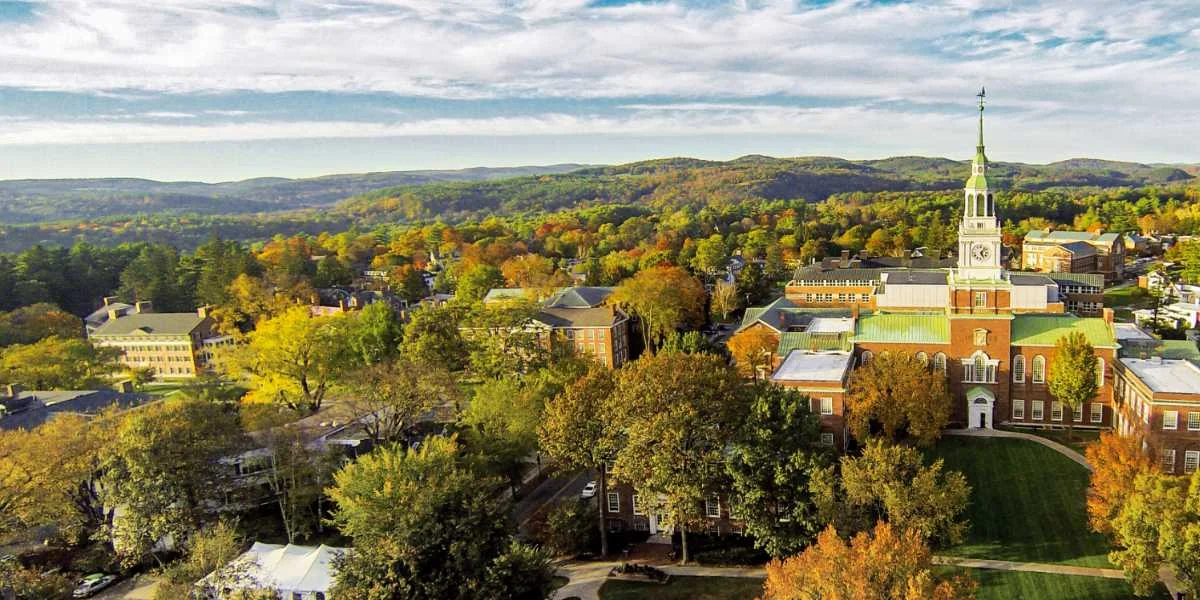
Dartmouth College sits in the small town of Hanover, New Hampshire, surrounded by mountains that give it a distinctive natural and academic atmosphere. As the smallest of the Ivy League schools, it uses the D-Plan four-term system, offering students highly flexible opportunities for study and internships. Undergraduate education is especially strong, with more than 60% of students involved in research, and an alumni network that is broad and far-reaching. Its distinctive Greek life culture, outdoor traditions, the homecoming bonfire, and a very low proportion of Chinese students give Dartmouth a combination of elite education and a close-knit community, making it an ideal place for those who love adventure and deep learning.

We will examine the distinctive appeal of the University of Washington from several angles, showcasing its core features and its academic achievements and cultural character. Click the button below to view the full introduction to the school.

01. A university surrounded by mountains

02. The D-Plan quarter system

03. Always calling itself a "college"

04. Greek life culture

05. A wealth of outdoor activities

06. The most refined Ivy League school

07. One of the strongest alumni networks in the United States

08. Need-blind admissions policy for international students

09. Homecoming bonfire event

10. The Ivy League university with the fewest Chinese students among the eight Ivy League schools in the United States

Most popular majors

Social Sciences
31%
Computer and Information Sciences and Support Services
9%
Multi/Interdisciplinary Studies
9%
Biological and Biomedical Sciences
9%
Mathematics and Statistics
8%
Engineering
6%
Visual and Performing Arts
4%
Physical Sciences
4%
Foreign Languages, Literatures, and Linguistics
4%

Graduate programs

Computer Science

Computer Science

Program Overview

The standard Master of Science in Computer Science is one of two master's programs offered in Computer Science at Dartmouth. The program has two tracks: the coursework track, in which students primarily take a series of courses to master the foundational theory and practical skills of computer science, and the research thesis track, in which students complete a research project or write an academic thesis demonstrating in-depth understanding and research ability in a specific area.

Degree Type

MS in Computer Science

Program Length

Two-year full-time program

Sources:

Dartmouth MS in Computer Science

Dartmouth Masters in Computer Science

Application Requirements

Language Scores

If English is not your native language, the admissions office requires you to take the TOEFL or IELTS. Dartmouth's program requires an IELTS score of 7.0 or above, but sets no specific TOEFL score requirement. If you have attended an English-language university in the United States for at least four years, the admissions office may waive the language test.

TOEFL institution code: 3351, department code: 78

GRE/GMAT

Students applying to the graduate program for Fall 2024 must take the GRE. All applicants may self-report their GRE scores. Official test scores are not required unless you are admitted and accept our offer of admission.

GRE institution code: 3351, department code: 0402

Letters of Recommendation

Three letters of recommendation are required. Letters from scientists in the same academic and research field as the department's faculty carry more weight.

Application Essay

What are your specific reasons for coming to Dartmouth? What are your specific study goals? What significant work experience do you have? Why do you want advanced training in computer science? Include any publications you have written (no more than 30 pages total).

In addition to the program-specific application requirements above, full application requirements can be found in the [Application Requirements] section of our website

Source: Dartmouth Masters in Computer Science

Graduation Requirements

Credit Requirements

The coursework track requires completion of 13 computer science courses.

The thesis track requires completion of 9 computer science courses, plus 5 research credits and a thesis.

Grade Requirements

Some master's students are required to take CS10; a grade below B in CS 10 (that is, B-, C+, C, C-, D, or E) will result in immediate withdrawal from the program.

Thesis Requirements

The master's program has two tracks: the coursework track and the thesis track. Students choosing the thesis track must prepare a thesis approved by a faculty committee and defend it publicly. The thesis should be primarily independent work, and its quality should be sufficient for publication in a refereed journal (with appropriate revisions).

Sources:

Dartmouth Masters in Computer Science

Expectations, Policies, and Procedures

Course Description

For the coursework track, students must meet these course and research requirements:

Students must satisfactorily complete at least 13 computer science courses taken for graduate credit and submit an essay approved by the program director explaining how these courses form a coherent whole. At least five of these courses must be numbered 130 or above. At least one of the 13 courses must be an advanced topics course in computer science at the graduate level (listed as COSC 149/249, COSC 169/269, and COSC 189/289). Any course taken outside the Computer Science Department must be approved by the master's program director. Students may use at most two research credit courses (such as 297-299) to satisfy these requirements, provided the student earns a P or HP and the master's program director approves the substitution. Under department policy, some upper-level undergraduate courses may count for graduate credit toward the master's degree. COSC 191, 200, 210, 295, and 296 do not count for MSCS graduate credit.

For the thesis track, students must meet these course and research requirements:

Students must satisfactorily complete at least 9 computer science courses taken for graduate credit. At least one of these 9 courses must be an advanced topics course in computer science at the graduate level (COSC 149/249, COSC 169/269, and COSC 189/289). Any course taken outside the Computer Science Department must be approved by the master's program director. Research credit courses (such as 297-299) may not be used to satisfy these requirements. Under department policy, selected upper-level undergraduate courses may count for graduate credit toward the master's degree. Computer science courses numbered 100-129 do not satisfy any master's required course. COSC 191, 200, 210, 295, and 296 do not count for MSCS graduate credit.

By the end of the third term after matriculation, students must apply for a thesis to the department's master's committee and be accepted.

Students must successfully complete at least five courses equivalent to research courses from COSC 297, COSC 298, or COSC 299.

For the complete MS in CS course list, see: Computer Science Courses

Source: Dartmouth MS in Computer Science

Career Development

The master's degree is essentially a technical degree; compared with general programmer-type jobs, a master's degree can open up a range of jobs that are more interesting, carry greater responsibility, are more creative, offer more flexibility, and pay more than a bachelor's degree, with opportunities in academia, industry (research and/or development), and government (research laboratories). Dartmouth's Guarini School of Graduate and Advanced Studies provides key resources for Dartmouth graduate students, postdocs, and alumni to help them succeed in the academic and non-academic job search.

The school also offers various courses and workshops to help graduate students and postdocs prepare for the career paths they choose. Services include learning how to build an outstanding resume, interview practice and techniques, understanding the dos and don'ts of academic and non-academic interviews, creating a personal development plan, and more.

Source: Dartmouth Career Service

Electrical and Computer Engineering

MEng: Electrical Computer Engineering

Program Overview

The MEng: Electrical/Computer Engineering program at Dartmouth College offers a comprehensive and in-depth educational platform for aspiring professional engineers or engineers seeking to enhance their existing skills. The program covers foundational scientific knowledge and emphasizes the application of that knowledge to solving real-world problems, with the goal of developing students' expertise and skills in research. Coursework is broad and includes the application of electrical principles in modern technologies such as semiconductor devices and communication networks. Students may choose to focus on a specific area of electrical and computer engineering, or, based on their interests and career goals, select courses from multiple complementary subfields to build a personalized plan of study. This flexibility ensures that students gain the expertise they need while remaining adaptable to emerging technologies and interdisciplinary fields. Through these experiences, students build a strong foundation for future careers or further academic study.

In addition, the Electrical and Computer Engineering program offers an MS with concentration in ECE, a track focused on developing innovative research capabilities, advanced engineering skills, and project management experience. Through interdisciplinary collaboration, the curriculum strengthens students' foundations in applied mathematics and engineering and provides in-depth specialized knowledge. Students are free to design their own plan of study to meet their personal interests and career goals. Faculty and students draw on experience from multiple fields to achieve broader societal impact.

Degree Type

MEng: Electrical Computer Engineering

Program Length

3 terms

Source:

Dartmouth College Electrical and Computer Engineering Program Overview

Dartmouth's MEng in Electrical and Computer Engineering

Application Requirements

Applicant requirements:

Applicants with an accredited bachelor's degree in engineering or a bachelor's degree in a scientific field such as physics, chemistry, or computer science are encouraged to apply.

The admissions committee will consider applicants who do not hold an accredited bachelor's degree in engineering on a case-by-case basis. Depending on the applicant's background engineering knowledge and skills, these applicants may be required to take necessary prerequisite courses in addition to the MEng degree requirements.

Writing Requirements

Statement of Purpose/Essay

Applicants will be prompted to write a short essay describing their interests and career goals and why they wish to pursue graduate study at Dartmouth. Include any information not presented elsewhere. If possible, keep your essay to 1-2 pages.

Optional Essay

Dartmouth's Thayer School of Engineering is committed to fostering an atmosphere that recognizes and accepts diversity of perspectives and backgrounds and supports a culture that promotes inclusion and the active pursuit of equity. In this optional essay, applicants are encouraged to share how their personal perspectives and unique life experiences will contribute to Dartmouth and the Dartmouth engineering community.

Interview Requirement

Applicants selected for an interview during the admissions process will be contacted directly by the Electrical and Computer Engineering program. Interviews will be conducted via Zoom.

Language Requirements

Non-U.S. citizens must submit language proficiency test scores, except students who are currently enrolled in or have already earned a degree from a U.S. or Canadian institution or from the following countries/regions: Australia, Canada, Denmark, Germany, Ghana, Ireland, the Netherlands, New Zealand, Nigeria, Slovenia, Sweden, the United Kingdom, and the United States. Recommended score ranges are as follows:

TOEFL score of 100 or higher, institutional code 3360;

IELTS score of 6.5 or higher;

Duolingo score of 135 or higher.

In addition to the program-specific application requirements above, full application requirements can be found in the corresponding Application Requirements section of Dartmouth College's official website.

Source: Dartmouth College Electrical and Computer Engineering Application Requirements

Graduation Requirements

Students must complete nine courses, including:

5 core courses;

4 electives, which may be any graduate engineering or science course at Dartmouth College.

Source: Dartmouth College Electrical and Computer Engineering Graduation Requirements

Curriculum

The curriculum consists of nine courses within the six MEng research areas, five of which must come from the core course list. The remaining four electives may be any graduate-level engineering or science course at Dartmouth. Students without an engineering background may need additional courses.

Core Courses

Choose 5 courses from 1 of the following 5 areas

Computer Engineering

Course English Name Course Number Modern Information Technologies ENGS 112 Advanced Digital System Design ENGS 128 Math for Machine Learning ENGS 96 Principles of Machine Learning ENGS 106 Bayesian Statistical Modeling and Computation ENGG 107 Control, Signal Processing, and Image Processing

Devices & Circuits

Optics & Electromagnetics

Miniaturized & Mobile Health Sensors

For more core course information, see: Core Courses.

Elective Courses

Starting in Fall 2024, students taking the design project elective may choose one of the following tracks to partially satisfy the four-elective requirement. The appropriate option will depend on each student's prior experience and coursework, as the two tracks require different prerequisites.

Course English Name Course Number Option 1 Product Design and Development ENGM 191 Option 2 Engineering Design and Methodology Project Initiation ENGS 190 Engineering Design Methodology and Project Completion ENGS 290 For more elective course information, see: Engineering Courses.

Source: Dartmouth College Electrical and Computer Engineering Curriculum

Career Development

The Electrical and Computer Engineering program at Dartmouth College is committed to providing students with comprehensive career services. The career services website offers a full range of job-search resources, including guides to writing resumes and cover letters, interview tips, application preparation, salary negotiation strategies, and information on career development workshops and job fairs. Students can use these resources to strengthen their competitiveness in the job market. In addition, the website provides industry resources that allow students to stay current on the latest job market trends and recruitment information and to expand their professional networks through the alumni network. For international students and students from diverse backgrounds, the website also offers dedicated support to help them address the specific challenges they may encounter during the job search. Through comprehensive career resources and personalized support, the program ensures that graduates succeed on their career paths in engineering.

Source: Dartmouth College Electrical and Computer Engineering Career Development

Biomedical Engineering

MEng: Biomedical Engineering

Master of Science in Biomedical Engineering

Program Overview

MEng: Biomedical Engineering

Dartmouth's Master of Engineering in Biomedical Engineering program is built on interdisciplinary training that closely integrates engineering, medicine, and the life sciences. The curriculum is designed to prepare students to apply engineering tools to key problems in medicine and biology, particularly in human health and medical technology innovation. Through coursework, students learn to combine the quantitative analysis methods of traditional engineering with core principles of the life sciences to advance the development of medical devices, diagnostic tools, biological systems, and treatments. Coursework spans mechanical engineering, electrical engineering, computer science, and core biomedical fields, with an emphasis on linking theory to practical application. Students may also take part in research projects in the Thayer School of Engineering and the medical school to strengthen their hands-on experience. The program's study plan is flexible and allows students to choose a specialization based on their interests, including but not limited to biomaterials, medical imaging, tissue engineering, biomechanics, and applications of artificial intelligence in medicine.

MS: Biomedical Engineering

Dartmouth's Master of Science in Biomedical Engineering program focuses on developing innovative researchers and engineers who advance health care technology by combining cutting-edge research with engineering practice. The program offers students a comprehensive platform for growth, emphasizing both core engineering skills and the expansion of interdisciplinary knowledge. Coursework covers biomechanics, biomaterials, medical imaging, tissue engineering, and modeling of biological systems, helping students build a solid foundation in applied mathematics and engineering techniques. Students explore their areas of interest in depth through individualized coursework and research topics. The degree requires the completion of a high-quality research thesis; students conduct in-depth research on their topic under the guidance of an advisor. Applicants are encouraged to contact faculty members of interest before enrolling to clarify their research direction, so they can integrate into research work more quickly and improve the quality of their academic output.

Degree Types

MEng: Biomedical Engineering

Master of Science in Biomedical Engineering

Program Length

MEng: Biomedical Engineering: 1 year

Master of Science in Biomedical Engineering: 2 years

Sources:

Dartmouth Biomedical Engineering MEng Overview

Dartmouth Biomedical Engineering MS

Application Requirements

Language Requirements

Non-U.S. citizens must submit language proficiency test scores, except those who are earning or have earned a degree at a U.S. or Canadian institution, or who are from the following countries/regions: Australia, Canada, Denmark, Germany, Ghana, Ireland, the Netherlands, New Zealand, Nigeria, Slovenia, Sweden, the United Kingdom, and the United States. For all graduate programs, the Dartmouth School of Engineering accepts the following English proficiency tests: TOEFL, IELTS, and Duolingo.

TOEFL: minimum score of 100 or above; institution code is 3360

IELTS: 6.5 or above

Duolingo: 135 or higher

GRE

Optional. The program has no minimum score requirement. Institution code 3360.

Optional Essay

The Dartmouth School of Engineering is committed to fostering an atmosphere that recognizes and embraces diversity of perspectives and backgrounds, and to supporting a culture that promotes inclusion and actively pursues equity. In this optional essay, applicants are encouraged to share how their personal perspectives and unique life experiences will contribute to Dartmouth and the Dartmouth Engineering community.

Research Area

Applicants must select one research area of interest (one of six available options) at the time of application and note all interest areas in the application. Students may change their research direction after the program begins.

MEng:

Statement of Purpose/Essay

You need to write a short essay describing your interests and career goals and why you wish to pursue graduate study at Dartmouth. Include any information not presented elsewhere that would help the school evaluate your application. If possible, keep the essay to 1-2 pages.

Academic Background

Applicants with an accredited bachelor's degree in engineering or in a science field such as physics, chemistry, or computer science are encouraged to apply. Applicants without an accredited bachelor's degree in engineering will be considered by the admissions committee on a case-by-case basis. Depending on their background engineering knowledge and skills, these applicants may be required to take necessary prerequisite courses in addition to the master's degree requirements.

MS:

Selecting Dartmouth Engineering Faculty of Interest

In the supplemental application form, applicants must select at least one professor and may select up to three professors to match research interests. Applicants are strongly encouraged to contact Dartmouth professors before applying to discuss research opportunities at an initial stage.

Personal Statement/Application Essay

Applicants must submit a short application essay describing their research interests, career goals, and reasons for choosing Dartmouth for graduate study. The essay should provide information helpful to the evaluation of the application, and is recommended to be 1-2 pages.

In addition to the program-specific application requirements above, full application requirements can be found in the corresponding Application Requirements section of our website

Sources:

Dartmouth Biomedical Engineering MEng Application

Dartmouth Biomedical Engineering MS Application

Graduation Requirements

Credit Requirements

MEng:

Students must complete 9 courses, of which 5 must come from the core course list.

The remaining 4 courses may be any graduate-level engineering or science-related course offered at Dartmouth.

Students without an engineering background may need to take additional foundational courses.

MS: Students must complete at least 9 courses, including applied mathematics, engineering courses, and research.

Grade Requirements

MEng:

No fewer than 8 courses with a grade of HP (A, A-) or P (B+, B, B-).

MS:

No more than 1 LP grade (C+, C, C-) per 6 courses.

Thesis Requirements

MEng: Not required

MS: Students must take the course ENGG 700: Responsible & Ethical Conduct of Research. The research must result in a written thesis demonstrating depth of knowledge in a specific area of engineering research or design. The thesis must also be publicly defended orally, with the defense conducted by the candidate's thesis committee. The master's thesis committee typically consists of three Dartmouth faculty members (including the student's thesis advisor); one of the three may be from outside the program of study. Candidates are responsible for providing each committee member with a final, signature-ready copy of the thesis for review at least two weeks before the defense. Candidates must submit electronic notice of the defense to the registrar two weeks in advance so that it can be distributed to faculty and posted.

Sources:

Dartmouth Biomedical Engineering MEng

Dartmouth Biomedical Engineering MS

Dartmouth Academic Policies

Course Information

MEng:

Core Courses (choose 5 from the following)

Course (Chinese) Course (English) Course Code Digital Image Processing ENGS 111 Image Visualization and Analysis ENGG 113 Computational Imaging ENGS 117 Biomedical Circuits and Systems ENGS 129 Heat, Mass and Momentum Transfer ENGS 156 For more courses, see the official course list

Electives

Choose 4 courses from the following:

Engineering

Any graduate-level engineering science course, including:

ENGS 91: Numerical Methods in Computation

ENGS 92: Fourier Transforms and Complex Variables

ENGS 93 or ENGG 193: Statistical Methods in Engineering

ENGS 105: Computational Methods for Partial Differential Equations I

ENGS 108: Applied Machine Learning

ENGS 110: Signal Processing

Design Project

Students may choose one of the following options to partially satisfy the four-elective requirement. The appropriate choice will depend on each student's prior experience and coursework, since the two tracks require different prerequisites.

Option 1 (1 course)

ENGM 191: Product Design and Development

Option 2 (2 courses)

ENGS 190: Engineering Design and Methodology Project Initiation

ENGS 290: Engineering Design Methodology and Project Completion

MS:

Applied Mathematics: choose one

Course Course Code Numerical Methods in Computation ENGS 91 Fourier Transforms and Complex Variables ENGS 92 Statistical Methods in Engineering ENGS 93 / ENGG 193 Math for Machine Learning ENGS 96 Engineering Depth: choose at least three

Course Course Code Methods in Applied Mathematics ENGS 100 Operations Research ENGS 103 Engineering Breadth: choose at least two

With the approval of the thesis advisor and the graduate program committee, students may select courses from any graduate course listing area.

Research: choose one

Course Course Code Responsible & Ethical Conduct of Research ENGG700 For a fuller course list, see the official website

Sources:

Dartmouth Biomedical Engineering MEng

Dartmouth Biomedical Engineering MS

Career Development

Graduates of Dartmouth's Biomedical Engineering program are sought after by many well-known companies, and their employment spans technology, health care, finance, consulting, energy, and other fields. Technology giants such as Google, Microsoft, and Amazon are major recruiters. Beyond technology companies, Dartmouth graduates are also sought after by traditional manufacturing firms, energy companies, financial institutions, and many other types of organizations.

The school also provides students with a variety of career support services. The program's curriculum is designed to develop students into technical experts and well-rounded leaders. Graduates combine engineering expertise with communication, leadership, and creative problem-solving skills, giving them a distinctive leadership position in any field. Alumni of the Dartmouth School of Engineering have lifelong access to engineering career services. Graduates can continue to receive job information, networking opportunities, and career guidance, and connect with alumni eager to find opportunities for them within their own companies. Many graduates have founded their own companies.

Source: Dartmouth Biomedical Engineering Careers

Campus life

Transportation

Nearby Airports

Lebanon Municipal Airport (LEB)

Distance from campus: 8.7 miles

Campus to airport travel:

Driving/rideshare:

Typically takes about 15 minutes. It may take longer during heavy traffic.

Public transportation:

Bus: Yellow Line to West Lebanon, transfer to Red Line

Manchester-Boston Regional Airport (MHT)

Distance from campus: 80.7 miles

Campus to airport travel:

Driving/rideshare:

Typically takes about 1 hour 25 minutes. It may take longer during heavy traffic.

Public transportation:

Take Greyhound US 0260 bus to the airport.

Boston Logan International Airport (BOS)

Distance from campus: 127 miles

Campus to airport travel:

Driving/rideshare:

Typically takes about 2 hours. It may take longer during heavy traffic.

Public transportation:

Take the Dartmouth Coach bus, or take Greyhound US0260 to Boston / South and transfer to the Logan Airport line or the Hyannis line.

City Public Transportation

Dartmouth College is located in Hanover, New Hampshire, and public transportation in the surrounding area is relatively limited, but there are still some options:

Advance Transit: Advance Transit is a free public transportation system serving the town of Hanover and the Hanover college community. It offers multiple routes covering the areas around the school and major parts of Hanover. You can check their website or get schedules and route information on campus.

Amtrak Train: The Vermonter line of Amtrak stops at the nearby White River Junction train station, which is about a 15-minute drive from Dartmouth College. You can take a taxi or use other transportation to get to the train station, and then take the train to other cities or regions.

Grafton County Transit: Grafton County Transit provides some regional public transportation services that may cover some areas near Dartmouth College. You can learn about their service area and schedules.

Safety

LiveSafe App

Download the LiveSafe App to access safety services.

Bicycle Registration

Register your bicycle or personal electric vehicle at Ferry Rd. This is free, and it helps Dartmouth College find your bicycle/electric vehicle if it is lost.

Lost & Found

Find lost items at the Lost & Found on the 3rd floor of 5 Rope Ferry Road.

Medical Transport

Medical transport services are limited to sudden illness or injury, and provide 24-hour medical transport to and from DHMC every day.

Unlocks

The Department of Safety and Security (DoSS) unlocks residence halls after 4:00 PM on weekdays and all day on weekends and holidays.

Dartmouth Campus Access Check

For event planners and organizers: When inviting individuals (or groups) to campus, the Security Department will help you diligently determine whether anyone on the invitation list holds a valid "Notice Against Trespass."

Student's Guide to Fraud Scams

The guide PDF document is provided by the International Association of Financial Crimes Investigators (IAFCI).

Anonymous Reporting Form

Use this form to report any information about crimes or other matters to the Dartmouth College Department of Safety and Security.

Housing

Dartmouth College offers six residential houses for students. One of the core goals is to improve the continuity of the residential experience, increase opportunities for students to interact with faculty and staff in residential spaces, and build community by creating opportunities for social connection and shared experiences within the residential system. Students can participate in all house activities, including dinners and events held at faculty residences in the houses.

Residential Colleges

Undergraduate Housing

Undergraduate students can live in ALLEN HOUSE, EAST WHEELOCK HOUSE, NORTH PARK HOUSE, SCHOOL HOUSE, SOUTH HOUSE, and WEST HOUSE, among which:

First-Year House

First-year students will receive a randomly assigned house membership during the summer. First-year students will live on first-year floors affiliated with their house community, unless they live in a living-learning community where roommates will have membership in the same house. All first-year students will participate in house activities, and then begin living in house residence halls starting in their sophomore year. For more information, you can read: Housing Location

Upper-Class Housing

In addition to student residence halls, Dartmouth also offers upper-class students three other housing options: Living Learning Communities, Senior Apartments, and Greek Life Housing.

Living Learning Communities are a vibrant alternative to traditional residence hall life. Each program has a unique theme. Dartmouth College has the Sustainable Living Center, the Max Kade German Center, the Native American House, and more! Students interested in participating in one of these living learning communities need to go through a selection process with program advisors. These communities sponsor events for both their own residents and the larger residential community.

Greek Life Housing refers to upper-class students who join fraternities, sororities, coed organizations, or college societies and may choose to live in their organization's house. These arrangements are made within the organization, and many members live in their house for at least one semester at Dartmouth. For more information, you can read: LIVING LEARNING COMMUNITY HOUSES, Apartments, and Greek.

Graduate Housing

The school provides students with a list of Dartmouth-owned rental properties, as well as a list of private rental properties in the Upper Valley. Tuck School of Business provides comfortable, state-of-the-art housing facilities. Single students or students without partners or children can live in Tuck School of Business residence halls (Achtmeyer Hall, Buchanan Hall, Pineau-Valencienne Hall, Whittemore Hall), or they can stay farther from the school at Sachem Village and South Street Apartments. For more Tuck School of Business housing information, you can read Housing options.

On-Campus Housing Application Process

Every Dartmouth student is randomly assigned to one of six house communities. Most first-year students live on first-year floors with other members of their house community. Your housing and roommate assignments are based on the information you provide in the lifestyle survey in your housing profile. Although the questions in the lifestyle survey only let Dartmouth College understand your personality and living preferences, Dartmouth College finds these questions to be good indicators of roommate compatibility.

Be sure to answer these survey questions truthfully. First-year student rooms include singles, doubles, triples, and quads. Most rooms are carpeted. Dartmouth College does not accept first-year student requests for building/location, house community, or roommates.

Dining

Dartmouth College Dining Services offers a diverse range of options to meet the needs of students, faculty, staff, and visitors. Dining halls provide breakfast, lunch, and dinner service, with corresponding hours on weekends and holidays. The school offers a variety of dining choices, including buffet-style dining halls, fast-food outlets, and cafes, with diverse and varied menus.

School Dining Halls

The school has 12 dining locations, including public dining halls, SNACKBAR, and CAFÉ, for example:

The Class of 1953 Commons

A buffet-style dining hall with nine different stations. Offerings include comfort food, vegetarian and vegan dishes, oven-fired pizza, breakfast sandwiches and a stir-fry station, a full grill, a gluten-free station, and a certified kosher kitchen.

BACK OF THE NAPKIN

Dartmouth College's newest cafe is located in the Class of 1982 Engineering and Computer Science Center and offers fresh fast food, including sandwiches, salads, sushi, and hot dishes. The restaurant accepts meal swipes, discretionary meal dollars, and credit cards.

CAFÉ AT BAKER

Offers Mocha Joe's coffee, espresso drinks, quiche, locally baked specialties, homemade hand pies, and Dartmouth College's Rishi loose-leaf tea.

Meal Plan

Meal Plan Requirements:

All first-year students must use the Ivy Unlimited plan during their first year (fall, winter, and spring terms). In addition, all transfer students and exchange students (without D-Plan) will use the Ivy Unlimited plan during the fall term.

Meal Plan Prices:

Ivy Unlimited Plan:

Students can enjoy unlimited access to Dartmouth College's flagship dining hall, The Class of 1953 Commons, and can also use equivalent meal vouchers at participating cafes during dining hours, or use takeout meal vouchers at '53 Commons during dining hours. The plan also includes 5 guest passes and $250 in meal dollars per term. Cost per term: $2,447.

115 Block Plus Plan 80: This plan includes 115 swipes per term and $475 in meal dollars. Cost per term: $2,150.

80 Block Plus Plan 80: This plan includes 80 swipes per term and $725 in meal dollars. Cost per term: $2,130.

On-Campus Apartment Plan:

This plan is available to students living in designated on-campus apartments, including Channing Cox, Ledyard Apartments, and Maxwell and North Park Apartments (Ivy Lane and North Park St.). It includes 45 swipes per term and $975 in meal dollars. Cost per term: $1,720.

Off-Campus Plan:

This plan is available to any undergraduate student not living on campus. The plan provides $850 in meal dollars per term. Cost per term: $850.

Admissions

Acceptance rate
6%
SAT range
1500-1570
ACT range
33-35
SAT / ACT
SAT reading and writing, 25th–75th percentile: 740-780
SAT math, 25th–75th percentile: 760-790
SAT median: 1540
ACT English, 25th–75th percentile: 35-36
ACT math, 25th–75th percentile: 31-35
ACT median: 34

Admissions data

Admission to Dartmouth College is highly competitive. The acceptance rate is 6%.
Among applicants admitted to Dartmouth College, half have SAT scores between 1440 and 1560, or ACT scores between 33 and 35.
The Dartmouth College application deadline is January 3, and the application fee is $80.
Dartmouth College admissions officers consider a student's GPA to be an important academic factor.
Dartmouth College admissions officers will consider an applicant's high school class rank, but the quality of letters of recommendation is also a very important consideration.
Applicants
Admitted
Female applicants
Male applicants
Female admits
Male admits
Waitlist offered
Yes
Students on waitlist
1,606
Students accepting a place
2,352
Admitted from waitlist
0

Application checklist

01.
Common Application
02.
Dartmouth Writing Supplement
03.
Secondary School Report (including transcript, school profile, and counselor evaluation)
04.
Two teacher recommendations
05.
SAT or ACT
Not required for students applying for 2027
06.
TOEFL or IELTS
International students
07.
Strongly recommended: peer recommendation

Application deadlines

Deadline
Date
Early Decision I
Nov. 1
Regular Decision
Jan. 2
ED I notification
Dec. 15
RD notification
April 1

Transfer requirements

01.
All candidates applying to transfer to Dartmouth must use Dartmouth's transfer application system.
02.
Students who have been enrolled at a college and who will have completed two years or less of college coursework by the date of application are eligible for transfer admission.
03.
Students who have previously earned a bachelor's degree or its equivalent are not eligible for admission to Dartmouth College.
04.
Students who have taken college courses that counted toward high school graduation must apply for first-year admission. This includes students who earned an associate degree while completing high school.
05.
Students who are not currently enrolled or who have had an interruption in their education may apply for admission and use the "Additional Information" section of the application to provide context about their experiences and educational path.
06.
An applicant's expected graduation year or the number of credits completed within the guidelines above will not affect the admission decision. Because Dartmouth enrolls a very small number of transfer students each year, the admissions committee does not need to balance the number of students entering as new sophomores or juniors.

Transfer checklist

01.
Dartmouth application and related essays
02.
Application fee
03.
Complete secondary school report and transcript
04.
Official college report and transcript, updated through May/June and covering final semester grades
05.
2 letters of recommendation from college instructors
06.
SAT & ACT scores
07.
If admitted, students must submit transcripts and course syllabi to determine final transfer credits
08.
TOEFL and IELTS scores
International students

Transfer deadlines

Deadline
Date
Fall application deadline
Mar. 1
Fall materials deadline
Mar. 1

Similar universities

Admissions FAQ

What is the acceptance rate at Dartmouth College?

The reported acceptance rate is 6%. Acceptance rates vary by applicant pool and application cycle; confirm the current figure with Dartmouth College.

What SAT scores does Dartmouth College expect?

The reported SAT range is 1500-1570. Test-optional and score-reporting policies can change by application cycle; check the university's official admissions page before applying.

When is the application deadline at Dartmouth College?

The listed Regular Decision deadline is Jan. 2. Deadlines can vary by program and application cycle; confirm the exact date with the university.

How much does Dartmouth College cost?

The listed tuition and fee figure is $19,749. Costs vary by residency, programme and academic year; confirm current costs with the university.

Where is Dartmouth College located?

Dartmouth College is located at 6016 McNutt Hall Dartmouth College Hanover, NH 03755 USA.

Planning your application?

Build a school list around your profile.

Ivy Elite advisors help students compare programs, plan coursework and prepare applications for U.S. universities.