


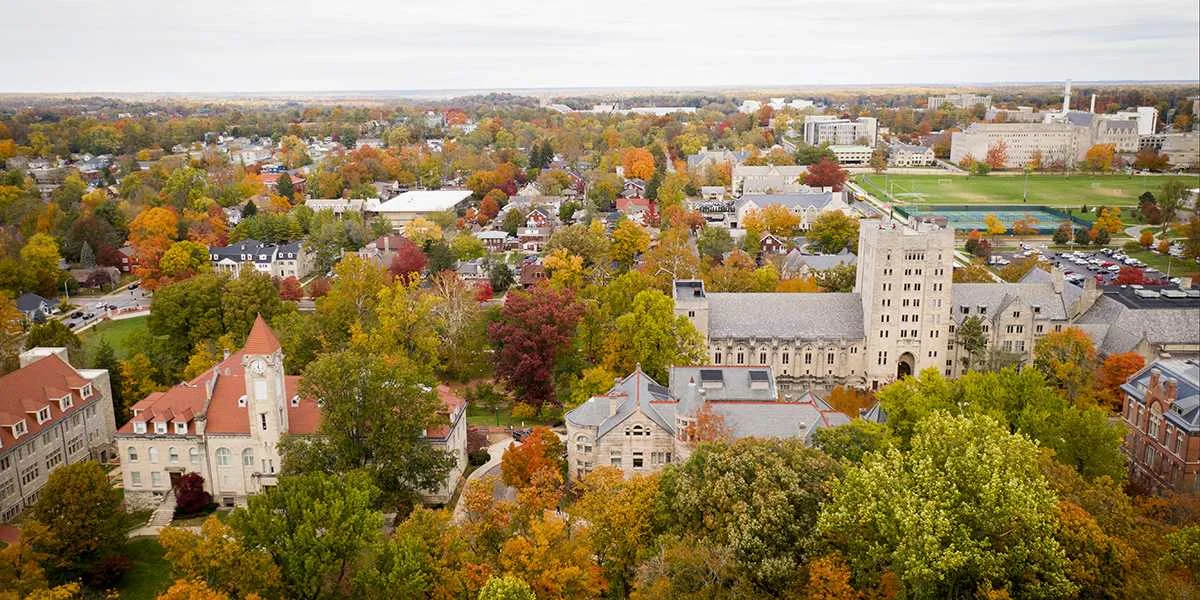
Indiana University Bloomington currently has 16 degree-granting schools and colleges, including one graduate school and 15 undergraduate schools, many of which are among the best in the nation and the world; the university also has the Hutton Honors College. Its curriculum is broad and rich, spanning the arts, business, medicine, education, and the sciences, and fully develops students' potential. The university continually upgrades the quality of its school-level education to meet the new challenges of today's workplace. A first-rate academic environment, real-world experience, and a community that supports students in every way will spark your interest and cultivate students' capacity for innovation.
About the university
School data is compiled from public sources and may change. Confirm current tuition, deadlines and requirements with the university before applying.
At a glance
Alumni starting salaries
Student body
Most popular majors
Graduate programs
Finance
Finance
Program Overview
The Master of Science in Finance program at Indiana University Bloomington is designed to prepare finance analytics professionals for roles across industries worldwide, giving organizations deep financial analysis expertise and specialized knowledge. The program emphasizes not only theoretical foundations but also practical skill development, so students can apply what they learn flexibly to real business challenges. Applicants are welcome whether or not they have a business background; through a rich curriculum and hands-on projects, students become professionals with in-demand finance and business skills. The program actively promotes interaction between students and industry recruiters, broadening career options and helping graduates secure positions in corporate finance, consulting, capital markets and other diverse fields.
Degree Type
MS in Finance
Program Length
11 months
STEM Designation
Yes
Source: Indiana University Bloomington, Master of Science in Finance, Program Overview
Application Requirements
Requirements applicants are expected to meet:
An expected grade point average of 3.2 or above.
Personal Statement
Describe your career plans and how you believe the Master of Science in Finance program will help you achieve your goals, and demonstrate your written communication skills.
Be concise, approximately 500 words.
GRE/GMAT
Official codes: GMAT, 8ZG-41-82; GRE, 001324.
If your GPA (on a 4.0 scale) is 3.5 or above, you may be eligible for a GRE/GMAT waiver.
Kelley School of Business students on the IU Bloomington campus do not need GMAT/GRE scores. Kelley School of Business students with a GPA of 3.2 or above (on a 4.0 scale) do not need to submit GMAT/GRE scores.
Language Requirements
All applicants from non-U.S. institutions must take the Test of English as a Foreign Language (TOEFL) or the International English Language Testing System (IELTS):
Minimum TOEFL scores: 105 on the new iBT, 620 or above on the paper-based test, or 260 or above on the computer-based test. The TOEFL code is 001324.
Minimum IELTS score: 7.5.
Interview Requirement
Competitive applicants may be invited to interview on campus. Applicants who are not local will interview via Zoom or by phone.
In addition to the program-specific requirements above, full application requirements can be found in the Application Requirements section of our website.
Source: Indiana University Bloomington, Master of Science in Finance, Application Requirements
Graduation Requirements
Credit Requirements
A total of 31.5 credits is required, including:
7.5 credits of finance core courses
22.5 credits of elective courses
1.5 credits of capstone
Students without a business background must complete 6 credits of business boot camp (if they choose to attend the business boot camp, this means completing 37.5 credits)
Internship Requirement
Students can complete the full-time Kelley residential Master of Science in Finance program in 10 months, 11 months or 18 months, depending on whether they need to attend the June business fundamentals boot camp or choose an internship.
Students who choose to do an internship may take the internship course BUS-F579 MSF Practicum I or BUS-F579 MSF Practicum II. For more information about internships, see: Indiana University Bloomington – Internship Overview
Capstone
Students must complete a 7-week capstone in which they work with local, national and international companies and nonprofit organizations to implement projects proposed by the benefiting organizations. Students meet weekly with the project client and the faculty member responsible for the course.
Sources:
Indiana University Bloomington, Master of Science in Finance, Graduation Requirements
Indiana University Bloomington, Master of Science in Finance, Capstone
Curriculum
Required Courses
Course | Course Number | Credits: Financial Economics, F513, 3; Leadership, Professional and Career Development, X505, 1.5; Corporate Finance and Valuation, F516, 1.5
Elective Courses
Course | Course Number | Credits. Required courses: Asset Valuation and Strategy, BUS-F520, 1.5; The Firm in the Capital Markets, BUS-F540, 1.5. Corporate Finance track: Short-Term Financial Management, BUS-F507, 1.5; Real Options in Capital Budgeting, BUS-F508, 1.5; Venture Capital & Entrepreneurial Finance, BUS-F517, 1.5. Financial Institutions track: Fixed Income Investments, BUS-F528, 1.5; Spreadsheet Modeling for Finance, BUS-F541, 1.5. Investment Banking track: Derivative Securities, BUS-F526, 1.5; Equity Markets, BUS-F529, 1.5; Business Analytics Programming, BUS-S536, 1.5. Investment Management track: Corporate Financial Risk Management, BUS-F525, 1.5; Corporate Financial Strategy, BUS-F546, 1.5. Real Estate track: Real Estate Investments, BUS-R510, 1.5
Sources:
Indiana University Bloomington, Master of Science in Finance, Curriculum
Indiana University Bloomington, Master of Science in Finance, Elective Tracks
Career Development
The Master of Science in Finance program at Indiana University Bloomington is committed to providing students with comprehensive career development support to help them succeed in the highly competitive finance field. The school offers assistance from certified career coaches who help students build personalized career plans and strengthen their interview and interpersonal skills.
Through connections with recruiters at top companies, students have opportunities to meet with leading employers from around the world and expand their job prospects. Employers view the program's graduates favorably because they combine non-business backgrounds with in-demand finance expertise. The Master of Science in Finance program's teaching prepares graduates to excel in the workplace and stand out to employers.
Source: Indiana University Bloomington, Master of Science in Finance, Career Development
Data Science Program
Data Science
Program Overview
The Data Science program at Indiana University Bloomington gives students the opportunity to work with highly respected faculty, build an interdisciplinary approach to data science, and collaborate with scholars and experts across the university to address today's major problems. The curriculum focuses on developing students' core competencies in programming, statistics, data analysis, machine learning, data processing, data visualization, communication, business fundamentals, and professional ethics, strengthening their competitiveness in the job market. By focusing on the real challenges facing local and global communities, organizations, and citizens, students hone their expertise as data specialists through hands-on practice. The program emphasizes the importance of foundational knowledge, and through practical training such as research projects, interdisciplinary collaboration, and internships, students gain an edge in today's competitive job market. Through this comprehensive learning experience, graduates become data science professionals with broad expertise and practical skills.
Degree Type
M.S. in Data Science
STEM Designation
Yes
Source: Indiana University Bloomington, Master of Science in Data Science, Program Overview
Application Requirements
Eligibility Requirements for Applicants
Applicants should have a GPA of at least 3.0 (B) or higher.
Writing Requirement
All applicants must submit a personal statement. Be sure to include your name on the personal statement. The personal statement may be submitted only once. Your personal statement should be sincere, direct, and, most importantly, written by you. Be sure to follow the instructions provided in the online application regarding what the personal statement should contain, as requirements may vary by program. You may also use the personal statement to explain any anomalies in your academic record. The statement should be approximately 750 words, generally one to three pages, and typically covers the following:
Why the program at Indiana University Bloomington is a good fit for your academic and career goals
Why you want to be part of the program
A description of your academic goals and abilities
Discuss your plans after completing your degree
Information about the research areas you hope to pursue (if applicable)
Applicants to the Data Science program need to describe which research areas interest them and which Indiana University faculty they hope to work with.
Language requirements
All non-native English speakers must submit language test scores:
Most students have a TOEFL score of 100 or above, an IELTS score of 7.0 or above, or a Duolingo score of 130 or above;
The TOEFL school code is 1324 and the department code is 99;
For IELTS, you should send your scores to "Indiana University, Office of International Admissions";
For Duolingo, you should send your scores to "Indiana University - Undergraduate/Graduate".
Applicants to master's programs who have earned a bachelor's degree from a U.S. university are exempt from the English proficiency requirement.
In addition to the program-specific application requirements listed above, the complete application requirements can be found in the corresponding "Application Requirements" section of our official website.
Source:
Indiana University Bloomington Master of Science in Data Science Application Requirements
Indiana University Bloomington Master of Science in Data Science Admission
Graduation Requirements
Credit Requirements
A total of 30 credits is required, of which:
The Applied Data Science Track requires 12 credits of core courses, 6 credits of domain courses, 9 credits of elective courses, and 3 credits of a capstone project;
The Big Data System Track requires 21 credits of core courses and 9 credits of elective courses;
The Computational and Analytical Track requires 15 credits of core courses and 15 credits of elective courses;
The Mangerial Data Science Track requires 9 credits of Master of Data Science core courses, 12 credits of information and library science courses, 3 credits of data science electives, and 6 credits of other electives
Capstone Project
Students in the Applied Data Science Track and the Mangerial Data Science Track must complete a capstone project. Students participate in a project that applies the knowledge and skills they have learned to solve real-world problems for a company, organization, or individual. This can be accomplished through a capstone project, an internship, or an independent study project.
Source: Indiana University Bloomington, Master of Data Science, graduation requirements
Course Overview
Applied Data Science Track
Core Courses
Course | Course Number | Credits Introduction to Statistics | STAT-S 520 | 3 Data Mining and Search (choose one of the following courses) Elements of Artificial Intelligence | CSCI-B 551 | 3 Machine Learning | CSCI-B 555 | 3 Data Mining | CSCI-B 565 | 3 Applied Machine Learning | CSCI-P 556 | 3 Machine Learning for Signal Processing | ENGR-E 511 | 3 Search | ILS-Z 534 | 3 Network Science | INFO-I 606 | 3 Data Management and Engineering (choose one of the following courses) Advanced Database Concepts | CSCI-B 561 | 3 Applied Database Technologies | DSCI-D 532 | 3 Engineering Cloud Computing | ENGR-E 516 | 3 Management, Access, and Use of Big and Complex Data | INFO-I 535 | 3 Data Visualization and Storytelling (choose one of the following courses) Information Visualization | ENGR-E 583 | 3 Scientific Visualization | ENGR-E 584 | 3 Topics in Informatics | INFO-I 590 | 3 Exploratory Data Analysis | STAT-S 670 | 3 Domain Courses
Students may choose two courses from the following six domains:
Augmented and Virtual Reality
Data Security and Privacy
Economic Data Analytics
Health and Biomedical Data Science
Human Robotic Interaction
Social Data Science
Big Data System Track
Core Courses
Course | Course Number | Credits Statistical Methods (choose one of the following) Statistical Analysis for Effective Decision-making | SPEA-V 506 | 3 Introduction to Statistics | STAT-S 520 | 3 AI and Machine Learning for Engineering (choose two of the following) Machine Learning | CSCI-B 555 | 3 Data Mining | CSCI-B 565 | 3 Applied Machine Learning | CSCI-P 556 | 3 Machine Learning for Signal Processing | ENGR-E 511 | 3 Deep Learning Systems | ENGR-E 533 | 3 High Performance Graph Analytics | ENGR-E 536 | 3 AI and Machine Learning for Engineering (choose three of the following) Advanced Database Concepts | CSCI-B 561 | 3 Engineering Cloud Computing | ENGR-E 516 | 3 HPC and Cloud Computing for Large Scale Image Applications | ENGR-E 522 | 3 Big Data Applications | ENGR-E 534 | 3 Information Visualization | ENGR-E 583 | 3 Scientific Visualization | ENGR-E 584 | 3 Core Engineering (choose one of the following) Introduction to Intelligent Systems | ENGR-E 503 | 3 High Performance Computing | ENGR-E 517 | 3 Image Processing for Medical Applications | ENGR-E 535 | 3 Simulating Nanoscale Systems | ENGR-E 551 | 3 Computational and Analytical Track
Core Courses
Course Course Number Credits Advanced Database Concepts CSCI-B 561 3 Algorithmic Foundation (choose one of the following) Algorithms Design and Analysis CSCI-B 503 3 Applied Algorithms CSCI-B 505 3 Data Analytics Foundation Introduction to Statistics STAT-S 520 Data Analytics Foundation (choose one of the following) Machine Learning CSCI-B 555 3 Data Mining CSCI-B 565 3 Big Data Infrastructure (choose one of the following) Applied Database Technologies DSCI-D 532 3 Engineering Cloud Computing ENGR-E 516
3 Management, Access and Use of Big and Complex Data INFO-I 535 3 Managerial Data Science Track
Core Courses
Course Course Number Credits Statistical Methods (choose one of the following) Statistical Analysis for Effective Decision-Making SPEA-V 506 3 Introduction to Statistics STAT-S 520 3 Machine Learning, Data Mining, and Text Mining (choose one of the following) Applied Algorithms CSCI-B 505 3 Elements of Artificial Intelligence CSCI-B 551 3 Machine Learning CSCI-B 555 3 Advanced Database Concepts CSCI-B 561 3 Data Mining CSCI-B 565 3 Computer Vision CSCI-B 657 3 Applied Machine Learning CSCI-P 556 3 Machine Learning for Signal Processing ENGR-E 511 3 Search ILS-Z 534 3 Usable Artificial Intelligence INFO-I 513 3 Network Science INFO-I 606 3 Data Visualization and Storytelling (choose one of the following) Information Visualization
ENGR-E 583 3 Scientific Visualization ENGR-E 584 3 Data Visualization Topics in Informatics INFO-I 590 3 Management in Theory (choose two of the following) Organizational Informatics ILS-Z 513 3 Topics in Library and Information Science ILS-Z 604 3 Social and Organizational Informatics of Big Data ILS-Z 645 3 Management in Practice (choose two of the following) Information Systems Design ILS-Z 512 3 Systems Analysis and Design ILS-Z 556 3 Digital Curation ILS-Z 586 3 Elective Courses
All tracks: elective courses are chosen from other data science-related courses offered by the school. Students may not choose courses that satisfy core, domain, or capstone requirements, and:
DSCI-D 591 may count for a maximum of 3 credits;
No more than 3 credits may be earned from the DSCI-D 590 "Data Science Ramp" course.
Source: Indiana University Bloomington, Master of Science in Data Science, Curriculum Overview
Career Development
The Master of Science in Data Science at Indiana University Bloomington offers students abundant career opportunities and significantly enhances their earning potential. Whether students aspire to become analysts, engineers, researchers, managers, scientists, or developers, this program can help them achieve their goals. Graduates enter a wide range of industries and become data specialists across diverse fields, including data analytics and visualization, machine learning, statistical analysis and modeling, data privacy and security, business intelligence, natural language processing, artificial intelligence, and software development.
As students, they have the opportunity to participate in compelling research projects, take part in internships, and seek relevant part-time work. By graduation, students will possess the practical experience employers seek. In addition to electives that support their career goals, the program's dedicated career advisors help students make a strong impression on employers.
Source: Indiana University Bloomington, Master of Science in Data Science, Career Development
Computer Science
Computer Science
Program Overview
The Computer Science program at Indiana University Bloomington offers a technically rigorous degree with strong market prospects, preparing students well for employment in Silicon Valley and around the world. Its curriculum covers a broad range of computer science, from applications to software libraries to operating systems, and students explore and master all aspects of computing in depth. The program focuses on the themes shaping the future of computing, such as artificial intelligence, machine learning, big data, and security, and develops students' ability to find efficient, secure, and scalable solutions. Graduates gain a combination of technical fundamentals and cutting-edge application skills, giving them a solid foundation for pursuing high-paying careers in an ever-expanding field.
Degree Type
M.S. in Computer Science
Program Length
1.5–2 years
Sources:
Indiana University Bloomington, Computer Science Program Overview
Indiana University Bloomington, Computer Science Program About
Application Requirements
Applicant Qualifications
Applicants should have a GPA of at least 3.0 (B) or higher.
A bachelor's degree in computer science, informatics, or a related field is not required, but Indiana University Bloomington expects applicants to have background in key areas. For a computer science degree, for example, you should have taken courses such as data structures, machine organization and assembly language, and discrete structures.
Writing Requirements
The personal statement has no word limit. It is generally one to three pages and typically includes explanations of the following:
Why the program at Indiana University Bloomington fits your academic and career goals
Why you want to be part of the program
A description of your academic goals and abilities
A discussion of your plans after completing the degree
Information about the research areas you hope to pursue
Students applying to the data science program need to describe which research areas interest them and which Indiana University faculty they hope to work with.
Language Requirements
All non-native English speakers must submit language test scores:
Most students have a TOEFL score of 100 or above, an IELTS score of 7.0 or above, or a Duolingo score of 130 or above;
The TOEFL school code is 1324;
For IELTS, you should send your scores to "Indiana University, Office of International Admissions";
For Duolingo, you should send your scores to "Indiana University - Undergraduate/Graduate".
If you have earned a bachelor's degree from a U.S. university, the English proficiency requirement is waived for master's applicants.
In addition to the program-specific requirements above, the complete application requirements can be found in the corresponding Application Requirements section of the Indiana University Bloomington website.
Sources:
Indiana University Bloomington, Computer Science Program Application Requirements
Indiana University Bloomington, Computer Science Program Admission
Graduation Requirements
Credit Requirements
A total of 30 credits is required, including:
3 credits of foundation coursework;
3 credits of systems coursework;
15 credits of computer science coursework, of which up to 3 credits may be independent study (CSCI-Y 790, Y 791, Y 792, or Y 793);
9 credits of the creativity requirement, of which up to 3 credits may be a professional practicum internship and up to 6 credits may be independent study (CSCI-Y 790 or Y 791) or a master's thesis.
Thesis Requirements
Students who choose to write a master's thesis must obtain approval from the director of graduate studies and must take 6 credits of CSCI-Y 792. The master's thesis must be completed and submitted according to the guidance of the Computer Science Graduate Office.
Internship Requirements
Students may choose to do an internship:
1 credit is earned for every 160 hours of internship work, with a maximum of 2 credits per internship
The internship must be related to the coursework
Fall or spring internships are limited to remote or local internships
Internships are not permitted in the final semester
Sources: Indiana University Bloomington, Computer Science Program Graduation Requirements
Course Information
Course Course Number Credits Foundation Courses (choose one of the following) Theory of Computing CSCI-B 501 3 Algorithms Design and Analysis CSCI-B 503 3 Applied Algorithms CSCI-B 505 3 Systems Courses (choose one of the following) Advanced Operating Systems CSCI-P 536 3 Computer Networks CSCI-P 538 3 Computer Science Courses (15 credits):
Courses with course codes such as DSCI, ENGR, INFO, ILS, and STATS are not included;
Up to 3 credits of independent study may be included (CSCI-Y 790, Y 791, Y 792, or Y 793 independent study);
CSCI-A 500–A 599 courses are not included;
The Professional Practicum Internship (CSCI-Y 798) is not included
Creativity Requirement (9 credits):
Any course with a CSCI, DSCI, ENGR, INFO, ILS, or STATS course code at the 500+ level may be completed;
The Professional Practicum Internship (CSCI-Y 798) may be included;
Up to 6 credits of independent study (CSCI-Y 790 or Y 791 Independent study) and the master's thesis (CSCI-Y 792 Master's thesis) may be included
For more course information, see Courses
Sources: Indiana University Bloomington, Computer Science Program Course Information
Career Development
Graduates of the computer science program at Indiana University Bloomington are highly sought after by employers in the job market. The curriculum emphasizes developing in-depth technical skills and adaptability to meet employer needs. Graduates work at well-known companies such as Amazon, ServiceNow, Microsoft, General Electric, IBM, and JPMorgan Chase. Complete an unpaid internship or multiple paid internships locally or in coastal regions while earning course credit and building connections with potential employers. The university's career center offers various ways to prepare for interviews; for example, students can read and study the "Career Search Guide," schedule mock technical interviews, take part in programming contests, and join the Programmatik club for programming practice. The curriculum and career services help students transition smoothly into the workplace and advance their careers.
Sources: Indiana University Bloomington, Computer Science Program Career Development
Campus life
Transportation
Nearby Airports
Indianapolis International Airport
Distance from campus: 45.7 miles
Trip from campus to airport:
By car/rideshare:
Typically takes about 55 minutes. It may take longer during heavy traffic.
Public transportation:
Take FlixBus route 2512 to the Indianapolis station and transfer to bus route 8. Alternatively, take the shuttle bus to the IMU, Wilkie, and McNutt stops. For more information, read: shuttle bus
Monroe County Airport
Distance from campus: 5.8 miles
Trip from campus to airport:
By car/rideshare:
Typically takes about 14 minutes. It may take longer during heavy traffic.
Public transportation:
Take bus route 3W or 3E to the airport.
Nearby Train Stations
Amtrak Train Station: Indianapolis
Trip from campus to train station:
By car/rideshare:
Typically takes 1 hour 5 minutes. However, it may take longer during heavy traffic.
Public transportation:
Take FlixBus route 2512 directly. Alternatively, take bus route 1 to Arriving Downtown Transit Center and transfer to the Terre Haute route bus.
City Public Transportation
Indiana University Bloomington has a relatively wide range of public transportation options nearby, including:
Off-campus buses: Greyhound buses serve Indiana and can take you to many cities in the United States and Canada. Catch-A-Ride offers student express bus service from IU to destinations in Chicago, Northwest Indiana, and the South Bend area during semester breaks, specific holidays, and weekends. For more information, read: TRAVEL OUTSIDE OF BLOOMINGTON
Campus bus service: Indiana University Bloomington also provides bus service on campus, covering locations throughout campus. Routes include the X Route, E Route, B Route, and F Route. These buses are usually free and available to students, faculty, staff, and visitors. For more information, read: Campus Bus
Shared bikes and electric scooters: Shared bike and electric scooter services can also be found in Bloomington, and these services can help students get from campus to various locations around the city.
Safety
Whether students need emergency assistance, want to learn about the latest weather conditions that may affect campus, or need a ride home late at night, Indiana University Bloomington security services can help.
IU Police Department
The IU Police Department (IUPD) is a law enforcement agency located on campus. IUPD full-time and part-time officers receive the same training standards as all other law enforcement officers in Indiana.
Protect IU
Keeps students informed about everything related to health, safety, security, and preparedness. Learn everything from responding to severe weather to keeping your laptop secure. Find the annual safety and fire report, including information on crime statistics, in "Protect IU."
Stop Sexual Violence
Indiana University is committed to leading the fight against sexual violence. In the 2019 campus climate survey, 89% of respondents said they feel safe on campus, but the university still has more work to do.
IU Ride
IU Ride is a student-operated service through which all IU Bloomington students and employees can call for a free ride anywhere within the city of Bloomington to get home or to work, as an alternative to walking alone at night. Safe rides are available seven days a week while IU classes are in session.
Housing
Indiana University Bloomington has a total of 21 residential colleges and apartment communities, divided into four geographic areas that Indiana University Bloomington calls "neighborhoods." Each community has an academic support center, one or two "All You Care To Eat" (AYCTE) dining halls, campus cafes, convenience stores, multipurpose auditoriums, late-night student entertainment options, and a small library. It puts you in the middle of academic, social, and recreational life on campus.
Residential Colleges
Housing for undergraduate students
The residential colleges and apartments in the Central and Northwest neighborhoods are for undergraduate students. They include Ashton Center, Collins, Eigenmann Hall, Briscoe Quadrangle, Foster Quadrangle, and others.
Housing for second-year through graduate students
The apartments in the Northeast neighborhood are for upperclass students and graduate students. They include Campus View Apartments and Tulip Tree Apartments.
Housing for all students
The residential colleges and apartments in the Southeast neighborhood are for all students, including 3rd & Union, Forest Quadrangle, Mason Hall, Read Hall, Spruce Hall, and others.
On-campus housing application steps
First-time Applicants and transfer and graduate students
Create an IU network account and password. Your student ID number is on the official admission letter sent to you by the admissions office. If you are under 18 years old, your parent or guardian must agree to the contract terms. Therefore, have them create an eProxy account. If you believe you do not need to live on campus, review the residency exemption process. For more information, read: First-time Applicants
Dining
Dining halls and eateries offer a variety of nutritious meals, including plant-based, vegetarian, and vegan meals. These foods highlight local, regional, and global cuisines and satisfy students' tastes. Menus change daily, so students can enjoy more choices and flexibility.
Campus Dining
Bookmarket Eatery
Many small eateries offer sandwiches, cakes, and cookies, with daily soups and fresh, crisp salads.
Collins Eatery
This eatery offers takeout service, with hot and cold food bars and a variety of beverages. The menu changes daily.
Forest Dining Hall
Offers Mexican cuisine: bowls, burritos, tacos, and nachos. Midwestern food: smoked, braised, roasted, and grilled items.
Meal Plan
Meal Plan requirements:
All first-time residents living in on-campus residence halls or furnished apartments under Residential Programs and Services (RPS) must select one of three IU 7-day meal plans when completing the housing application.
Meal Plan prices:
7-Day Meal Plan
Classic
7-Day Meal Plan
Plus
7-Day Meal Plan
Maximum
Meal Swipes
25
Meal Swipes 125
Annual cost $4233 $4790 $5347 $649 $3245 Per-semester cost $2166.50 $2395 $2,673.50 $324.50 $1,622.50 Meal swipes Unlimited Unlimited Unlimited 25 125 Weekly meal exchanges 3 4 5 25 125 Flex dollars per semester $50 $250 $450 $25 $200
Admissions
Admissions data
Application requirements

Application checklist
Application deadlines
Transfer requirements
Transfer checklist
Similar universities
Admissions FAQ
What is the acceptance rate at Indiana University—Bloomington?
The reported acceptance rate is 80%. Acceptance rates vary by applicant pool and application cycle; confirm the current figure with Indiana University—Bloomington.
What SAT scores does Indiana University—Bloomington expect?
The reported SAT range is 1170-1400. Test-optional and score-reporting policies can change by application cycle; check the university's official admissions page before applying.
When is the application deadline at Indiana University—Bloomington?
The listed Regular Decision deadline is rolling. Deadlines can vary by program and application cycle; confirm the exact date with the university.
How much does Indiana University—Bloomington cost?
The listed tuition and fee figure is $13,984. Costs vary by residency, programme and academic year; confirm current costs with the university.
Where is Indiana University—Bloomington located?
Indiana University—Bloomington is located at 107 South Indiana Ave., Bloomington, IN, 47405-7000.
Planning your application?
Build a school list around your profile.
Ivy Elite advisors help students compare programs, plan coursework and prepare applications for U.S. universities.