


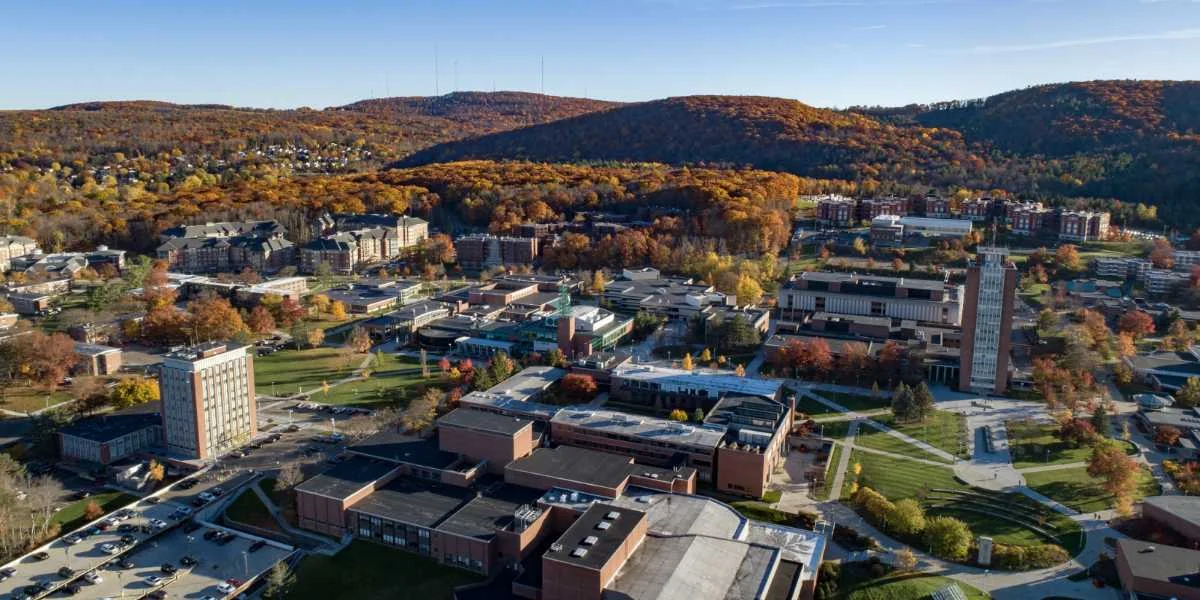
Binghamton University currently comprises 6 undergraduate colleges and 3 graduate schools. The university has achieved notable distinction in sustainability and environmental studies and is home to an internationally recognized environmental research center. Through advanced research facilities and interdisciplinary collaboration, the university has conducted extensive innovative research in environmental science and sustainable technology. Binghamton University's distinctive educational model emphasizes combining practice with theory and is designed to cultivate students' independent thinking and problem-solving abilities. The curriculum not only covers a broad range of academic theory but also stresses practical application, enabling students to apply what they learn in the classroom to the real world through internships, research projects, and community service.
About the university
School data is compiled from public sources and may change. Confirm current tuition, deadlines and requirements with the university before applying.
At a glance
Alumni starting salaries
Student body
Most popular majors
Graduate programs
Data Analytics
Data Analytics
Program Overview
The Master of Science in Data Analytics at Binghamton University, State University of New York, gives students a comprehensive foundation in data analytics and a diverse, balanced skill set through instruction from leading faculty in management, computer science, statistics, systems science, and related fields, along with hands-on projects. Students experience experiential learning through applied projects in areas such as business, nonprofit organizations, and healthcare. Whether working independently or in student teams, program members have the opportunity to apply different analytics and methods to solve real data problems provided by corporate and organizational partners.
Degree Type
Master of Science in Data Analytics
Program Length
10 months
STEM Designation
Yes
Source: Binghamton University Master of Science in Data Analytics
Application Requirements
Language Requirements
International applicants must submit language test scores.
Minimum scores: TOEFL 80; IELTS 6.5 with no subsection below 5; Pearson PTE Academic 53; Duolingo 105
TOEFL institution code: 2535
Personal Statement
The MS in Data Analytics admissions committee asks applicants to provide the following in their personal statement:
One to two pages
Two or three courses from your previous degrees that you enjoyed and why
Details of analytics-related internships or work experience over the past few years
Anything unusual in your academic background, such as poor grades, and how you improved or prepared for graduate study
Career goals after completing the MS in Data Analytics
Academic Background
Applicants must hold a bachelor's or graduate degree and have a strong quantitative background.
Students from mathematics, statistics, or other applied sciences (business, economics, political science, engineering, etc.) are welcome to apply.
Applicants should have a grade point average of 3.0 or higher.
Applicants with at least two years of work experience in a business or industrial setting are especially encouraged to apply.
International applicants should have at least one year of work experience. Applicants with two or more years of work experience will receive priority consideration.
In addition to the program-specific requirements above, full application requirements can be found in the Application Requirements section of our website.
Sources:
Binghamton University INTERNATIONAL STUDENT REQUIREMENTS
Binghamton University MSDA Admission
Graduation Requirements
Credit Requirements
Students must complete 30 credits, including 6 core courses and 2 practicums.
Grade Requirements
Students must achieve a grade point average of at least 3.0 in all courses counted toward the degree in the Graduate School.
Practicum Requirements
The two practicums involve team-based data analytics projects carried out with real-world organizations. This ensures that students understand the course material through a problem-solving framework and lets them test their knowledge and skills through hands-on projects. Learn more about the projects at this link.
Sources:
Binghamton University ACADEMIC POLICIES AND PROCEDURES FOR GRADUATE STUDENTS
Binghamton University MSDA Curriculum
Curriculum
On-campus students can complete the program in about 10 months, starting in the fall semester and ending at the end of Summer Session I. Students are assigned a faculty academic advisor and must meet with the advisor each semester to review course progress, practicum placement, and career goals.
Fall
Course Course Code Credits Introduction to Data Analytics DATA500 3 Predictive & Inferentl Analytics DATA501 3 Machine Learning & Data Mining DATA502 3 Database & Lrg Data Respotries Data504 3 Winter
Course Course Code Credits Communicating & Visualizing Data DATA 580A 3 Spring
Course Course Code Credits Applied Optimization and Decision Analytics DATA 503 3 Analytics Practicum I DATA 510 3 Plus two electives; for more information about electives, contact msda@binghamton.edu.
Summer
Course Course Code Credits Analytics Practicum 2 DATA 511 3 Source: Binghamton University MSDA Curriculum
Career Development
The University's Fleishman Career Center provides students with skills and resources that build career confidence and prepare them to thrive in the workplace after graduation. From personalized one-on-one advising to a comprehensive online resource library available around the clock, the career center supports students at every step of their job search. Services include:
One-on-One Career Advising
Advising includes career and major exploration, resume and cover letter review, interview preparation and mock interviews, personal statement review, job and internship search navigation, graduate school applications, job offer negotiation, finding part-time jobs, finding internships, research and other opportunities, networking, and using LinkedIn.
Career Courses
The Fleishman Career Center designs and oversees four career development courses that give students career preparation skills and experience. These courses are designed by career advisors and then approved by a faculty-led academic committee to ensure they meet Binghamton University's rigorous academic standards. Each course targets students at a different stage of their career development journey.
Career Fairs and Recruiting Opportunities
The Fleishman Career Center holds job and internship fairs every semester. Students of all majors and class years are encouraged to attend these fairs and connect with representatives from organizations recruiting for jobs and internships. Even if students are not yet ready to apply for a job or internship, they are encouraged to attend career and internship fairs to explore career options, expand their professional network, and become comfortable interacting with employers.
Source: Binghamton University STUDENT SERVICES AND RESOURCES
Computer Science
Computer Science
Program Overview
The Computer Science program at Binghamton University, State University of New York is part of the Thomas J. Watson College of Engineering and Applied Science. This Master of Science program is designed for students with a strong background in computer science who wish to pursue research or professional practice. The program offers two tracks: Artificial Intelligence and Cybersecurity. In addition to the required professional core courses, students may choose electives in different areas according to their interests and career goals.
Degree Type
MS in Computer Science
Program Length
2 years
STEM Designated
Yes
Source: Binghamton University, State University of New York, MS in Computer Science
Application Requirements
Language Requirements
International applicants must submit language test scores.
Minimum scores: TOEFL 80; IELTS 6.5 with no subscore below 5; Pearson PTE Academic 53; Duolingo 105
TOEFL institution code: 2535
GRE
GRE is not mandatory; institution code: 2535
Academic Background
Applicants must hold a bachelor's degree in computer science or a related field. Applicants whose undergraduate degree is not in computer science must complete the following GAP courses:
(1) Complete the MATH calculus sequence up to Calculus II
(2) MATH 314 or equivalent — discrete mathematics
(3) CS 110 Programming Concepts & Applications (Python)
(4) CS 120 Programming & Hardware Fundamentals
(5) CS 220 Architecture from a Programmer's Perspective
(6) CS 240 Data Structures & Algorithms
(7) CS 320 Advanced Computer Architecture
(8) CS 350 Operating Systems
(9) CS 375 Design & Analysis of Algorithms
Note: Applicants cannot take these courses at Binghamton University (Binghamton's undergraduate courses are typically full).
In addition to the program-specific admission requirements above, full application requirements can be found in the Application Requirements section of our website.
Sources:
Binghamton University, State University of New York, INTERNATIONAL STUDENT REQUIREMENTS
Binghamton University, State University of New York, PROGRAM-SPECIFIC ADMISSION REQUIREMENTS
Graduation Requirements
Credit Requirements
All students must complete 31 credits.
Grade Requirements
Students must achieve a grade point average of at least 3.0 in all courses counted toward the degree in the Graduate School.
Academic Requirements
Students may choose the Project Option or the Thesis Option; students choosing the Thesis Option must write and defend a thesis.
Project Option:
Six electives approved by the student's advisor (ten courses total) and a 1-credit project developed and presented by the student.
Thesis Option:
Five electives approved by the student's advisor (nine courses total) and a 4-credit thesis written and defended by the student.
Sources:
Binghamton University, State University of New York, ACADEMIC POLICIES AND PROCEDURES FOR GRADUATE STUDENTS
Binghamton University, State University of New York, MS IN COMPUTER SCIENCE Curriculum
Curriculum Overview
All MSCS students must complete the 31 credits of graduate computer science coursework listed below. Students may choose to complete coursework in the Artificial Intelligence or Cybersecurity track.
Core Courses
Complete the following four core courses (12 credits total). Students are advised to complete these four core courses in their first two semesters.
Course | Course Code | Credits: Computer Architecture & Organ, CS 520, 3; Operating System, CS 550, 3; Programming Languages, CS 571, 3; Design & Analysis Comp Algorit, CS 575, 3
Electives
Course | Course Code: Social Media Data Science Pipeline, CS 515; Intelligent Mobile Robotics, CS 524; Internet of Things, CS 526; Mobile Systems Security, CS 527; Computer Networks and Data Communications, CS 528; Database Systems, CS 532; Information Retrieval, CS 533; Introduction to Data Mining, CS 535; Introduction to Machine Learning, CS 536. For more elective information, see the official website.
Career Development
The Watson Career and Alumni Connections Center at Binghamton University, State University of New York provides students with a variety of career support, including career development resources.
Handshake's hireBING
Schedule appointments with WCAC professionals, register for events and information sessions, apply for jobs and internships, and access a variety of professional development resources.
WCAC Student Google Drive
A one-stop shop for engineering resume and cover letter templates, interview guides, and various career-related resources.
WCAC Dropbox Form
Upload any of the following for professional review: resume, cover letter, LinkedIn URL, graduate school essay, or scholarship essay.
Mentor Match
An online platform connecting Binghamton University students with alumni to help them prepare for a successful future, navigate their careers, and perhaps explore new career paths.
Watson Career Foundations Micro-Credential
Build essential skills, advance your career, and improve your employability.
H1B Grader
Search H1B sponsors by company name, job title, city, and salary.
Big Interview
An online interview training system that allows students to record, review, and share their answers. It offers dozens of interview formats and more than 20 different industries/majors to choose from.
Yoodli
An online AI speech career coach that helps you improve your communication skills through personalized feedback.
For more resources, see the official website
Electrical and Computer Engineering
Electrical and Computer Engineering
Program Overview
The MS in Electrical and Computer Engineering at Binghamton University, State University of New York, has produced many outstanding graduates through its high-quality education and research programs. The program is designed to balance advanced theory with practical engineering knowledge, preparing students for professional practice or for continued study toward a doctoral degree. The culminating experience consists of a thesis or a project report; through these tasks, students have the opportunity to develop the ability to conduct independent state-of-the-art research and to present their research findings in written form.
Degree Type
MS in Electrical and Computer Engineering
Program Length
18–24 months
STEM Designation
Yes
Source: Binghamton University, State University of New York, MS in Electrical and Computer Engineering
Application Requirements
International applicants must submit language test scores.
Minimum scores: TOEFL 80; IELTS 6.5 with no subsection below 5; Pearson PTE Academic 53; Duolingo 105
TOEFL institution code: 2535
GRE
Not required, but recommended. Institution code: 2535
Personal Statement
2 to 3 pages describing why you are pursuing graduate study, your career aspirations, your particular interests in the field, and anything unusual in your background that may need explanation or that may be of interest to the graduate admissions committee.
Academic Background
Applicants must hold a bachelor's degree in electrical engineering, computer engineering, or a related field and must demonstrate through transcripts that they have previously completed coursework in the following: calculus, differential equations, computer programming, circuits, electronics, digital design logic, and laboratory experience.
Note: Qualified applicants with other backgrounds may be granted conditional admission until they meet the department's requirements for full admission.
In addition to the program-specific admission requirements above, complete application requirements can be found in the corresponding Application Requirements section of our website.
Sources:
Binghamton University, State University of New York, PROGRAM-SPECIFIC ADMISSION REQUIREMENTS
Binghamton University, State University of New York, INTERNATIONAL STUDENT REQUIREMENTS
Graduation Requirements
Credit Requirements
Students must complete 30 credits.
Grade Requirements
Maintain a minimum average grade of B in all graduate courses.
Academic Requirements
Thesis option: EECE 598 (3 credits) and EECE 599 (3 credits), and successfully pass the master's thesis defense.
Project option: EECE 598 (3 credits)
Source: Binghamton University, State University of New York, MS in Electrical and Computer Engineering
Curriculum Overview
Courses are structured across different areas and levels of breadth.
Focus Areas
Course | Course Code | Analog Circuit Design | EECE 501 | Power Systems: Equipment and Power Flow | EECE 502 | Electric Drives | EECE 503 | Power Electronics | EECE 504 | BioMEMS and Bioelectronics | EECE 505 | Mathematical Methods in Electrical Engineering | EECE 506 | Mathematical Methods in Computer Engineering | EECE 507 | More courses can be found in the course list on the official website.
The ECE department also offers many special-topics courses. Please consult faculty to determine the area of each special-topics course.
Breadth Courses
Two EECE courses in two areas outside the focus area.
Math Methods Course
EECE 506 Mathematical Methods in Electrical Engineering; or
EECE 507 Mathematical Methods in Computer Engineering; or
another graduate-level mathematical methods course approved in advance by the dean of the graduate school.
Elective Courses
Choose two courses (thesis option) or three courses (project option) from the following list:
Any regular EECE graduate course; and/or
EECE 597 Independent Study (may be used for all electives); and/or
regular graduate courses in other engineering, mathematics, and science departments
(with ECE approval*); and/or
regular graduate courses in the School of Management (with ECE approval)
Source: Binghamton University, State University of New York, MS in Electrical and Computer Engineering
Career Development
The university career center's career clusters are groups built around similar career paths, designed to help students easily explore various career options and organize their search. Joining a career cluster gives students exposure to a wide range of career fields, regions, and roles, and shows them the value of the transferable skills they gain inside and outside the classroom.
Career clusters connect students with relevant people, information, and resources to help them explore interests and opportunities within the cluster. The university currently has 7 career clusters in total.
Source: Binghamton University, State University of New York, Career Clusters
Public Administration
Public Administration
Program Overview
The Public Administration program at Binghamton University, State University of New York is accredited by the Network of Schools of Public Policy, Affairs, and Administration (NASPAA). The program partners with community organizations and aims to prepare students to become future leaders, innovators, and managers in public and nonprofit service. The MPA is a highly regarded professional degree that fully prepares students for management careers in public and nonprofit organizations. The program offers both a traditional two-year option and a one-year option, and the one-year option allows students to complete half of their coursework online.
Degree Type
Master of Public Administration (MPA)
Program Length
2 years
Source: Binghamton University MPA
Application Requirements
Language Requirements
International applicants must submit language test scores.
Minimum scores: TOEFL 80; IELTS 6.5 with no subscore below 5; Pearson PTE Academic 53; Duolingo 105
TOEFL institution code: 2535
GRE
GRE is not required; institution code: 2535
Personal Statement
The personal statement should be no more than 500 words or two double-spaced pages and should answer the following question: "Why do you want to pursue an MPA?"
Binghamton University encourages you to describe your reasons for pursuing graduate study in public administration, your career aspirations, your special interests in the field, and anything unusual in your background that may need explanation or that the admissions committee in your field may find interesting.
When evaluating the personal statement, the graduate admissions committee assesses your commitment to public and/or nonprofit administration and your written communication skills.
In addition to the program-specific requirements above, full application requirements can be found in the Application Requirements section of our website.
Sources:
Binghamton MPA Admission
Binghamton University INTERNATIONAL STUDENT REQUIREMENTS
Graduation Requirements
Credit Requirements
Students must complete 42 credits.
Grade Requirements
Students must achieve a cumulative GPA of 3.0 to graduate from the program.
Students must earn a grade of B or higher in all required (core) courses.
Internship Requirement
Students must complete an internship in a public or private nonprofit agency in a professional field of their own choosing.
Note: Students must complete 17 credits in the MPA program, receive a satisfactory mid-point evaluation, and obtain approval from the MPA faculty before they may begin the internship.
Sources:
Binghamton MPA curriculum
Binghamton University MPA
Curriculum Overview
The MPA curriculum totals 42 credits, including 7 core courses (25 credits), 12 credits of electives, a 2-credit internship course, and a 3-credit capstone experience course.
Core Courses
Course | Course Code | Credits: Research Design and Methods | PAFF 510 | 4; 21st Century Governance | PAFF 520 | 4; Foundations of Public Service | PAFF 521 | 4; Managing Info and Technology | PAFF 526 | 2; Budgeting and Financial Mgmt | PAFF 527 | 4; Evidence-based Decision Making | PAFF 528 | 4. Choose one:
Course | Course Code | Credits: Program Evaluation | PAFF 515 | 4; Performance Analysis | PAFF 516 | 4; Intro to Policy Analysis | PAFF 523 | 4; Managing People | PAFF 524 | 4. Choose one:
Course | Course Code | Credits: Project Management | PAFF 532 | 3; Human Resource Mgmt: Pub/NonPf | PAFF 534 | 3; Organizational Theory | PAFF 535 | 3; Managing Networks | PAFF 536 | 3. Specialization or Electives (12 credits)
The Department of Public Administration and Policy offers two certificates/specializations:
Nonprofit Management & Leadership
Local Government Management & Leadership
The department also has established connections with Social Work, Higher Education and Student Affairs, Education, Sustainable Communities, the School of Nursing (for students interested in health policy management), and the Department of Geography (for students interested in environmental policy). In addition, students have the opportunity to choose elective courses from other graduate academic departments that suit their professional academic interests.
Recommended courses for students interested in sustainable communities:
SUST 500
SUST 510
Any one SUST elective
Any other electives needed to complete the 12 credits. (Please note that SUST 500 and 510 are both four-credit courses.)
Applied Learning
PAFF 594 Internship
Capstone Experience/Competency Demonstration
PAFF 589 The Reflective Practitioner
Basic Skills Courses
Students may complete one or more basic skills courses during their MPA studies (PAFF 502: Basic Computer Skills; PAFF 503: Introduction to Administrative Systems). In addition, the MPA faculty strongly encourages all students who receive feedback that their background or skills need development to apply to take these courses. These courses do not count toward the MPA degree, and each course may be taken only once.
Non-Matriculated Study
Non-matriculated students may take up to 12 credits, although some departments further limit this credit allowance. Departments may also restrict non-matriculated students who are applying for a degree or certificate from taking their courses. Degrees, certificates, and graduate assistantships are not awarded to non-matriculated students.
Source: Binghamton MPA curriculum
Career Development
The University's Watson Career and Alumni Center provides students with a variety of job opportunities and guidance. The career center recommends that students meet with staff for resume and cover letter reviews, mock interview practice, job/internship search assistance, and more. Attend career and alumni networking events, use networking to meet professionals in fields of interest, and participate in the Watson Career Fair and the Job and Internship Fair.
The University also offers a variety of career resources for international students. Recruitment-related events held by the University include industry visits, employer recruitment events, and career development workshops. The WCAC office can also help students prepare for their job search through one-on-one advising. You can schedule an appointment with employment services staff on hireBING through Handshake.
Source: Binghamton University EMPLOYMENT OPPORTUNITIES
Teaching English to Speakers of Other Languages (TESOL)
TESOL
Program Overview
The TESOL graduate program at Binghamton University, State University of New York is designed to meet the needs of global students and certified teachers who are passionate about education. Graduates of the program earn a Master of Arts in TESOL and are able to teach English as a second language/foreign language at higher education institutions worldwide. The program is also suitable for international students, including adult EFL programs in higher education or private English programs. The program offers a diverse learning environment where students from different countries can share experiences and expand their knowledge and skills through the program.
Degree Type
Master of Arts (MA) in TESOL
Program Length
18 months
Source: SUNY-TESOL-Program Overview
Application Requirements
Language Requirements
TOEFL iBT: minimum 80, MyBest scores accepted, available at test centers, as the Home Edition, or as the Paper Edition.
TOEFL Essentials: minimum 9, MyBest scores accepted.
IELTS: minimum overall band 6.5, with no subsection below 5.0, online test accepted.
Pearson PTE Academic: minimum 53, online test accepted.
Duolingo English Test: minimum 105.
Exemption Requirements
The applicant is a citizen or permanent resident of a country on the exemption list where English is an official language and the language of instruction. The applicant should have earned (or have earned) a bachelor's degree or higher from an institution in a country on the exemption list. The applicant has completed at least two years of full-time study at an accredited higher education institution in a country on the exemption list where English is an official language and English is also the language of instruction. The applicant is a current Binghamton University student.
Countries eligible for exemption are limited to the following: the United States, the United Kingdom (England, Northern Ireland, Scotland and Wales), Ireland, Australia, New Zealand, Ghana, Liberia, Kenya, Nigeria, Sierra Leone, Uganda, Zimbabwe, Namibia, Botswana, Zambia, Malawi, Gambia, Tanzania and some Canadian provinces.
Academic Requirements
Official transcripts from all university study. A cumulative undergraduate grade point average of at least B (3.0 on a 4.0 scale).
Personal Statement
Please write a 2-3 page essay, double-spaced, addressing the following three topics:
Your academic and professional background related to TESOL
Your reasons for applying to the TESOL master's program at Binghamton University
Your educational and career goals after graduate school
In addition to the program-specific application requirements above, the complete application requirements can be found in the corresponding [Application Requirements] section of our website.
Source:
SUNY-TESOL-Application Requirements
SUNY-TESOL-International Student Application
Graduation Requirements
Credit Requirements
You need to complete 33 credits.
Thesis Requirement
TESOL students take an advisor-supervised capstone course in their final semester. The capstone course provides a unified research foundation for completing the final research project.
Source: SUNY-TESOL-Program Overview
Course Introduction
Course Course Number Credits Foundations of Bilingual & Multicultural Education EDUC 504 3
Grammar for English Teachers EDUC 529 3
Linguistics for Teachers EDUC 581 3
Second Language Acquisition EDUC 583 3
Methods & Assessment for ELLs EDUC 584 3
Global Contexts for TESOL EDUC 585 3
L2 Reading, Writing & Technology 3
Content-Based ESL Curriculum & Instruction EDUC 588 3
Internship in TESOL EDUC 591 3
TESOL Capstone Project or Thesis EDUC 595 3
Source: SUNY-TESOL-Program Overview
Career Development
The TESOL program currently offers a new international internship opportunity in South Korea through the EPIK (English Program in Korea) Plus program. The program provides a paid learning opportunity for individuals interested in teaching English in South Korea.
Source: SUNY-TESOL-Program Overview
Campus life
Transportation
Nearby Airport
Greater Binghamton Airport
Distance from campus: 11.1 miles
Trip from campus to the airport:
Driving/rideshare:
Under normal conditions, the trip takes about 15 minutes. It may take longer when traffic is heavy.
City Public Transportation
Binghamton University is located in Binghamton, New York, and a range of public transportation options nearby gives students, faculty, and staff convenient ways to get around. The main public transportation options are listed below:
OCCT (Off-Campus College Transport): This is the free bus service that Binghamton University provides for students, covering multiple locations on and off campus. OCCT bus routes include service to downtown, shopping centers, the train station, and other major destinations. Students simply show their student ID to ride free of charge.
BC Transit (Broome County Transit): Broome County Transit is the public bus system for the city of Binghamton and the surrounding area. BC Transit bus routes cover a wide area, including service to downtown Binghamton, surrounding communities, and other important destinations. Students can buy a bus pass or pay the fare in cash.
Campus Shuttle: Binghamton University provides an on-campus shuttle service that helps students move conveniently between different buildings and residence halls on campus. The shuttle service generally runs on fixed routes and schedules, ensuring that students can easily reach classes and other campus facilities.
Safety
The safety of students and the entire campus community is Binghamton University's top priority, and the university has established comprehensive plans and procedures to help every member of the university community stay safe. The university's safety efforts touch every aspect of students' daily lives, whether in residence halls, classrooms, dining halls, offices, or on and off campus.
Safety in Residence Halls
All residence hall doors are locked 24 hours a day and require a key card swipe. Secure access phones are located outside the main entrance of each residence hall. Guests, visitors, or delivery personnel can call the student to let them know they are waiting outside the lobby. Residents are responsible for greeting such callers and escorting them while they are in the building. Residence life staff are trained to recognize safety issues among roommates, floor mates, friends, classmates, and others and to seek solutions, as well as to respond properly to emergencies. They work closely with residence directors and Binghamton University's Office of Residential Life, the University Counseling Center, University Police, Environmental Health and Safety, Emergency Management, Emergency Medical Services, and local first responders.
Safety on Our Campus
From midnight to 5 a.m., all gates except the main campus entrance are closed to vehicle traffic. 82 highly visible blue light phones are located outdoors throughout campus; these phones connect users directly to University Police. Several areas on campus, including the women's locker room, are equipped with emergency alarm buttons that provide direct, immediate contact with University Police.
Safety Crossing Campus
An on-campus escort service is available to all members of the university community 24 hours a day, 365 days a year, simply by calling University Police.
Safety Communications in Emergency Situations
Binghamton uses an alert system (B-Alert) to send text messages to cell phones. The system is used for emergency purposes only, and you will not receive any messages other than official Binghamton University communications. Electronic message boards at the main campus entrances and in dining facilities can display emergency information to students. Messages can also be sent to student listservs, on B-Line, and posted to the university homepage. In addition, during an emergency, a toll-free phone line is dedicated to updating outside audiences and to contacting outside media and keeping them updated.
Safety Programs for Students
University Police offer safety programs throughout the academic year, including self-defense, crime prevention, and drug and alcohol education. Many campus offices offer educational programs on issues such as alcohol and other drug abuse, fire safety, other aspects of personal safety, and related topics.
Safety Support Services
University Police hold full authority and are trained state law enforcement officers who can meet the unique needs of a university campus. They work with residential colleges and faculty, staff, and students across campus to promote awareness and deliver education on crime prevention. Several university offices, including the University Counseling Center, provide student support services to help students resolve conflicts with other students, stressors, and personal issues.
Housing
At Binghamton, the university's residential communities help students connect with friends and have fun while learning. Whether it's playing in a Saturday flag football game or joining a study group with friends in the lounge, you can build connections in any of the halls. Students can choose from six residential communities, each with its own traditions, style, and personality.
Residential Communities
College-in-the-Woods
Dickinson Community
Hinman College
Mountainview College
Newing College
Apartments Community
On-Campus Housing Application Steps
First-Year/Transfer Students
Complete the online application and create a group
When searching for roommates in the housing portal, you can only find and pair with others who have selected the same housing type. To register together, you must select each other in the portal to form and verify your group. Once formed, the group leader will verify the group by clicking the Verify Group button on the roommate selection page. This must be done by midnight the night before your room selection time slot. Remember that you are not considered to be in a group with someone until the group is formed in the portal. Whoever has the earliest time slot should be the group leader. The group leader will provide housing for everyone in the group. To change the group leader, the current leader must return to the group formation page in the portal and make the change. Pairing roommates or forming a group does not guarantee room availability or the total number of spaces needed. Even if you are part of a group, you may need to log in to select a room as an individual, so be prepared.
Select a Room
When selecting a room, you will only see rooms that match your housing type. Before you begin room selection, you can return to the housing application to change your housing type. Once you have selected a room, the room cannot be changed again until the room change process begins at the start of the fall semester.
Dining
The university offers 4 dining halls and multiple cafés, restaurants, and more.
University Dining Halls
Appalachian Dining Hall
Items served at Appalachian Dining Hall include student favorites such as Ben & Jerry's milkshakes, beef and tofu Philly cheesesteaks, taco salad bowls, hot dogs with a variety of toppings, weekend pancakes and French toast, and more. The menu changes daily.
C4 Dining Hall
C4 Dining Hall's daily rotating, nutritionally balanced menu offers a variety of classic and trendy dishes, including daily vegan and vegetarian options, custom Boar's Head deli sandwiches, a make-your-own salad bar, a rotating pizza and pasta menu, and desserts made in-house by the campus bakery.
CIW Dining Hall
CIW Dining Hall serves favorites such as cheeseburgers, grilled chicken sandwiches, and Beyond Burgers.
For more information, read the dining hall list.
Meal Plan
Binghamton University's meal plans offer the ultimate in convenience and flexibility. With your meal plan, you can dine freely anywhere on campus, anytime. The university requires all students living on campus to purchase a resident dining plan, except students living in the Hillside and Susquehanna communities. It works like a debit card. Each time you purchase a meal at a dining location, the amount is deducted from your account balance. Dining Dollars can be used anytime, anywhere. The cost of your meal plan consists of two parts:
Membership Fee - This covers the non-food costs associated with operating the four residential dining halls (Appalachian, C4, CIW, and Hinman). This includes labor, supplies, maintenance, utilities, and paper.
Dining Dollars - The amount available for purchasing food; this varies based on the meal plan you choose.
Resident Meal Plans
Meal PlanMembership FeeDining DollarsCostPlan A2063/semester1281/semester3344/semesterPlan B2063/semester1141/semester3204/semesterPlan C2063/semester1000/semester3063/semesterPlan D2063/semester882/semester2945/semesterPlan E2063/semester792/semester2855/semesterPlan F2063/semester577/semester2640/semesterCommuter Meal Plans
Meal PlanMembership FeeDining DollarsCostCommuter Annual 375/year400/year775/yearCommuter Semester 200/semester200/semester400/semesterThe 25 Plan027.5/year25/year
Admissions
Admissions data
Application requirements

Application checklist
Application deadlines
Transfer requirements
Transfer checklist
Transfer deadlines
Similar universities
Admissions FAQ
What is the acceptance rate at Binghamton University--SUNY?
The reported acceptance rate is 38%. Acceptance rates vary by applicant pool and application cycle; confirm the current figure with Binghamton University--SUNY.
What SAT scores does Binghamton University--SUNY expect?
The reported SAT range is 1320-1490. Test-optional and score-reporting policies can change by application cycle; check the university's official admissions page before applying.
When is the application deadline at Binghamton University--SUNY?
The listed Regular Decision deadline is Rolling. Deadlines can vary by program and application cycle; confirm the exact date with the university.
How much does Binghamton University--SUNY cost?
The listed tuition and fee figure is $18,809. Costs vary by residency, programme and academic year; confirm current costs with the university.
Where is Binghamton University--SUNY located?
Binghamton University--SUNY is located at 4400 Vestal Parkway East, Vestal, NY, 13850-6000.
Planning your application?
Build a school list around your profile.
Ivy Elite advisors help students compare programs, plan coursework and prepare applications for U.S. universities.