


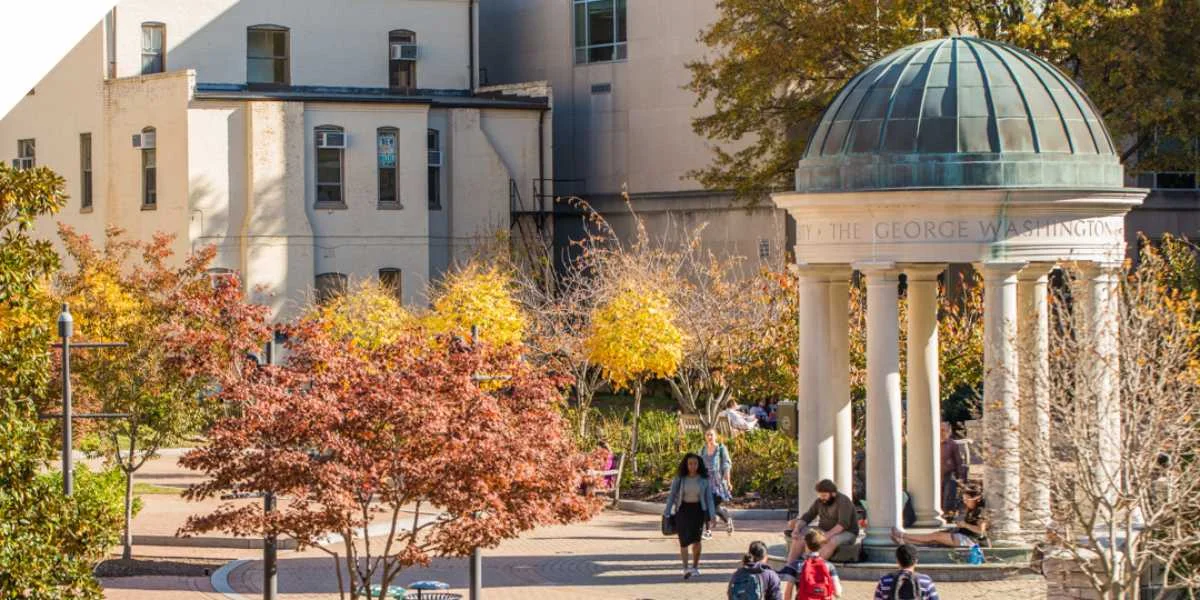
George Washington University (GWU) offers a diverse range of colleges, including 10 undergraduate colleges and 14 graduate schools, covering a broad array of academic disciplines. As a global research university located in the U.S. capital, GWU enjoys a strong reputation in international affairs, political science, public policy, and related fields, and its academic reputation and influence are widely recognized internationally. The university maintains close ties with government, nonprofit organizations, and industry, giving students abundant opportunities for hands-on experience and career development. Through internships, research projects, volunteer work, and similar activities, students can connect their studies with real-world work settings, building practical skills and professional capabilities that prepare them for future careers. In addition, GWU's location in Washington, D.C., offers an advantageous setting and a rich, diverse academic environment. Students can take advantage of this opportunity to participate in activities related to politics, international affairs, social service, and more, interacting with people from different backgrounds and fields, broadening their perspectives and enriching their experience as they build a solid foundation for becoming global citizens and future leaders.
About the university
School data is compiled from public sources and may change. Confirm current tuition, deadlines and requirements with the university before applying.
At a glance
Alumni starting salaries
Student body
Most popular majors
Graduate programs
Business Analytics
Business Analytics
Program Overview
Launched in 2013, the George Washington University (GW) School of Business Master of Science in Business Analytics (MSBA) program is designed to equip students with analytics and consulting skills applied in real-world settings so they can make data-driven decisions more effectively. The program partners with leading analytics organizations such as IBM and Deloitte to develop and strengthen a rigorous and balanced curriculum spanning technical, quantitative and qualitative skills for effectively developing, deploying and communicating business analytics solutions. The curriculum uniquely combines a range of analytical methods, electives in application areas, soft skills and technologies (SAS tools, R, Python, SQL, no-SQL, and others).
A highlight of the program is a practicum in which students work in teams with peers to apply their expertise to real business challenges sponsored by partner industry organizations.
GW also offers students Combined Degree Options. Students can combine the degree with a bachelor's degree through GWSB's new 4+1 program, enabling them to complete both the bachelor's and master's degrees in five years. For 4+1 program options, eligibility and degree pathways, see the 4+1 program page.
Degree Type
Master of Science in Business Analytics
STEM Program
Yes
Application Requirements
GW follows a rolling admissions policy and strongly recommends that applicants submit their applications early. Admission decisions are influenced by factors such as the applicant's academic background, grade trends, personal achievements and letters of recommendation.
Personal Background
A bachelor's degree from a regionally accredited college or university
Strong academic performance
Demonstrated professional interest in business analytics
GRE/GMAT
The GW MSBA does not require applicants to take the GRE or GMAT. However, if you believe submitting scores would strengthen your application, the GW School of Business welcomes your scores.
Statement of Purpose
In no more than 500 words, describe how this program aligns with your professional life and career goals.
In addition to the program-specific application requirements above, the complete application requirements can be found in the [Application Requirements] section of our website.
Graduation Requirements
Credit Requirements
You must complete 30 credits, including 21 credits of required courses and 9 credits of elective courses.
Grade Requirements
Achieve a cumulative grade point average (GPA) of at least 3.0 at graduation.
Complete all degree requirements within five years.
Curriculum
Required Courses
Course | Course Number Analytics Edge and Data Ethics | DNSC 6301 Programming for Analytics I | DNSC 6302 Programming for Analytics II | DNSC 6303 Data Management for Analytics | DNSC 6305 Decision Models | DNSC 6306 Optimization I | DNSC 6307 Stochastic Foundation: Probability Models | DNSC 6311 Statistics for Analytics I | DNSC 6312 Statistics for Analytics II | DNSC 6313 Machine Learning I | DNSC 6314 Machine Learning II | DNSC 6315 Business Analytics Practicum | DNSC 6317 Electives
Select 9 credits from the following elective courses
Course | Course Number Big Data Analytics | DNSC 6278 Supply Chain Analytics | DNSC 6280 Special Topics | DNSC 6290 Optimization II | DNSC 6308 Time Series Forecasting for Analytics | DNSC 6319 Pricing and Revenue Management | DNSC 6320 Social Network Analytics | DNSC 6321 Visualization for Analytics | DNSC 6323 Business Process Simulation | DNSC 6325 Sports Analytics | DNSC 6327 Responsible Machine Learning | DNSC 6330
Career Development
The GW Master of Science in Business Analytics program has a Corporate Advisory Board composed of representatives from leading U.S. analytics firms and organizations. This group is dedicated to supporting business analytics, advising on the development of the MSBA program, helping students complete the practicum, and providing career development and networking opportunities. The current Corporate Advisory Board includes representatives from IBM, Deloitte, Elder Research Group, Attain, NIH, Catalist and the U.S. Department of the Treasury. Their professional experience enriches students' learning experience.
Popular Data and Analytics Roles
Analyst and Planner
Business Analytics and Optimization Consultant
Business Case Modeling Analyst/Consultant
Business Intelligence Analyst
Data Scientist
Decision Science Analyst
Internal Quantitative Marketing Strategy Consultant
Modeling and Analytics Manager
Pricing and Revenue Optimization Analyst
Project Manager/Promotion Response Analytics
Quantitative Analyst - Asset Allocation
Quantitative Analyst - Insurance Risk
Quantitative Marketing Solutions Director and Manager
Quantitative Modeler
Quantitative Research Analyst
Industries with the Highest Adoption of Big Data and Analytics
Finance
Healthcare
Human Resources
International Business
Marketing
Operations
Scientific Solutions
Security and Fraud Detection
Strategy
Supply Chain Management
Tourism
Source: MSBA Careers & Employment
Source for the entire article: GW Master of Science in Business Analytics
Finance
Finance
Program Overview
The Master of Science in Finance (MSF) program at the George Washington University (GW) School of Business is designed to develop leaders in finance. Through a comprehensive and in-depth curriculum, students gain the expertise and practical skills needed to succeed in complex financial environments. The program's coursework leans toward financial engineering, banking, risk management, banking, corporate finance, and portfolio analysis and management, with an emphasis on combining quantitative and computer skills with financial theory and application. The MSF program is now a STEM program, further underscoring its focus on science, technology, engineering, and mathematics. This enables students to better integrate technical and financial knowledge and enhances their competitiveness in the evolving finance field.
Degree Type
MS in Finance (MSF)
Program Length
Intensive Track (12 months): Complete the degree requirements within 12 months, including one summer session.
Regular Track (24 months): Designed for working professionals, including two summer sessions.
STEM Designation
Yes
Application Requirements
Background
A bachelor's degree from a regionally accredited college or university, with completed coursework in the following subjects:
Advanced Mathematics (6 credits; three of which must be in calculus)
Microeconomics (3)
Macroeconomics (3)
Financial Accounting (3)
Managerial Finance (3)
Statistics (3)
Additional coursework, degrees, and/or work experience in these five areas will be given preference in the selection process.
Strong academic record
Demonstrated interest in the finance profession
Statement of Purpose
Write no more than 500 words describing how the program aligns with your professional life and career goals.
In addition to the program-specific requirements above, full application requirements can be found in the Application Requirements section of our website.
Graduation Requirements
Credit Requirements
You must complete 48 credits.
Grade Requirements
Students must successfully complete the following course and program requirements and achieve a cumulative grade point average of at least 3.0 at graduation to be eligible for the Master of Science in Finance degree.
Course Information
Students with a strong background in a given subject area may request a waiver of a required course and substitute an elective approved by the program director.
All courses are 4 credits and last one semester (14 weeks). The summer term is mandatory for MS candidates, and all four-credit courses run for one semester (12 weeks).
Required Courses
CourseCourse Title (English)Course NumberFinancial Modeling and EconometricsFINA 6271Global Financial MarketsFINA 6272Cases in Financial Management and Investment BankingFINA 6273Corporate Financial Management and ModelingFINA 6274Investment Analysis and Global Portfolio ManagementFINA 6275Financial Engineering and Derivative SecuritiesFINA 6276Comparative Financial Market Regulation and DevelopmentFINA 6277Financial Theory and ResearchFINA 6278Real Estate Finance and Fixed-Income Security ValuationFINA 6279Financial Institution Management and ModelingFINA 6280Cases in Financial Modeling and EngineeringFINA 6281Advanced Financial Econometrics and ModelingFINA 6282
Career Development
MSF graduates typically find employment at the most prestigious financial institutions, including Goldman Sachs, Morgan Stanley, Merrill Lynch, and Wells Fargo. In addition, GWSB's unique location in Washington, DC offers MSF graduates opportunities to work at renowned and highly attractive international financial institutions such as the World Bank, the International Monetary Fund, the International Finance Corporation, and the Inter-American Development Bank. GW graduates have also found positions at many government agencies, including the Federal Reserve and the U.S. Department of the Treasury, and at private financial firms such as Freddie Mac and Fannie Mae.
To promote employment for the program's graduates, the GW School of Business actively engages with a wide range of financial institutions through faculty, alumni, and administrative offices:
Posting job openings
Arranging interviews
Creating demand for MSF graduates
In addition, George Washington University maintains a resume database for prospective employers, organizes career workshops to help students prepare for job searches and interviews, and offers a variety of career services in partnership with the F. David Fowler Career Center. Finally, as a member of the International Association of Financial Engineers (IAFE), George Washington University organizes student trips to New York for the Financial Mathematics Career Fair.
To further promote internships and full-time employment, the MSF program produces a resume book each year featuring the resumes of current students seeking new job opportunities.
Source: GW MS in Finance (MSF)
Computer Science
Computer Science
Program Overview
The George Washington University Computer Science program is designed to help students develop advanced programming and coding skills across a range of areas, including artificial intelligence, graphics and user interfaces, and cloud computing. Taught by faculty from top institutions and the growing technology industry, the program provides rigorous foundational training in computer science and offers students the opportunity to take courses that address modern technological problems in areas such as algorithms and theory, computer architecture, networks, parallel and distributed computing, computer security and information assurance, database and information retrieval systems, machine intelligence and cognition, multimedia, animation, graphics and user interfaces, and software engineering and systems.
Degree Type
Master of Science in Computer Science
Program Length
Two years (full-time) or three years (part-time)
Source: GW Master of Science in Computer Science
Admission Requirements
Background
A bachelor's degree in any major, with coursework in the following areas:
Mathematics: two courses beyond the pre-calculus level
Lab science: one year of coursework
Computer science: prerequisite coursework in structured languages, discrete structures, data structures, or computer architecture
GPA Requirement
A GPA of at least 3.0 (on a 4.0 scale) or equivalent in the last 60 credits of undergraduate coursework.
Language Requirement
All applicants must take the TOEFL, IELTS, or PTE Academic exam.
Applicants are exempt if they hold a bachelor's, master's, or doctoral degree from a U.S. university or a university in a country where English is an official language. Minimum scores:
IELTS Academic: overall 6.0 with no individual band below 5.0; applicants seeking funding must achieve an overall score of 7.0 with no individual band below 6.0; or
TOEFL: 550 on the paper-based test or 80 on the internet-based test; applicants seeking funding must achieve 600 on the paper-based test or 100 on the internet-based test; or
PTE Academic: 53; applicants seeking funding must achieve 68.
Statement of Purpose
You need to write a 250- to 500-word essay. In this essay, you should state your purpose in pursuing graduate study at George Washington University; describe your academic goals, research interests, and career plans; and discuss your relevant qualifications, including university, major, and community activities, as well as other substantive achievements not mentioned elsewhere.
In addition to the program-specific requirements above, full application requirements can be found in the corresponding [Application Requirements] section of our website
Source: GW Master of Science in the Field of Computer Science Admission
Graduation Requirements
Credit Requirement
You must complete 30 credits.
Thesis option: includes 9 credits of required courses and 15 credits of elective courses, plus 6 credits of thesis.
Non-thesis option: includes 9 credits of required courses and 21 credits of elective courses.
Of the 30 credits required for the degree, at least 24 credits must be in courses at the 6000 level or above.
Any course below the 6000 level must be approved in writing by the advisor in advance.
Thesis Requirement
There are two options: thesis and non-thesis.
Thesis Option:
Coursework will be replaced by research credit courses.
Master's thesis advisor and co-advisor:
Each master's thesis must be supervised by a faculty member who is either: (1) a regular full-time faculty member at GW with a primary or secondary appointment in the Department of Computer Science; or (2) a research faculty member in the Department of Computer Science.
In addition to the thesis advisor, master's students may have one or more co-advisors, who may be full-time or part-time GW faculty or outside professionals. Co-advisors should hold at least a master's degree.
Non-Thesis Option: additional courses will fulfill the remaining credits.
Source: GW Master of Science in the Field of Computer Science (STEM)
Course Information
Required Courses
Course | Course Number | Design and Analysis of Algorithms | CSCI 6212 | Advanced Software Paradigms | CSCI 6221 | Computer System Architecture | CSCI 6461 | Electives
Students choosing the thesis track must complete 15 credits
Students choosing the non-thesis track must complete 21 credits
Unless a student's admission letter states that CSCI 6010 and CSCI 6011 are required, students may take up to 6 credits of non-CSCI courses with the prior written approval of their advisor.
Students who must take CSCI 6010 and CSCI 6011 may not take any non-CSCI courses as part of their program requirements. Such students are strongly advised to take CSCI 6010 and CSCI 6011 in their first semester.
Thesis
Students choosing the thesis track must take the following courses, form a thesis committee, and complete a thesis defense.
CSCI 6998 Thesis Research
CSCI 6999 Thesis Research
Source: GW Master of Science in the Field of Computer Science (STEM)
Career Development
After graduation, students will have comprehensive computer science knowledge that lays the foundation for future career development in the technology industry.
In addition, students will gain up-to-date industry knowledge, receive professional career guidance, and find job opportunities through professional organizations:
Association for the Advancement of Artificial Intelligence (AAAI) - aaai.org
Association for Computing Machinery (ACM) - acm.org
Association for Women in Computing (AWC) - awc-hq.org
Computing Research Association (CRA) - cra.org
International Association of Computer Science and Information Technology (IACSIT) - iacsit.org
Source: GW SEASCareers
Public Administration
Public Administration
Program Overview
The Public Administration program at George Washington University is dedicated to preparing students to become leaders in public service. In the areas of management and leadership, the Trachtenberg School offers MPA students a challenging curriculum that ensures they are prepared to lead. Throughout the program, MPA students apply what they learn to organizations and government agencies. In addition, by working with public-service clients, students have the opportunity to test theoretical knowledge and to keep learning through practice.
Degree Type
Master of Public Administration
Application Requirements
GRE
Students applying to the Trachtenberg School are not required to take the Graduate Record Examination (GRE). The current application form has no space for entering GRE scores. If you believe these scores would supplement your application, you may have your test scores from the past five years sent directly from ETS to GW, and they will be added to your file (code 5246). For a better understanding of how your scores may affect your application, contact tsadmit@gwu.edu.
Statement of Purpose
This is your opportunity to communicate your message to the admissions committee. In addition to the other information you provide in the application (including your resume), you may provide any information you would like the admissions committee to consider.
In an essay of 250-500 words, state your purpose in pursuing graduate study in your chosen field. Include your academic goals, research interests, and career plans. In addition, discuss your relevant qualifications, including university, major, and community activities, as well as any other significant achievements not mentioned in the application or resume/CV.
Language Scores
If you are a citizen of a country where English is not an official language, you must submit TOEFL scores; an exception applies if you hold a degree from a college or university in a country where English is an official language and the language of instruction. Supporting transcripts must be submitted for this exception.
The Trachtenberg School recommends:
Minimum TOEFL scores are: 637 on the paper-based test, 270 on the computer-based test, and 100 on the Internet-based test. TOEFL scores must be no more than two years old. George Washington University's ETS reporting code is 5246.
As an alternative to the TOEFL, students may submit Academic International English Language Testing System (IELTS) scores. The Trachtenberg School recommends a minimum Academic IELTS overall score of 7.0, with no individual band score below 6.0.
If you need a U.S. student visa and/or hold a bachelor's degree from a foreign institution, you must successfully apply to the graduate program in the Trachtenberg School of Public Policy and Public Administration in accordance with international admissions requirements.
In addition to the program-specific requirements above, the complete application requirements can be found in the corresponding Application Requirements section of our website.
Source: GW MPA Application Checklist
Graduation Requirements
Credit Requirements
You must complete 40 credits, including 25 credits of required courses, at least 9 credits in a selected policy field, and at least 3 credits of electives.
Course Information
Required Courses
CourseCourse Title (English)Course NumberPerspectives on Public ValuesPPPA 6000Introduction to Public Service and AdministrationPPPA 6001Research Methods and Applied StatisticsPPPA 6002Economics for Public Decision MakingPPPA 6003Managing Public OrganizationsPPPA 6004Public Budgeting, Revenue, and Expenditure AnalysisPPPA 6005Policy AnalysisPPPA 6006MPA/MPP CapstonePPPA 6008Public and Nonprofit Program EvaluationPPPA 6016Policy Field
Students complete at least 9 credits in a selected policy field.
FieldsBudget and Public Finance (graduate certificate possible)Education PolicyEnvironmental PolicyHealth PolicyHomeland Security and Emergency ManagementInternational DevelopmentManaging State and Local GovernmentsNational Security and Foreign PolicyNonprofit Management (graduate certificate possible)Politics, Policy and AdministrationProgram Evaluation and Policy AnalysisPublic-Private Policy and ManagementRegulatory PolicyScience and Technology PolicySocial PolicyUrban PolicyElectives
Electives require at least 3 credits.
Students should consult their advisor regarding policy fields.
Career Development
GW is committed to providing comprehensive career development support to students and alumni. The university's career development center offers resources including professional career advisors, a broad employer network, and an alumni community, providing lifelong career services to students and alumni. The school maintains a LinkedIn Group and a TSPPPA-specific jobs and internships section, and also offers personalized advising services, including career exploration at every professional level, resume review, LinkedIn advice, interview preparation, and salary negotiation.
Source: GW Lifelong Career Services for Students & Alumni
Source for the entire article: GW Master of Public Administration
Data Science
Data Science
Program Overview
The Data Science program at Georgetown Washington University is built on statistics, computer science, and mathematics, with an emphasis on making effective use of the wealth of information found in the natural and social sciences. Through an interdisciplinary curriculum and partnerships with outside institutions and organizations, students gain extensive hands-on experience. In their courses, students work with the latest analytical and data visualization tools and examine complex questions in depth, such as how to identify patterns in large volumes of data. The curriculum also covers machine learning and programming languages including Python, JavaScript, and R.
Degree Type
MS in Data Science
Application Requirements
Language Requirements
Graduate applicants who have not completed a higher education degree at a U.S. institution must submit official scores from TOEFL, IELTS, Duolingo, or PTE (Pearson Test of English Academic). For students taking the TOEFL, CCAS graduate programs will accept official scores from the standard TOEFL (ibT or pbT) or the TOEFL Home Edition. For more information about the tests, please visit the ETS website.
Applicants to graduate programs who have earned (or will earn before enrollment) an associate degree from an institution in a country where English is the sole language of instruction may be exempt from the English language proficiency requirement. Applicants seeking an English proficiency exemption may be required to complete an academic English course, which may increase their study time and costs.
You can visit GW's "International Applicant Requirements" page for more information about international students.
Statement of Purpose
The statement of purpose is typically an essay of about 250-500 words in which you explain your reasons for pursuing graduate study in your chosen field. The length and requirements of the statement of purpose depend on the program you are applying to. For more information, please visit the page for your program on the GW Bulletin's Graduate Program Finder website.
In addition to the program-specific application requirements described above, the complete application requirements can be found in the [Application Requirements] section of our website.
Source: GW MS DS Application Components
Graduation Requirements
Credit Requirements
You must complete 30 credits, including 18 credits of required courses and 12 credits of electives.
Capstone Project
A highlight of the program, students must take a three-credit capstone course and apply the skills and knowledge they have gained in data analysis during their final semester. In the capstone, students work in teams to complete a practical application of data science principles. Capstone team projects are selected in consultation with the course instructor.
Curriculum
Required Courses Required
Course Course NumberIntroduction to Data ScienceDATS 6101Data WarehousingDATS 6102Introduction to Data MiningDATS 6103Data Science CapstoneDATS 6501Machine Learning I: Algorithm AnalysisDATS 6202Visualization of Complex DataDATS 6401Electives Electives
12 credits of DATS elective courses at the 6000 level or above.
Career Development
Graduate students and alumni of the Data Science program can contact career coach Melissa Feuer through Handshake for advice on job applications. Some employers offer recruiting opportunities for members of different groups, including women, people of color, LGBTQIA+ people, and people with disabilities. GW's Office of Diversity, Equity, and Community Engagement also has extensive resources, including tools for students.
GW offers students a job recruitment website
Apple Careers
Google Careers
Amazon Careers
Facebook Careers
Remote
FairyGodBoss
Angel
Idealist
MindSumo
WayUP
Association for Women in Science
ParkerDewey
Goinglobal
Chegg Internships
Climatebase
Hired
DataYoshi
Disability Solutions
Tech Nonprofit Job Board
Tech Jobs for Good
Source: GW MSDS Career
Sources for this article: GW MSDS
Campus life
Transportation
Nearby Airports
Ronald Reagan Washington National Airport (DCA)
Distance from campus: 4.2 miles
Campus to airport travel:
By car/rideshare:
Typically about 10 minutes. It may take longer during heavy traffic.
Public transit:
Take the Metro Blue Line directly to the airport, or take the Silver/Orange Line and transfer to the Blue Line.
Baltimore/Washington International Thurgood Marshall Airport (BWI)
Distance from campus: 34.9 miles
Campus to airport travel:
By car/rideshare:
Typically about 35-50 minutes. It may take longer during heavy traffic.
Public transit:
Take bus route 80, transfer to GreyHound US0305/Northeast Regional, and transfer to bus route 75/Shuttle.
Dulles International Airport (IAD)
Distance from campus: 24 miles
Campus to airport travel:
By car/rideshare:
Typically about 25-35 minutes. It may take longer during heavy traffic.
Public transit:
Take the Metro Silver Line directly to the airport, or take bus routes 33/32/36 and transfer to the Silver Line.
Nearby Train Stations
Washington Union Station
Campus to train station travel:
By car/rideshare:
Typically 15-20 minutes. However, it may take longer during heavy traffic.
Public transit:
Take bus routes GT-US/80 directly to the train station.
City Public Transportation
George Washington University is located in Washington, D.C., and is surrounded by a convenient public transportation system, mainly including:
Metro (subway system): There are several Metro stations near GWU, and students can use the Washington, D.C. Metro system to reach campus and various locations in the city. The closest Metro stations to GWU include Foggy Bottom-GWU, Dupont Circle, and Farragut West, which are on the Orange, Red, and Blue Lines.
Public bus service: The public bus system in Washington, D.C. is operated by the Washington Metropolitan Area Transit Authority (WMATA) and covers the entire district and surrounding areas. Students can use the public bus service to reach campus and various destinations in the city.
On-campus shuttle: GWU may provide on-campus shuttle service to help students move conveniently around campus, especially between different academic buildings.
Safety
The George Washington University Police Department (GWPD) maintains multiple fixed posts in administrative areas and residence halls on campus and also patrols the campus on foot, by bicycle, and by vehicle. GWPD officers are supported by Community Service Aides, who are students trained by GWPD to monitor residence hall access and maintain security in specific areas. GWPD provides 24/7 patrols and other services to the university community. It also enforces federal and local regulations as well as GW regulations.
Security Escort Services:
Safe ride options are provided for GW community members to and from locations on and around the Foggy Bottom campus. The service operates late at night and provides safe transportation between buildings on the GW Foggy Bottom campus.
Safety Measures:
Safe working conditions are important. Any unsafe conditions should be reported to your manager.
Fire Safety and Prevention:
The university has established standard procedures for fire emergency action plans that must be followed in the event of a fire. Each building has an evacuation plan. Staff should be familiar with the plan for their work area. Managers and/or floor coordinators should be able to address questions about building evacuation. The Office of Emergency Management, Health, and Safety can also assist with information about fire hazards, proper handling and storage, potential fire sources and their control procedures, fire equipment or systems, and identifying personnel responsible for maintaining fire prevention equipment.
Housing
At George Washington University, residence halls are environments that foster belonging, student success, personal growth, and a shared community. From traditional residence halls to apartment-style living, GW's residential life offers students the opportunity to experience it all. Students are eligible for housing by class based on the year they entered the university as undergraduates, not on the number of credits they have earned.
Residential Colleges
First-year students: Clark Hall, Cole Hall, Guthridge Hall, Hensley Hall, Madison Hall, etc.
Sophomores: 2109 F Street, Amsterdam Hall, The Dakota, District House, Lafayette Hall, etc.
Upperclassmen: 1959 E Street, Amsterdam Hall, The Dakota, District House, International House, etc.
For more information, please read the residence hall list.
On-Campus Housing Application Steps
First-Year/Transfer Students
Review the criteria for obtaining a residency requirement exemption
George Washington University requires all first- and second-year students to live on campus unless they are approved for an exemption from the residency requirement. If a first-year student believes they meet one of the seven criteria and wishes to live off campus, they may apply for an exemption from the requirement. Applying for an exemption does not guarantee that the exemption will be approved. Approved exemptions will remain valid for the remainder of the student's undergraduate career at George Washington University unless the exemption is waived as needed to allow the student to live on campus.
Complete the online application registration and sign the contract
Students need to indicate their personal living preferences through a series of scaled questions on important topics such as sleep schedule, room use, and cleanliness. If a student does not request a specific roommate, these answers will be used to assign roommates.
Students need to rank a list of 17 different first-year residence halls and room sizes from 1 to 17. This ranking preference list is used to assign students to the hall and room size as high on the list as possible.
Roommate Assignments
Students find each other and agree to live together. Students may choose to live with any other first-year student, regardless of gender, or students will be automatically assigned one or more roommates of similar gender. This roommate assignment uses the personal living preferences indicated in the student housing registration to match them with students who may have similar lifestyles or preferences, or
Students who want to live with any other student, regardless of gender, can participate in the gender-inclusive housing group. Students who wish to do so will indicate this in their housing registration and will be placed in a group of students who may be assigned to live with each other regardless of roommate gender or sex. Individual living preferences will be used to match roommates with others. Students participating in this gender-inclusive housing group should welcome and affirm all students' gender identities, sexual orientations, or other identities.
Current Students
Roommate Matching and Roommate Group Creation
Students are required to fill out the required housing profile information, complete the roommate matching questionnaire (even if you know who you want to live with), and can optionally search for roommates or create a roommate group.
Complete the Housing Registration
Students will rank a list of up to 26 residence halls, with 1 being the highest priority. This ranking preference list is used to assign students to the hall and room size as high on the list as possible. When ranking halls and room types as a roommate group, only the group leader's ranking list will be considered for housing assignment.
Dining
The university offers multiple dining locations and options to meet students' diverse needs.
On-Campus Restaurants
Chaat House
Curry, spices, and chutneys take center stage at Chaat House. The menu at Chaat House is inspired by regional Indian flavors and is divided into sections including snacks, bowls, and wraps.
Absurd Bird
Absurd Bird offers a retro fried chicken shack experience with rich, bold flavors.
The Eatery at Pelham Commons
The Eatery at Pelham Commons mainly offers grilled chicken, roasted vegetables, macaroni, etc.
For more information, please read the restaurant list.
Meal Plans
At GW, meal plans are designed to meet your unique needs and provide a complementary experience during your time at GW. With flexibility, convenience, and affordability in mind, the core mission of the dining team is to provide students with high-quality, nutritious food that is culturally diverse and allergy-friendly through state-of-the-art dining facilities and online services, as well as off-campus dining partners.
Meal Plan | Meals | Dining Dollars | Eligibility | Cost
All Access | 1/1h | 240/semester | All grades | 2940/semester
Vern All Access | 1/1h | 340/semester | Living in Mount Vernon | 2940/semester
Revolutionary 85 | 85 days unlimited | 840/semester | 2nd, 3rd, 4th year | 2940/semester
Block 175 | 175/semester | 500/semester | 3rd, 4th year | 2775/semester
Block 120 | 120/semester | 640/semester | 3rd, 4th year | 2200/semester
Block 90 | 90/semester | 1030/semester | 3rd, 4th year | 2200/semester
Commuter Block 50 | 50/semester | 200/semester | Non-residential students | 850/semester
Commuter Block 25 | 25/semester | 100/semester | Non-residential students | 425/semester
Admissions
Admissions data
Application requirements

Application checklist
Application deadlines
Transfer requirements
Transfer checklist
Transfer deadlines
Similar universities
Admissions FAQ
What is the acceptance rate at George Washington University?
The reported acceptance rate is 44%. Acceptance rates vary by applicant pool and application cycle; confirm the current figure with George Washington University.
What SAT scores does George Washington University expect?
The reported SAT range is 1350-1498. Test-optional and score-reporting policies can change by application cycle; check the university's official admissions page before applying.
When is the application deadline at George Washington University?
The listed Regular Decision deadline is Jan. 5. Deadlines can vary by program and application cycle; confirm the exact date with the university.
How much does George Washington University cost?
The listed tuition and fee figure is $16,920. Costs vary by residency, programme and academic year; confirm current costs with the university.
Where is George Washington University located?
George Washington University is located at 1918 F Street, NW, Washington, DC, 20052.
Planning your application?
Build a school list around your profile.
Ivy Elite advisors help students compare programs, plan coursework and prepare applications for U.S. universities.