Ivy Elite
Boston College

Boston College currently offers 30 undergraduate schools and 6 graduate schools. The university is known for its outstanding business school and law school, and it also excels in fields such as the liberal arts, sciences, and engineering. What sets it apart is a diverse campus atmosphere with a global outlook, preparing students to take part in community service and international exchange and dedicated to developing well-rounded global leaders.

About the university

School data is compiled from public sources and may change. Confirm current tuition, deadlines and requirements with the university before applying.

At a glance

Acceptance rate 16%
Tuition and fees $18,916
SAT range 1430-1540
Application deadline Jan. 2
Undergraduate enrollment 9,780
Student-faculty ratio 10:1
Location 140 Commonwealth Avenue, Chestnut Hill, MA, 002467
School type Private nonprofit (4-year) Roman Catholic
In-state tuition
702
Out-of-state tuition
$18,916
Room and board
$18,916
Graduation rate
88%
Student-faculty ratio
10:1
Gender ratio
47:54

Alumni starting salaries

Area, Ethnic, Cultural, Gender, and Group Studies
+
Biological and Biomedical Sciences
+
Business, Management, Marketing, and Related Support Services
+
Communication, Journalism, and Related Programs
+
English Language and Literature/Letters
+
Mathematics and Statistics
+
Health Professions and Related Programs
+
Physical Sciences
+

Student body

First-year diversity
White
59%
Hispanic
11%
Asian
12%
Black
5%

Inside the school

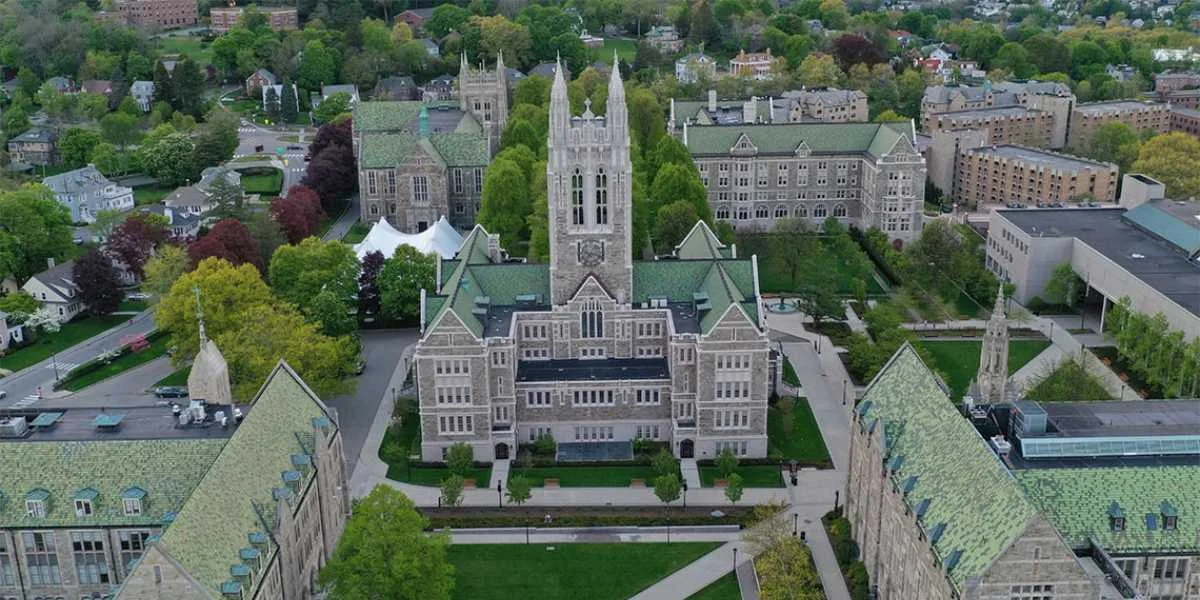
Boston College sits on the picturesque Chestnut Hill, where a collection of Gothic buildings gives the campus a distinctive English atmosphere and has earned it the nickname "Crown of the Hill." The school combines elite education with the resources of a comprehensive university, excelling in the liberal arts and humanities and social sciences, with a particularly outstanding business school. Because of its stained glass and architectural beauty, Bapst Library has been named one of the most beautiful university libraries in the United States. Boston College's core curriculum emphasizes interdisciplinary education and cultivates students' critical thinking and cultural understanding. As a strong athletics school, its Eagles compete actively in NCAA events. In addition, a powerful alumni network and abundant career resources give its graduates strong competitiveness in fields such as finance, consulting, and technology.

We will examine the distinctive appeal of Washington University from several angles, showcasing its core features and conveying its academic achievements and cultural character. Click the button below to view the full introduction to the school.

01. Location

02. Campus Environment

03. One of America's Most Beautiful Libraries

04. A Small, Elite School

05. Boston College's Distinctive Core Curriculum

06. Abundant Career Opportunities

07. A vast alumni network

08. One of America's standout schools in athletics and the arts

09. A top-ranked business school in the United States

10. A strikingly beautiful Catholic university

Most popular majors

Economics
13%
Biology/Biological Sciences
10%
Finance
7%
Computer Science
6%
Speech Communication and Rhetoric
6%
Developmental and Child Psychology
Registered Nursing
5%
Business Analytics
5%
Political Science and Government
4%
Psychology
4%

Graduate programs

Finance

Finance

Program Overview

The Finance program at Boston College equips students with enduring principles that run through financial markets and opens a wide range of career opportunities, building particular distinction in corporate finance, asset management, and investment banking. The curriculum emphasizes developing students' financial analysis skills so they can excel in workplaces such as corporate finance, asset management, and investment banking. Students also have the opportunity to apply to the Quantitative Finance track to further deepen their expertise and capabilities in finance.

Degree Type

M.S. In Finance

Program Length

12 months

STEM Designation

Yes

Source: Boston College MSF

Application Requirements

English Proficiency

If you are not a U.S. citizen or permanent resident, you must submit an English language proficiency test score with your application. TOEFL, IELTS, or PTE scores are accepted; the Duolingo English Test is not accepted. Scores must be from the past two years, and applicants must meet the following minimum score requirements:

TOEFL, iBT, and TOEFL iBT Home Edition: 100

IELTS: 7.5

PTE: 68

You may qualify for a waiver of the language test requirement if you meet any of the following conditions:

You have completed a four-year bachelor's degree or a two-year master's degree (or higher) at an institution where English is the language of instruction. You must have completed the entire degree program at an institution where English is the language of instruction. The language of instruction must be noted on the transcript or verified in an official letter from the institution.

You have worked full-time, post-degree, for at least two years in the United States or in a country or region where English is an official language. Note: working for a company that conducts business in English in a country or region where English is not an official language does not qualify for the language test waiver.

GRE/GMAT

Applicants must submit GMAT or GRE scores from the past five years. The GMAT and GMAT Focus Edition are both accepted. The test codes are:

GMAT school code: 44x-J5-96

GRE school code: 3033

Essays

All applicants must submit an essay of no more than 500 words describing your past experience, short- and long-term goals, and why you want to pursue a finance degree at Boston College. You may also submit an optional essay discussing aspects of your candidacy not covered elsewhere in your application.

In addition to the program-specific requirements above, the complete application requirements can be found in the Application Requirements section of our website

Source: Boston College MSF Application Requirements

Graduation Requirements

Credit Requirements

Students choosing the general Finance track must complete 10 courses, specifically 7 required courses and 3 elective courses

Students choosing the Quantitative Finance track must complete 10 courses, specifically 8 required courses and 2 elective courses

Internship Requirement

The Carroll School has a proud tradition of service to the community. In keeping with this tradition and the Jesuit tradition, all Master of Finance students must complete 10 hours of community service to graduate.

Source: Boston College MSF Graduation Requirements

Curriculum Overview

Finance track students must complete 10 courses, specifically 7 required courses and 3 elective courses. These electives must be courses at the MFIN66XX or MFIN88XX level.

Required Courses (Core Course)

Course Course Number Semester Investments MFIN8801 Fall Corporate Finance MFIN8807 Fall Management of Financial Institutions MFIN8820 Fall Financial Econometrics MFIN8852 Fall Quantitative Portfolio Management MFIN8803 Spring/Summer Derivatives & Risk Analytics MFIN8860 Spring/Summer Advanced Corporate Finance MFIN8881 Spring/Summer Quantitative Finance track students must complete 10 courses, specifically 8 required courses and 2 elective courses. These electives must be courses at the MFIN66XX or MFIN88XX level.

Required Courses (Core Course)

Course Course Number Semester Investments MFIN8801 Fall Corporate Finance MFIN8807 Fall Management of Financial Institutions MFIN8820 Fall Financial Econometrics MFIN8852 Fall Choose four of the following spring and summer courses

Course Course Number Semester FinTech and Cryptocurrencies MFIN6650 Spring/Summer Quantitative Portfolio Management MFIN8803 Spring/Summer Global Macro and the Financial System MFIN8850 Spring/Summer Derivatives and Risk Analytics MFIN8860 Spring/Summer Behavioral Finance MFIN8865 Spring/Summer Data Analytics in Finance MFIN8870 Spring/Summer Fixed Income Analysis MFIN8880 Spring/Summer Source: Boston College MSF Curriculum Overview

Career Development

At the Carroll School, career development is a core commitment: dedicated graduate career advisors provide tailored support, working with each student to set personal career goals and assisting throughout the job search and salary negotiation process. Boston College's influential and loyal alumni network provides connections to help you succeed.

Area Content Experienced career advisors help students set career goals and develop and implement a strategic job search plan Jobs and internships Access jobs and internships through GradLeaders, Handshake, and other relevant career sites Career workshops Focus on interviewing skills, networking approaches and follow-up techniques, and building connections through networking events Networking events Employers can meet with graduate students to share information about their organizations Interview preparation Includes mock interviews and interview guides provided by the school Weekly newsletter Information about upcoming events Eagle Exchange platform Boston College's online mentoring platform that facilitates career-related conversations between current Boston College students and alumni Career clubs Host panel discussions and presentations to learn about the latest industry trends and provide opportunities to connect with alumni and peers Source: Boston College MSF Career Development

Campus life

Transportation

Nearby Airports

Boston Logan International Airport

Distance from campus: 11.8 miles

Travel from campus to the airport:

By car/rideshare:

Typically takes about 18–22 minutes. It may take longer during heavy traffic.

By public transit:

Take Bus 57 and transfer to Bus BB/117 to reach the airport. You can also take the Green Line D/B and transfer to Bus BB to reach the airport.

Nearby Train Stations

Boston South Station

Travel from campus to the train station:

By car/rideshare:

Typically takes 14–18 minutes. It may take longer during heavy traffic.

By public transit:

Take Bus 57 directly to the station. You can also take the Green Line B/D directly to the station.

Boston North Station

Travel from campus to the train station:

By car/rideshare:

Typically takes 16–22 minutes. It may take longer during heavy traffic.

By public transit:

Take Bus 57 or the Green Line D directly to the station. You can also take the Green Line B and transfer to the Orange Line to reach the station.

City Public Transit

The public transit system around Boston College is very convenient and includes the subway, buses, and taxis:

Subway: Several subway lines run near Boston College, the most commonly used being the Green Line. Students can take the Green Line to stations near campus, such as Hynes Convention Center and Kenmore.

Bus: Multiple bus routes cover the area around Boston College, and students can take the bus to campus or other destinations.

Walking and biking: Walking and biking are also common ways to get around Boston, and students can walk or bike to campus or surrounding areas.

Safety

Boston College is a very safe campus and community. Numerous programs, policies, and procedures help ensure the safety of the campus community and guests.

Campus Safety and Access to Campus:

Boston College residence halls, buildings, and facilities are private property. Trespassing and soliciting are prohibited. For safety purposes, Boston College Police regularly monitor BC buildings. Academic and administrative buildings and facilities are secured within a reasonable time after the end of normal operating hours. Propping open secure exterior doors is prohibited. Boston College Police regularly patrol buildings and check exterior doors, and all checks are documented. Residence hall exterior doors are locked 24 hours a day. They use electronic card access systems and are equipped with mechanisms that ensure door locks are secure when entering and exiting residence halls. These doors sound alarms and are connected to the Boston College Police Department, enabling detection of and response to any propped doors. Residence hall student rooms are equipped with door and window locks. Access to residence halls is limited to University community members and their guests. Guests must register with the resident director or assistant director and must obtain written authorization from the Director of Residential Life to stay more than four consecutive nights. Solicitation of any kind is prohibited within the residence hall system unless specifically approved by the Director of Residential Life. During periods of lower occupancy, such as holidays and breaks, the number of residence hall staff remaining on site is reduced, while the frequency of Boston College Police interior patrols and access checks increases. Vehicle access to the main campus area is restricted and monitored by security/parking personnel. University community members are responsible for the conduct of their visitors and must ensure that visitors know, understand, and comply with University rules and regulations. The Boston College Police Department regularly inspects the entire campus to identify safety issues such as lighting, emergency "blue light" intercoms, and shrubbery in need of repair or attention. After dark, University electricians also regularly inspect lighting across campus. Any lighting found to be out is repaired or replaced immediately.

Fire Safety:

Every building at Boston College has some form of fire protection. These systems include battery-powered smoke detectors and fully addressable systems monitored by the Boston College Police Department. Most academic buildings, residence halls, and some BC houses have master fire alarm boxes outside or inside the main entrance. When a fire alarm sounds, these boxes communicate with the City of Newton (52 boxes) or the City of Boston (14 boxes). As required by state law, these systems are tested quarterly. The BC Office of Environmental Health and Safety works with Residential Life staff, students, and local fire departments to conduct two fire drills in each residence hall each year. These drills are held as early as possible at the start of each semester.

Safe Study or Travel Abroad:

Boston College provides international health and emergency services assistance, administered and managed by GeoBlue, for BC students, faculty, and staff studying or traveling abroad. Note: You must register with BC Risk Management before traveling to receive benefits. The BC Office of International Programs regularly monitors U.S. Department of State travel advisories and consular information sheets and encourages students and their parents to stay informed as well. In addition to State Department warnings, students can obtain information from their respective U.S. embassies/consulates abroad.

Housing

Boston College has 32 residence halls, all offering students a distinctive living experience.

Residential Colleges

First-year students: Cheverus Hall, Claver Hall, Cushing Hall, Duchesne Hall (East & West), Fenwick Hall, and others

Upperclass students: 66 Commonwealth Avenue, Gabelli Hall, Greycliff Hall, Ignacio Hall, Modulars, and others

For more information, please read the residence hall list.

On-Campus Housing Application Steps

First-year students

One to two business days after submitting the enrollment confirmation fee, students receive the housing application. To submit the housing application, you need to complete the following steps:

Log in to your BC Applicant Status Portal

Scroll down and select the "Complete Your Housing Application" drop-down menu

Follow the steps provided to submit your housing application

Current students

Attend an information session

Complete the housing application

Confirm whether you are part of a group

If you are part of a group, select a group leader to register your group. If you are not part of a group, use open registration. For open registration, you will list your top 3 preferences for where you would like to live and, if you wish, have the opportunity to provide specific information. In mid-June, you will be notified of your assignment.

Room Selection

If your group is selected to pick rooms, your group leader will receive an email with a scheduled "pick time" and other important details. There is no waitlist after selection that allows movement to alternate rooms. Once you select a room, your choice becomes final for the next academic year.

Open Registration

Any student who is eligible for housing at the time of room selection but does not wish to form a group and select a space is welcome to participate in open registration. Students can complete open registration in the days before and after the group process. At registration, students can rank their room type preferences (traditional, suite, or apartment) and provide any roommate preferences, if applicable. Beginning in June, students will be assigned to available spaces.

Dining

Award-winning BC Dining Services serves fresh, delicious food at multiple locations around campus. Students can find abundant healthy options in the University's traditional dining areas, cafés, and small markets.

Dining Halls

Carney Dining Room

Whether you want a bowl of noodles or a bowl of oatmeal, Carney Dining Room has you covered. This sunny third-floor dining room offers ample space and choices, with an extensive menu that includes hot dishes and grab-and-go meals. Students with dietary restrictions will find stations dedicated to vegetarian, gluten-free, nut-free, and dairy-free options.

Hillside Café

Hillside Café features a full-service Starbucks coffee counter and also offers freshly made deli and panini sandwiches, a bagel bar, and a variety of grab-and-go items, including fresh sushi.

Lower Live

Lower Live is always lively and is home to the famous Screamin' Eagle steak and cheese, along with a large selection of made-to-order meals and a salad bar with healthy toppings. Enjoy a comfortable dinner with friends in a booth, grab a snack by the fireplace, or order a custom omelet in the sunny central dining room.

For more information, you can read the dining hall list.

Meal Plan

All first-year students and students living in residence halls without kitchens must participate in a mandatory residential meal plan. Students can choose from three different spending levels based on their dining habits. All students are automatically enrolled in the Base plan and may choose to upgrade to the Premium plan or opt for the Light plan.

Unlike other universities with a fixed number of meals per week, Boston College's meal plans are based on a declining balance system. This means you start the academic year with a starting balance on your BC ID, much like a debit card. You pay only for what you purchase. With a declining balance meal plan, you have flexibility in what you eat and when, and you can choose to take food to go when needed. You can check your balance online through the Agora Portal or at the cash register.

Meal Plan | Dining Bucks | Cost | Light | 250/semester | $3,050/semester | Base | 300/semester | $3,300/semester | Premium | 350/semester | $3,743/semester

Admissions

Acceptance rate
16%
SAT range
1430-1540
ACT range
33-34
SAT / ACT
SAT reading and writing, 25th–75th percentile: 710-760
SAT math, 25th–75th percentile: 720-780
SAT median: 1490
ACT composite, 25th–75th percentile: 34-36
ACT English, 25th–75th percentile: 35-35
ACT math, 25th–75th percentile: 30-34
ACT median: 34

Admissions data

Admission to Boston College is among the most selective, with an acceptance rate of 19% and an early acceptance rate of 14.7%.
Half of the applicants admitted to Boston College have an SAT score between 1420 and 1540 or an ACT score of 33 to 34.
However, one quarter of admitted applicants achieved scores above these ranges and one quarter scored below these ranges.
The application deadline is January 1, and Boston College's application fee is $80.
Boston College admissions officials consider a student's GPA to be a very important academic factor.
An applicant's high school class rank, when available, is considered important, and letters of recommendation are also considered important by Boston College admissions officials.
Applicants
Admitted
Female applicants
Male applicants
Female admits
Male admits
Waitlist offered
Yes

Application requirements

01.
Students may apply through the Common Application system.

Application checklist

01.
Supplementary writing materials
02.
Official high school transcript
03.
SAT scores and ACT scores
04.
$75 application fee or a fee waiver request

Application deadlines

Deadline
Date
Early Decision I
Nov. 1
Regular Decision
Jan. 2
ED I notification
Dec. 15
RD notification
April 1

Transfer requirements

01.
First, there are firm requirements for academic performance that every applicant must meet.
02.
Second, admissions officers also weigh broader qualities, including papers, letters of recommendation, volunteer activity experience, and internship experience.
03.
Boston College's minimum GPA requirement for transfer students is 3.0; to be more competitive, applicants should ideally keep their GPA above 3.6.
04.
At the same time, successful transfer applicants must also have strong high school grades and standardized test scores.
05.
Students who have completed their high school coursework and earned more than 9 credits at a college or community college may apply to transfer to Boston College.
06.
Credits earned during high school and credits earned at a school during the summer after high school graduation cannot be transferred.
07.
In addition, spring transfer applications from first-year students after the end of their first semester are not accepted.
08.
Applicants to Boston College may mail any supplementary application materials to the following address:
09.
Application Mailing Address:
10.
Boston College Transfer Admission Processing Center
11.
P.O. Box 67485
12.
Chestnut Hill, MA 02467
13.
Courier Service (FedEx, DHL, UPS):
14.
Boston College Transfer Admission
15.
Document Processing Center
16.
124 Heritage Avenue Suite #14
17.
Portsmouth, NH 03801

Transfer checklist

01.
Academic Evaluation
02.
Transfer College Report
03.
Mid-Term Report
04.
Writing Supplement (choose 1 of 4 topics)
05.
Official Transcript from all previously attended schools
06.
Standardized Testing
07.
$75 application fee

Transfer deadlines

Deadline
Date
Spring application deadline
Nov. 1
Fall application deadline
Mar. 15

Similar universities

Admissions FAQ

What is the acceptance rate at Boston College?

The reported acceptance rate is 16%. Acceptance rates vary by applicant pool and application cycle; confirm the current figure with Boston College.

What SAT scores does Boston College expect?

The reported SAT range is 1430-1540. Test-optional and score-reporting policies can change by application cycle; check the university's official admissions page before applying.

When is the application deadline at Boston College?

The listed Regular Decision deadline is Jan. 2. Deadlines can vary by program and application cycle; confirm the exact date with the university.

How much does Boston College cost?

The listed tuition and fee figure is $18,916. Costs vary by residency, programme and academic year; confirm current costs with the university.

Where is Boston College located?

Boston College is located at 140 Commonwealth Avenue, Chestnut Hill, MA, 002467.

Planning your application?

Build a school list around your profile.

Ivy Elite advisors help students compare programs, plan coursework and prepare applications for U.S. universities.