Ivy Elite
University of Virginia

The University of Virginia is currently home to 13 schools. Students, faculty, staff, and alumni at the University of Virginia challenge convention, break down barriers, and pursue the greater good across its campuses and around the world. The University is an iconic public institution of higher education, with nationally ranked schools and programs, a diverse and distinguished faculty, a major academic medical center, and a proud history as a renowned research university. Active student self-governance, an ongoing commitment to the arts, and strong NCAA Division I athletics enrich the University's community and culture.

About the university

School data is compiled from public sources and may change. Confirm current tuition, deadlines and requirements with the university before applying.

At a glance

Acceptance rate 17%
Tuition and fees $15,862
SAT range 1410-1530
Application deadline Jan. 5
Undergraduate enrollment 17,310
Student-faculty ratio 14:1
Location 1827 University Avenue, Charlottesville, VA, 22903-2628
School type Public (4-year)
In-state tuition
$118
Out-of-state tuition
$15,862
Room and board
$15,862
Graduation rate
92%
Student-faculty ratio
14:1
Gender ratio
44:57

Alumni starting salaries

Biological and Biomedical Sciences
+
Architecture and Related Services
+
Area, Ethnic, Cultural, Gender, and Group Studies
+
Business, Management, Marketing, and Related Support Services
+
Engineering
+
English Language and Literature/Letters
+
Mathematics and Statistics
+
Psychology
+

Student body

First-year diversity
White
50%
Hispanic
8%
Asian
19%
Black
6%

Inside the school

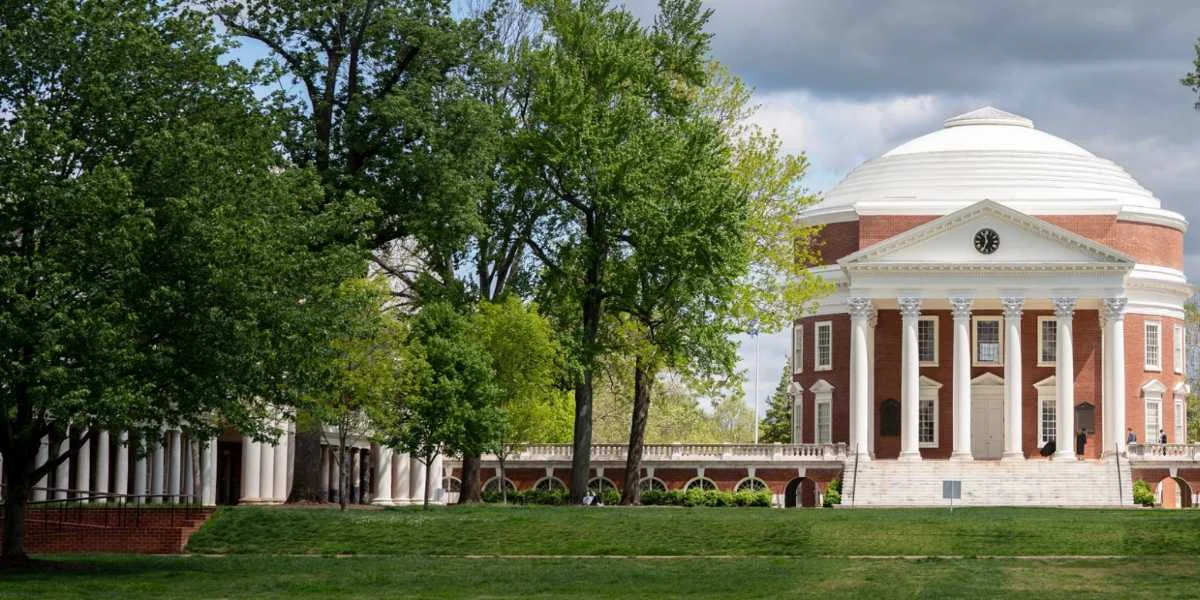
The University of Virginia is renowned worldwide for its beautiful campus, outstanding academic tradition, and rigorous honor code. The campus was designed by Thomas Jefferson, the third President of the United States; its classical architecture and natural landscape complement each other, and it is inscribed on the UNESCO World Heritage List. UVA is not only the first university in the United States independent of any church, but also a member of the Public Ivies, and it has long ranked among the top public universities in the nation. Its Darden School of Business is known for its all-case teaching method and is called the "Little Harvard," while its law school's employment rate ranks among the highest in the country.

We will examine the distinctive appeal of the University of Washington from several angles, showcasing the school's core features and its academic achievements and cultural character. Click the button below to view the school's full introduction.

01. One of the most beautiful college campuses in the United States

02. The first university independent of any church

03. Inscribed on the UNESCO World Heritage List

04. One of the strongest alumni networks in the United States

05. A business school called the "Little Harvard"

06. The most social party school

07. A vibrant and diverse campus life

08. An exceptionally strict honor code

09. High competitiveness on par with the Ivy League

10. The law school with the highest student satisfaction

Most popular majors

Liberal Arts and Sciences/General Studies
20%
Social Sciences, General
14%
Engineering
10%
Business/Trade
9%
Computer and Information Sciences
7%
Biology/Biological Sciences
6%
Psychology
4%
Health Professions and Related Clinical Sciences
4%
Physical Sciences
3%

Graduate programs

Computer Science

Computer Science

Program Overview

The Computer Science program at the University of Virginia is designed to develop professionals in computer science who are both research-capable and practically skilled. The degree is course-based, but students can choose different areas of emphasis within the program according to their own interests and needs. The curriculum is highly flexible, allowing students to select from a broad range of courses based on their interests and career goals. In addition, the program offers a rich set of interdisciplinary electives that let students broaden their knowledge. Beyond the extensive course content, the program also gives students the opportunity to conduct applied research in collaboration with a faculty advisor. Through this collaboration, students apply theoretical knowledge in practice, participate in real research projects, and gain hands-on experience. These applied research opportunities help students better understand what they learn in the classroom and provide valuable experience and skills for their future careers.

Degree Type

Master of Computer Science (MCS)

Program Length

2 years

STEM Designation

Yes

Source: University of Virginia Master of Computer Science

Application Requirements

Language Requirements

International students must submit TOEFL or IELTS scores. A waiver may be requested if you meet the following conditions:

If you earned a four-year degree at an English-language institution (whether or not that institution is in the United States), you do not need TOEFL/IELTS scores.

If you have strong English writing and speaking skills, you may be exempt from TOEFL/IELTS! Email the school explaining why you believe the TOEFL/IELTS requirement should be waived (provide supporting evidence, such as proof of extensive English-language communication during a teaching assistantship, a copy of an expired TOEFL/IELTS score, or a presentation at an English-language conference).

Minimum Scores

TOEFL 90; TOEFL institution code: B875

IELTS 6.5

Academic Requirements

There is no minimum GPA requirement for admission. However, most applicants admitted to this program have a GPA of at least 3.3 on a 4.0 scale. Grades in computer science, mathematics, and related courses matter more than the overall GPA.

Academic Background

The Department of Computer Science does not require applicants to hold a bachelor's degree in computer science. However, the school expects applicants to have a solid computer science background.

Appropriate background includes coursework in the following core areas:

Data Structures

Discrete Mathematics

Assembly Language and Computer Organization

Programming in a procedural language such as C, C#, C++, or Java

In addition, applicants should have taken some (but not necessarily all) courses in specialized areas:

Operating Systems

Programming Languages

Algorithms

Compilers

Artificial Intelligence

Computer Networks

Automata and Formal Languages

Software Engineering

Students also need one year of college calculus. Generally, work experience is not considered equivalent to successful completion of the courses listed above.

In addition to the program-specific application requirements above, full application requirements can be found in the Application Requirements section of our website

Source: University of Virginia CS application

Graduation Requirements

Credit Requirements

Students must complete 31 credits

Grade Requirements

No course may be graded below a B. The average grade in courses taken during the graduate degree in Computer Science must be at least a B (that is, a cumulative GPA of at least 3.0).

Source: University of Virginia CS Master Degree Requirements

Course Information

Completing the master's degree requires:

CS 6190 (Computer Science Perspectives), 1 credit.

12 credits of graded graduate-level CS breadth electives

Cyber Physical Systems, Internet of Things, Embedded Systems

Course | Course Code | Human-Robot Interaction | CS 6465 | Principles of Modeling for CPS | CS 6501 | Internet of Trillions of Things | CS 6501 | Mobile and IoT Security | CS 6501 | IoT Sensors and Systems | CS 6501 | Machine Learning, Natural Language Processing, Information Retrieval, Text Mining, Data Mining

Course | Course Code | Machine Learning | CS 6316 | Deep Learning for Visual Recognition | CS 6501 | Learning Theory | CS 6501 | Statistical Learning and Graphical Models | CS 6501 | Security, Privacy, Cryptography

Course | Course Code | Introduction to Cryptography | CS 6222 | Mobile and IoT Security | CS 6333 | Dependable Computing Systems | CS 6434 | Software Security via Program Analysis | CS 6501 | Theory and Algorithms

Course | Course Code | Theory of Computation | CS 6160 | Algorithms | CS 6161 | Convex Optimization for Engineering and Data Science | CS 6501 | Neural Network Verification | CS 8501 | Computer Systems

Course | Course Code | Cloud Computing | CS 6111 | Computer Architecture | CS 6354 | Dependable Computing Systems | CS 6434 | Introduction to Parallel Computing | CS 6444 | Software Engineering

Course | Course Code | Software Engineering | CS 6240 | Analysis of Software Artifacts | CS 6501 | Compilers | CS 6620 | Software Logic | CS 6501 | The courses above are examples of courses in each area. For more course information, please see the website

Every master's degree requires 18 credits of graduate-level CS electives (or other graduate courses approved by the advisor and the master's program director).

5000-level CS courses are not accepted.

CS 6993/7993 (Independent Study) may count for at most 3 credits.

CS 8897/9897 (Graduate Teaching Instruction) may be used to satisfy full-time requirements.

Source:

University of Virginia Master of Computer Science

University of Virginia CS Course List

Career Development

The Center for Engineering Career Development holds an annual fall career fair and career conferences for engineering and computer science students at the University of Virginia, where undergraduate and graduate students can meet employers and attend workshops on a variety of career-related topics. Students can take part in the following activities:

Career Fair

Students can meet representatives from more than 75 employers seeking engineering students for internships or full-time positions.

Career Talks

Learn about careers in consulting, manufacturing, engineering for social good, semiconductors, and computer application development.

Skills Workshops

Master interview techniques, learn how to build a professional network for career success, and get inside information on securing internships.

DEI Events

Employers and University of Virginia staff hold career-themed workshops for first-generation college students, students with disabilities, and international students. Students also have the opportunity to meet employers at the University of Virginia's Multicultural Center and to connect with students from engineering student affinity groups.

Source: University of Virginia CS career fair

Public Policy

Public Policy

Program Overview

The Public Policy program at the University of Virginia's Frank Batten School is dedicated to a new model of innovative leadership and policy education. Through interdisciplinary study and practical activities, it helps students work continuously toward practical, workable solutions to real-world problems, guided by rigorous cost-benefit analysis and innovative thinking. This interdisciplinary approach also enables students to understand and analyze complex policy problems more comprehensively and to propose solutions with real practical feasibility. The program aims to give students a solid and lasting foundation in the concepts, methods, and strategies needed for policy analysis and effective leadership. Students learn how to assess the impact of policy, formulate effective policy recommendations, and achieve those policy goals through leadership and teamwork skills.

Degree Type

Master of Public Policy

Program Length

2 years

Source: University of Virginia MPP

Application Requirements

Language Requirements

International applicants must take the TOEFL or IELTS.

Institution code: B582

Minimum scores: TOEFL 100 (with no section below 22)

IELTS 7

International students who have studied for four years at a university where English is the primary language of instruction may be exempt from submitting TOEFL or IELTS scores.

GRE

The Frank Batten School has eliminated the standardized test requirement. If you have already taken the GRE, you may send your unofficial scores to the school. The school's institution code: B582

Essays

Applicants must complete three essays.

What motivates you to pursue a career in public policy and leadership? Please describe your interest in addressing one or more policy areas or social problems. Which work, activities, or educational experiences have best prepared you for graduate study in this field? (Please limit your answer to 500 words.)

One of the school's goals is to improve students' leadership capacity in a diverse and divided world. Please describe an experience in which you had to work across divides to address a challenge or improve some outcome. What did you learn from it? How do these lessons inform your future success, especially professionally?

Which aspects of your background, perspective, or experience would be a source of strength for you or for those around you at the University of Virginia? Please write freely about any past experience or part of your background that has shaped your perspective and will be a source of strength for you, including but not limited to experiences or background related to your community, upbringing, educational environment, race, or gender, or any other aspect that matters to you. (Please limit your answer to 250 words.)

Optional Application Addendum

There is no penalty for not submitting an application addendum! However, some applicants may wish to provide additional information for the admissions committee to consider. If your background is not addressed elsewhere in this application, you are welcome to add positive information about yourself. Likewise, you may wish to put some seemingly negative information in the application into its actual context. Please format this application addendum as a letter to the admissions committee, no longer than one page.

In addition to the program-specific application requirements above, the complete application requirements can be found in the corresponding Application Requirements section of our website.

Sources:

University of Virginia International Applicants

University of Virginia Applying: Master of Public Policy

Graduation Requirements

Credit Requirements

To earn the MPP degree, students must complete 49 credits.

Internship Requirement

Students must complete a 400-hour policy internship during the summer between the first and second years. The program's capstone course is the Applied Policy Project, in which students carry out a professional-quality study for a real-world client under faculty supervision.

Source: University of Virginia MPP curriculum

Curriculum Overview

Students must complete 11 required core courses at the Batten School:

Analytical courses: problem solving and policy analysis

Course | Course Code | Credits: Economics of Public Policy I | LPPA 6100 | 3; Economics of Public Policy II | LPPA 7110 | 3; Research Methods & Data Analysis I | LPPA 6150 | 3; Research Methods and Data Analysis II | LPPA 7160 | 3

Leadership courses: leadership

Course | Course Code | Credits: Leadership in the Public Arena | LPPL 6050 | 3; Psychology for Leadership | LPPL 7410 | 3; Values-Based Leadership | LPPL 7025 | 3

Foundations and contexts of public policy courses

Course | Course Code | Credits: Foundational Skills Workshop | LPPP 6001 | 1; Politics of Public Policy | LPPP 6350 | 3

Applied, experiential learning

Course | Course Code | Credits: Policy Analysis | LPPP 6250 | 3; Applied Policy Project I | LPPP 7700 | 3; Applied Policy Project II | LPPP 7750 | 3; and a one-credit Foundational Skills Workshop.

15 elective credits, including:

three credits of elective coursework

two credits of policy clinics

one credit of short courses (taken at Batten or elsewhere in the University, subject to approval by the director of the academic program)

For more course information, see the 20240MPP Brochure.

Source: University of Virginia MPP Course

Career Development

The career services team established by the Batten School, home of the Public Policy program, helps students and alumni build the foundation they need to succeed in the public policy field.

The team helps students assess their strengths and identify their career direction. The school also works closely with major employers to foster partnerships and meaningful networking opportunities. The team's employment services are tailored to the unique needs of Batten students and include:

strategic career advising

resume and cover letter review

mock interviews

career events and connections with industry professionals and mentors

assistance with offer negotiation

job search tools

Source: University of Virginia Student Career Support

Data Science Program

Data Science

Program Overview

The faculty team for the University of Virginia's Master of Science in Data Science program is made up of outstanding leaders with extensive experience at major companies, enterprises, and in research fields. These faculty collaborate on top-tier projects sponsored by corporate and government partners, and they bring their practical experience and industry insight into the classroom. Course content covers fundamental data analysis topics, including natural language processing, machine learning, text analytics, and deep learning. Through the integrated curriculum, students learn practical data science skills and apply them to sound data science principles.

Degree Type

M.S. in Data Science (MSDS)

Program Length

One year

STEM Designation

Yes

Source: University of Virginia M.S. in Data Science

Application Requirements

Language Requirements

Applicants who earned a bachelor's degree from an institution where English is not the primary language of instruction must submit TOEFL or IELTS scores themselves at the time of application. Only admitted students need to provide official scores.

TOEFL institution code B875 (no department code required)

The minimum TOEFL (iBT) score is 100 (including 22 in Speaking, 22 in Writing, 23 in Reading, and 23 in Listening).

The minimum IELTS score is 7.0 (including a minimum of 6.5).

Application Short Answer Questions

How will the University of Virginia's MSDS program help you achieve your short-term and long-term goals? (150 words or fewer)

The purpose of data science is to solve the world's most challenging and compelling problems. Tell the school about a meaningful challenge you have solved as part of a team (the challenge does not have to be data-related). What was the problem, what role did you play in solving it, and what was the result? (150-250 words)

Required: Which aspects of your background, perspective, or experience will be a source of strength for you or for those around you in the School of Data Science? Please write freely about any past experience or part of your background that has shaped your perspective and will be a source of strength, including but not limited to experiences or background related to your community, upbringing, educational environment, race, or gender, or other aspects that matter to you. (250 words or fewer)

Optional Addendum: The application addendum is not required; however, you may have additional information that would be useful to the admissions committee. Please use this space to discuss positive aspects of your background not highlighted in this application, or to provide insight and/or context on other matters, including but not limited to grade anomalies, gaps in your academic record or resume, or other extenuating circumstances. (250 words or fewer; optional).

Prerequisite Courses and Minimum Eligibility Requirements

No specific undergraduate major or program of study is required. Applicants must have earned a bachelor's degree from a three- or four-year accredited institution before enrollment.

The Master of Science in Data Science program requires several prerequisite courses. You may still apply without all prerequisites completed, but you must complete them before enrollment. If an applicant is admitted and accepts the offer of admission, proof of completion of any unfinished prerequisites will be required.

Applicants must complete college-level prerequisite courses at an accredited institution, whether in person or online. In your best interest, choose courses that rigorously cover the relevant topics so that you are fully prepared for the MSDS curriculum.

In addition to the program-specific application conditions above, full application requirements can be found in the corresponding Application Requirements section of our website.

Source: University of Virginia M.S. in Data Science Admission

Graduation Requirements

Credit Requirements

Students must complete 32 credits.

Thesis Requirement

Master of Science in Data Science students must complete a capstone project. Project teams consist of two to four students and a faculty advisor. Teams select their capstone projects at the beginning of the year and complete them over two semesters.

Teams may develop web-based applications that support ongoing decision-making. The capstone concludes with a thesis and a presentation.

Source: University of Virginia MSDS academic

Curriculum Overview

The Master of Science in Data Science curriculum totals 32 credits and is delivered across three terms: summer, fall, and spring. Students take core courses and electives in the spring.

Required Courses

Summer

Course Course Code Credits Programming for Data Science DS 5100 3 Practice and Application of Data Science DS 6001 3 Linear Models for Data Science STAT 6021 3 Fall

Course Course Code Credits Foundations of Computer Science CS 5012 3 Statistical Learning CS 5012 3 Bayesian Machine Learning DS 6040 3 Ethics of Big Data DS 6002 2 Data Science Capstone Project Work I DS 6011 1 Spring

Course Course Code Credits Deep Learning DS 6050 3 Data Science Capstone Project Work II DS 6013 2 Electives

Course Course Code Theory of Computation CS 6160 Parallel Computing CS 6444 Database Systems CS 6750 Advanced Use of Geographical Information Systems EVSC 7070 Advanced Quantitative Analysis GCOM 7240 For more elective information, please see the official website.

Career Development

Data Science students at the University of Virginia can access a range of career resources, including one-on-one advising, workshops, and career events, to build career development skills and connect with employers and alumni. The School of Data Science career services team works with students from networking through negotiation, enabling them to navigate resources and career opportunities with confidence.

Graduate and undergraduate students also have access to a broad alumni network of data scientists and other professionals. University of Virginia alumni are spread across government, nonprofits, and a wide range of industries. Alumni range from startups to Fortune 300 companies, spanning fields such as finance, healthcare, insurance, and technology.

Source: University of Virginia Data Science career service

Electrical Engineering

M.S./M.E. in Electrical Engineering

Program Overview

The Electrical Engineering program at the University of Virginia shares office space with the School of Medicine, enabling faculty and students to conduct interdisciplinary research in frontier fields such as medical imaging, bioengineering, and data mining. With the growing prevalence of artificial intelligence and machine learning, these technologies have become central to the design and operation of engineering systems. The school is committed to being an inclusive hub of innovation, combining research and teaching to train future leaders in electrical and computer engineering to address the major technological challenges facing society. The department has a world-class research tradition in photonics, high-frequency diodes, materials science, and other areas, and a deep history in computer engineering, devices and circuits, signal and image processing, and communications. The department offers two master's degrees: the Master of Science (MS), which requires a thesis, and the Master of Engineering (ME), which does not. Students who receive departmental funding are typically expected to choose the MS (thesis) option and must obtain the consent of an advisor to supervise their master's thesis.

Degree Types

M.S. in Electrical Engineering

M.E. in Electrical Engineering

Source:

University of Virginia EE degree requirements

University of Virginia EE

Application Requirements

Language Scores

Applicants whose native language is not English (institution code B875) must submit TOEFL or IELTS scores. If you are a U.S. permanent resident, or if you earned a bachelor's degree from an institution where English is the primary language of instruction, these scores are not required.

Essays

Beyond test scores and transcripts, who are you? What sets you apart?

What are your plans for graduate study and your career, and how will this program help you achieve your goals?

What prior research and leadership experience do you have, and how has it prepared you for success?

Have you overcome any difficulties or obstacles that demonstrate your determination and passion (this may also be used to explain any gaps or weak indicators in your academic record)?

How do your research interests align with those of the program's faculty?

Admission Background

Applicants should have an average grade of at least B to be admitted to graduate study.

In addition to the program-specific application requirements above, the complete application requirements can be found in the corresponding [Application Requirements] section of our website.

Source: University of Virginia EE application requirements

Graduation Requirements

Credit Requirements

M.S. in Electrical Engineering: Students must complete 31 credits of coursework.

M.E. in Electrical Engineering: Students must complete 31 credits of coursework.

Grade Requirements

M.S. in Electrical Engineering: If a graduate student's cumulative GPA falls below 3.0, the student will be considered on academic probation, and the dean's office will notify the graduate student of this status. Graduate students on academic probation are generally not eligible for financial aid. If the graduate student's cumulative GPA is not raised to 3.0 within one semester, the student will be dismissed.

M.E. in Electrical Engineering: If a graduate student's cumulative GPA falls below 3.0, the student will be considered on academic probation, and the dean's office will notify the graduate student of this status. Graduate students on academic probation are generally not eligible for financial aid. If the graduate student's cumulative GPA is not raised to 3.0 within one semester, the student will be dismissed.

Thesis Requirements

M.S. in Electrical Engineering: Students must complete 6 credits of ECE 8999 thesis.

M.E. in Electrical Engineering: None

Source: University of Virginia EE graduation requirements

Course Information

M.S. in Electrical Engineering:

1 credit of ECE 6505: ECE Seminar (offered only in the fall semester)

24 credits of graded coursework

At least 12 credits must be ECE-approved

3 credits of mathematics at the 5000 level or above are required, selectable from APMA, MATH, ECE 6711, MAE 6410, and SYS 6005

6 credits of ECE 8999 – thesis

No more than 9 credits of 5000-level coursework

No more than 6 credits of 5000-level coursework in the ECE department

No more than 3 credits of independent study (e.g., ECE 6993, ECE 7993)

M.E. in Electrical Engineering:

1 credit of ECE 6505: ECE Seminar (offered only in the fall semester)

30 credits of graded coursework

May include 3–6 credits of ECE 6995/ECE 7995 – master's project

At least 18 credits must be ECE-approved

3 credits of mathematics at the 5000 level or above are required, selectable from APMA, MATH, ECE 6711, ECE 7438, MAE 6410, and SYS 6005

The remaining nine graduate course credits may be in SEAS, PHYS, BIO, CHEM, or MATH

No more than 9 credits of 5000-level coursework

No more than 6 credits of 5000-level coursework in the ECE department

No more than 3 credits of independent study (e.g., ECE 6993, ECE 7993)

Source: University of Virginia EE course information

Career Development

The Electrical Engineering program enjoys a strong reputation in both industry and academia and is a cradle for developing outstanding engineers and researchers. Faculty maintain this reputation by continually updating courses to reflect current scientific and technological advances and requirements, and by maintaining a vibrant interdisciplinary research program that provides faculty and graduate students with a high-level learning experience relevant to societal needs.

Recent graduates have gone on to companies such as Apple, Amazon, BAE Systems, Booz Allen Hamilton, Corning, Facebook (now Meta), General Electric, General Motors, Google, Halliburton, Intel Labs, Microsoft Research, NVIDIA Research, Northrop Grumman, Oracle, Qualcomm, and Samsung Research. Some graduates have entered government research laboratories, including the Air Force Research Laboratory, the Army Research Laboratory, NASA, the National Institute of Standards and Technology, and the U.S. Department of Energy National Renewable Energy Laboratory.

Others have followed in their advisors' footsteps into academia, pursuing postdoctoral research or faculty positions in the United States and abroad, including at Kuwait University, National University of Defense Technology (China), the Royal Thai Air Force Academy, Shanghai Jiao Tong University (China), the University of California, Davis, the University of Florida, the University of Illinois Urbana-Champaign, the University of New Hampshire, the University of Notre Dame, and Virginia Commonwealth University.

Source: University of Virginia EE career development

Campus life

Transportation

Nearby Airport

Charlottesville-Albemarle Airport (CHO)

Distance from campus: 8.4 miles

Campus to airport travel:

Driving/rideshare:

Typically takes about 15 minutes. It may take longer during heavy traffic.

Public transit:

Take bus route 4/7/CROZ-W and transfer to route 29N, or take route 29N directly. The trip takes about 1 hour 4 minutes to 1 hour 58 minutes.

Nearby Train Station

Charlottesville Amtrak Station

Campus to train station travel:

Driving/rideshare:

Typically takes 2 minutes. It may take longer during heavy traffic.

Public transit:

There is no public transit to the train station; the station is an 8-minute walk away.

City Public Transit

Public transit around the University of Virginia mainly consists of campus shuttle bus service and city bus service.

The campus shuttle bus service covers key locations across campus and provides a convenient way to get around.

Charlottesville also operates bus service covering the city's main areas, giving students and residents a wider range of travel options.

Safety

The University is committed to creating the safest possible living and learning environment. The University is here 24 hours a day to help with any situation that makes you feel uneasy, uncomfortable or unsafe.

Safe Transportation Options:

Resources are available to help you get home safely. Learn about free transportation options around Grounds, including late-night and on-demand options.

University Police and Ambassadors:

The University Police Department is responsible for the well-being of everyone at the University of Virginia. Access the crime log, request event security or learn more about the ambassador program.

Just Report It:

Just Report It is UVA's online reporting system, covering situations including but not limited to bullying, harassment, bias and discrimination, and threatening or violent behavior.

Threat Assessment:

The Violence Prevention Committee has established policies and procedures to prevent campus violence, including assessment of and intervention with individuals whose behavior poses a threat to the safety of the University community.

24/7 Virtual Mental Health Resource:

TalkNow provides 24/7, on-demand access to mental health professionals to discuss any concern at any time. Students can connect to TalkNow within minutes to discuss concerns at any level, from a conflict with a roommate to a more serious mental health crisis.

Housing Safety Information:

The University strives to give all residents a safe, healthy year. You can help! One of the most important things you can do on Grounds is to take a proactive approach to your personal safety.

Housing

Departments work together to create an open, welcoming campus community for University of Virginia students. Residents are empowered to realize their potential as scholars and leaders through self-governance and participation in residential area activities and leadership. From first-years and returning undergraduates to transfer students, graduate students and faculty and staff, residents encounter an inclusive environment that supports the University's academic, cultural and social goals.

Residential Colleges

Incoming first-year undergraduates: Alderman Road Hall-Style, Alderman Road Suite-Style, Brown Residential College, Gooch/Dillard Suite-Style, Hereford Residential College, International Residential College, McCormick Road Hall-Style

Incoming transfer students: Bice House, Bond House, Brown Residential College, CASA BOLÍVAR (SPANISH HOUSE), and others

Returning Undergraduates: Bice House, Bond House, Brown Residential College, CASA BOLÍVAR (SPANISH HOUSE), and others

Graduate students: Copeley Hill Apartments, Faulkner Drive Rooms, Piedmont Apartments, The Range, Off-Grounds Housing

For more information, see the residence hall list.

Dining

The University's dining locations will satisfy your appetite, offering only the widest variety and best value in food. The University offers multiple restaurants, food courts, convenience stores and cafés.

University Dining Locations

Observatory Hill Dining Room

Observatory Hill Dining Room is located at the southwest corner of Alderman Road and McCormick Road, near the first-year residence halls. Commonly called O'Hill on Grounds, this dining room has a spacious seating area across two levels and eight delicious dining stations to choose from! It mainly serves pasta, roast chicken and pizza.

Fresh Food Company

Located in Newcomb Hall, this 35,000-square-foot renovated facility features 8 made-to-order stations, including an international station, a deli station and a vegetarian station, plus a produce and salad bar and more! UVA students love the "new" Newcomb dining room and praise its menu choices and comfortable, fun dining atmosphere. It mainly serves macaroni, burgers and pizza.

Café McLeod

Café McLeod mainly serves Bleecker Street sandwiches, Java City coffee and pastries.

For more information, see the dining location list.

Meal Plan

First-Year Students

Every first-year student is required to have a comprehensive meal plan in both semesters.

The meal plan allows you to swipe into all-you-care-to-eat dining rooms multiple times a day, plus 2 or 3 meal exchanges/to-go meals per day (depending on the plan chosen) and 10 Guest Meals per semester. Students can choose the amount of Flex Dollars allocated to their plan.

Meal Plan | Meals | Meal Exchange | Guest Meals | Flex Dollars | Price

All Access | Unlimited | 210/semester | 150/semester | 3300/semester

All Access | Unlimited | 210/semester | 300/semester | 3460/semester

All Access | Unlimited | 310/semester | 400/semester | 3565/semester

Upperclass Students or Graduate Students (the following plans are additionally available)

Meal Plan | Meals | Meal Exchange | Guest Meals | Flex Dollars | Price

Block 160 | 160/semester | 20/semester | 300/400/500/semester | 1970/2080/2185/semester

Block 100 | 100/semester | 20/semester | 300/400/500/semester | 1445/1555/1660/semester

Block 50 | 50/semester | 20/semester | 300/400/500/semester | 960/1065/1775/semester

Admissions

Acceptance rate
17%
SAT range
1410-1530
ACT range
32-34
SAT / ACT
SAT reading and writing, 25th–75th percentile: 700-750
SAT math, 25th–75th percentile: 710-780

Admissions data

The University of Virginia has the highest acceptance rate, at 21%.
Half of the applicants admitted to UVA have an SAT score between 1390 and 1530 or an ACT score between 32 and 35.
However, one quarter of admitted applicants achieved scores above these ranges and one quarter scored below these ranges.
The application deadline is January 1, and the University of Virginia application fee is $75.
The University of Virginia admissions officials consider a student's GPA to be a very important academic factor.
An applicant's high school class rank, when available, is considered very important, and letters of recommendation are also considered very important by University of Virginia admissions officials.
Applicants
Admitted
Female applicants
Male applicants
Female admits
Male admits
Waitlist offered
Yes
Students on waitlist
5,114
Students accepting a place
8,899
Admitted from waitlist
320

Application requirements

01.
Submit the online application through the Common Application system and pay the $70 application fee.
02.
Official high school transcript. Documents not in English must be accompanied by a notarized English translation.
03.
High school transcript: the school strongly recommends submitting it through CDGDC verification;
04.
Counselor recommendation and school report, 2 letters, from the homeroom teacher and a subject teacher; (the required forms are on the Common Application website).
05.
Teacher evaluation form (the required forms are on the Common Application website).
06.
SAT or ACT scores; the writing section is not required.
07.
Test score reports must be sent directly from the testing agency to the University of Virginia. SAT/ACT plus writing scores: submitting 2 SAT II subject test scores is strongly urged (Strongly Urged);
08.
Students in the arts must submit a portfolio.
09.
International students must submit language test scores (TOEFL or IELTS).
10.
Applicants from non-English-speaking countries must provide language scores: TOEFL iBT of 80 or above, TOEFL CBT of 213 or above, TOEFL PBT of 550 or above; IELTS of 6 or above.

Application checklist

01.
$70 application fee
02.
Official high school transcript
03.
High school transcript
04.
Counselor recommendation and school report, 2 letters, from the homeroom teacher and a subject teacher
05.
Teacher evaluation form
06.
SAT or ACT scores
07.
Portfolio required for art students
08.
English proficiency test scores required for international students (TOEFL or IELTS)
09.
Proof of funds: not required at the time of application, but required after admission
10.
Copy of a valid passport

Application deadlines

Deadline
Date
Early Decision I
Nov. 1
Early Action
No
Regular Decision
Jan. 5
ED I notification
Dec. 15
EA notification
Nov. 1

Transfer requirements

01.
Applicants must have completed at least one year of full-time college study to be considered a competitive candidate by the admissions committee.
02.
Students who successfully transfer into the University of Virginia must live on campus for at least two years.
03.
Students who have already completed three or more years of study at another four-year college or university are not eligible for admission to the College of Arts & Sciences.
04.
Applicants who have accumulated three years of college study after transferring from a community college or another four-year institution into a four-year university also cannot enter the University of Virginia as transfer students.
05.
High school students or home-schooled students must apply for admission as first-year students.
06.
Students who took some college courses during high school cannot apply for admission as transfer students.
07.
Transfer applicants must be in good standing both academically and socially.

Transfer checklist

01.
Applicants may submit their application through the Common Application system
02.
Application fee
03.
Official high school transcript
04.
College transcript (the average college GPA of admitted students is 3.5)
05.
SAT or ACT scores (not required), except that standardized test scores are required for applicants to the McIntire School of Commerce or the Teacher Education program in the School of Education
06.
International students must provide TOEFL or IELTS scores

Transfer deadlines

Deadline
Date
Spring application deadline
Mar. 1
Fall application deadline
Oct. 1

Similar universities

Admissions FAQ

What is the acceptance rate at University of Virginia ?

The reported acceptance rate is 17%. Acceptance rates vary by applicant pool and application cycle; confirm the current figure with University of Virginia .

What SAT scores does University of Virginia expect?

The reported SAT range is 1410-1530. Test-optional and score-reporting policies can change by application cycle; check the university's official admissions page before applying.

When is the application deadline at University of Virginia ?

The listed Regular Decision deadline is Jan. 5. Deadlines can vary by program and application cycle; confirm the exact date with the university.

How much does University of Virginia cost?

The listed tuition and fee figure is $15,862. Costs vary by residency, programme and academic year; confirm current costs with the university.

Where is University of Virginia located?

University of Virginia is located at 1827 University Avenue, Charlottesville, VA, 22903-2628.

Planning your application?

Build a school list around your profile.

Ivy Elite advisors help students compare programs, plan coursework and prepare applications for U.S. universities.