


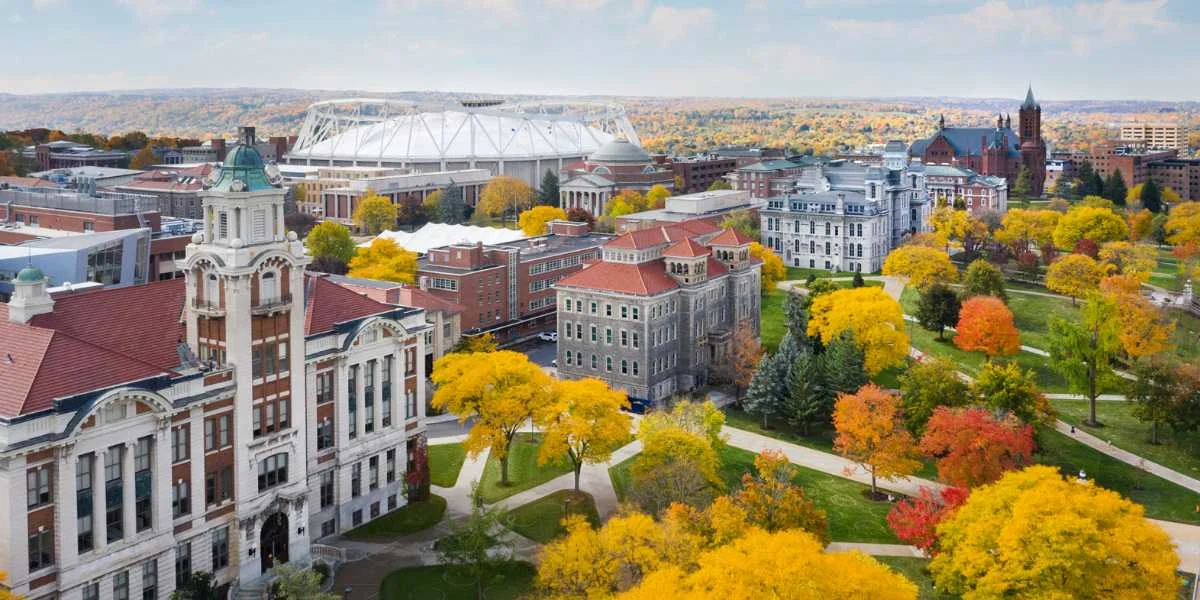
Syracuse University is home to 13 schools and colleges, including the College of Arts and Sciences and the College of Engineering and Computer Science, as well as a graduate school. The university has made significant achievements in fields such as medicine, aerospace, and information science. What sets it apart is its beautiful campus setting and its close collaboration with local industry and the community, which provides students with abundant internship and research opportunities.
About the university
School data is compiled from public sources and may change. Confirm current tuition, deadlines and requirements with the university before applying.
At a glance
Alumni starting salaries
Student body
Most popular majors
Graduate programs
Computer Engineering
Computer Engineering
Program Overview
The Computer Engineering program in Syracuse University's College of Engineering and Computer Science is one of the university's popular majors. As society's use of digital computers and artificial intelligence applications increases, more and more people are becoming interested in this field. The program mainly covers three areas—hardware systems, software systems, and security systems—meaning students will encounter knowledge and skills in these areas during their studies.
Degree Type
Master of Science in Computer Engineering
Program Length
1 year
Sources:
Syracuse University Master of Science in Computer Engineering
Syracuse University Master of Science in Computer Engineering FAQ
Application Requirements
Academic Background
Students who have not earned a bachelor's degree in electrical engineering or computer engineering must take specific additional courses at the undergraduate or graduate level to make up for gaps in their preparation.
Language Scores
All international applications must submit TOEFL, Duolingo, or IELTS scores. You may submit one of these scores; you do not need to submit both.
When asking ETS (Educational Testing Service) to send your scores electronically to Syracuse University, please use institution code 2823. There is no need to request that scores be sent to more than one department.
If you have completed a four-year (or higher) degree program at a U.S. institution of higher education, or if you come from certain countries that are exempt from providing English language test scores, the TOEFL/IELTS/Duolingo requirement may be waived. Please email topgrads@syr.edu to confirm your eligibility.
For more information on language requirements for international students, see: International Graduate Students Requirements
In addition to the program-specific application conditions above, the complete application requirements can be found in the corresponding Application Requirements section of our official website.
Sources:
Syracuse University Graduate Application Requirement
Syracuse University Master of Science in Computer Engineering Application Requirement
Syracuse University Application FAQs
Graduation Requirements
Credit Requirements:
Students must complete at least 30 credits of coursework beyond the undergraduate level, including at least 18 credits of CSE courses, with no more than 6 credits at the 500 level.
Grade Requirements:
Students must maintain a cumulative grade point average of at least 3.0 in courses that count toward the master's degree.
Students must maintain a cumulative grade point average of at least 2.8 in all graduate courses taken at Syracuse University.
Students must complete the final examinations for all core courses with an average grade of B- or better.
Thesis Requirement:
Students choosing the thesis option must include CSE 997 - Master's Thesis (typically 6 credits) in their program of study. The thesis is optional. The master's thesis must be prepared in accordance with the Graduate School's Instructions for Thesis Preparation and must be approved in advance by the thesis advisor. The thesis must be presented orally and defended before a faculty committee.
Project Requirement:
The Computer Engineer Degree Project
CSE 995 This project allows students to conduct an investigation that may be original research, the application of recent technology, the solution of a series of related small problems, or a critical study of a special topic. Topics may be proposed by faculty or by the student. Students will be assigned a project advisor, who must approve the topic and agree to supervise the student's work. Students employed in engineering may arrange to carry out project work at the employer's site or laboratory, provided the advisor can participate without restriction. After completing all graduate coursework, a formal project report must be submitted and a final examination on the report must be taken.
Source: Syracuse University Master of Science in Computer Engineering Degree Requirement
Curriculum
The course requirements for Syracuse University's Computer Engineering program are as follows:
Four Required Courses
The program must include at least 18 credits of CSE courses (including required courses).
No more than 6 credits may be at the 500 level.
Students may take up to 3 credits of independent study (with approval from the course instructor).
Core Courses Course Number Course Credits Term Offered Advanced Computer Architecture CSE 661 3 credits Fall/Spring Introduction to System-on-Chip Design CSE 664 3 credits Fall/Spring Advanced Data Structures and Algorithms CSE 674 3 credits Offered depending on enrollment Object Oriented Design CSE 687 3 credits Fall/Spring Optional Courses Course Number Course Credits Term Offered Digital Machine Design CSE 561 3 credits Offered depending on enrollment Introduction to Database Management Systems CSE 581 3 credits Fall/Spring Special Problems in Computer Systems Engineering CSE 591 3 credits Offered depending on enrollment Mathematical Basis for Computing CSE 607 3 credits Fall/Spring Cloud Computing CSE 612 3 credits Fall/Spring For more information, see the Syracuse University Computer Engineering course catalog.
Source: Syracuse University Master of Science in Computer Engineering Course Requirement
Career Development
Syracuse University maintains close relationships with industry leaders, who regularly connect with students through information sessions, lobby tables, career fairs, on-campus interviews, and other means.
Area Details Source Advancing Women Engineers Provides a networking pathway to help inspire, recruit, retain, develop, and advance more women engineers and computer scientists so they can succeed in their careers. This network can build mentoring relationships for young women and boost confidence, leadership skills, and a sense of belonging. Advancing Women Engineers Alumni Mentoring Syracuse University uses the Firsthand online platform to let students meet alumni mentors and receive one-on-one advice on career development, academic success, interpersonal connections, and more. Firsthand automates the mentor matching process. Mentees and mentors can meet virtually within Firsthand around the clock. Alumni Mentoring Career Services Team Students can connect with career advisors through Handshake to get help. Career Services Team Source: Syracuse University Career Services
Public Administration
Public Administration
Program Overview
The Public Administration program at Syracuse University is designed to give professionals with a commitment to public service the ability to put their creative ideas into practice. The program prepares students to lead public, private, or nonprofit organizations and to improve the lives of those around them. Blending theory and practice, students in the program are trained to collaborate across sectors and apply public service values. Students gain practical policy analysis and public management skills and have the flexibility to choose areas of study that interest them, giving them both foundational and specialized preparation.
Degree Type
Master of Public Administration
Program Length
12 to 18 months
Sources:
Syracuse University – Public Administration
Syracuse University – Public Administration – MPA Course Catalog
Application Requirements
Language Scores
English proficiency exam (for international students only): TOEFL, IELTS, Duolingo, or Cambridge English Assessment.
TOEFL: minimum score of 100; the median TOEFL score has consistently been above 105.
Duolingo: Literacy – 125, Comprehension – 110, Conversation – 120, Production – 95 | Overall – 115 to 120
IELTS: minimum score of 7.0.
Cambridge English Assessment: B2 First, C1 Advanced, or C2 Proficiency: 185
Students may be exempt from the English score requirement if they:
are native English speakers
completed a four-year, English-taught bachelor's degree in the United States
Academic Requirements
There is no strict cutoff or minimum or maximum GPA. However, the average cumulative GPA of our students is 3.5.
GRE
GRE scores are not required, but applicants to the Master of Public Administration program are encouraged to take the GRE.
Recommended GRE benchmarks for M.P.A. applicants are: Verbal 158, Quantitative 156, Analytical Writing 4.5
Sources:
Syracuse University – Public Administration – Application Checklist
Syracuse University – Public Administration – Application Checklist PDF
Graduation Requirements
Credit Requirements
The Master of Public Administration degree requires 40 graduate course credits, including 25 credits of required courses and 15 credits of electives.
Grade Requirements
Minimum GPA of 3.0
Source: Syracuse University – Public Administration – Graduation Requirements
Curriculum
Required Core Courses (25 credits total)
All Master of Public Administration students must complete all core course requirements. Through the core courses, students gain proficiency in the following areas of public administration: applied public management principles, applied decision-making, civic and public affairs leadership, policy formulation, program design, public and nonprofit organizations, and quantitative policy analysis.
Course | Course NumberPublic Affairs Colloquium | PAI 600Public Organizations & Management | PAI 712Introduction to Statistics | PAI 721Quantitative Analysis | PAI 722Economics for Public Decisions | PAI 723Public Budgeting | PAI 734M.P.A. Workshop | PAI 752Leadership and Public Policy | PAI 753Public Administration & Democracy | PAI 755Elective Courses (15 credits)
Electives are intended to develop specialization in a policy subfield and must be chosen in consultation with an academic advisor, making full use of the interdisciplinary strengths of the Department of Public Administration and International Affairs (PAIA) and the Maxwell School. At least nine credits must come from PAIA. PAIA specialization courses include:
Data Analytics for Public Policy
Course | Course NumberData Driven Management | PAI 724Ethics of Data Science | PAI 730Public Policy & Program Evaluation | PAI 774Advanced Policy Analysis | PAI 789Predictive Analytics | PAI 793Environmental Policy and Administration
Course | Course NumberCorporations & Sustainability | PAI 600Sustainability Driven Enterprise | PAI 600Science, Technology and Public Policy | PAI 772Economics of Environmental Policy | PAI 777Government Financial Analysis and Management
Course | Course NumberPublic Private Partnerships | PAI 730Financial Management in State & Local Governments | PAI 731State and Local Government Public Finance | PAI 735Metropolitan Government & Politics | PAI 744International Development and Administration
Course | Course NumberFollow the Money: Key Issues in Illicit Finance | PAI 685Fundamentals of Post-Conflict Reconstruction | PAI 719International Development Policy & Administration | PAI 756Economics of Development | PAI 757Humanitarian Action | PAI 765Law, Courts, and Human Rights | PAI 768National and International Security Policy
Course | Course NumberCentral Challenges in National Security Law & Policy | PAI 683Follow the Money: Key Issues in Illicit Finance | PAI 685Supreme Command: Soldiers, Statesmen and Leadership | PAI 700Great Power Cooperation and Conflict | PAI 700U.S. National Security and Foreign Policy | PAI 718Fundamentals of Post-Conflict Reconstruction | PAI 719U.S. Intelligence Community: Governance & Practice | PAI 738U.S. Defense Strategy | PAI 739Public and Nonprofit Management
Course | Course NumberGrant Writing | PAI 600Data Driven Management | PAI 724Public Private Partnerships | PAI 730Financial Management in State & Local Governments | PAI 731Metropolitan Government & Politics | PAI 744Human Resources Management | PAI 747Managing Individual, Group, & Systemic Conflict | PAI 750Public Management of Technological Development | PAI 771Policy Design and Implementation | PAI 785Social Inequality and Policy
Course | Course NumberIntroduction to Social Entrepreneurship | PAI 600Public Policy & Program Evaluation | PAI 774Social Welfare Policy | PAI 781Health Service Management | PAI 782Changing American Healthcare System | PAI 783More detailed course selection information can be found on page 12 of the Syracuse University – Public Administration – Student Handbook.
Sources: Syracuse University – Public Administration – Areas of Specialization
Career Development
The Maxwell School provides students with the knowledge, skills, experience, and connections that are essential to career success. Maxwell works closely with domestic and international employers and with 37,000 alumni around the world to offer students opportunities for career exploration, networking, internships, and fellowships.
Career support for Maxwell students includes:
Career counseling
Mock interviews and interview preparation
Cover letter and resume review
Networking advice
Skills training sessions on topics such as resume writing, building an online professional profile, and networking
Career conversations with experienced industry professionals
Access to Maxwell graduate professional job and internship listings and resume posting through Handshake.
Source: Syracuse University – Public Administration – Career Center
Computer Science
computer science
Program Overview
The Master of Science in Computer Science at Syracuse University stands out for its flexible course structure and its emphasis on mathematical foundations. Students can freely select courses according to their individual interests and career direction, building a study plan that fits them best. At the same time, the program strengthens students' mathematical grounding, providing solid mathematical support for deep understanding and application in computing. Together, these two features allow the program to develop computer science professionals with strong mathematical competence.
Degree Type
Master of Science in Computer Science
Program Length
3 years (for students without a computer science background) or flexible
Source: Syracuse University computer science M.S. program overview
Application Requirements
Language Scores
If your native language is not English, you must submit TOEFL, IELTS, or Duolingo scores; any one of these is sufficient. When ETS (Educational Testing Service) sends electronic scores to Syracuse University, please use institution code 2823. For more information on language requirements for international students, see: International Graduate Students Requirements.
Waiver: The TOEFL/IELTS/Duolingo requirement may be waived if you have completed a four-year (or higher) degree program at a U.S. institution of higher education, or if you are from a specified country (which exempts you from submitting English language test scores).
GRE (Optional)
In the evaluation process, the committee applies the following guidelines:
GRE Verbal score of 150 or above (using the new GRE scoring system);
GRE Quantitative score of 155 or above (using the new GRE scoring system);
GRE Analytical (multiple choice) score of 650 or above, or a score of 3.5 or above on the new Analytical Writing section;
International students: TOEFL computer-based score of 223 (internet-based 85; paper-based 563) or above;
In addition to the program-specific requirements above, full application requirements can be found in the [Application Requirements] section of our website
Sources:
Syracuse University computer science M.S. application requirements
Syracuse University computer science M.S. admission requirements
Graduation Requirements
Credit Requirements
A minimum of 30 credits, comprising 10 graduate-level courses, including 4 required courses (core courses) and 6 elective courses.
A minimum of 18 credits in CIS courses.
Grade Requirements
Final examination scores in core courses and grades on the transcript must be at least B- (2.667).
Students must maintain a GPA of at least 3.0 in courses counted toward the master's degree, and a GPA of at least 2.8 in all graduate courses taken.
Thesis Requirement
The thesis is optional; students who intend to pursue a doctoral degree are encouraged to choose the thesis option after completing the master's coursework.
Students may, in accordance with Graduate School regulations, prepare and defend a master's thesis, earning up to 6 of the required 30 credits. The master's thesis must be prepared according to the Graduate School's Instructions for Thesis Preparation and must be approved in advance by the thesis advisor. The thesis must be presented orally and defended before a faculty committee. Students choosing the thesis option must include CIS 997 - Master's Thesis (typically 6 credits) in their study plan.
Source: Syracuse University computer science M.S. graduation requirements
Course Information
Students with a computer science background must take 10 graduate-level courses, including 4 required courses (core courses) and 6 elective courses.
The core courses are as follows:
Course, Course Number, Credits, Term Offered: Structured Programming and Formal Methods, CIS623, 3, Spring or Fall; Computer Architecture, CIS655, 3, Spring or Fall; Principles of Operating Systems, CIS657, 3, Spring or Fall; Design and Analysis of Algorithms, CIS675, 3, Spring or Fall. Students whose bachelor's degree is in a non-computer-science field may choose the three-year study plan:
Students who lack the mathematical and technical background for graduate study in computer science but have a strong interest in computer science research can meet the preparation requirements by combining appropriate undergraduate courses with the regular graduate curriculum plus an additional year of courses. Requirements for students choosing this plan are:
One year of calculus (equivalent to MAT 295 and MAT 296)
At least one advanced programming language (equivalent to CPS 196 Introduction to C Programming, or ECS 102 Introduction to Computing). For descriptions of MAT 295, MAT 296, CPS 196, and ECS 102, see the Syracuse University undergraduate catalog.
The courses in the three-year study plan are as follows; courses numbered below 500 do not count for graduate credit and serve as intermediate preparation for the graduate courses listed later in the plan.
Course, Course Number, Term Offered: Introduction to Abstract Mathematics, CIS 375, Fall; Data Structures, CIS 351, Fall; Programming Languages: Theory and Practice, CIS 352, Spring; Computer Organization and Programming Systems, CIS 341, Spring; Introduction to Systems Programming, CIS 342, Spring; Introduction to Algorithms, CIS 477, Fall; Design of Operating Systems, CIS 486, Fall; Structured Programming and Formal Methods, CIS 623, Spring; Computer Architecture, CIS 655, Spring; Design and Analysis of Algorithms, CIS 675, Spring; Principles of Operating Systems, CIS 657, Fall. Source: Syracuse University computer science M.S. course catalog.
Career Development
The school maintains close relationships with industry leaders, who regularly connect with Syracuse University students through information sessions, lobby tables, career fairs, and on-campus interviews. Our strong industry connections, together with our workshops, seminars, office hours, and drop-in advising, enable us to help students successfully achieve their career goals.
Premier Partners: Clean Harbors, Novelis, Micron
Career Development Partner: Pursuit Aerospace
Optional Sponsors: SRC, Nationalgrid
Source: Syracuse University computer science M.S. career development
Business Analytics
Business Analytics
Program Overview
Syracuse University's Business Analytics program emphasizes the rapidly growing market demand for professionals who can use analytical tools to deliver positive business outcomes. This Business Analytics program is a STEM-designated Master of Science in Business Analytics, using an action-oriented approach designed to prepare students to become data-driven business leaders and decision-makers.
Degree Type
M.S. in Business Analytics
Program Length
16 months16 months21 monthsFall, Spring, FallFall, Spring, Summer Internship, FallFall, Spring, Fall, SpringSTEM-designated
Yes
Source: Syracuse University M.S. in Business Analytics
Application Requirements
Language Requirements
TOEFL iBT minimum total score of 100; IELTS Academic minimum overall band score of 7.0; the preferred IELTS Speaking score is 7.0.
Duolingo English Test minimum total score of 130
The preferred TOEFL Speaking score is 23. The TOEFL institution code is 2823, and the department code, if needed, is 02
Video Requirement
You must answer three questions in a five-minute video.
In addition to the program-specific application requirements above, the complete application requirements can be found in the [Application Requirements] section of our website
Source:
MASTER'S DEGREE APPLICATION CHECKLIST
M.S. PROGRAMS ADMISSIONS
Graduation Requirements
Credit Requirements
Regardless of which program length you choose, you must complete 36 credits
Curriculum
Required Courses Analytics Core (6 credits)
Data Analysis & Decision Making
Business Analytics
Analytics Applications Core (6 credits; choose 2 of the following)
Accounting Analytics
Marketing Analytics
Financial Analytics
Principles of Management Science
Analytics Depth Core (6 credits)
Choose 2 of the following, which may include any courses not already selected from the Analytics Applications Core
Courses Linear Statistical ModelsTime Series Modeling and AnalysisCustomer Relationship Management with SAPApplied Data ScienceAdvanced Data AnalyticsStatistical Methods in Information Science and TechnologyData MiningBasics of Information Retrieval SystemsInformation VisualizationData WarehouseResearch Methods in Information Science and TechnologyIntroduction to Database Management SystemsAnalytical Data MiningAnalytics Electives (18 credits)
6 selected courses — may include any courses not already selected from the Analytics Applications Core or the Analytics Depth Core)
Courses Data Base Administration Concepts & DB Mmgt.Natural Language ProcessingObject-oriented programming in C++Introduction to Artificial IntelligenceExplorations in Computing & Programming Artificial Neural Networks Software EngineeringSimulation and ModelingNote: Students must pass a comprehensive exam at the end of their final semester in the program.
Source: M.S. IN BUSINESS ANALYTICS CURRICULUM
Career Development
With the help of experienced career advisors at Syracuse University, you will create a personal career plan. Use our career development workshops, individual coaching sessions, and interview practice to further support your job search.
Career Fairs
The Whitman Career Center and Syracuse University's campus partners actively promote Syracuse University to employers worldwide and provide these employers with venues to recruit Syracuse University students. In the fall and spring, career centers across the university offer job fairs and on-campus interview options as a way for students to connect with recruiters.
Syracuse University also offers career fairs for students, providing a public forum in which to meet recruiters. Recruiters are eager to meet you; they expect that you have researched the company and understand how your skills match current job openings. Career fairs give you the opportunity to market your skills to recruiters and generate interest in you as a candidate.
Corporate Information Sessions
Some companies offer dedicated sessions that let you learn about career opportunities within the company. These sessions are more structured and introduce you to the company and what it looks for in candidates. Background information about information sessions is available on Handshake. Connect here.
Campus Recruiting
Syracuse University and the Whitman School encourage companies to interview students directly on campus. Companies will interview you for 30 minutes to determine whether you have the skills needed to succeed at their company. To be considered for an interview, you must apply to the job listing through Handshake. If you are selected for an interview, you will be notified through Handshake and asked to schedule a meeting time.
Source: SEARCHING FOR A JOB OR INTERNSHIP
Finance
Finance
Program Overview
The Syracuse University MS in Finance program is designed to be flexible, giving students the foundational knowledge in corporate finance, investments, and financial management they need to succeed in a challenging and constantly changing professional finance environment. Within the program, students can specialize in corporate finance, investments, or real estate. The program offers numerous advantages, including access to current market data, real-time news feeds, analytical software, and other resources used by professionals in the field, including 11 Bloomberg terminals; preparation for the Bloomberg certification and professional exams such as the CFA, FRM, and CAIA designations; and participation in business case competitions such as the CFA Institute Research Challenge and other university competitions.
Degree Type
M.S. in Finance
Program Length
The Syracuse University MS in Finance offers several program-length options so students can choose the timeline that fits their needs and plans: 9 months, 16 months, or 21 months.
STEM Designation
Yes
Source: Syracuse MSF
Application Requirements
Admission Requirements
Students must complete the following foundation courses to be considered for admission:
Financial Accounting
Managerial Accounting
Managerial Finance
Data Analysis/Business Statistics
Economics for Managers
Students who have not completed the foundation courses may still be admitted to the program, but may need two years to complete the degree.
Although the school prefers applicants who hold degrees in finance, accounting, economics, business, mathematics, or other quantitative disciplines, it will also consider students with different backgrounds.
There is no specific formula for admission decisions. Candidates are evaluated individually, and the school pays particular attention to candidates' professional experience and achievements, including career growth and promotion potential. Other factors include the candidate's prior academic record, GMAT score, and the communication skills demonstrated in the application essays.
Video Requirement
The five-minute video will include three questions to answer.
English Proficiency
Applicants who have studied on-site for at least three years at an institution in the United States, the United Kingdom, Australia, or an English-speaking province of Canada may be exempt from the English test requirement. The school counts two 14-week semesters as one year, for example one fall semester (August to December) plus one spring semester (January to May). Students who have worked or studied in the United States for less than three years must submit official test scores.
U.S. citizens or permanent residents who have not studied or worked in the United States for at least three years will need to submit official English test scores.
All applicants must ask the testing center to send current official score reports to Syracuse University. Applicants may also upload copies of unofficial scores to their application to help the processing center match official scores with the correct application.
In addition to the program-specific requirements above, full application requirements can be found in the corresponding Application Requirements section of our website.
The minimum total TOEFL score is 100, IELTS Academic is 7.0, and Duolingo English Test is 130.
The TOEFL Speaking section requirement is 23, and IELTS Speaking is 7.0.
The TOEFL institution code is 2823, and the department code, if needed, is 02.
IELTS: Please contact the test center where you took the exam directly and ask them to send your official test scores electronically through the IELTS system.
All IELTS test centers worldwide can send scores electronically to Syracuse University's institution.
Electronic download username: Syracuse University-Graduate Admissions
Electronic download address: Enrollment Processing 400 Ostrom Ave. Syracuse NY 13244
Sources:
Syracuse Admission
Syracuse CURRICULUM
Graduation Requirements
Credit Requirements
Regardless of which program length students choose, they must complete 30 credits.
Grade Requirements
Students must maintain a GPA of 3.0 or higher to meet the degree requirements.
Internship Requirement
Students may choose to complete the program in 16 months, with a summer internship worth 3 credits.
Source: Syracuse MSF
Curriculum
Finance Courses 18-21 credits
Required Courses (9 credits)
Course Course Number Corporate Financial Policy & Strategy FIN 751 Investment Analysis FIN 756 Financial Management FIN 855 Additional Finance (9-12 credits)
Course Course Number Selected Topics 1-6 credit(s) Corporate Restructuring, Derivatives FIN 600 International Financial Management FIN 657 Fixed Income Securities FIN 660 Value Investing FIN 666 Control Investing FIN 673 Financial Modeling FIN 761 Courses from Related Fields (9-12 credits)
Regression and Time Series Analysis
Accounting
Economics
International Business
Real Estate
Sources:
Syracuse M.S. IN FINANCE CURRICULUM
Syracuse MSF course catalog
Career Development
The Whitman Career Center focuses on providing students with transformative opportunities that help them plan their future career paths. Here, students can explore their interests, take part in meaningful experiences, and connect academic knowledge with practical industry.
Guided by the career center team and working with Syracuse University faculty, staff, alumni, and professional corporate partners, students develop professional skills and learn to share the experience gained throughout their educational journey to meet the demands of a constantly changing global business environment.
Developing a personal career plan takes time and effort, and the Whitman Career Center supports students throughout the process. From the career workbook available on mywhitman.syr.edu, engaging career reading links, and interactions with national providers such as Vault Career Insider, to targeted workshops and individual coaching sessions, students have the opportunity to gain the knowledge they need to achieve ongoing career growth and success.
The Whitman Career Center helps students with the following:
Job and internship strategies
Understanding career paths and industries
Business communication skills
Interview and presentation preparation
Negotiation strategies
Questions about applying to graduate school
Assistance with job and internship searches while studying abroad
Questions about Handshake and LinkedIn
Source: Whitman career center
Campus life
Transportation
Nearby Airport
Syracuse Hancock International Airport
Distance from campus: 6.8 miles
Campus-to-airport travel:
By car/rideshare:
Typically about 10 minutes. It may take longer during heavy traffic.
Public transit:
Take bus SU344 and transfer to Sy 84. Or take bus SU344 and transfer to Sy62/68/76, then finally transfer to Sy 84.
Nearby Train Station
Syracuse Amtrak Station
Campus-to-train-station travel:
By car/rideshare:
Typically 10 minutes. It may take longer during heavy traffic.
Public transit:
Take bus SU344, transfer to Sy40, and finally transfer to Sy74; you can also transfer directly to Sy74/80.
City Public Transit
Syracuse University is located in Syracuse, New York, and has a variety of nearby public transit options, mainly including:
Public bus service: Public transit in the city of Syracuse is operated by the Central New York Regional Transportation Authority (Centro). Centro provides public bus service covering the city of Syracuse and surrounding areas, and students can use the buses to reach campus and various locations in the city.
On-campus shuttle buses: Syracuse University may provide on-campus shuttle bus service to help students move conveniently around campus, especially between different academic buildings.
Walking and biking: Syracuse University is located in downtown Syracuse, with many shops, restaurants and other facilities nearby, and students can choose to walk or bike to campus and surrounding areas.
Safety
Campus Safety and Emergency Management Services (CSEMS) brings together functional areas focused primarily on community safety, crisis and emergency response, investigations, and campus law enforcement. This business unit is responsible for coordinating student safety, security and emergency services, with a stronger focus on student interests, including proactive responses to personal safety issues on and off campus, crime prevention, and emergency preparedness, response and communication.
Law Enforcement and Community Policing:
The Department of Public Safety (DPS) includes a campus police force serving the Syracuse University campus and properties controlled by Syracuse University in New York State. The department employs 42 public safety officers and 14 auxiliary community service officers, who are stationed around campus and patrol surrounding neighborhoods. Public safety officers are on duty 24 hours a day, 7 days a week, and the DPS emergency call center is also available around the clock to meet the community's safety and security needs. All DPS public safety officers must successfully complete training as certified campus peace officers or at a police academy. Public safety officers carry firearms while on duty and complete firearms proficiency training twice a year.
Fire and Life Safety:
Fire and Life Safety is responsible for maintaining a safe and healthy environment for the campus community through fire safety inspections and audits of student residence facilities, common areas, South Campus apartments, academic and administrative buildings, and mechanical spaces within residence halls. The Fire and Life Safety department also works with the Syracuse Fire Department (SFD), an Insurance Services Office (ISO) Class 1 fire department, to respond to fire alarms on the Syracuse University campus.
Emergency Management:
As a unit of the Department of Public Safety, the Emergency Management department is responsible for developing, implementing and maintaining policies and plans related to the university's general emergency preparedness and business continuity planning. This includes coordinating and integrating the activities necessary to build, sustain and improve the capability to prepare for, respond to, recover from, or mitigate threats or actual disasters or emergencies affecting the campus. Coordination occurs among university departments as well as local first responders and emergency support organizations.
Global Safety and Support:
Syracuse University has a long-standing commitment to international scholarship and engagement, actively promoting global travel and study beyond its main campus in Central New York. To support this engagement, a complex world requires thoughtful planning before participation and careful preparation to support members of the university community when they encounter difficulties. Global Safety and Support serves as an expert advisor to institutional travelers, helping constituents prepare and safely pursue scholarships and study abroad as well as at university-operated locations in New York, Los Angeles and Washington, D.C. In addition, the department is the primary institutional university coordinator supporting faculty, staff and students who may encounter difficulties while pursuing institutional goals outside the main campus.
Video Access Security Technology Team (VASTT):
The Video Access Security Technology Team (VASTT) coordinates the installation, maintenance and operation of various specific forms of campus safety technology. This includes campus-wide video security systems (VSS) and electronic card access systems. In addition, the team supports the department's body-worn camera program for public safety officers and parking attendants, as well as other information technology projects. VASTT's mission is to support the safety of the campus community by implementing cost-effective, state-of-the-art security technology systems.
Housing
In one of the school's 21 residence halls, you can easily feel at home. Housing options meet different needs. About 53% of students live on campus. As you settle in, it is easy to make new friends.
Residential colleges
First-year students: Boland Hall, Brewster Hall, Brockway Hall, Lawrinson Hall, Sadler Hall, etc.
Current students: Boland Hall, Brewster Hall, Brockway Hall, Lawrinson Hall, Sadler Hall, etc.
For more information, please read the residence hall list.
On-campus housing application steps
First-year students
Complete the online application
Find a roommate
The housing office uses the roommate compatibility feature in the housing self-service to help first-year students find compatible roommates. In your housing portal, you will be able to complete a questionnaire that gives you the opportunity to connect with first-year students and determine roommates before arriving on campus. On this tab of the housing portal, new students will be able to answer questions about their habits and hobbies and select attributes to discover what they have in common with other Syracuse University new students.
Room assignment
Most new students will be randomly assigned to open double rooms and divided double rooms. Some first-year students will be placed in 4-person rooms. Incoming transfer students are usually placed in open double rooms and two- and three-person apartments. Housing is guaranteed for all first-year students, but not for all transfer students. On-campus housing for transfer students is managed based on available space until all allocated spaces are filled.
Current students
Complete the online application and sign the contract
Choose a roommate
Use My College Roomie (MCR) to connect with compatible roommates. Students will receive an MCR invitation by email the day after completing the housing contract. After connecting with students using MCR, you will submit a roommate request in the self-service housing portal before selecting a room. If you already know who you plan to live with, simply make sure to select each other during roommate selection.
Room selection rounds
Orange status is for students who have met the 2-year residency requirement. Blue status is for students who are obligated to comply with the 2-year residency requirement. Students with both Orange and Blue status can participate in this selection round, and rooms must be filled at the time of selection. Students with Blue status can choose single or multi-person rooms in North Campus residence halls, while students with Orange status can only choose South Campus locations.
Dining
Food courts and cafes across campus offer a wide variety of choices.
School dining locations
Schine Dining
Schine Dining is a great place to enjoy a morning Dunkin' coffee or breakfast. Other options include Panda Express, CoreLife Eatery, Halal Shack, The Tomato Wheel and Biscotti Cafe.
Goldstein Dining
Goldstein Dining is part of the Goldstein Student Center and is the activity hub for South Campus students.
For more information, please read the restaurant list.
Meal Plan
With your meal plan, you can dine at any of Syracuse's two food courts, five residential dining centers and 14 campus cafes. The residential dining centers require just a swipe of your meal plan to "meet all your needs," and each plan comes with guest meals for when you have visitors or simply want to treat friends.
Dining Dollars: Dining Dollars are a supplemental declining balance that comes with certain meal plans. Dining fees reset each semester and do not roll over to later semesters. The only way students receive meal plan Dining Dollars is by choosing a meal plan that includes them. If students want to add more funds to use on campus after Dining Dollars run out, they should add 'CUSE Cash.
'CUSE Cash: 'CUSE Cash is a declining balance cash account that provides access to food, goods and services through the SU ID card. This account is separate from the meal plan Dining Dollars account and must be established each academic year. While Meal Plan Dining Dollars can only be used to purchase food, 'CUSE Cash can be spent at almost every point of sale on campus: food service locations, vending machines, campus convenience stores, shops and concession stands in the Dome, and products at all Syracuse University campus stores. The 'CUSE Cash account balance rolls over from the fall semester to the spring semester. After the start of each academic year, any unused 'CUSE Cash balance will be credited to the student's financial account.
Meal Plan Meals Dining Dollars Eligible Students Cost Orange Unlimited Plan Unlimited 330/semester All students None Block 130 Plan 130/semester 200/semester Upperclass students None Block 85 Plan 85/semester 200/semester Upperclass students None Deluxe Dining Dollars Plan 0/semester 1200/semester Non-residence-hall students None Value Dining Dollars Plan 0/semester 500/semester South Campus apartment/off-campus residents None
Admissions
Admissions data
Application requirements

Application checklist
Application deadlines
Transfer requirements
Transfer checklist
Similar universities
Admissions FAQ
What is the acceptance rate at Syracuse University?
The reported acceptance rate is 42%. Acceptance rates vary by applicant pool and application cycle; confirm the current figure with Syracuse University.
What SAT scores does Syracuse University expect?
The reported SAT range is 1260-1430. Test-optional and score-reporting policies can change by application cycle; check the university's official admissions page before applying.
When is the application deadline at Syracuse University?
The listed Regular Decision deadline is Jan. 5. Deadlines can vary by program and application cycle; confirm the exact date with the university.
How much does Syracuse University cost?
The listed tuition and fee figure is $19,188. Costs vary by residency, programme and academic year; confirm current costs with the university.
Where is Syracuse University located?
Syracuse University is located at 900 South Crouse Ave., Syracuse, NY, 13244.
Planning your application?
Build a school list around your profile.
Ivy Elite advisors help students compare programs, plan coursework and prepare applications for U.S. universities.