
Since its founding in 1861, the University of Washington and its alumni have produced numerous major inventions and contributions that have benefited all of humanity: they developed the hepatitis B vaccine and kidney dialysis, mapped the human genome to reveal the secrets of life, led the design of the world's largest Boeing 747 airliner, the lunar-orbiting spacecraft, and the Columbia space shuttle, trained 11 astronauts, invented ethylene synthetic rubber technology, took an active part in NASA's spacecraft lunar exploration program, and contributed the computer DOS operating system, among others.


School type: Public (4-year)
Founded: 1861
Religious affiliation: None
Academic calendar: Quarter system
President / Chancellor: Ana Mari Cauce
Website:
https://www.washington.edu
Phone: 2065432100
Location: 1400 NE Campus Parkway, Seattle, WA, 98195-4550
U.S. News 2027
49
QS
76
Undergraduate
View
Graduate
View
Apply now
Get the admissions guide
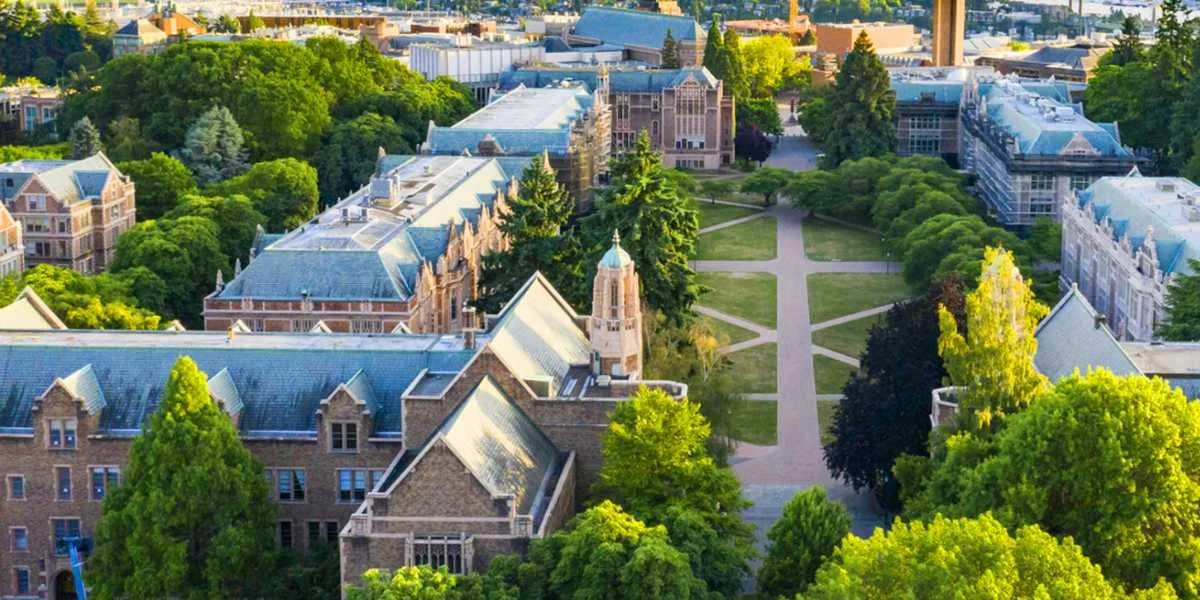
The University of Washington is the oldest university in Seattle and one of the largest universities in the Pacific Northwest. UW currently offers 18 colleges and schools, giving students a broad choice of disciplines and fields of study. The University of Washington consists of campuses in Seattle, Bothell, and Tacoma, along with a world-class medical center, serving the state and the region. Each year, UW inspires more than 60,000 students to learn from renowned experts in their fields. As a "best buy" public university and one of the world's most innovative universities, UW's goal is to make higher education accessible to all.
About the university
School data is compiled from public sources and may change. Confirm current tuition, deadlines and requirements with the university before applying.
At a glance
Acceptance rate 43%
Tuition and fees $18,405
SAT range 1260-1510
Application deadline Nov. 15
Undergraduate enrollment 32,244
Student-faculty ratio 20:1
Location 1400 NE Campus Parkway, Seattle, WA, 98195-4550
School type Public (4-year)
In-state tuition
$973
Out-of-state tuition
$18,405
Room and board
$18,405
Graduation rate
71%
Student-faculty ratio
20:1
Gender ratio
54:47
Alumni starting salaries
Architecture and Related Services
+
Area, Ethnic, Cultural, Gender, and Group Studies
+
Biological and Biomedical Sciences
+
Business, Management, Marketing, and Related Support Services
+
Computer and Information Sciences and Support Services
+
Education
+
Engineering
+
Health Professions and Related Programs
+
Student body
First-year diversity
White
34%
Hispanic
13%
Asian
27%
Black
8%
Inside the school
The University of Washington attracts outstanding students and researchers from around the world with its academic excellence, broad research scope, and deep tradition of innovation. The campus is beautifully landscaped, combining Gothic architecture with modern facilities and fostering a rich academic atmosphere. As a core institution in Seattle, a hub of technology and business, the University of Washington works closely with tech giants such as Amazon and Microsoft, offering abundant internship and employment resources. Its programs also cover cutting-edge fields such as artificial intelligence and genetic science, giving students the chance to take part in frontier research and supporting their future career development.
We will examine the University of Washington's distinctive appeal from several perspectives, highlighting the school's core features and its academic and cultural strengths. Click the button below to view the full introduction to the university.
01. Location
02. A Gothic-Style Campus of Cherry Blossoms
03. Abundant Career Opportunities
04. One of the Most Beautiful Libraries in the United States
05. Major Inventions Created at the University of Washington
06. One of the Best Public Business Schools in the United States
07. UW and Its Huskies
08. The Quarter System at the University of Washington
09. The University of Washington's Distinctive Admissions Policies
10. The Nationally Top-Ranked Allen School of Computer Science
Most popular majors
Computer and Information Sciences and Support Services
12%
Social Sciences
12%
Biological and Biomedical Sciences
10%
Business, Management, Marketing, and Related Support Services
10%
Engineering
9%
Health Professions and Related Programs
6%
Psychology
5%
Mathematics and Statistics
4%
Multi/Interdisciplinary Studies
4%
Physical Sciences
4%
Graduate programs
Business Analytics
Business Analytics
Program Overview
The Foster School of Business at the University of Washington offers a Business Analytics program ranked fifth in the nation. This is a 12-month STEM Master of Science in Business Analytics degree. In this program, students learn to combine data analysis with storytelling to have a major impact on an organization's decision-making process, and to apply technical skills and concepts to real-world challenges. The school's course schedule offers flexibility, and students can choose evening and weekend classes.
Degree Type
Master of Science (M.S.) in Business Analytics (MSBA)
Program Length
One-year full-time program
Source: University of Washington Master of Science in Business Analytics
Application Requirements
Video Interview
In the online application, students are asked a set of random questions. For each question, students have some time to prepare and then 1 minute to answer. In total, students need to spend 15-20 minutes recording video interview answers.
GRE/GMAT
GMAT: school code 459-75-19
GRE: school code 4854
Although the school does not require the GMAT or GRE, based on data the school has provided in the past, most MSBA applicants do submit test scores.
However, if you do not have standardized test scores, please make sure you meet any one of the following conditions:
1) A cumulative grade point average (GPA) of 3.3 or higher on a 4.0 scale, with grades in quantitative courses also at 3.3 or higher on a 4.0 scale.
2) A bachelor's, master's, or advanced degree in a STEM field (i.e., science, technology, engineering, statistics, economics, finance, information systems, mathematics) with strong academic performance.
3) Completion of at least four quantitative or analytical courses at the 300 to 600 level (or U.S. equivalent).
4) Two or more years of professional work experience demonstrating strong quantitative or analytical skills.
GPA
The school requires a student GPA of 3.0 or above, along with exposure to R, Python, Excel, and SQL.
Background Assessment
Students need to complete the "self-assessment of qualifications" section of the application to describe their technical skills. In no more than two sentences, describe your experience, relevant coursework, and/or knowledge in the following areas. If none, write "N/A."
Mathematics, Probability and Statistics
Information Technology/Systems
Programming languages (e.g., R, Python, SQL)
MS Excel
Data and database management
Language Requirements
If your native language is not English, you need to submit proof of English proficiency with your application.
TOEFL iBT: minimum score requirement is 92 iBT / 580 PBT, but a score of at least 100 is recommended. School code 4854. IELTS: minimum score requirement is 7.0, but a score of at least 7.5 is recommended. The University of Washington may take 21 days to process scores, so please take the test as early as possible before the application deadline.
Duolingo English Test: minimum score requirement is 120, but a score of at least 125 is recommended. The school requires students' official scores to be sent directly from Duolingo to the University of Washington.
For more information about language requirements, you can read the University of Washington International Applicants page.
In addition to the program-specific application requirements above, you can view the complete application requirements in the [Application Requirements] section of our website.
Source: University of Washington admissions
Graduation Requirements
Credit Requirements
Students need to complete 47 credits of coursework within 12 months.
Source: University of Washington MSBA Information session
Curriculum
Expand your technical skillset
Course, Course Number, Credits: Spreadsheet Modeling, BUS AN 507, 2; Probability and Statistics, BUS AN 510, 3; Programming Essentials, BUS AN 511, 2; Data Management & SQL, BUS AN 512, 2; Special Topics – Data Visualization & Storytelling, BUS AN 579, 2. Learn to think analytically
Course
Course Number
Credits
Customer Analytics
BUS AN 513
3
Analytics for Firm Decisions
BUS AN 514
3
Digital Marketing
BUS AN 515
3
Operations Research Data Analytics
BUS AN 516
3
Machine Learning Methods and AI
BUS AN 517
3
Special Topics – Pricing Analytics
BUS AN 579
3
Advance your leadership, teamwork, and communication skills
Course
Course Number
Credits
Leadership and Professional Development
BUS AN 513
2
Business Analytics' Leader Series
BUS AN 550
3
Business Analytics' Practicum
BUS AN 515
2
Gain a strong understanding of business
Course
Course Number
Credits
Finance and Accounting
BUS AN 500
3
Competitive Strategy
BUS AN 503
2
Operations and Supply Chain Management
BUS AN 506
3
Independent Study
BUS AN 516
N/A
Source: University of Washington curriculum
Career Development
The Foster School's EY Career Development Center offers MSBA students a variety of career-focused services. The school's team of career coaches provides one-on-one guidance to students, actively guiding and directing their career paths and creating plans for them. Career coaches also help students one-on-one with resumes and portfolios. In addition, each year MSBA invites recruiters from top companies to campus for mock interviews with students. Students have the opportunity to improve their interview skills and build connections with companies and business leaders in Seattle. The school also regularly holds on-campus career fairs each year, where students can connect with well-known companies in the U.S. and around the world. Students can also actively participate in career development events, alumni events, company visit days, and industry nights hosted by the school.
Source: University of Washington career service
Education Policy, Organizations and Leadership
Education Policy, Organizations and Leadership
Program Overview
The Education Policy, Organizations and Leadership (Edpol) program at the University of Washington offers master's and doctoral students the opportunity to collaborate with renowned education professionals both domestically and internationally. Through coursework and projects, students will master rigorous and innovative research methods, build strategic partnerships with practitioners and policymakers in the field of education, and work to advance equity and excellence in education systems and achieve systemic and sustained improvement. This process aims to cultivate students with deep professional knowledge and cross-system collaborative skills in educational leadership, contributing wisdom and innovation to the continuous development of education systems.
Degree Type
M.Ed in Education Policy, Organizations and Leadership
Sources:
UW Education Graduate Program
UW Edpol Program Information
Application Requirements
Language Proficiency
According to the UW Graduate School policy, if your native language is not English and you did not earn a degree in one of the following countries, you must submit proof of English language proficiency: United States/United Kingdom/Australia/Bahamas/Canada/Ireland/Jamaica/New Zealand/Singapore/South Africa/Trinidad and Tobago.
Acceptable test formats include: TOEFL, IELTS, Duolingo.
TOEFL minimum score: 80, recommended score: 92+. TOEFL school code: 4854
IELTS minimum score: 6.5, recommended score: 7.0+; Duolingo minimum score: 105, recommended score: 120+
IELTS mailing address: University of Washington All Campuses, Organisation ID 365, Undergraduate & Graduate Admis, Box 355850, Seattle, WA, 98105, United States of America
Undergraduate Prerequisite Background
The UW Graduate School requires a cumulative GPA of 3.0 for your most recent 90 graded quarter credits or 60 semester credits. However, faculty in the University of Washington's College of Education will still review your application holistically.
Letters of Recommendation
Three letters of recommendation are required for Education Policy, Organizations and Leadership.
Statement of Purpose
Your statement should address your goals, relevant experience, future plans, and how the specific program you are applying to meets your needs. Be sure to describe your personal experiences that have prepared you for the challenges of graduate school, such as academic interests, career goals, your fit with the program, and faculty interests. Master's statements are typically 1-2 pages.
Personal History Statement (Optional)
You may submit a personal history statement with your application to enhance your application. The personal history statement should address your intellectual growth and development, including and beyond your academic goals. It may address the following topics:
Educational, cultural, and economic opportunities and disadvantages you have experienced
How these experiences have influenced the development of your special interests, career plans, and future goals.
Any other topics relevant to the program page
Writing Sample
Applicants must submit an academic writing sample (e.g., a course paper, article, essay). This sample should demonstrate your ability to analyze or synthesize information and to think critically about information. The writing sample must be written solely by you. You may submit only one sample for faculty review. If you do not have an appropriate academic writing sample, the University of Washington recommends that you consider preparing a medium-length (10-12 pages) critical essay reviewing a book you consider relevant to your educational interests.
In addition to the special application requirements for this program described above, complete application requirements can be found in the corresponding [Application Requirements] section on our website.
Sources: UW Education School Graduate Admission
Graduation Requirements
Credit Requirements
A minimum of 45 credits of graduate coursework, all at the 400 level or above; of these, 18 credits must be at the 500 level or above.
No more than 6 graduate-level credits transferred from other academic institutions may be applied.
A maximum of 12 graduate non-matriculated (GNM) credits may be applied toward the master's degree.
Thesis option students must complete at least 9 thesis credits (EDUC 700).
Grade Requirements
A cumulative GPA of 3.0 is required for graduation.
All courses counted toward the degree must have a GPA of at least 2.7.
Thesis Requirements
Graduate students completing a master's degree in the College of Education should complete a "final capstone project." The capstone project may include a thesis, a project (broadly defined), or an exam or internship.
According to the Graduate School's definition, a master's thesis "demonstrates the graduate student's ability to conduct independent research and present the results in a clear and systematic form." The thesis is ultimately submitted to the Graduate School and published as "original research." "Original research" means that the student generates new knowledge through conceptual inquiry or empirical research. Conceptual inquiry involves synthesis and argumentation using theory and literature, while empirical research involves the analysis of quantitative or qualitative data.
The Graduate School, in partnership with UW Libraries, provides comprehensive resources for students writing, submitting, and publishing academic papers. These pages outline information and policies related to preparing a thesis, including formatting, deadlines, copyright and distribution decisions, and final graduation.
Internship Requirements
Graduate students completing a master's degree in the College of Education should complete a "final capstone project." The capstone project may include a thesis, a project (broadly defined), or an exam or internship.
The internship involves working with a specific organization to gain practical experience related to the student's professional interests and, at the end of the internship, reporting to the supervising instructor and second reader/committee member on what was learned. Students may choose to complete the internship over one year (approximately 10 hours/week), two quarters, or one quarter (approximately 30 hours/week). The student's work at the internship site should be determined and agreed upon by the student and the internship sponsor at the outset.
Sources:
UW College of Education Graduation Thesis versus Non-Thesis Options
UW College of Education Program Requirements
UW College of Education Degree Requirements
Course Introduction
Core Requirements
Course
Course Number
Credits
Race, Equity, and Leading Educational Change
EDLPS 565
3
Policy and Policymaking in Education
EDLPS 560
3
The Dynamics of Educational Organizations
EDLPS 550
4
One to two others from leadership, policy, or organizations
XX 3 XX 3 Supporting Coursework
Thematic focus courses anywhere in the college or university relevant to the student's primary interests
Course
Course Number
Credits
1-2 Foundational Courses (required)
EDLPS 520, 521, 522, 530, 538, 539, 540
3
Other Electives
Other courses include Methodological Foundations for Data Literacy and use in educational systems, etc.
For more information, please refer to the downloadable Course of Study Forum in UW College of Education Program Requirements.
Career Development
The University of Washington College of Education has more than 25,000 graduates across the state, nation, and world who are making a difference in society. These alumni will be the most valuable network resources on future career paths.
The College of Education is committed to supporting students and alumni in career planning and assessing career goals. Together with other UW departments, the college provides support to help students gain the skills and knowledge needed for career development and advancement. Students and alumni can access various resources, including networking events, workshops, and job/internship opportunities. At the same time, the college will fully prepare students for job searches, offering comprehensive services including resumes, cover letters, interviews, and negotiation.
The Career & Internship Center also supports the diverse career paths of UW graduate students, including posting numerous jobs and internships on the Handshake platform, opportunities and events to connect with alumni and employers, and one-on-one career advising by appointment.
Sources:
UW College of Education Graduate Service
UW College of Education Professional Development
Public Administration
Public Administration
Program Overview
The University of Washington's Public Administration program gives students distinctive skills to help improve public policy and lead change in public-sector organizations. Whether you want to build a career in the public and nonprofit sectors or plan to move toward a more socially responsible career path, the program turns the desire to change the world into career development that produces real impact and opens the door to a career filled with purpose. The Evans School is convinced that finding solutions to real-world challenges requires thinking innovatively, acting collaboratively, and leading effectively. The MPA curriculum gives students a foundation of knowledge and skills, ensures students have flexibility throughout their careers, and offers ample opportunity to delve deeply into areas of specialization at the University of Washington.
Degree Type
Master of Public Administration (MPA)
Program Length
Two-year full-time program
Source: UW Evans Master of Public Administration
Application Requirements
English Language Scores
Every applicant whose native language is not English must demonstrate English language proficiency. Applicants who meet the following three conditions may be exempt from this requirement:
A bachelor's, master's, or doctoral degree from a regionally accredited U.S. institution where English is the language of instruction.
A bachelor's, master's, or doctoral degree from a university in Australia, the Bahamas, Canada, Ireland, Jamaica, Kenya, New Zealand, Singapore, South Africa, Trinidad and Tobago, or the United Kingdom where English is the language of instruction. Students must have resided on campus while enrolled at the degree-granting institution.
If the applicant's bachelor's degree is from a country or region other than those listed above, official documentation from the applicant's bachelor's degree-granting institution must be provided showing that all instruction was conducted in English. At least three years of enrollment at the undergraduate institution is required, and the documentation must be submitted to the Graduate School. Acceptable documentation must be an official or certified letter from the undergraduate college, the university registrar, or the office of the examinations controller; alternatively, official transcripts, certified grade reports, or degree statements are also accepted if they specify English as the language of instruction.
Minimum official English test scores: TOEFL iBT 80 (TOEFL school code: 4854); TOEFL MyBest 80; Duolingo 105; IELTS 6.5.
GRE/GMAT
Applicants are not required to submit GRE scores. Applicants may optionally submit official scores as part of the application review process. Applicants who submit GRE scores should self-report them in the application; applicants who choose not to submit GRE scores in the application will not be disadvantaged.
GRE school code: 4854; Public Administration department code: 4801
Undergraduate Prerequisite Background
All applicants must hold a bachelor's degree and have a grade point average of at least 3.0 over the final 90 quarter credits (60 semester credits) of undergraduate study. The MPA admissions committee evaluates applicants based on their prior academic or professional knowledge of government and policymaking, their undergraduate coursework in mathematics, microeconomics, or statistics, and strong writing ability.
Resume
The resume must include relevant academic, professional, volunteer, and/or military experience; academic and/or professional honors, awards, or scholarships; leadership positions; organizations and clubs you belong to; and so on.
Statement of Purpose
In a statement of purpose of 750 words or fewer, describe:
Yourself and your experiences in the context of your decision to pursue an MPA degree and a career in public service
What you expect from the program in helping you achieve your career goals
Your academic background, extracurricular activities, professional experience, community and/or volunteer work, and any other factors relevant to your interest in public policy
Statement of Quantitative Purpose
The Statement of Quantitative Purpose form should describe how you believe you are or will be prepared for the quantitative courses in the MPA program (specifically PUBPOL 516, 517, 527, and 528). The admissions office encourages applicants to demonstrate one or more of the following:
Coursework in quantitatively intensive subjects such as economics, statistics, quantitative research methods, precalculus, calculus, linear algebra, chemistry, or physics at the undergraduate or graduate level. This coursework must be evidenced in transcripts uploaded to the online application. The "Schools Attended" section of the online application should include unofficial transcripts for the courses described.
Current and/or future coursework in quantitatively intensive subjects such as economics, statistics, quantitative research methods, precalculus, calculus, linear algebra, chemistry, or physics at the undergraduate or graduate level. This may include community college or other available courses, such as microeconomics, statistics and probability, and/or Algebra 1 at Khan Academy.
Current and/or past professional work requiring substantial quantitative and/or analytically intensive knowledge and skills (such as financial work, or positions conducting program evaluation or making policy recommendations). Describe the skills you applied in your analytical work and how these skills prepare you for your MPA studies.
Alternatively, if you majored or minored in a quantitative field as an undergraduate, state which major or minor you completed. This may include fields such as biology, chemistry, economics, engineering, mathematics, physics, and statistics.
In addition to the program-specific application conditions above, full application requirements can be found in the corresponding Application Requirements section of our website
Sources:
UW MPA Admissions
UW Graduate School English Language Proficiency Requirements
Graduation Requirements
Credit Requirements
To earn the Evans School Master of Public Administration (MPA) degree, students must complete 72 quarter credits of coursework, including core courses and electives, of which at least 60 quarter credits must be from the Evans School.
Internship Requirement
To earn the Evans School Master of Public Administration (MPA) degree, students must complete a capstone project and a 400-hour internship. The capstone project involves participating in a student consulting lab, completed in the second year, in which teams of Evans School MPA students are paired with regional public and nonprofit sector clients to address critical organizational issues. These projects help students apply classroom knowledge, build community networks, and create a portfolio.
Source: UW MPA Degree Requirements
Curriculum Overview
Core Courses
Management, Leadership, and Budgeting
Course
Course Number
Managing Politics & the Policy Process
PUBPOL 511
Managing Organizational Performance
PUBPOL 512
Financial Management and Budgeting
PUBPOL 522
Economics
Course
Course Number
Microeconomic Policy Analysis
PUBPOL 516
Microeconomic Management Analysis
PUBPOL 517
Quantitative Methods
Course
Course Number
Quantitative Analysis I
PUBPOL 527
Quantitative Analysis II
PUBPOL 528
Applications in Policy Analysis and Program Evaluation
Course
Course Number
Public Policy Analysis
PUBPOL 513
Program Evaluation
PUBPOL 526
The MPA program's electives span seven distinct areas:
PUBLIC POLICY ANALYSIS & EVALUATION
The Public Policy Analysis & Evaluation electives deepen students' analytical and evaluation skills beyond the core curriculum. These courses are designed to help students master the skills needed to carry out analysis and evaluation in a broad range of institutional settings, preparing students for careers in which they can apply these skills across a variety of policy areas.
ENVIRONMENTAL POLICY & MANAGEMENT
The Environmental Policy & Management electives give MPA students the opportunity to master the tools, methods, interdisciplinary perspectives, and substantive topic knowledge needed to become successful analysts, managers, and leaders in public, nonprofit, and private organizations addressing a wide range of environmental and natural resource issues.
INTERNATIONAL DEVELOPMENT
The International Development electives lay a foundation for students to address complex issues of poverty and development.
PUBLIC LEADERSHIP, MANAGEMENT, & DECISION-MAKING
The Leadership & Decision-Making electives cultivate Evans School students as people of integrity and reflection who advance the common good in institutions and policy. These courses focus on cultivating ethical and effective habits of mind, skilled deliberation, deployable frameworks for judgment, and personal self-awareness of values and character.
NONPROFIT MANAGEMENT & PHILANTHROPY
The Nonprofit Management & Philanthropy electives give MPA students the opportunity to develop the management and leadership skills and substantive topic knowledge needed to become successful managers and leaders in nonprofit, philanthropic, and social sector organizations.
PUBLIC FINANCE & BUDGETING
The Public Finance & Budgeting electives give students the opportunity to understand how finance works through management and policy perspectives. These courses emphasize effective resource management in complex environments.
SOCIAL POLICY
The Social Policy electives prepare students for work in government and nonprofit organizations in the design, implementation, management, and evaluation of education and social policy. Courses in this area develop students' ability to apply policy analysis and management tools to education and social policy issues.
Each area offers a very rich selection of different courses; see UW MPA Electives for further details
Source: UW MPA Degree Requirements
Career Development
The Evans School career development team is the bridge between students and employers, finding opportunities for students to work with industry leaders by applying the skills and knowledge learned in the classroom to real-world challenges. Relevant career experience is essential to every student's career and employability after graduation. The career development team works with students in a variety of ways to ensure they gain the experience and network needed for an impactful career in public service. From the first day of enrollment to one year after graduation, the Evans School career development team is here to serve. For more than 60 years, the Evans School has had a distinguished reputation in the Pacific Northwest and is trusted by public, private, and nonprofit organizations in the Pacific Northwest and beyond.
The Evans School alumni network spans 6 continents, 56 countries, 49 U.S. states and territories, and 684 cities worldwide. More than 5,500 alumni work at organizations such as the City of Seattle, the Obama Foundation, the Washington State Department of Ecology, and Mathematica Policy Research.
The University of Washington Career & Internship Center also supports the diverse career paths of UW graduate students, including posting a large number of jobs and internships on the Handshake platform, opportunities and events to connect with alumni and employers, and one-on-one career advising by appointment, among other services.
Source: UW Evans Career Development
Data Science
Data Science
Program Overview
The Data Science program at the University of Washington is designed to provide students with in-depth training in data science so they can succeed in this growing field. The program is offered each fall on the University of Washington campus, with evening classes.
Through industry-relevant coursework, students gain the skills to extract valuable insights from big data. In this program, students learn expertise in statistical modeling, data management, machine learning, data visualization, software engineering, research design, data ethics, and user experience to meet the growing needs of industry, nonprofits, government agencies, and other organizations. The courses are designed to build deep expertise in data science so that students can address the pressing demand for data insights and solutions across a range of fields.
Degree Type
Master of Science in Data Science
Program Length
One and a half years, full-time
STEM Designation
Yes
Source: UW Data Science Masters
Application Requirements
English Language Proficiency
All applicants whose native language is not English must demonstrate English language proficiency in order to be admitted to the University of Washington and must also demonstrate English language proficiency that meets the requirements of the MSDS program. The following are the primary ways to demonstrate the English proficiency required to apply to the MSDS program:
A bachelor's or graduate degree from a regionally accredited institution in the United States, the United Kingdom, Canada, Australia, or another country where English is an official language and the language of instruction.
Official documentation from the applicant's undergraduate institution confirming that all coursework was completed in English. This typically takes the form of a note on the transcript or a separate letter from the school stating only that "the language of instruction is English."
Submit English language test scores. Minimum score requirements: TOEFL iBT 106, with 25 in each section; TOEFL Home Edition and TOEFL MyBest scores are accepted; Duolingo 125; IELTS 7.5
TOEFL school code: 4854
GRE/GMAT
Applicants are not required to submit GRE/GMAT scores. There is no benefit to providing GRE or GMAT scores with the application.
Undergraduate Prerequisite Background
Each applicant must demonstrate computer science and mathematics skills through any of the following:
A major/minor in communications, computing, or mathematics courses.
Completed, graded, credit-bearing courses covering the listed skill areas.
A letter from a technical professional confirming mastery of these skills in a specific project.
For further details on undergraduate prerequisite courses, see UW Data Science Prerequisite
Undergraduate GPA
Applicants must have a GPA of at least 3.0 in the last 60 semester credits or the last 90 quarter credits, or roughly the equivalent of the last two years of credits (undergraduate and/or graduate).
If your GPA is below 3.0 in your last two years of full-time graded study but you are a strong candidate for this program, you may still be admitted. If this applies to you, use the optional essay section to explain the reasons for the lower GPA and why you are still likely to be a successful graduate student in this program despite the lower GPA.
Essays
Your application requires four short essays. These essays are your opportunity to explain your application to the Master of Science in Data Science program at the University of Washington. Your essays play an important role in the University of Washington's overall admission process, and the University of Washington expects your essays to be your own original work. You can read the full essay prompts on the University of Washington's essay questions page or in the MyGrad online application. The prompts are:
Essay 1: Why UW MSDS? (maximum 350 words)
Essay 2: Data Visualization (maximum 500 words)
Essay 3: Communication and Collaboration (maximum 350 words)
Essay 4: Diversity and Equity (maximum 500 words)
In addition to the program-specific application requirements above, you can find the complete application requirements in the [Application Requirements] section of our website
Sources:
UW Data Science Admission Requirements
UW Data Science International Students
Graduation Requirements
Credit Requirements
To earn the Master of Science in Data Science, students must complete 45 credits, including 8 core courses (40 credits) and a two-quarter capstone (5 credits).
Internship Requirement
In the final two quarters of the program, students gain hands-on experience working in teams to solve data science challenges faced by companies or nonprofits. At the end of the capstone project, the sponsoring organization is invited to a formal capstone event where students present their work. Capstone projects typically span a wide range of interest areas, including energy, agriculture, retail, urban planning, healthcare, marketing, and education.
Source: UW Data Science Master Curriculum
Curriculum
Course
Course Number
Data Visualization for Data Scientists
Data Visualization for Data Scientists
DATA 511
Human-Centered Data Science
Human-Centered Data Science
DATA 512
Data Management for Data Science
Data Management for Data Science
DATA 514
Software Design for Data Science
Software Design for Data Science
DATA 515
Scalable Data Systems & Algorithms
Scalable Data Systems & Algorithms
DATA 516
Introduction to Statistics & Probability
Introduction to Statistics & Probability
DATA 556
Applied Statistics & Experimental Design
Applied Statistics & Experimental Design
DATA 557
Statistical Machine Learning for Data Scientists
Statistical Machine Learning for Data Scientists
DATA 558
Data Science Capstone I – Project Preparation
Data Science Capstone I – Project Preparation
DATA 590
Data Science Capstone II – Project Implementation
Data Science Capstone II – Project Implementation
DATA 591
Special Topics in Data Science
Special Topics in Data Science
DATA 598
Sources:
UW Data Science Master Curriculum
UW Data Science Curriculum Plan
Career Development
MSDS alumni work at top companies, including JPMorgan Chase & Co., Parsons Corporation, IBM, Costco IT, Toyota, Northrop Grumman, and Zillow. Graduates also work at leading nonprofits such as Seattle Children's Hospital and the Institute for Health Metrics and Evaluation.
The MSDS program provides students with dedicated career services, including a data science career fair held every February. Every February, the MSDS program hosts a data science career fair where MSDS students can connect with industry recruiters early. In the past, employers attending the fair have included large corporations, mid-sized companies, startups, and nonprofits. In addition, the MSDS program provides students with personalized career support and numerous opportunities to connect with employers, such as industry talks, data science panels, resume reviews, technical interview workshops, alumni referrals, networking dinners, social gatherings, and professional event support.
Source: UW Data Science Master Career
Computer Science and Engineering
Computer Science and Engineering
Program Overview
The University of Washington's Combined B.S./M.S. Program in Computer Science and Engineering is designed for students to complete a Bachelor of Science in CS or CE and a Master of Science in CSE in approximately five years of study. In practice, students take varying amounts of time to complete the program depending on when they enter the Allen School and how many credits they have earned. The program is designed to add breadth and depth to students' studies and to prepare them more fully for their careers, and its design drew on feedback from faculty, industry associations, and CSE students.
Students in the Allen School's B.S./M.S. program earn the master's degree after completing approximately one year of coursework beyond the standard bachelor's degree requirements. Most students are admitted in their junior year after completing the 300-level requirements, which allows them to plan their senior-year and graduate CSE requirements as a coherent two-year plan. The application process for the B.S./M.S. program is highly competitive, with approximately 60 applicants admitted each year.
Degree Type
Combined B.S./M.S. Program in Computer Science & Engineering
Source: University of Washington BS/MS CSE Academics
Application Requirements
Undergraduate Prerequisite Background
Must be a current undergraduate in the Allen School's CS or CE major. Students who have already graduated are not eligible to apply.
Junior standing or above (90 or more credits).
A grade point average of 3.0 or higher.
Must have completed CSE 311, 312, 332, and 351. Courses in progress during spring quarter also count.
Statement of Purpose
Suggested length: 750-1000 words. Topics to address include (1) Why are you interested in pursuing the Combined B.S./M.S. program? (2) Which specific aspects of the field are you interested in, such as research areas? (3) Why are you a good fit for the program?
References
Please list 2 faculty members as references; you must have 2 references who can attest to your coursework and/or research ability. One of the references must be from the Allen School.
MyCSE:
Confirm that your MyCSE profile is up to date, including scholarships, co-ops/internships, and research.
In addition to the program-specific application requirements above, the full application requirements can be found in the Application Requirements section of our website.
Source
University of Washington BS/MS CSE Application
Degree Requirements
Credit Requirements
Students must complete 40 credits to graduate. Of these, 36 credits must be approved 400-level core courses and 500-level courses; at least 32 credits must be in Computer Science and Engineering courses; and at least 20 credits must come from 500-level Computer Science and Engineering 4-credit-level courses or other approved 500-level Computer Science and Engineering courses.
You can begin working toward the master's degree during your undergraduate years.
Up to 12 master's degree credits earned after admission to the B.S./M.S. program and before completion of the bachelor's degree may count toward the master's degree, but these courses may not be used to satisfy any bachelor's degree requirements.
Thesis Requirements
Students may apply up to 12 CSE 600 research credits toward the master's degree, but they must complete a thesis for these credits to count toward degree requirements. Specifically:
The thesis must use standard thesis formatting (e.g., single column, double-spaced). The LaTeX University of Washington thesis format (uwthesis.cls) is recommended.
The thesis must be at least 20 pages long (assuming double-spaced formatting). This works out to approximately 6,000 words.
The thesis introduction should be understandable to someone with an undergraduate education in computer science.
The thesis should be submitted by the last day of final exams in the graduating quarter. The thesis can be submitted through the MyCSE portal. Then, please notify your adviser that you have submitted the thesis so that they can log in and approve it.
For more details on thesis requirements, see the UW BS/MS FAQ.
Internship Requirement
Students must complete an approved internship/co-op or at least 3 credits of Computer Science and Engineering research.
Source: University of Washington BS/MS CSE Degree Requirements
Course Information
The courses available to each student vary by quarter and individual preparation. Students may choose courses freely in accordance with degree requirements, and the school provides Degree Planning Tools to help students plan their courses.
Most courses can be chosen from the following areas:
Master's courses within doctoral courses (known as "breadth" courses)
Professional Master's Program courses (generally, up to 2 PMP courses may be taken in the BSMS program)
Master's versions of undergraduate courses (listed as "CSE M" on the time schedule)
400-level courses approved as core courses
Courses satisfying one of the check-box requirements, such as the capstone
Below is a possible schedule for completing the master's requirements:
Complete all master's requirements within one year. This is done by taking three graded courses per quarter, plus one to two credits of colloquium/research seminar per quarter. One course per quarter may be replaced by research.
Take 12 credits during the undergraduate years, plus one year of master's courses. Then take two graded courses per quarter or one graded course plus research. Graduate students serving as teaching assistants or research assistants generally take two courses and two seminars per quarter.
In addition, undergraduate courses may be applied to master's degree requirements if they meet all of these criteria:
The course must be taken after admission to the B.S./M.S. program.
The course must be at the 400 or 500 level.
The course must be entirely beyond all undergraduate requirements, including the 180 or 225 credits required for graduation.
Source: University of Washington BSMS CSE Degree Planning
Career Development
The University of Washington Allen School is committed to working with students to explore all opportunities and options after graduation. The collective resources of the Allen School, the College of Engineering, and the University of Washington are all designed to help students achieve their goals after graduation. The Allen School offers students diverse paths for career exploration; students can explore their goals through PathwayU and connect those goals to academic plans and internship opportunities.
Students can also research specific companies and internship programs for additional insight and read reviews from past employees in Vault Guides. Through the University of Washington Career & Internship Center, students can explore career exploration communities related to interests, identities, and affiliations, and can also sign up for alerts from the UW Tech/Data/Game interest community and view related news stories, announcements, and the latest information.
In addition to specific company websites (be sure to check the websites of Allen School affiliate partners), there are general job boards for finding and researching jobs and internships, such as Handshake, the University of Washington's online job and internship database; because new jobs and internships are posted regularly, students can check it often. For more support, or to discuss any career development-related questions, the school encourages students to meet with their academic adviser through an appointment for advising and/or a booking at the school's resume lab.
Overall, the Allen School offers students services including but not limited to the following:
1) Tech Talks, where you can connect with potential employers
2) Affiliates recruiting fairs held in autumn and winter quarters
3) Before each Affiliates recruiting fair, the University of Washington holds a number of preparation events, including
Employer panels that include industry affiliates, preparing students for the interview process
Resume review workshops
Technical interview coaching to help students prepare for mock and actual technical interviews
Mock technical interviews, in which engineers, hiring managers, and other technical interviewers volunteer as mock interviewers to give students feedback on mock technical interviews.
5) The University of Washington Career Center and the College of Engineering Career Center offer many other employment-related services, such as career counseling, workshops, and individual career planning appointments.
Source: University of Washington Allen School of Engineering Career Development
Campus life
Transportation
Nearby Airports
Seattle-Tacoma International Airport (SEA)
SEA is one of the busiest airports in the Pacific Northwest and ranks among the top ten airports in the United States. It is a major hub for flights to and from Asia and Europe. It serves several major airlines, including Alaska Airlines, Delta Air Lines, and United Airlines, offering numerous domestic and international flights connecting cities around the world.
Distance from campus: 23–25 miles
Campus to airport:
By car or rideshare:
Typically 20–30 minutes. It may take longer during heavy traffic.
By public transit:
You can take bus routes 45/67/31/32/372, transfer at various bus stops to the 1 Line light rail to the airport, and arrive at SEA.
Paine Field Airport (PAE)
PAE is a relatively small airport that mainly serves regional and scheduled commercial flights, offering convenient travel options. The airport also serves general aviation, including private aircraft, charter services, and some flight training and aviation maintenance activities. In addition, it is one of Boeing's major manufacturing sites.
Distance from campus: 34–45 miles
Campus to airport:
By car or rideshare:
Typically 25–35 minutes. It may take longer during heavy traffic.
By public transit:
You can take the appropriate bus routes and transfer to the light rail to reach the airport. (You can visit the websites of Seattle's public transit system, usually King County Metro, and Seattle's light rail system, known as Sound Transit Link Light Rail, to find information on relevant bus routes and stops.)
Nearby Train Stations
Seattle King Street Station
Seattle King Street Station is a historic building constructed in 1906 and designed in a style similar to Italian Renaissance architecture. Its distinctive clock tower and spires make it one of the landmarks of downtown Seattle. The station is primarily operated by Amtrak and offers long-distance rail service, including trains to destinations such as California, Oregon, Ohio, and Chicago.
Campus to train station:
By car or rideshare:
Typically 10–20 minutes. It may take longer during heavy traffic.
By public transit:
You can take bus routes 372/45/67/31/32 and then transfer to the 1 Line to reach Seattle King Street Station.
City Public Transit
Light Rail
Seattle's light rail system is operated by Sound Transit and is known as Link Light Rail. There is a light rail station near the University of Washington, the UW Station, which connects downtown, the airport, and nearby areas.
Bus Services
King County Metro: King County Metro is the main bus service operator in the Seattle area. Multiple bus routes serve the area near the University of Washington, providing service to downtown and surrounding communities.
Community Transit: Community Transit is the bus service operator for the Everett and Snohomish County areas, providing service connecting northern Seattle and the area near the University of Washington.
Seattle Center Monorail
The Seattle Center Monorail connects downtown Seattle with attractions such as the Space Needle. Although its coverage is limited, it is an interesting transportation option for visitors and short trips within the city.
Safety
The University of Washington offers numerous resources to help keep students safe while studying and living on campus:
UW Police Department
The University of Washington Police Department (UWPD) is dedicated to maintaining the safety of the campus community and is on duty 24 hours a day. If you encounter an emergency or are the victim of a crime, contact the UW Police Department.
Emergency situations
To stay informed about emergencies occurring on campus at any time, register for "UW Alert." UW Alert is a tool for issuing alert notifications to students, faculty, and staff; if an emergency or event occurs that could disrupt normal campus operations, UW Alert will promptly issue an alert notification.
Getting home safely
UW safety escort services, such as the Husky NightRide shuttle and Husky NightWalk, help students get home safely at night.
The NightRide shuttle picks up and drops off students at eight campus locations on weekdays and lets them off near their destinations.
The Husky NightWalk program provides uniformed security escorts to walk students to campus locations or nearby residences every day of the week.
Sexual assault resources
The University of Washington is committed to preventing and responding to sexual misconduct and provides support and resources for victims affected by sexual assault, domestic violence, stalking, or sexual harassment. For those who have experienced sexual misconduct, the University of Washington offers resources that can help them obtain confidential support, address safety concerns, find medical and counseling providers, and learn how to report sexual assault.
Rape Aggression Defense (RAD)
RAD is a free program offered by the UW Police Department that trains women in awareness, risk reduction, and self-defense in the event of an attack.
SafeCampus
SafeCampus is the UW's violence prevention and response program and can help you respond to a variety of situations, whether they affect you or someone you know, including threats, stalking, sexual assault, relationship violence, harassment, suicide concerns, workplace violence, and more.
Campus safety and emergency resources
For more information and resources about UW campus safety, visit the UW campus safety and emergency resources page.
Source: UW Safety
Dining
On-Campus Dining
The University of Washington campus has more than 30 different dining locations, including restaurants, cafés, food trucks, food courts, and grocery stores. For example:
By George: Primarily offers Starbucks coffee and tea, Alki Bakery pastries, fresh hot sandwiches, and soups. It also offers a full-service smoothie and acai bar, as well as a variety of snacks, sandwiches, and salads.
Center Table: Located in the center of four new HFS residence halls on the scenic north campus, it offers seven innovative food stations. Plant-based options are available.
Cultivate: A unique, sustainability-based gastropub-style dining concept focused on sourcing fresh local food. It introduces special dishes each quarter, with ingredients coming directly from the UW farm.
Meal Plan
For students choosing to live in a Residence Hall or Apartment, the University of Washington offers different Meal Plans. Whether you live on west campus or north campus, dining and grocery options are available nearby.
Meal Plan requirements:
For students living in a Residence Hall:
Unless you live in Mercer Court, Nordheim Court, Stevens Court, or a studio apartment, all students living in residence halls must purchase a dining plan.
For students living in an Apartment:
A Meal Plan is not mandatory. However, students who choose to purchase a Meal Plan can enjoy a 10% discount at District Market.
Meal Plan prices
For students living in a Residence Hall:
The University of Washington Meal Plan has 6 different levels, with prices ranging from $1,123 to $2,512. You can choose according to your needs. At the beginning of each quarter, the amount you select is deposited into your dining plan for your use.
For students living in an Apartment:
The University of Washington Meal Plan has 6 different levels, with prices ranging from $1,060 to $2,512.
Sources:
UW Dining on Campus
UW Housing and Food Services
UW Residence Hall Dining Plan
UW Apartment Dining Plan
Housing
The University of Washington does not require students to live on campus, but 70% of first-year students choose to do so.
If you choose to live on campus, before applying you will also need to:
Determine your preferred contract term: undergraduates can apply for a 9-month residence hall or a 12-month apartment.
Decide which building, room type, and bathroom type you prefer
Decide whether you are interested in a living-learning community
Decide whether you are interested in gender-inclusive or mixed-gender rooms
Residential colleges
The residential colleges open to undergraduates with 9-month contracts include 11 residential colleges such as Alder Hall, Elm Hall, and Hansee Hall.
The residential colleges open to undergraduates with 12-month contracts include 2 residential colleges, Cedar Apartments and Commodore Duchess.
On-campus housing application steps
STEP 1: Complete your HFS student profile. Go to the "My HFS" homepage.
Your HFS student profile will determine whether you are eligible to apply for housing and will unlock your application on the appropriate date.
STEP 2: Submit your housing application. When your application is available, you will see it on the "My HFS" homepage. You can then complete your housing application. Sources:
UW Student Housing
UW undergraduate communities
UW Apply For Housing
Admissions
Acceptance rate
43%
Average GPA
3.8
SAT range
1260-1510
ACT range
30-34
SAT / ACT
Admissions data
Admission to the University of Washington is more selective, with an acceptance rate of 53%.
Half of the applicants admitted to the University of Washington have an SAT score between 1220 and 1470 or an ACT score between 29 and 34.
However, one quarter of admitted applicants scored above these ranges and one quarter scored below these ranges.
The application deadline is November 15, and the University of Washington application fee is $80.
University of Washington admissions officials consider a student's GPA to be a very important academic factor.
University of Washington admissions officials do not consider an applicant's high school class rank or letters of recommendation.
Applicants
Admitted
Female applicants
Male applicants
Female admits
Male admits
Waitlist offered
Yes
Students on waitlist
4,122
Students accepting a place
7,915
Admitted from waitlist
2,985
Application requirements
01.
University of Washington: Academic Preparation and Academic Performance

Although admissions officers at the University of Washington consider many factors when reviewing applications, applicants' academic preparation and academic performance remain key areas of focus. GPA, standardized test scores, and the courses taken in high school are all indicators admissions officers use to assess academic ability. Having taken AP or IB courses in high school, or having taken courses beyond the university's admission requirements, is a plus.
02.
University of Washington: Personal Achievements and Personal Qualities
Outstanding personal achievements and personal qualities strengthen the overall application. These include, but are not limited to: active participation in community service, with leadership demonstrated through that service; demonstrating a sense of responsibility in different settings such as family, community, and workplace; completing a college-preparatory education in the face of significant personal adversity; and demonstrating cultural perspective or a unique viewpoint or experience.
Application checklist
01.
Apply through the Coalition Application system
02.
Coursework: The Coalition Application system requires applicants to report the courses they completed in high school.
03.
SAT or ACT scores (although the University of Washington does not require international students to submit SAT or ACT scores, if applicants have taken the tests, the school encourages them to submit their scores to demonstrate their academic ability)
04.
TOEFL or IELTS language scores.
If an international student received their high school education in Australia, Canada (English-speaking regions), the United Kingdom, Ireland, New Zealand, or the United States, the language score requirement may be waived. Note that being born in these places without receiving high school education there does not waive the language requirement. The school's minimum TOEFL iBT requirement is 76, but the recommended score is 92 or above. The minimum IELTS requirement is 6, but the recommended score is 7 or above.
05.
An $80 application fee; to request a fee waiver, an additional application must be submitted
06.
Official high school transcripts (calculated on a 4.0 scale, the University of Washington considers a 2.0 GPA to be a C, and applicants' high school grades must be above a C)
07.
Note: The University of Washington does not require letters of recommendation and does not schedule interviews during the application stage.
Application deadlines
Deadline
Date
Regular Decision
Nov. 15
RD notification
March 15
Transfer requirements
01.
Applicants must complete specific academic subject credit requirements before enrollment
4 credits of English, 3 credits of mathematics, 3 credits of social science, 2 credits of world language, 2 credits of science, 1 credit of advanced mathematics quantitative coursework, 0.5 credit of art or visual and performing arts, and 0.5 credit of academic electives. Standard high school coursework generally satisfies these requirements; if high school coursework does not meet all requirements, college coursework may be used to supplement them. At quarter-system colleges, 5 credits equal 1 high school credit. At semester-system colleges, 3 credits equal 1 high school credit.
Transfer checklist
01.
Personal Statement
The personal statement should be a comprehensive narrative essay outlining significant aspects of the applicant's academic and personal history.
02.
High School and College Transcripts
International students: Submit unofficial high school transcripts with the online application. Only official college transcripts need to be sent to the University of Washington. Make sure your full name appears on all transcripts. Transcripts from Washington state community college students should be sent electronically; students from other colleges should mail their transcripts to the Office of Admissions.
03.
$90 Application Fee
04.
TOEFL / IELTS Scores
Tests must be taken by February 15, and scores must be sent directly from the testing agency to the University of Washington. Minimum TOEFL score is 76, recommended 92; minimum IELTS score is 6, recommended 7. TOEFL code is 4854. IELTS scores should be sent to the Office of Admissions. Students with an SAT Evidence-Based Reading and Writing score of 580 or an ACT English score of 22 are exempt from the TOEFL/IELTS requirement; SAT/ACT scores must be sent directly from the testing agency to the university. Students who earned a grade of B or higher in all English writing or literature courses during four years of U.S. high school are exempt from the TOEFL/IELTS requirement.
05.
Admissions Office Mailing Address
Regular mail: University of Washington Office of Admissions Box 355852 Seattle, WA 98195-5852 Express mail: University of Washington Office of Admissions 1410 NE Campus Parkway— 225 Schmitz Hall Seattle, WA 98195-5852
06.
Note: International students are not required to submit SAT/ACT scores. There is no interview for transfer applications, and letters of recommendation and portfolios are not required.
Transfer deadlines
Deadline
Date
Fall application deadline
Feb.15
Similar universities
Virginia Tech 210 Burruss Hall, 800 Drillfield Dr., Blacksburg, VA, 24061-0131Rutgers University--New Brunswick 83 Somerset St, New Brunswick, NJ, 008901-1281The Pennsylvania State University 201 Old Main, University Park, PA, 16802-1503Stony Brook University--SUNY 310 Administration Building, Stony Brook, NY, 11794-0701Texas A&M University JKW Administration Building, Suite 200, College Station, TX, 77843-1248University of Massachusetts—Amherst 374 Whitmore Building 181 Presidents Drive, Amherst, MA, 001003
Admissions FAQ
What is the acceptance rate at University of Washington?
The reported acceptance rate is 43%. Acceptance rates vary by applicant pool and application cycle; confirm the current figure with University of Washington.
What SAT scores does University of Washington expect?
The reported SAT range is 1260-1510. Test-optional and score-reporting policies can change by application cycle; check the university's official admissions page before applying.
When is the application deadline at University of Washington?
The listed Regular Decision deadline is Nov. 15. Deadlines can vary by program and application cycle; confirm the exact date with the university.
How much does University of Washington cost?
The listed tuition and fee figure is $18,405. Costs vary by residency, programme and academic year; confirm current costs with the university.
Where is University of Washington located?
University of Washington is located at 1400 NE Campus Parkway, Seattle, WA, 98195-4550.
Planning your application?
Build a school list around your profile.
Ivy Elite advisors help students compare programs, plan coursework and prepare applications for U.S. universities.