


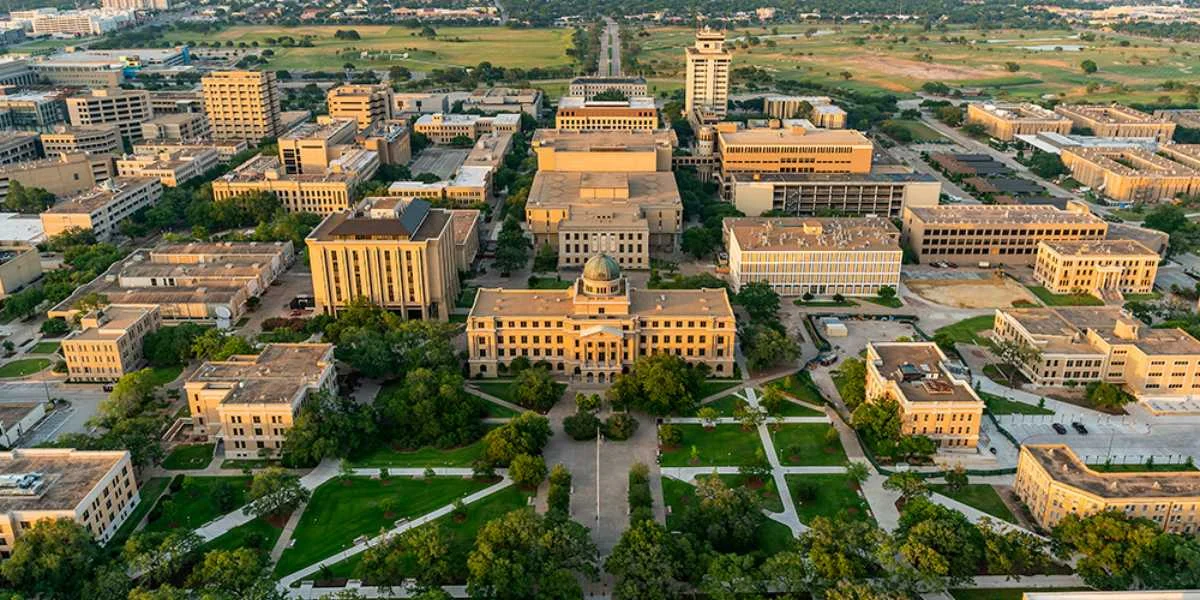
Texas A&M University has 12 undergraduate colleges and 9 graduate colleges. A jewel of Texas, it is known for outstanding education and research in fields such as agriculture, engineering, science, and business. The university has an excellent faculty and modern teaching facilities, and is dedicated to preparing students to become future leaders and innovators. Its undergraduate and graduate colleges offer a rich array of academic programs and degree options, giving students broad room for growth.
About the university
School data is compiled from public sources and may change. Confirm current tuition, deadlines and requirements with the university before applying.
At a glance
Alumni starting salaries
Student body
Most popular majors
Graduate programs
Finance
Finance
Program Overview
The Finance program at Texas A&M University is one of the nation's top finance departments, and its goal is to provide students with the theoretical and empirical tools needed to achieve a high level of expertise across all areas of finance. The program and its close corporate relationships will give you the knowledge, skills and experience needed for a successful career. All applicants must be current undergraduates at Texas A&M University, and coursework centers primarily on finance and accounting.
Degree Type
Master of Science in Finance (MSF)
Program Length
1 year
Source: Texas A&M University Master of Science in Finance
Application Requirements
GPA
Applicants must have a GPA of no lower than 3.0
GRE
The quantitative section of the GRE must be at or above the 50th percentile
Admission Background
All applicants must be current undergraduates at Texas A&M University. Students in engineering, other STEM fields, economics and non-finance business majors are encouraged to apply in their sophomore year. A small number of places are reserved for upperclassmen.
In addition to the program-specific admission requirements above, the complete application requirements can be found in the corresponding Application Requirements section of our website
Source: Texas A&M University Master of Science in Finance Application Requirements
Graduation Requirements
Credit Requirements
Students must complete 36 credit hours, including 8 required courses and 3 elective courses
Internship Requirement
Students must complete a six-credit internship course (FINC 601)
Source: Texas A&M University Master of Science in Finance Graduation Requirements
Curriculum
Prerequisites
No prerequisite courses are required at the time of application. Students who are admitted and begin the MSF must complete the prerequisite courses by the end of the spring semester at Texas A&M University College Station following their application. AP/transfer credit is accepted.
Accounting Principles I
ACCT 209/229/640* |
3 credits
A grade of B or above is required
Micro (or Macro) Economics
ECON 202 (or ECON 203)
3 credits
A grade of B or above is required
Curriculum
Students must complete 36 credit hours, including 8 required courses and 3 elective courses
Required Courses
Course | Course Number | Credits: Financial Statement Analysis I | ACCT 327 | 3; Financial Statement Analysis II | ACCT 328 | 3; Financial Reporting & Analysis | ACCT 647 | 3; Financial Analysis Practicum | FINC 601 | 6; Corporate Finance | FINC 602 | 3; Investments | FINC 603 | 3; Valuation & Financial Marketing | FINC 605 | 3; Statistical Foundation of Data Analytics or CFA | SCMT 611 or FINC 685 | 3
Source: Texas A&M University Master of Science in Finance Curriculum
Career Development
The school offers world-class career development and management and has a strong record of helping MSF students find jobs before graduation. The employment rate at graduation is 99%, and average first-year compensation is $100,00 - 156,000.
At Mays Business School, alumni make an unparalleled contribution to the school's success and to the success of future generations of Mays students. The school offers many opportunities to stay involved. Whether you are a recent graduate or an experienced professional, the school hopes to accompany you on your life's journey.
Sources:
Texas A&M University Master of Science in Finance Career Development
Texas A&M University Master of Science in Finance Alumni
Computer Science
Computer Science
Program Overview
The master's degree in Computer Science at Texas A&M University is a research-oriented degree covering areas of computer science including theory, systems, human-computer interaction and data science. After graduation, students in the program can take part in outreach and recruiting events, including the National Science Foundation Graduate Research Fellowship Program and Research Laboratory Day, to advance their careers.
Degree Type
Master of Science in Computer Science (MSCS)
STEM Designated
Yes
Source: Texas A&M University MSCS
Application Requirements
Language Scores
Graduate applicants from other countries must meet the same admission requirements as U.S. applicants. In addition, applicants must demonstrate the ability to read, write, speak and understand English. Students whose native language is not English may take the TOEFL or IELTS Academic English test.
Applicants from non-English-speaking countries must provide a TOEFL iBT score of at least 80, a TOEFL Essentials score of 8.5, or an IELTS overall score of at least 6.0 to be eligible to apply to graduate programs and obtain the documents needed for a visa application.
Texas A&M University does not accept MyBest TOEFL scores. The English language proficiency requirement may be waived if the applicant completed all credits for a bachelor's degree or higher in the United States, or achieved a score of 146 or higher on the verbal section of the GRE. Some departments reserve the right to require TOEFL/IELTS scores even if one of the above conditions would waive this requirement. The institution code is 6003.
In addition to the program-specific admission requirements above, the complete application requirements can be found in the corresponding Application Requirements section of our website
Source: Texas A&M University MSCS Application Requirements
Graduation Requirements
Credit Requirements
Students must complete at least 30 credit hours
Grade Requirement
Students must maintain an overall grade point average of 3.000 or above
Thesis Requirement
Students must submit an acceptable thesis to receive the Master of Science degree. The completed thesis must reflect a comprehensive understanding of the relevant literature and clearly express, in English, the problem, methods, significance and results of the student's original research. Thesis preparation guidelines are provided in the Thesis Manual, which is available on the Graduate and Professional School website.
Sources:
Texas A&M University MSCS Graduate Grade Requirements
Texas A&M University MSCS Graduation Requirements
Curriculum
Students must complete at least 30 credit hours, specifically including:
At least 18 credit hours of graduate Computer Science and Engineering (CSCE) courses (excluding CSCE 681, 684, 685 and 691).
Three CSCE breadth courses, choosing one from each group: Theory (627, 629), Systems (605, 611, 613, 614 and 678) and Software (604, 606, 634, 655, 656, 670, 671, 672 and 713). A grade of B or above is required in these courses. These courses may count toward the 18 credit hours of graduate CSCE courses.
At most one 3-credit 400-level undergraduate CSCE course approved by the graduate advisor. This course does not count toward the 18 credit hours of graduate-level CSCE courses.
At most 6 credit hours of non-CSCE graduate-level courses (excluding 681, 684, 685 and 691).
1 credit hour of CSCE 681 (Graduate Seminar).
Three to six credit hours of CSCE 691 (Research).
At most three credit hours of CSCE 685 (Directed Studies). The combination of 685 and 691 cannot exceed seven credit hours.
Source: Texas A&M University MSCS Curriculum
Career Development
The Texas A&M University College of Engineering holds multiple outreach and recruiting events to promote graduate education opportunities.
Outreach: National Science Foundation Graduate Research Fellowship Information Session
Each academic year, the College of Engineering, together with the Texas A&M Engineering Experiment Station (TEES) Research Development Office, co-hosts a National Science Foundation Graduate Research Fellowship Program (NSF GRFP) information session to help applicants prepare and submit strong fellowship applications.
Outreach: Research Laboratory Day
Research Laboratory Day provides graduate and postdoctoral engineering students with an opportunity for employment at national and private laboratories.
Source: Texas A&M University MSCS Career Development
Computer Engineering
Computer Engineering
Program Overview
The Computer Engineering program at Texas A&M University draws on both electrical engineering and computer science, with an emphasis on hardware/software systems engineering. The degree covers hardware/software systems engineering grounded in electrical engineering and computer science, delivered through projects and coursework. Students do not need to complete a thesis or a final examination to earn the degree. After completing the Master of Science in Computer Engineering, Texas A&M students may submit a letter of intent to apply to the doctoral program.
Degree Types
Master of Science in Computer Engineering (MSCE)
Master of Engineering in Computer Engineering
Program Length
Master of Science in Computer Engineering (MSCE): None
Master of Engineering in Computer Engineering: None
STEM Designation
Yes
Sources:
Texas A&M MSCE
Texas A&M MENG
Application Requirements
Language Scores
Graduate applicants from other countries must meet the same admission requirements as U.S. applicants. In addition, applicants must demonstrate the ability to read, write, speak and understand English. Students whose native language is not English may take the TOEFL or the IELTS Academic.
Applicants from non-English-speaking countries must provide a TOEFL iBT score of at least 80, a TOEFL Essentials score of 8.5, or an IELTS overall score of at least 6.0 to be eligible to apply to graduate programs and to obtain the documents needed for a visa application.
Texas A&M does not accept MyBest TOEFL scores. Applicants may be exempt from the English language proficiency requirement if they completed all credits for a bachelor's degree or higher in the United States, or if they earned a score of 146 or higher on the verbal section of the GRE. Some departments reserve the right to require TOEFL/IELTS scores even when one of these conditions would waive the requirement. The institutional code is 6003.
In addition to the program-specific application requirements above, the full application requirements can be found in the [Application Requirements] section of our website.
Source: Texas A&M International Student Application Requirements
Graduation Requirements
Credit Requirements
Whether you choose the Master of Science in Computer Engineering (MSCE) or the Master of Engineering in Computer Engineering, students must complete at least 30 credit hours.
Grade Requirements
Both the Master of Science in Computer Engineering (MSCE) and the Master of Engineering in Computer Engineering require students to maintain an overall grade point average of 3.000 or higher.
Thesis Requirements
Master of Science in Computer Engineering (MSCE)
Students must submit an acceptable thesis to earn the Master of Science degree. The completed thesis must reflect a comprehensive understanding of the relevant literature and express in clear English the problem, methods, significance and results of the student's original research. Thesis preparation guidelines are provided in the Thesis Manual, which is available on the Graduate and Professional School website.
Master of Engineering in Computer Engineering
None
Internship Requirements
Master of Science in Computer Engineering (MSCE)
None
Master of Engineering in Computer Engineering
The final examination may not be held until all other degree requirements (including the internship) are substantially complete.
Sources:
Texas A&M College of Engineering Graduate Grade Requirements
Texas A&M MSCE Graduation Requirements
Texas A&M MENG Graduation Requirements
Texas A&M MENG Graduation Internship Requirements
Curriculum
Master of Science in Computer Engineering (MSCE)
Students must complete at least 30 credit hours, specifically:
At least 12 credit hours of graduate Computer Science and Engineering (CSCE) courses (excluding CSCE 681, 684, 685 and 691).
At least 6 credit hours of graduate graded Electrical and Computer Engineering (ECEN) courses (excluding ECEN 681, 684, 685 and 691) that are not cross-listed with CSCE courses.
At least 6 credit hours of graded graduate elective courses (excluding 681, 684, 685 and 691). These may include CSCE, ECEN or other approved graduate courses.
At most one 400-level CSCE or ECEN undergraduate course (3 credit hours) approved by the graduate advisor. This course does not count toward the 12 credit hours of graded CSCE graduate courses.
1 credit hour of CSCE 681 (Graduate Seminar).
Three to six credit hours of CSCE 691 (Research).
At most three credit hours of CSCE 685 (Directed Studies). The combination of 685 and 691 may not exceed six credit hours.
Master of Engineering in Computer Engineering
Students must complete at least 30 credit hours, specifically:
At least 12 credit hours of graduate Computer Science and Engineering (CSCE) courses (excluding CSCE 681, 684, 685 and 691).
At least 6 credit hours of graduate graded Electrical and Computer Engineering (ECEN) courses (excluding ECEN 681, 684, 685 and 691) that are not cross-listed with CSCE courses.
At least 6 credit hours of graded graduate elective courses (excluding 681, 684, 685 and 691). These may include CSCE, ECEN or other approved graduate courses.
At most one three-credit 400-level CSCE or ECEN undergraduate course approved by the graduate advisor. This course does not count toward the 12 credit hours of graded CSCE graduate courses.
1 credit hour of CSCE 681 (Graduate Seminar).
At most three credit hours of CSCE 685 (Directed Studies).
Sources:
Texas A&M MSCE Curriculum
Texas A&M MENG Curriculum
Career Development
The Texas A&M College of Engineering hosts numerous outreach and recruiting events to promote graduate education opportunities.
Outreach: National Science Foundation Graduate Research Fellowship Informational Session
Each academic year, the College of Engineering co-hosts a National Science Foundation Graduate Research Fellowship Program (NSF GRFP) informational session with the Texas A&M Engineering Experiment Station (TEES) Research Development Office to help applicants prepare and submit strong fellowship applications.
Outreach: Research Labs Day
Research Labs Day offers graduate and postdoctoral engineering students the opportunity to pursue employment at national and private laboratories.
Source: Texas A&M College of Engineering Career Development
Public Service and Administration
Public Service and Administration
Program Overview
The Public Service and Administration program at Texas A&M University is divided into three tracks: nonprofit organization management, public management, and public policy analysis. The Public Policy Analysis (PPA) track gives students the opportunity to develop a deeper understanding of how policymakers evaluate policy options. The track examines why governments should or should not act on particular issues and familiarizes students with specific evaluation techniques such as cost-benefit analysis, cost-effectiveness analysis, and risk assessment. In addition, students in the track have multiple opportunities to apply what they learn to current policy problems.
Degree Type
Master of Public Service and Administration
Program Length
2 years
Sources:
Texas A&M University Public Service and Administration
Texas A&M University Public Service and Administration Program Length
Application Requirements
English Proficiency
Most international applicants are required to submit official English language proficiency (ELP) test scores; the institution code is 6003. Citizens of certain English-speaking countries may be exempt from this requirement. If your country is not on the list of exempt countries, you must provide proof of English proficiency through one of the following:
GRE: a Verbal score of 146 or higher (or a GMAT Verbal score of 22), with the test taken within five years of application.
TOEFL: an i-BT score of 80 or higher on a test taken within two years of application; the Bush School prefers an i-BT score of 100. MyBest TOEFL scores are not accepted.
IELTS: an overall score of 6.0 or higher on a test taken within two years of application; the Bush School prefers applicants with an overall score of 7.0 or higher.
Alternative verification: completion of a four-year bachelor's degree or higher (a master's degree is generally two years).
Resume
The resume must be no more than two pages and should include activities since high school. The resume template is as follows:
Name and contact information
Education: undergraduate institution; include the month/year of graduation (or expected graduation)
Degrees earned, including major and minor
Cumulative GPA on a 4.0 scale (if helpful, you may also include your GPA for the last 60 credit hours or your major GPA)
List any other bachelor's/master's/doctoral degrees and certificates you have completed or are completing
Academic honors and awards
Work/internship experience: list all professional work or internship experience (full-time, part-time, and internships)
Include military service and duties
International experience (if applicable)
Relevant/key coursework (optional)
Applied projects/activities (optional)
Skills and certifications (optional). Languages: list languages and current speaking proficiency (beginner, intermediate, advanced, fluent). Reading and writing proficiency are optional
Computer: list relevant software names
Security clearance: highlight any relevant clearances
Leadership, service, organizations, and honors: identify the organization, the position/role held, the time/dates involved, and the time commitment per week/month/semester
Essay
The essay should use 11 pt font with 1.5-inch spacing, include your name, the title "Essay," and the page number on each page, and answer the following questions in 750 words or fewer:
Your personal and professional goals for the career you wish to pursue
What (including people, places, or events) has motivated you to pursue a career in public service
How earning the Bush School MPSA will help you achieve your goals
Your public service experience and the value you bring to the program.
In addition to the program-specific application requirements above, the complete application requirements can be found in the [Application Requirements] section of our website
Source: Texas A&M University Public Service and Administration Application Requirements
Graduation Requirements
Credit Requirements
Students must complete 48 credit hours
Grade Requirements
Students must maintain an overall average grade of 3.000 or higher
Internship Requirement
Students without substantial professional experience must complete a non-credit internship during the summer between the first and second years.
Sources:
Texas A&M University Public Service and Administration Graduation Requirements
Texas A&M University Graduate Grade Requirements
Curriculum
Students must complete 48 credit hours (16 courses in total), specifically including:
8 degree core courses
Track requirements consisting of 4 courses (2 core courses and 2 elective courses)
4 elective courses
The Public Policy Analysis courses specifically include:
Core Courses. Course / Course Number: Policy Analysis PSAA615; Public Finance PSAA622. Elective Courses
Course / Course Number: Homeland Security Policies, Strategies, and Operations PSAA605; Environmental Policy and Management PSAA606; Cybersecurity Policy, Issues and Operations – A Manager's Guide PSAA608; Immigration and Education Policy PSAA613; Managing Workplace Diversity in Public and Nonprofit Organizations PSAA616. For more information, you can read the Texas A&M University Public Service and Administration course catalog.
Career Development
Although the Bush School is a relatively young school, its graduates have already distinguished themselves in public service at all levels of government and in the independent sector.
The Bush School's employment record is impressive: recent graduates work at prominent organizations such as the U.S. Department of State, the Government Accountability Office, the Central Intelligence Agency, the Red Cross, the American Heart Association, and the World Bank. This strong record is due in large part to Bush School students' internships during their studies and to the career planning and employment services the School provides.
Bush School graduates make a significant impact through their service at the local, state, regional, national, and international levels.
Source: Texas A&M University Public Service and Administration Career Development
Data Science
Data Science
Program Overview
The Data Science program at Texas A&M University is an interdisciplinary program offered jointly by the Department of Computer Science and Engineering, the Department of Electrical and Computer Engineering, the Department of Mathematics, and the Department of Statistics. It is administered jointly by the College of Engineering and the College of Arts and Sciences at Texas A&M University, in collaboration with the Texas A&M Institute of Data Science. The program includes four academic departments, each offering one specialization track; students are admitted to a single track and remain in it throughout their studies. The multidisciplinary curriculum provides a solid foundation in mathematics, statistics, computer science, and machine learning.
Degree Type
Master of Science Data Science
Program Length
3 semesters
Sources:
Texas A&M MSDS
Texas A&M MSDS Detailed Information
Application Requirements
Language Scores
Graduate applicants from other countries must meet the same admission requirements as U.S. applicants. In addition, applicants must demonstrate the ability to read, write, speak, and understand English. Students whose native language is not English may take the TOEFL or the IELTS Academic English test.
Applicants from non-English-speaking countries must provide a TOEFL iBT score of at least 80, a TOEFL Essentials score of 8.5, or an IELTS overall score of at least 6.0 to be eligible to apply to graduate programs and to obtain the documents required for a visa application.
Texas A&M University does not accept MyBest TOEFL scores. The English language proficiency requirement may be waived if the applicant completed all credits for a bachelor's degree or higher in the United States, or received a score of 146 or higher on the Verbal section of the GRE. Some departments reserve the right to require TOEFL/IELTS scores even when one of the above conditions would waive this requirement. The institutional code is 6003.
Admission Background
Applicants must complete the following coursework before enrollment:
Mathematics: calculus and linear algebra
Statistics: a college-level introductory statistics course
Programming experience in at least one language: R, Python, C++
Applicants holding a bachelor's degree in mathematics, statistics, computer science, electrical engineering, industrial engineering, or a similar field should have sufficient background.
Statement of Purpose
Applicants should submit a statement explaining their reasons for pursuing graduate study, their academic and professional interests and goals, and the experiences that have prepared them for the graduate program.
Resume
The resume/CV should outline work experience, educational background, relevant publications and patents, and research experience; it should also include a section on relevant coursework and the corresponding grades.
In addition to the program-specific application requirements above, the complete application requirements can be found in the corresponding [Application Requirements] section on our website.
Sources:
Texas A&M MSDS Application Requirements
Texas A&M International Student Application Requirements
Graduation Requirements
Credit Requirements
Students must complete 30 credits of coursework.
Grade Requirements
Students must maintain an overall grade point average of 3.000 or higher.
Sources:
Texas A&M Graduate Grade Requirements
Texas A&M MSDS Graduation Requirements
Curriculum
The program consists of 30 credit hours made up of 10 courses. Students in all tracks take the same four core courses, which build a solid data science foundation in mathematics, statistics, computational skills, and machine learning. Students choose 6 elective courses from course lists offered by five different departments. Students must take 3 electives from the department of their admitted track; the remaining electives may be taken from any of the departments listed below.
Core Courses
Course | Course Number | Credits | Mathematical Foundations for Data Science | MATH 677 | 3 | Statistical Foundation For Data Science | STAT 650 | 3 | Databases and Computational Tools Used in Big Data | STAT 624 | 3 | Data Mining and Analysis | STAT 639/ECEN 758/CSCE 756 | 3 | Computer Science and Engineering
Course | Course Number | Database Systems | CSCE608 | Artificial Intelligence | CSCE625 | Machine Learning | CSCE633 | Deep Learning | CSCE636 | Natural Language Processing: Foundations and Techniques | CSCE638 | Deep Reinforcement Learning | CSCE642 | Pattern Analysis | CSCE666 | Information Storage and Retrieval | CSCE670 | Computer-Human Interaction | CSCE671 | Distributed Systems and Cloud Computing | CSCE678/ECEN 757 | Data Visualization | CSCE679 | Data Analytics for Cybersecurity | CSCE704/CYBR 604 | Parallel Computing | CSCE735 | Electrical and Computer Engineering
Course | Course Number | Digital Image Processing & Computer Vision | ECEN642 | Discretetime Systems | ECEN644 | Pattern Recognition | ECEN649 | Data Compression With Applications to Speech and Video | ECEN663 | Scientific Machine Learning | ECEN689 | For more information, see the Texas A&M Data Science program course catalog.
Mathematics
Course | Course Number | Numerical Analysis | MATH609 | Graph Theory | MATH613 | Topics in Mathematical Data Science | MATH664 | Introduction to Topological Data Analysis | MATH678 | Mathematical Algorithms and Their Implementations | MATH679 | Topics in Mathematical Data Science | MATH680 | Special Topics in Deep Learning: Theory and Application | MATH689 | Statistics
Course | Course Number | Regression Analytics | STAT608 | Statistical Aspects of Machine Learning I | STAT616 | Statistical Aspects of Machine Learning II | STAT618 | Methods in Time Series Analysis | STAT626 | Applied Multivariate Analysis and Statistical Learning | STAT636 | Applied Bayesian Analysis | STAT638 | Applied Biostatistics and Data Analysis | STAT645 | Statistical Bioinformatics | STAT646 | Applied Spatial Statistics | STAT647 | Statistical Computing with R and Python | STAT654 | Applied Analytics | STAT656 | Applied Categorical Data Analysis | STAT659 | Industrial and Systems Engineering
Course | Course Number | Engineering Data Analysis | ISEN613 | Analysis & Prediction | ISEN619
Career Development
Data Science offers growing career opportunities, including:
Technology companies
Industrial data science
Applied science
Financial technology
Healthcare and pharmaceuticals
Business consulting
Government agencies
Transportation and urban studies
Power and energy industry
Doctoral research in data science
Source: Texas A&M MSDS Career Development
Campus life
Transportation
Nearby Airport
Easterwood Airport
Distance from campus: 4.5 miles
Campus-to-airport travel:
By car/rideshare:
Typically takes about 12 minutes. It may take longer during heavy traffic.
Public transportation:
Bus routes 47-48 provide direct service to the airport.
City Public Transportation
City public transportation around Texas A&M University includes:
Bryan-College Station Metropolitan Area Transportation System: provides bus service covering the Bryan and College Station areas, including around campus.
Texas A&M University on-campus shuttle bus service: provides students with convenient movement between areas of campus.
Safety
Texas A&M University places great importance on campus safety and is committed to creating a safe and secure learning and working environment for students, faculty, staff and visitors. The following are the main measures and strategies Texas A&M University has adopted to ensure campus safety:
Emergency Notification System
Code Maroon is Texas A&M University's official university emergency notification system. It enables Texas A&M University to communicate health and safety information during major emergencies. This includes situations that pose an imminent physical threat.
Emergency Phones
Physical blue-light emergency phones are located throughout campus and are distinguished by blue lights. In an emergency, open the weatherproof box door and press the red button. The police dispatcher will immediately know your location and be able to speak with you. You can also access the blue-light phones through the Code Maroon app on your mobile device.
Corps of Cadets Safety Escorts
The Corps of Cadets provides safety escort service for students and employees from 6 p.m. to 7 a.m. on weekday afternoons during the fall and spring semesters, and all day on weekends. Escorts can accompany you to and from the library, classroom buildings, parking lots, residence halls and other campus locations. To request a safety escort, call 979-845-6789.
Safe Rides from CARPOOL
CARPOOL provides free, safe and impartial rides home in Bryan-College Station. This student-run nonprofit organization offers rides from 10 p.m. to 3 a.m. on Friday and Saturday nights during the fall and spring semesters. It does not matter whether you are a student. Call 979-693-9905 to contact CARPOOL.
Housing
Texas A&M University has 28 student residence halls, providing students with ample and safe on-campus housing. Students can flexibly choose their housing according to their preferences.
Residence Halls
Harrington Hall (Dorm 11)
Whiteley Hall (Corps Dorm 9)
Keathley Hall
Schuhmacher Hall
Moses Hall
Wells Hall
Neeley Hall
McFadden Hall
Legett Hall
On-Campus Housing Application Steps
Apply for housing:
Go to the myHousing Portal to apply for on-campus housing. It is recommended to apply immediately after admission.
Provide your preferences:
Phase two will open on the date specified at the end of phase one for selecting LLC preferences (optional), completing the lifestyle questionnaire, and choosing a roommate (optional).
Search for and select a roommate:
Phase three will open in the spring. Notification will be sent by email.
Select your room:
You will receive an assigned date and time in April. Information will be sent through the myHousing portal and by email.
Complete the annual housing orientation:
Complete the online housing orientation before move-in. Information will be sent in July through the myHousing portal and by email.
Schedule a move-in appointment:
All on-campus residents must schedule a move-in appointment. Select an arrival date and time in the myHousing Portal. Check your Texas A&M University email for important information.
Dining
Dining Halls
South Campus:
The Commons Dining Hall (South Campus): vegetable salad, fried eggs, hash browns, corn tortillas, Thai chicken coconut fish sauce curry, Korean fried chicken sandwich, various pizzas, burgers, pasta
North Campus:
Sbisa Dining Hall (North Campus): sloppy joe sandwiches, vegetable salad, adobo pork loin, french fries, sautéed green beans and mushrooms, various breads and pasta
Chick-Fil-A - Sbisa Underground Food Court: grilled chicken cool wrap, grilled market salad, Chick-Fil-A waffle fries, various desserts, sandwiches
Central Campus:
Chick-Fil-A - MSC Food Court: grilled chicken cool wrap, grilled market salad, Chick-Fil-A waffle fries, various desserts, sandwiches
Meal Plan
Meal Plan Requirements:
All students recognized by Texas A&M as "new freshmen" (regardless of college credits) living on campus in residence halls and White Creek during the fall and/or spring semester must have a minimum meal plan for each semester of the full academic year (or for the remainder of the academic year for students who apply for housing after the fall semester begins).
Commuters and upperclassmen: Upperclassmen who are not part of the Corps of Cadets (U2+) and students living off campus are not required to select a meal plan, but are welcome to purchase a plan according to their wishes. These students may choose any plan except the White Creek plan, as that plan is designed specifically for White Creek apartment freshmen.
If the on-campus housing contract is terminated for any reason before the end of the academic year, the student must submit a cancellation/modification of their meal plan through the Aggie Dining "Get Answers Now" page. After early termination of the housing contract, the student is responsible for canceling or modifying their meal plan through Aggie Dining.
Meal Plan Prices:
Meal Plan Dining Swipes Per Week Retail Swipes South Market Dining Swipes Guest Dining Swipes Dining Dollars Price Unlimited Unlimited 5 5 5 300 $2577 Unlimited Unlimited 5 5 5 200 $2529 Unlimited Unlimited 5 5 5 100 $2455 190 Plan 190 0 0 5 300 $2361 190 Plan 190 0 0 5 200 $2261 190 Plan 190 0 0 5 100 $2167 150 Plan 150 0 0 5 300 $2007 150 Plan 150 0 0 5 200 $1907 150 Plan 150 0 0 5 100 $1814 115 Plan 115 0 0 5 300 $1704 115 Plan 115 0 0 5 200 $1603 115 Plan 115 0 0 5 100 $1504
Admissions
Admissions data
Application requirements

Application checklist
Application deadlines
Transfer requirements
Transfer checklist
Transfer deadlines
Similar universities
Admissions FAQ
What is the acceptance rate at Texas A&M University?
The reported acceptance rate is 63%. Acceptance rates vary by applicant pool and application cycle; confirm the current figure with Texas A&M University.
What SAT scores does Texas A&M University expect?
The reported SAT range is 1140-1380. Test-optional and score-reporting policies can change by application cycle; check the university's official admissions page before applying.
When is the application deadline at Texas A&M University?
The listed Regular Decision deadline is Dec. 1. Deadlines can vary by program and application cycle; confirm the exact date with the university.
How much does Texas A&M University cost?
The listed tuition and fee figure is $13,008. Costs vary by residency, programme and academic year; confirm current costs with the university.
Where is Texas A&M University located?
Texas A&M University is located at JKW Administration Building, Suite 200, College Station, TX, 77843-1248.
Planning your application?
Build a school list around your profile.
Ivy Elite advisors help students compare programs, plan coursework and prepare applications for U.S. universities.