


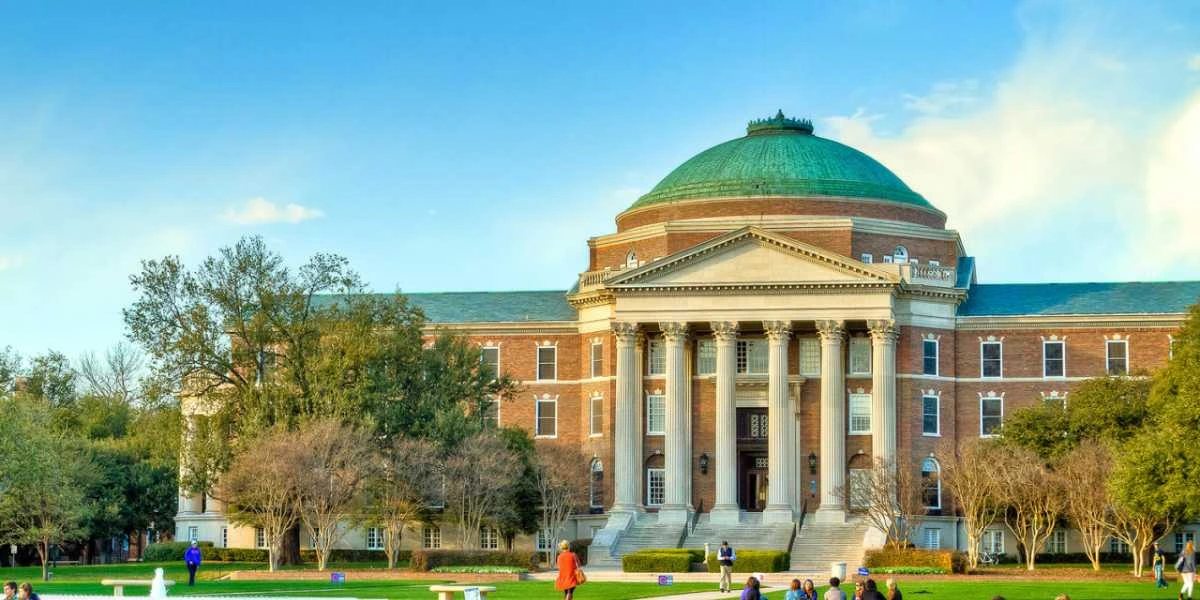
Southern Methodist University is home to 9 undergraduate schools and 6 graduate schools. The university is known for its strong business and law schools; the business school is regarded as one of the best in the world, and the law school enjoys a strong reputation in legal education. The university also emphasizes innovation and interdisciplinary research and is committed to developing well-rounded students. The campus is beautiful, with a rich array of cultural events and athletic programs that give students a varied and vibrant learning and living experience.
About the university
School data is compiled from public sources and may change. Confirm current tuition, deadlines and requirements with the university before applying.
At a glance
Alumni starting salaries
Student body
Most popular majors
Graduate programs
Business Analytics
Business Analytics
Program Overview
The Master of Science in Business Analytics program at SMU Cox School of Business is designed to equip students with the latest data analytics skills to meet future career demands. The program is STEM and OPT certified and offers both full-time and part-time study options, with coursework spanning business, statistics, and information technology. Students come from a wide range of academic backgrounds, including economics, mathematics, engineering, and marketing, bringing rich diversity to the program. Southern Methodist University is committed to providing students with practical, up-to-date business analytics skills that lay a solid foundation for success across industries.
Degree Type
Master of Science in Business Analytics
Program Length
The full-time program can be completed in nine months across two semesters (four seven-week modules).
Source: SMU-BA-Program Overview
Application Requirements
Language Requirements
International students may also choose to submit TOEFL/IELTS scores as part of their application materials. These test scores are not required. For applicants without test scores, SMU will evaluate their applications through a holistic review process that takes all application materials into consideration.
Tests must have been taken within two years of the application date.
TOEFL school code: 6660
Unofficial transcripts or degree progress reports
Degree progress reports must show cumulative GPA and a grade for each course.
After admission, students must provide official transcripts from any college or university where they earned 12 or more credits.
Optional: Unofficial GMAT or GRE report
Tests must have been taken within five years of the application date.
After admission, students must provide official score reports.
GMAT school code: HWG-KN-59
GRE school code: 6660
In addition to the program-specific requirements above, full application requirements can be found in the Application Requirements section of our website.
Source: SMU-BA-Application Requirements
Graduation Requirements
Credit Requirements
You must complete 33 credits.
Internship Requirement
Full-time MSBA students should gain hands-on experience with a company in the analytics field during the program. In the spring semester, students may intern with a company in the analytics field from January through May, or participate in a one-semester Capstone project. In the Capstone project, you and a team of fellow students in the business process analytics track will design, build, and test an analytics system for a real company. At the end of the semester, you will have a solid grasp of the system development life cycle and a deeper professional network.
Source: SMU-BA-Curriculum
Curriculum Overview
Core Courses
Courses: Business Metrics, Decision Models, Programming for Analytics, Managing Your Career (continues throughout every module in the MSBA program), Business Analytics Capstone or Business Analytics Internship, Applied Predictive Analytics I, Advanced Decision Models. Elective Courses
Courses are subject to change. Please refer to the course details for more information.
Self Study, Orientations, and Boot Camps
Summer Self Study:
During the summer, students complete the following:
DataCamp - review/learn skills such as SAS, SQL, R, and Python through more than 100 online courses
CMC Kickstart - preparation for the coming year, including some resume work and various career activities
Required Orientations and Boot Camps
Classes typically begin in mid-August, but students are strongly encouraged to arrive in Dallas in early August. International students may arrive up to 1 month before the start date. Before classes begin, students are required to participate in the following:
MSBA Orientation - mandatory for all students! It is held during the first week of August and lasts two days. Specific dates will be sent during the summer.
International Orientation - mandatory for international students. International students must attend both the MSBA Orientation and the International Orientation. The International Orientation is scheduled for early August. Specific dates will be sent during the summer.
Boot Camps - mandatory for all students! Two boot camps are held in August, and all students are required to attend.
Source: SMU-BA-Curriculum
Career Development
The MSBA program at SMU Cox is committed to supporting each student's career path individually, offering workshops, on-campus interviews, career fairs, and more through the Career Management Center (CMC) to help students shape their resumes, negotiate salaries, and achieve their dream careers.
Recruiting companies include: Accenture, Ally Financial, Amazon, Artis Consulting, AT&T, Capital One, Citi, Deloitte, Expedia Group, ExxonMobil, EY, GAP, Inc., JPMorgan Chase, Kearney, KPMG, PwC, Samsung, Toyota, and Walmart.
Each week, CMC experts at SMU Cox interact with Dallas business leaders to expose students to career opportunities in business analytics. In addition, the Cox Business Leadership Center (BLC) develops students' leadership abilities through various programs to prepare them for future career paths.
Source: SMU-BA-Career Development
Finance
Finance
Program Overview
Students in the Finance program at Southern Methodist University can gain hands-on experience using the Bloomberg Terminal trading simulation center at the Cox School of Business, which provides them with practical financial market experience. Through this hands-on approach to learning, students gain a better understanding of financial theory and can apply theoretical knowledge to real-world situations, preparing them for their future careers.
In addition, graduates of Southern Methodist University have the opportunity to earn a Master of Science in Finance (MSF) from the SMU Cox School of Business, which provides solid preparation for a career in finance. The program is STEM (Science, Technology, Engineering, and Mathematics) and OPT (Optional Practical Training) certified, meaning students can enjoy more employment and internship opportunities after completing their studies. Its curriculum is broad, covering areas such as financial accounting, statistics, international markets, and monetary policy, giving students comprehensive financial knowledge.
Degree Type
Master of Science in Finance
Program Length
18 months
Source: SMU-Finance-Program Overview
Application Requirements
Language Requirements
International students may also choose to submit TOEFL/IELTS scores as part of their application materials. These test scores are not required. For applicants without test scores, SMU will evaluate their applications through a holistic review process that takes all application materials into consideration.
Tests must have been taken within two years of the application date.
TOEFL school code: 6660
Unofficial transcripts or degree progress reports
Degree progress reports must show cumulative GPA and a grade for each course.
After admission, students must provide official transcripts from any college or university where they earned 12 or more credits.
Optional: Unofficial GMAT or GRE report
Tests must have been taken within five years of the application date.
After admission, students must provide official score reports.
GMAT school code: HWG-KN-59
GRE school code: 6660
In addition to the program-specific requirements above, full application requirements can be found in the Application Requirements section of our website.
Source:
SMU-Finance-Application Requirements
SMU-Finance-International Graduate Admission Requirements
Graduation Requirements
Credit Requirements
You must complete 32 credits.
Source: SMU-Finance-Program Overview
Curriculum Overview
Master of Science in Finance curriculum overview:
4 credits of required accounting courses
Students must take at least 2 accounting courses
2 credits of statistics coursework - MAST 6201 is a required course worth 2 credits
20 credits of required finance courses
4 or 6 credits of electives, depending on the number of finance courses
Core Courses
Course names: Finance Theory and Practice, Portfolio Theory and Asset Pricing, Managerial Statistics, Career Management (0 credits), Valuation and Analysis, Derivatives, Financial Modeling, Fixed Income Securities, Quantitative Trading Strategies, Corporate Financial Policies, International Finance, Financial Markets and Monetary Policy. Source: SMU-Finance-Curriculum
Career Development
Lifelong Support
From the first day as an alumnus throughout the student's life, the school helps students transform their careers. Students can rely on tailored support, from small classes led by top faculty interested in students' futures to a hands-on career center and a closely connected global alumni community.
Career Management Center
As the student's world expands through Cox, the CMC serves the student. The staff's primary purpose is to provide students with the advice and resources they need to pursue and build their ideal careers, before, during, and after their studies in the MSF program. Students draw on a range of services, including the Joint Board mentoring program. Through Cox's Executive Mentoring Program, the Joint Board, students gain real insights and connections in the fields that interest them.
Career services workshops are held throughout the MSF program, beginning with finance career paths.
They cover a wide range of activities, from resume writing to interview skills to positioning for the CFA, CFP, and licensing certifications. MSF students have access to active job postings at investment banks, financial institutions, and multinational corporations. SMU holds an annual career fair each spring, attracting many employers eager to meet graduates of all SMU programs. Past MSF graduates have been hired by companies including AEW Capital Management, American Airlines, Andarko Petroleum, Deloitte, Goldman Sachs, JPMorgan Chase, and PwC.
Source: SMU-Finance-Career Development
Computer Science Major
Computer Science
Program Overview
The Computer Science program in the Lyle School of Engineering at Southern Methodist University is a research-oriented, student-centered department. With the continued development and advancement of technologies such as artificial intelligence, machine learning, data mining, big data, natural language processing, cloud computing, and software engineering, demand for skilled professionals in computer science continues to grow rapidly, the market is strong, and these skills are highly sought after across industries. The program aims to develop talent with strong logical thinking and problem-solving abilities who can apply computers and computational processes to build solutions that change the world. By studying computer science, students will master modern technologies and tools and deliver innovative solutions to real-world problems; this comprehensive training enables students to respond flexibly to a range of challenges and to succeed in the technology field.
Degree Type
Computer Science, M.S.
Program Length
18 months
Source:
SMU Computer Science – Program Overview
SMU Computer Science – Program Homepage
Application Requirements
English Language Requirements
TOEFL – minimum score of 80
IELTS – minimum score of 6.5
Duolingo – minimum score of 110
The English language proficiency requirement may be waived for students who earned a bachelor's or master's degree from an English-language institution in one of the following countries/regions: United States, Canada (except Quebec), United Kingdom, Ireland, Australia, New Zealand, South Africa, American Samoa, Bahamas, Barbados, Belize, Dominica, Ghana, Grenada, Grand Cayman, Guyana, Jamaica, Kenya, Liberia, Nigeria, Singapore, Trinidad and Tobago, Turks and Caicos Islands, U.S. Pacific Trust Territories.
Academic Background
A bachelor's degree in Computer Science, Computer Engineering, or a closely related field. Applicants who hold an undergraduate degree in a discipline other than Computer Science may also be admitted, but may be required to take bridge courses and/or satisfy competency requirements.
A minimum GPA of 3.000 on a 4.000 scale in the junior and senior years.
Reasonable mathematical maturity.
In addition to the program-specific admission requirements above, the complete application requirements can be found in the [Application Requirements] section of our official website.
Sources:
SMU - School of Engineering Language Standards
SMU - Computer Science - Application Requirements
Degree Requirements
Credit Requirements
A minimum of 30 graduate credits, or 24 course credits plus 6 thesis credits, is required to earn the master's degree.
Thesis Requirements
Students may choose to write a master's thesis, which can count for six credits of professional coursework. Students must register for at least six credits under CS 7(1-6)96. If the thesis option is chosen, all other requirements remain the same. The 6 thesis credits may satisfy 6 of the 9 required credits of advanced coursework.
The master's thesis represents one or more of the following: a synthesis of differing viewpoints or a scholarly review of the current literature, a creative research activity, or a significant design project, the results of which must be documented in a carefully written thesis. The thesis should be of publishable quality, and students are advised to submit it to an appropriate conference or journal before the thesis defense.
The thesis must be supervised by a faculty member chosen by the student. Any full-time faculty member who supports the student's professional area may serve as thesis advisor. It is the student's responsibility to find an advisor who is willing to offer a thesis topic or to supervise a topic of the student's own choosing. Once the student has found an advisor and selected a thesis topic, the student and advisor should jointly form a thesis committee.
The committee must consist of at least three members, two of whom must represent the professional area. The advisor serves as committee chair. The composition of the committee must be approved by the CS Chair and the Director of Graduate Studies. The student must provide the committee members with a written thesis proposal. Typically, this will be done before faculty agree to serve on the committee.
The thesis is judged by a supervisory committee on the basis of technical merit, originality, and quality of presentation. The thesis must be presented orally to the committee at a thesis defense. A copy of the thesis must be provided to each member of the committee at least two weeks before the scheduled defense. The defense must be scheduled with the Computer Science department office and announced on the appropriate bulletin boards. The defense is open to the public.
Source: SMU - Computer Science - Degree Requirements
Course Descriptions
Course Requirements:
Complete 6 credit hours of core courses chosen from 4 courses: CS 7330 File Org., CS 7350 Algorithm Engineering, CS 7343 Operating Systems, and CS 7381 Computer Architecture.
12 credit hours of CS major courses. The major courses consist of 6 credit hours of major core courses, with the remaining 6 credit hours selected from the depth elective list. Students choosing a thesis may count 6 credit hours of thesis as a depth elective.
12 hours of breadth electives. Breadth electives may be chosen from any CS graduate course. With advisor approval, students may choose breadth electives outside the CS department.
The degree plan must list at least two 8000-level courses (6 credit hours), with the remainder at the 7000 level or above.
Core Courses
Students choosing the non-thesis option must take 6 credits of core courses, 12 credits of specialization courses, and 12 credits of elective courses.
Choose 2 of the following:
Course | Course Number | Credits File Organization and Database Management | CS 73303 Operating Systems and System Software | CS 73433 Algorithm Engineering | CS 73503 Computer Architecture | CS 73813 Electives | 12 credits
Electives may be selected from existing graduate courses in the Lyle School of Engineering, provided they meet residency and level requirements and are approved by the advisor. Students choosing the thesis option will substitute thesis credits for specialization courses.
Broadening electives may be selected from any graduate-level computer science course. With advisor approval, students may choose broadening electives outside the Department of Computer Science.
Specialization Courses
Artificial Intelligence and Machine Learning
Specialization Core (6 credits)
Course | Course Number | Credits: Artificial Intelligence, CS 7320, 3; Machine Learning in Python, CS 7324, 3. Specialization Depth Electives
Choose 2 of the following courses:
Course | Course Number | Credits: Mobile Applications for Sensing and Learning, CS 7323, 3; File Organization and Database Management, CS 7330, 3; Data Mining, CS 7331, 3; Information Retrieval and Web Search, CS 7337, 3; Knowledge-Intensive Problem-Solving, CS 8320, 3; Machine Learning and Neural Networks, CS 8321, 3; Natural Language Processing and Internet Applications, CS 8322, 3; Logic Programming, CS 8325, 3; Advanced Data Mining, CS 8331, 3; Information Storage and Retrieval, CS 8337, 3; Software Engineering, CS 8340, 3.
Specialization Core (6 credits)
Course | Course Number | Credits: Software Testing and Quality Assurance, CS 7314, 3; Software Architecture and Design, CS 7319, 3. Specialization Depth Electives
Choose 2 of the following courses:
Course | Course Number | Credits: Software Systems Engineering, CS 7312, 3; Software Configuration Management, CS 7313, 3; Software Project Planning and Management, CS 7315, 3; Software Requirements, CS 7316, 3; Leadership for Architecting Software Systems, CS 7317, 3; Software Security, CS 7359, 3; Software Generation and Maintenance, CS 8312, 3; Object-Oriented Analysis and Design, CS 8313, 3; Software Metrics and Quality Engineering, CS 8314, 3; Software Acquisition, Legal, and Economic Issues, CS 8315, 3; User Interface Design, CS 8316, 3; Software Reliability and Safety, CS 8317, 3; Advanced Topics in Software Engineering, CS 8340, 3; Cybersecurity, CS 8340, 3.
Specialization Core (6 credit hours)
Course | Course Number | Credit Hours — Computer System Security | CS 7339 | 3; Data and Network Security | CS 7349 | 3 — Specialization Depth Electives
Choose 2 of the following courses:
Course | Course Number | Credit Hours — Security Economics | CS 7338 | 3; Cloud Computing | CS 7346 | 3; Internetworking Protocols and Programming | CS 7348 | 3; Data and Network Security | CS 7349 | 3; Software Security | CS 7359 | 3; Hardware Security and Trojan Detection | CS 7369 | 3; Advanced Operating Systems | CS 8343 | 3; Computer Networks | CS 8344 | 3; Advanced Network and System Security | CS 8349 | 3; Cryptography and Data Security | CS 8352 | 3; Digital Forensics | CS 8353 | 3; Border and Transportation Security | CS 8356 | 3; Advanced Software Security | CS 8359 | 3; Theory of Computation
Specialization Core (6 credit hours)
Course | Course Number | Credit Hours — Algorithm Engineering | CS 7350 | 3; Algorithms II | CS 8350 | 3 — Specialization Depth Electives
Choose 2 of the following courses:
Course | Course Number | Credit Hours — Compiler Construction | CS 7341 | 3; Concepts of Language Theory and Their Applications | CS 7342 | 3; Probability and Statistics for Scientists and Engineers | CS 7370 | 3; Logic Programming | CS 8325 | 3; Computer Arithmetic | CS 8351 | 3; Graph Theory: Algorithms and Applications | CS 8355 | 3; Coding Theory and Applications | CS 8375 | 3; Fault-Tolerant Computing | CS 8377 | 3; Parallel and Distributed Processing | CS 8380 | 3
Source: SMU - Computer Science - Course Descriptions
Career Development
The Hart Center is Lyle's career services center. Southern Methodist University offers comprehensive services, programs, and resources focused on career exploration and professional development for undergraduate, graduate, and international students. Distinctive networking opportunities such as Mock Interview Day, Engineering Resumania, and the Engineering Connections career fair give Lyle students the tools they need to succeed in the workplace. Students can schedule appointments or attend sessions on writing resumes and cover letters, finding a job or internship, and meeting employers and Lyle recruiters.
Source: SMU Lyle School of Engineering Career Development
Computer Engineering
Program Overview
The Master of Science in Computer Engineering program in SMU's Lyle School of Engineering is designed to equip students with professional skills in areas such as embedded systems, semiconductor design, artificial intelligence, and machine learning, building a solid foundation for future career development. Meanwhile, the program's research involves fields such as cybersecurity and electronic design automation, offering students opportunities for in-depth research and innovative solutions. Benefiting from a rich curriculum designed by an industry-leading faculty team, students can access course resources at any time through an online platform, including notes, course schedules, and online lectures, making the learning process more efficient.
Degree Type
Computer Engineering, M.S.Cp.E.
Program Duration
18 months
Sources:
SMU-Computer Engineering-Program Introduction
SMU-Computer Engineering-Program Homepage
Application Requirements
Language Requirements
Home-based tests accepted
TOEFL - minimum score 80
IELTS - minimum score 6.5
Duolingo - minimum score 110
Students may be exempt from the English language proficiency requirement if they earned a bachelor's or master's degree from an English-language institution in the following countries/regions: United States, Canada (except Quebec), United Kingdom, Ireland, Australia, New Zealand, South Africa, American Samoa, Bahamas, Barbados, Belize, Dominica, Ghana, Grenada, Grand Cayman, Guyana, Jamaica, Kenya, Liberia, Nigeria, Singapore, Trinidad and Tobago, Turks and Caicos Islands, U.S. Pacific Trust Territories.
Academic Requirements
A minimum GPA of 3.000 (on a 4.000 scale) in the junior and senior years
Admission Requirements
A bachelor's degree in computer engineering, computer science, or a closely related discipline. Applicants with undergraduate degrees in other fields may also be admitted to the program and may be required to take bridge courses. Reasonable mathematical maturity
In addition to the program-specific admission requirements above, complete application requirements can be found in the corresponding [Application Requirements] section on Southern Methodist University's official website
Sources: SMU-Computer Engineering-Program Introduction
Graduation Requirements
Credit Requirements
24 credit hours of coursework and a master's thesis, or 30 credit hours of coursework.
Thesis Requirements
Students may choose to write a master's thesis, which may count for six credits of professional coursework. Students must register for at least six credits under CSE 7(1-6)96. If the thesis option is chosen, all other requirements remain the same. The 6 thesis credits may satisfy 6 of the 9 credits required for advanced courses (CSE 8000 level).
A master's thesis represents one or more of the following: a synthesis of different ideas or scholarly criticism of current literature, a creative research activity, or a significant design project, the results of which must be documented in a well-written thesis. The thesis should be of publishable quality and is recommended to be submitted to an appropriate conference or journal before the thesis defense.
The thesis must be supervised by an advisor chosen by the student. Any full-time faculty member who supports the student's area of specialization may serve as thesis advisor. It is the student's responsibility to find an advisor willing to offer a thesis topic or willing to supervise a topic chosen by the student.
Once the student has found an advisor and selected a topic, the student and advisor should jointly form a thesis committee. The committee must consist of at least three members, two of whom must represent the concentration area. The advisor serves as chair of the committee. The composition of the committee is subject to approval by the CSE Chair and the Director of Graduate Studies. The student must provide a written thesis proposal to the committee members. Typically, this will be done before faculty agree to serve on the committee.
The thesis is reviewed by the supervisory committee based on technical merit, originality, and presentation. The thesis must be presented orally to the committee at the thesis defense. A copy of the thesis must be provided to each member of the committee at least two weeks before the scheduled defense. The defense must be scheduled by the CSE department office and posted on appropriate bulletin boards. The defense is open to the public.
Bridge Course Requirements
All students entering the program should have knowledge equivalent to the following courses:
Course Course Number Principles of Computer Science CSE 1341 Concepts of Programming CSE 1342 Assembly Language Programming and Machine Organization CSE 2240 Data Structures CSE 2341 Discrete Computational Structures CSE 2353 Foundations of Algorithms CSE 3353 Digital Logic Design CSE 3381 Digital Computer Design CSE 4381 Students who do not meet these requirements may be granted conditional admission to the program and will need to take some courses as bridge courses. Students must complete these bridge courses and maintain at least a 3.000 GPA. Students who fail to achieve this record will be automatically withdrawn from the graduate program, may not be able to register for graduate courses, and may be denied the right to apply for readmission. Students who maintain a minimum GPA of 3.000 in these courses may proceed to the balance of their study plan. These bridge courses should be completed as far as possible before attempting courses in the study plan. Completion of bridge courses is a prerequisite before taking any graduate courses.
Sources: SMU-Computer Engineering-Program Introduction
Course Information
Students choosing the non-thesis option must take 12 credits of core courses, 6 credits of concentration courses, and 12 credits of electives. Electives may be selected from existing graduate-level courses in the Lyle School of Engineering, subject to residency and level requirements and advisor approval. Those choosing the thesis option will substitute thesis credits for the concentration.
Core Courses (12 credits)
Course Course Number Operating Systems and System Software CSE 7343 Computer Networks and Distributed Systems II CSE 7344 Computer Architecture CSE 7381 Digital Systems Design CSE 7387 Computer Science Seminars CSE 8098 Concentration Courses (6 credits)
Architecture (choose two)
Course Course Number Microcontroller Architecture and Interfacing CSE 7385 Fault-Tolerant Computing CSE 8377 Parallel and Distributed Processing CSE 8380 Advanced Computer Architecture CSE 8383 Design Automation (choose two)
Course Course Number VLSI Algorithms CSE 7380 Digital Systems Design CSE 7387 Fault-Tolerant Computing CSE 8377 Switching Theory and Applications in VLSI CAD CSE 8387 Networking (choose two)
Course Course Number Internetworking Protocols and Programming CSE 7348 Data and Network Security CSE 7349 Computer Networks CSE 8344 Advanced Network and System Security CSE 8349 Elective Courses (12 credits)
Electives may be selected from existing graduate-level courses in the Lyle School of Engineering, subject to residency and level requirements and advisor approval.
Sources: SMU-Computer Engineering-Course Information
Career Development
Potential roles include: Machine Learning Engineer, Firmware Engineer, Hardware Engineer, Biomedical Engineer, Semiconductor Engineer, Autonomous Systems Engineer.
The Hart Center is Lyle's career services center. Southern Methodist University offers comprehensive services, programs, and materials focused on career exploration and professional development for undergraduate, graduate, and international students. Unique networking opportunities such as Mock Interview Day, Engineering Resumania, and the Engineering Connections career fair provide Lyle students with the tools they need to succeed in the workplace.
Resume and Cover Letter Writing
Create polished resumes and cover letters using the provided editable samples.
Finding a Job or Internship
When starting a job search, Southern Methodist University encourages students to research and explore companies that align with their interests, values, and career goals.
Meet Employers
Meeting employers face-to-face is an opportunity for students to demonstrate their potential to succeed in a company.
Lyle Recruiting
The Hart Center offers employers various opportunities to meet and work with engineering and computer science students at Southern Methodist University.
Sources: SMU-Lyle School of Engineering Career Development
Campus life
Transportation
Nearby Airports
Dallas-Fort Worth International Airport
Distance from campus: 21.4 miles
Trip from campus to the airport:
By car or rideshare:
Typically about 20-25 minutes. It may take longer during heavy traffic.
Public transportation:
Take bus routes 105/003 and transfer to the Orange Line of the light rail.
Dallas Love Field Airport
Distance from campus: 3.6 miles
Trip from campus to the airport:
By car or rideshare:
Typically about 8-12 minutes. It may take longer during heavy traffic.
Public transportation:
Take bus route 003, transfer to 001, then transfer to 222, and finally transfer to 005; alternatively, take bus route 105, transfer to 103, and finally transfer to 005.
Nearby Train Station
Union Station
Trip from campus to the train station:
By car or rideshare:
Typically 10-14 minutes. It may take longer during heavy traffic.
Public transportation:
Take bus route 003 directly, or take bus route 003 and transfer to 047.
City Public Transportation
Public transportation around Southern Methodist University is provided mainly by Dallas Area Rapid Transit (DART), including:
Light Rail: The DART light rail system covers the city of Dallas and surrounding areas. Students can use light rail stations such as Mockingbird Station and Cityplace/Uptown Station to travel from Southern Methodist University to downtown Dallas and other areas.
Bus Service: DART provides an extensive bus network covering the city of Dallas and surrounding areas. Students can use buses to reach a variety of destinations, including shopping centers, business districts, and residential areas.
DART GoLink Service: This is DART's on-demand bus service, offering more flexible transportation options in some areas, such as certain suburbs or low-density areas that may be difficult to reach by regular bus or light rail.
Safety
SMU Police patrol the campus 24 hours a day, 7 days a week. The department coordinates its operations with neighboring agencies and works with the Dallas County District Attorney's Office on criminal investigations. Emergency blue-light phones on campus connect directly to the SMU Police Department. SMU Police provide crime prevention education, self-defense training, and campus safety rides.
The SMU Aware Safety App connects users to campus safety resources, including one-touch calling of SMU Police or other emergency and non-emergency assistance, along with many other features designed to promote personal safety. The campus community is encouraged to download the app from the Apple App Store or Google Play.
SMU Safety Escort, provided by TransLoc, offers free rides on campus from 7 p.m. to 3 a.m. during the fall and spring semesters while classes are in session.
The SMU Police Department maintains a Daily Crime Log that can be viewed online and is available to the public during business hours at the dispatch window at 3128 Patterson Hall on Dyer Street.
SMU's Annual Security and Fire Safety Report is posted online and includes crimes reported over the past three calendar years.
Housing
SMU's residential college system is perhaps the university's most distinctive feature. It gives students a familiar, comfortable living environment, personal interaction with faculty and administrators, and exciting opportunities for academic and extracurricular exploration. The residential commons play a major role in fostering SMU's spirit, loyalty, and sense of community. All incoming first-year students are assigned to one of 11 residential commons.
Residential Commons
Armstrong Commons
Boaz Commons
Cockrell-McIntosh Commons
Crum Commons
Kathy Crow Commons
For more information, please read the residence hall list.
Steps to apply for on-campus housing
Complete the online application
Pay the deposit
Complete the roommate application according to the distribution instructions
Dining
At SMU, you can enjoy a wide variety of delicious food at Lee Dining Hall (located in the Umphrey Lee Center) and Arnold Dining Commons. Both are all-you-care-to-eat residential dining halls that accommodate most dietary needs and preferences.
Campus Dining Halls
Lee Dining Hall
Lee offers a cozy atmosphere, delicious food options, and friendly servers. Located on the lower level of the Umphrey Lee Center, this residential dining hall serves a hearty buffet menu with plenty of variety. It features fried chicken, dinner rolls, and assorted salads.
Arnold Dining Commons
Arnold Dining Commons uses state-of-the-art equipment across nine different stations. Professional chefs cook all food in front of you using fresh rather than frozen ingredients. This residential dining hall features a brick oven for delicious pizza, a full-size circular grill for mouthwatering stir-fry, a True Balance Station free of the 9 major allergens, and more! And of course, it is unlimited, so you can stop at any of the nine stations as you please, or return to the same station as many times as you like.
For more information, please read the dining hall list.
Meal Plan
Meal plans are convenient, flexible, and available in many options. Your meal plan includes dining locations across campus as well as a range of menus and products. Whether you eat on campus 3 times a week or 3 times a day, you get guaranteed value! It is already secured for you. See the meal plan options below for more information.
Meal Plan | Meals | Flex Dollars | Guest Meals | Cost
Block 150 + $200 Flex | 150/semester | 200/semester | 10/semester | $2,241/semester
Block 150 + $350 Flex | 150/semester | 350/semester | 10/semester | $2,361/semester
Block 150 + $500 Flex | 150/semester | 500/semester | 10/semester | $2,481/semester
Block 50 + $200 Flex | 50/semester | 200/semester | 10/semester | $909/semester
Block 50 + $350 Flex | 50/semester | 350/semester | 10/semester | $1,029/semester
Block 50 + $500 Flex | 50/semester | 500/semester | 10/semester | $1,149/semester
The Works + $200 Flex | Unlimited | 200/semester | 10/semester | $3,665/semester
The Works + $350 Flex | Unlimited | 350/semester | 10/semester | $3,785/semester
The Works + $500 Flex | Unlimited | 500/semester | 10/semester | $3,905/semester
Add On $500 | 0 | 500/semester | 0 | $440/semester
Add On $350 | 0 | 350/semester | 0 | $320/semester
Add On $200 | 0 | 200/semester | 0 | $200/semester
Add On $100 | 0 | 100/semester | 0 | $100/semester
Admissions
Admissions data
Application requirements

Application checklist
Application deadlines
Transfer requirements
Transfer checklist
Transfer deadlines
Similar universities
Admissions FAQ
What is the acceptance rate at Southern Methodist University?
The reported acceptance rate is 61%. Acceptance rates vary by applicant pool and application cycle; confirm the current figure with Southern Methodist University.
What SAT scores does Southern Methodist University expect?
The reported SAT range is 1320-1480. Test-optional and score-reporting policies can change by application cycle; check the university's official admissions page before applying.
When is the application deadline at Southern Methodist University?
The listed Regular Decision deadline is July 31. Deadlines can vary by program and application cycle; confirm the exact date with the university.
How much does Southern Methodist University cost?
The listed tuition and fee figure is $19,064. Costs vary by residency, programme and academic year; confirm current costs with the university.
Where is Southern Methodist University located?
Southern Methodist University is located at 6425 Boaz St, Dallas, TX, 75275-0221.
Planning your application?
Build a school list around your profile.
Ivy Elite advisors help students compare programs, plan coursework and prepare applications for U.S. universities.