
The University of Southern California's central campus, known as the University Park Campus, sits in the arts and education corridor of downtown Los Angeles. In addition to its locations in Southern California, Sacramento and Washington, D.C., USC maintains other campuses in Los Angeles. Students can join more than 1,000 on-campus organizations, ranging from religious groups to sports clubs. USC students are not required to live on campus, but the university offers housing in its roughly 40 residence halls and apartment buildings. A thriving Greek life includes more than 50 chapters and involves about 20% of undergraduates. The USC Trojans compete in the Pac-12 Conference and are known for their legendary football program.


School type: Private research university
Founded: 1880
Religious affiliation: None
Academic calendar: Semester system
President / Chancellor: Carol Folt (President)
Website:
https://www.usc.edu/
Phone: (213) 740-2311
Location: University Park, Los Angeles, CA, 90089
U.S. News
27
QS
125
Undergraduate
View
Graduate
View
Apply now
Get the admissions guide
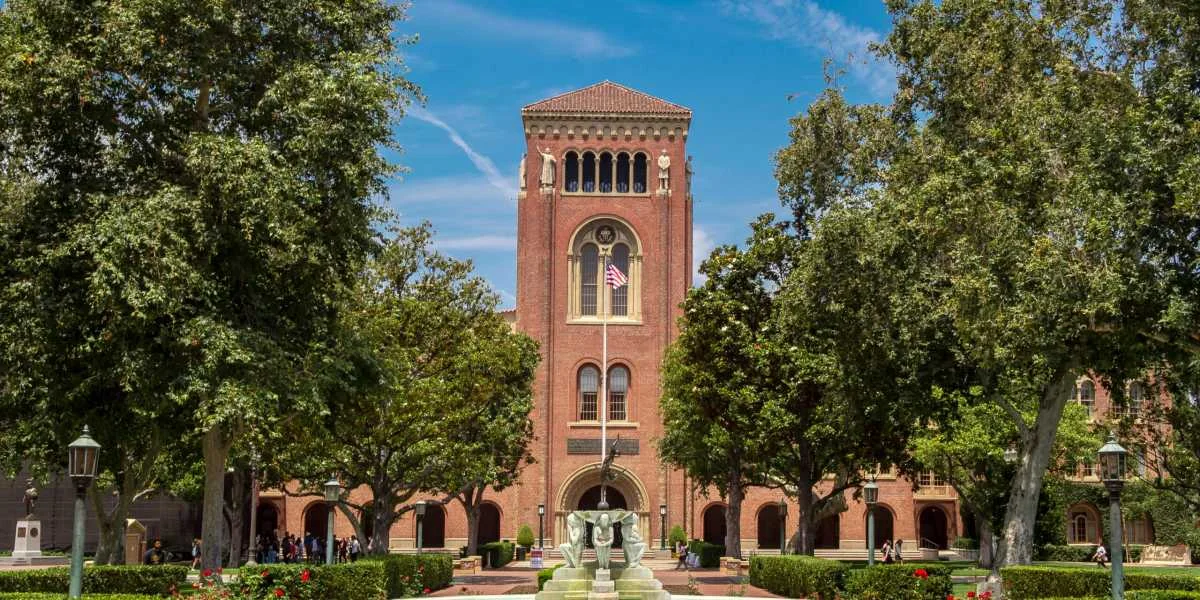
The University of Southern California has educated thousands of students since its founding and is now home to 23 schools and academic units. Located in the heart of one of the world's largest metropolitan areas, its campus is an institution that blends historical tradition with modern innovation.
About the university
In-state tuition
$647
Out-of-state tuition
$19,931
Room and board
$19,931
Graduation rate
81%
Student-faculty ratio
9:1
Gender ratio
48:52
Alumni starting salaries
Architecture and Related Services
+
Biological and Biomedical Sciences
+
Business, Management, Marketing, and Related Support Services
+
Communication, Journalism, and Related Programs
+
Engineering
+
English Language and Literature/Letters
+
History
+
Mathematics and Statistics
+
Student body
First-year diversity
White
28%
Hispanic
18%
Asian
25%
Black
7%
Most popular majors
Business, Management, Marketing, and Related Support Services
22%
Visual and Performing Arts
12%
Social Sciences
11%
Engineering
8%
Communication, Journalism, and Related Programs
8%
Computer and Information Sciences and Support Services
7%
Multi/Interdisciplinary Studies
7%
Biological and Biomedical Sciences
4%
Psychology
4%
Architecture and Related Services
3%
Graduate programs
Business Analytics
Business Analytics
Program Overview
The Business Analytics program at the USC Marshall School of Business brings a distinctive business perspective—you could also call it a data science program. It is one of the longest-running business analytics programs in the United States and has consistently ranked among the world's top programs. The curriculum includes project-based classroom learning that lets students explore real business challenges and dilemmas, gaining a deeper understanding of business analytics. Students in the program master the statistical and optimization tools needed to analyze large and unstructured datasets and to make optimized decisions that improve organizational performance. The program spans many business areas and focuses on business applications across industries and functions, including finance, operations, management, marketing, banking, human resources, supply chain, healthcare, and sports analytics.
Degree Type
Master of Science in Business Analytics (MSBA)
Program Length
One and a half years, full-time
Program Strengths
Community Engagement
Through an annual conference, USC's MSBA program actively engages with the community. The free "Data Con LA" conference is held on the USC campus, giving everyone interested in data a chance to connect with industry professionals and gain new perspectives on the field. The conference typically draws about 2,000 attendees from across the country, and through partnerships with various organizations and companies, students take part in a range of real-world projects.
Real-World Experience
During the MSBA program, students gain valuable hands-on experience through summer internships and projects with industry partners. Rather than requiring students to complete only a single capstone project at the end of the graduate program, USC MSBA students have the opportunity to work with companies to solve real business problems through data, strengthening their resumes.
Case Competitions
To further sharpen their business acumen, USC MSBA students also take part in various case competitions both within and beyond the program.
STEM Designation
The Business Analytics (MSBA) program at USC is a STEM program, meaning international students who, after completing the degree, work in the United States in a STEM-eligible role may apply to extend their current 12 months of Optional Practical Training (OPT—the practical training period for F1 students after graduation) to 36 months.
Sources:
USC Master of Science in Business Analytics
USC Business Analytics
Application Requirements
Language Scores
International students must submit language test scores. Applicants are exempt if English is their native language or if they earned a bachelor's degree in the United States or another English-speaking country.
Minimum score requirements:
TOEFL: total score of 100; at least 20 on each section (test school code: 4852)
IELTS: overall band of 7; at least 6 on each section (when submitting scores, select University of Southern California, Graduate Programs)
Prerequisite Coursework
All applicants must have completed at least one undergraduate-level or higher statistics course. An eligible statistics course must have been taken for credit at an accredited college or university and must cover all of the following topics:
Basic probability
Probability distributions (normal, exponential, etc.)
Inferential statistics, such as t-tests and chi-square tests, confidence intervals, and sampling
Introduction to linear regression.
Letters of Recommendation
Letters of recommendation are neither required nor accepted. Please do not submit such letters at any point in the admission cycle.
Work Experience
A few years of work experience is preferred but not required.
In addition to the program-specific application requirements above, full application requirements can be found in the corresponding Application Requirements section of our website.
Sources: USC MSBA Admission
Graduation Requirements
Credit Requirements
33 credits, including 19.5 credits of required courses and 13.5 credits of elective courses
Grade Requirements
While pursuing graduate study at USC, whether or not all course credits are applied toward the degree, graduation requires an overall grade point average of at least 3.0 across all courses. Courses earning graduate credit must be at least a C (2.0); grades of C- or below cannot count as subject or unit credit for any master's or doctoral course.
Thesis Requirement: None
Internship Requirement: None
Sources:
USC Business Analytics Degree Requirement
USC Requirements for Graduation
Curriculum
The degree requires a total of 33 credits, including 19.5 credits of required courses and 13.5 credits of elective courses. All students must complete all required core courses—DSO 510, DSO 545, and GSBA 545—in their first semester.
Required Courses
Core Courses (must be completed first)
Course
Course Number
Credits
Business Analytics
DSO 510
1.5, 3
Statistical Computing and Data Visualization
DSO 545
3
Communication for Management
GSBA 542
1.5
Data Driven Decision Making
GSBA 545
1.5
Additional Required Courses
Course
Course Number
Credits
Applied Modern Statistical Learning Methods
DSO 530
3
The Analytics Edge: Data, Models, and Effective Decisions
DSO 570
3
Data Analytics Driven Dynamic Strategy and Execution
DSO 573
3
Introduction to Data Management
INF 559
3
Electives
Complete at least 13.5 credits from the courses below, for a total of 33 credits.
Course
Course Number
Credits
Database Systems
CSCI 585
4
Probability and Data Modeling
DSO 516
1.5
Applied Time Series Analysis for Forecasting
DSO 522
1.5, 3
Data Warehousing, Business Intelligence, and Data Mining
DSO 528
1.5, 3
Monte Carlo Simulation and Decision Models
DSO 536
1.5
Designing Spreadsheet-Based Business Models
DSO 547
3
Fraud Analytics
DSO 562
3
Foundations of Information Security
INF 520
3
Marketing Analytics
MKT 566
3
Sources: USC Business Analytics Curriculum
Career Development
For more than 100 years, the USC Marshall School of Business has built deep connections with dynamic companies and business leaders in Southern California, across the country, and around the world, creating boundless opportunities for students across industries. The school combines its core curriculum with a range of experiential learning opportunities, enabling students to apply what they learn in the classroom to the real world in real time. Along the way, they learn more about themselves, about team dynamics, and about the broader social context in which business operates. Learning by doing prepares Marshall graduates to hit the ground running, thrive in the workplace, and stand out.
Marshall also offers comprehensive career development services for graduate students, with a mission to provide USC Marshall graduate candidates with the skills, knowledge, and resources that inspire confidence in achieving career success. Services include regular presentations, workshops, and one-on-one advising.
Sources:
USC Graduate Career Service
USC Real-World Learning
Finance
Finance
Program Overview
The University of Southern California Marshall Master of Science in Finance (MSF) program prepares students for a wide range of career opportunities in finance. This is a full-time program that begins in August and allows students to earn a graduate degree in 16 months, with all courses taught by Marshall School of Business award-winning faculty, researchers, and practitioners. The program builds a foundation through core courses in accounting, economics, finance, and statistics, supplemented by courses on the role of finance in the firm, investment analysis and portfolio theory, and forecasting and risk. In addition, students can take elective courses on topics such as real estate, mergers and acquisitions, and hedge funds to personalize their degree.
Degree Type
Master of Science (M.S.) in Finance
Program Length
16-month full-time program
Program Strengths
The program prepares students for careers across a variety of functions, including commercial and investment banking, asset management, quantitative research and trading, risk management, venture capital and private equity, consulting, sales and trading, impact investing, and fintech.
Students begin with core courses, during which classes overlap and finance students have the opportunity to collaborate and learn with students in other specialized master's programs such as business administration. This diversity enhances the classroom experience and provides unique networking opportunities.
The University of Southern California has more than 400,000 alumni worldwide and close ties to the Greater Asia region. In addition to typical finance and consulting career opportunities, students are uniquely positioned for careers in technology, media and entertainment, life sciences, and other growth industries thanks to the program's geographic advantage.
The vibrant campus community means the master's program extends beyond classroom instruction, offering many activities and programs that support every aspect of student life. The Marshall Master of Finance Association (MMFA) leadership also regularly organizes career exploration programs, beach days, escape rooms, and hiking trips to enrich student life.
STEM Designation
The University of Southern California Finance (MSF) program is a STEM program, meaning that international students who, after completing the degree, work in the United States in a STEM-eligible role may apply to extend their current 12 months of Optional Practical Training (OPT, the post-graduation practical training period for U.S. F1 visa students) to 36 months.
Source:
USC Master of Science in Finance
USC Master of Science in Finance
Application Requirements
Language Scores
International graduate applicants must submit TOEFL, IELTS, or PTE scores to demonstrate English proficiency. Applicants whose native language is English, or who earned a bachelor's degree in the United States or another English-speaking country, are not required to submit them.
Minimum Score Requirements
TOEFL: Total score of 100; at least 20 on each section (test school code: 4852)
IELTS: Overall score of 7; at least 6 on each section (when submitting scores, select University of Southern California, Graduate Programs)
GRE/GMAT
All applicants, regardless of educational background and work experience, must submit valid GMAT or GRE scores. (GRE test school code: 4852; GMAT test school code: 389-9C-23)
Letters of Recommendation
Letters of recommendation are neither required nor accepted. Please do not submit such letters at any point in the admission cycle.
Essays
The MSF application requires two essays in place of a general personal statement. Please submit your answers to the following essay prompts through the "Questions" section of the online application.
1. Describe your career aspirations. In what roles, companies, industries, and regions do you see yourself working, and how will the Marshall MSF program help you achieve your goals? (Maximum 300 words).
2. Tell us about who you are beyond your academic achievements. What are you passionate about? (Maximum 300 words).
Optional essay: Is there anything about you that you would like the admissions committee to know that has not yet been mentioned? (Optional; maximum 250 words).
Kira Interview
As part of the application to the University of Southern California Master of Science in Finance program, you may be invited to complete an online video assessment. This step in the application process is by invitation only. If you are invited to submit a Kira assessment, treat it as a formal interview.
In addition to the program-specific application requirements above, the complete application requirements can be found in the corresponding [Application Requirements] section of our website.
Source: USC Master of Science in Finance Admission
Graduation Requirements
Credit Requirements
36 credits, including 9 required courses (27 credits) and 9 elective courses.
Grade Requirements
Students must complete all courses required for the program's graduation requirements, and the overall GPA for USC graduate students must be at least 3.0 in order to graduate.
Thesis Requirement: None
Internship Requirement: None
Source: USC Master of Science in Finance Catalog
Curriculum
Summer Core
Course
Course Number
Credits
Quantitative Methods in Finance
FBE 506a
1.5
Accounting Concepts and Financial Reporting
GSBA 510
3
Microeconomics for Management
GSBA 511
3
Corporate Finance
GSBA 548
3
Additional Required Courses
Course
Course Number
Credits
Quantitative Methods in Finance
FBE 506b
1.5
Money and Capital Markets
FBE 524
3
Financial Analysis and Valuation
FBE 529
3
Corporate Financial Policy and Corporate Governance
FBE 531
1.5, 3
Forecasting and Risk Analysis
FBE 543
3
Investment Analysis and Portfolio Management
FBE 555
3
Electives (complete at least 9 credits)
Course
Course Number
Credits
Venture Capital and Private Equity
FBE 523
3
Entrepreneurial Finance: Financial Management for Developing Firms
FBE 527
3
Corporate Financial Strategy
FBE 532
3
CEO Pay, Corporate Governance, and the Politics of Finance
FBE 533
3
Applied Finance in Fixed Income Securities
FBE 535
1.5, 3
Hedge Funds
FBE 540
3
Trading and Exchanges
FBE 554
3
Business Law and Ethics
FBE 557
3
Law for Structuring, Financing, and Managing Businesses
FBE 558
3
Management of Financial Risk
FBE 559
3
Mergers and Acquisitions
FBE 560
3
Theory of International Trade
FBE 563
3
Economics of Urban Land Use: Feasibility Studies
FBE 565
3
Introduction to Financial Analysis: Practicum
FBE 571
3
Mortgages and Mortgage-Backed Securities and Markets
FBE 589
3
Real Estate Finance and Investment
FBE 591
3
Source: USC Master of Science in Finance Curriculum
Career Development
No matter what stage of their career journey students are at, the Graduate Career Services (GCS) team at the USC Marshall School of Business is ready to help students transition to the next level. By leveraging our full range of services and resources, including one-on-one career strategy and coaching, career skills workshops, mock interviews, case/technical interview preparation, and negotiation strategies, you will be able to pursue your post-graduation career goals with confidence.
MBA Alumni Mentor Program: The MBA Alumni Mentor Program is one of the longest-running programs of its kind at USC Marshall, connecting MBA students and alumni with the goal of helping students make informed career decisions. Our mentors are experienced professionals from a range of functions and industries, and they are typically USC alumni. As a result, our mentors are uniquely qualified to advise mentees on managing the MBA program and the job search from the perspective of the business world.
Source:
USC Master of Science in Finance
USC Career Services
Why Choose Marshall
Public Administration
Public Administration
Program Overview
The University of Southern California's Public Administration program is NASPAA-accredited and is dedicated to preparing students to become future public administration leaders. This is a two-year full-time program covering core courses in political institutions, organizational behavior, and analytics, along with multiple elective areas. The program emphasizes the integration of practice and theory and offers abundant real-world projects and research opportunities. Graduates gain deep professional knowledge and practical application skills, preparing them for success in the public affairs field. Students can further expand their professional expertise by working with research centers and earning additional certificates. Graduates enjoy global career services support to help them succeed in the workplace.
Degree Type
Master of Public Administration
Program Length
Two-year full-time program
Source: USC Master of Public Administration
Application Requirements
Language Scores
International students must submit official TOEFL/IELTS scores. Applicants whose native language is English, or who have earned a bachelor's degree in the United States or another English-speaking country, are not required to submit them. Official scores must be issued directly by the testing service, and the test date may not be earlier than 24 months before the start of the applicant's first semester at the University of Southern California.
Test school code: 4852
Note: The University of Southern California does not set a minimum admission score. The scores listed are used only for placement to determine whether admitted students need to take the International Student English (ISE) exam upon arriving at USC.
The following scores exempt students from the ISE exam: TOEFL 90 with at least 20 in each section; or IELTS 6.5 with at least 6 in each section.
Undergraduate Academic Record
Applicants must have earned a bachelor's degree from an accredited university and achieved an average grade of B or better in their undergraduate coursework.
Undergraduate Prerequisite Background
Social Science Background: The USC MPA program places no restriction on applicants' undergraduate background, but applicants must have completed at least 12 semester credits of undergraduate coursework in cultural anthropology, economics, ethnic studies, social and human geography, political science, sociology, or a related social science field; no more than two courses may be in the same field.
Statistics Background: MPA coursework requires students to have basic competency in descriptive and inferential statistics, which can be satisfied in one of two ways: 1) Entering students must pass an undergraduate inferential statistics course with a grade of B or better at an accredited university within three years of enrollment. 2) If students do not meet this prerequisite, they must take PPD 502x Foundations of Statistics for Public Management and Policy, a two-credit graduate inferential statistics course, and must complete it with a grade of B or better. Credits associated with this course may not be applied toward the MPA degree.
GRE/GMAT
The Price School, which houses the MPA program, no longer reviews applicants' GRE/GMAT scores.
Letters of Recommendation
Three letters of recommendation are required, including at least one academic letter of recommendation.
Statement of Purpose
Approximately 1,000 words are required, and you must answer the following questions:
Why are you interested in pursuing a master's degree in public administration?
How will a master's degree in public administration influence or advance your career ambitions and goals?
Please share how your experiences, background, and/or interests have shaped you and will shape your involvement in the Price community.
In addition to the program-specific application requirements above, the complete application requirements can be found in the corresponding Application Requirements section of our website.
Sources:
USC Master of Public Administration Admission
USC Master of Public Administration Catalog
Graduation Requirements
Credit Requirements
40 credits. If students have fewer than two years of professional work experience at the time of enrollment and are classified as pre-service students, 41 credits are required, with the additional 1 credit being a seminar following the internship.
Thesis Requirement
The thesis electives PPD 594a Master's Thesis (2 credits) and PPD 594b Master's Thesis (4 credits) may be taken as part of the electives. All theses submitted to satisfy graduate degree requirements must conform to school regulations in form and method of preparation.
Internship Requirement
Most USC MPA students are classified at admission as pre-service or in-service students; pre-service students are those with fewer than two years of professional work experience at the time of enrollment. In addition to coursework, pre-service students must complete at least 300 hours of internship and the internship seminar (PPD 543).
Source: USC MPA Catalog
Curriculum Overview
Core Courses (10 credits)
They are organized around two themes: political institutions and organizations and analytics for public administration.
If choosing Institutions and Organizations, the core courses are:
Course
Course Number
Credits
Fundamentals of Public Administration
PPD 540
4
Public and Nonprofit Organizational Behavior
PPD 545
4
Professional Workshop in Public Administration
PPDE 505
2
If choosing Analytics, the core courses are:
Course
Course Number
Credits
Economics for Public Policy
PPD 503
4
Essential Statistics for Public Management
PPD 504
2
Public Financial Management and Budgeting OR
PPD 541
4
Financial Management of Nonprofit Organizations
PPDE 645
4
Electives (16 credits)
Students take 16 units of electives, of which 8 units are selected from a course list that expands their institutional/organizational management and analytical reasoning abilities.
Analytic Elective
Students choose one four-credit elective from the following list:
Course
Course Number
Credits
Policy and Program Evaluation
PPD 542
4
Foundations of Policy Analysis
PPD 554
4
Modeling and Operations Research
PPD 557
4
Multivariate Statistical Analysis
PPD 558
4
Management Elective
Students choose one four-credit elective from the following list:
Course
Course Number
Credits
Collaborative Governance
PPD 672
4
Strategic Planning in the Public Sector
PPD 673
4
Nonprofit Management and Leadership
PPD 675
4
Performance Management
PPDE 648
4
Capstone
In completing the capstone, students integrate the competencies gained in core and elective courses to complete a policy or management analysis for an organizational client.
Course
Course Number
Credits
Capstone in Public Administration
PPD 546
4
Source: USC MPA Curriculum
Career Development
The Price School Office of Career Services connects students committed to solving local and global problems with practitioners already working on those problems, helping them build lifelong, fulfilling careers by strengthening their ability to navigate career complexity. The Office of Career Services provides highly detailed services to students, graduates, and employers alike. For students, Handshake is the Price School's official career platform, where students can search for jobs, schedule career advising appointments, and access Price-specific career resources.
In addition, students can schedule one-on-one appointments for questions and difficulties encountered in their job search, and dedicated advisors serve international students. For graduates, alumni undergoing a career transition, whether through promotion or entry into a new field, can make full use of the Handshake platform to find new career opportunities.
The USC Price School Office of Career Services adopts EXPERTISE-DRIVEN, ACCESSIBLE, PROFESSIONAL CONNECTORS, and GLOBALLY-MINDED AND COMMUNITY-CENTRIC as its working principles. The office also regularly hosts various career events, such as job search talks, career fairs, and networking nights, to help all current students and graduates find their ideal career paths.
Source: USC Price Career
Computer Science
Computer Science
Program Overview
If you want to deepen your understanding of the fundamental knowledge and the latest important issues in today's computer science and computer engineering fields, so that you can pursue more competitive employment or continue on to a more advanced degree, the Computer Science program at USC is an excellent choice. The program provides students with intensive preparation in design, programming, and applications related to computer systems. In addition to taking a broad range of courses, students are also allowed to explore areas of specialization in depth.
Degree Type
Master of Science (M.S.) in Computer Science
STEM Designation
The Computer Science program (MSCS) at USC is a STEM program, which means that international students who, after completing the degree, work in the United States in a job that meets STEM requirements may apply to extend their current 12 months of Optional Practical Training (OPT, optional practical training for F1 visa students after graduation) to 36 months.
Sources:
USC MS in Computer Science Catalog
USC MS in Computer Science
Application Requirements
Language Scores
International students must submit official TOEFL/IELTS scores. Applicants are exempt if their native language is English, or if they earned a bachelor's degree in the United States or another English-speaking country.
Official scores must be sent directly by the testing service, and the test date may not be earlier than 24 months before the start of the first semester in which the applicant intends to enroll at USC. TOEFL/IELTS Home Edition scores are accepted, but ETS iBT MyBest scores are not accepted.
Test school code: 4852
Note: USC does not set a minimum admission score. The scores listed are used only for placement to determine whether admitted students need to take the International Student English (ISE) exam after arriving at USC.
The following scores exempt students from the ISE exam: TOEFL 90 with at least 20 in each section; or IELTS 6.5 with at least 6 in each section.
Undergraduate Prerequisite Background
Applicants must have a bachelor's degree in computer science or be completing a bachelor's degree in computer science to be considered for admission.
Applicants without a bachelor's degree in computer science will be considered only after completing at least three computer science core courses and at least one mathematics course related to computer science, with strong performance in those courses.
Computer science core courses include: Artificial Intelligence, Geometric Modeling, Theory of the Brain, Operating Systems, Compilers, Robotics, Computer Architecture, Software Design in Computer Science, Computer Organization, Software Engineering, Computer Communications, Three-Dimensional Graphics and Rendering, Computer Vision, Network Technologies, Database Systems
Computer science-related mathematics courses include: Algorithms, Data Structures, Discrete Mathematics, Discrete Structures, Numerical Computation
GRE/GMAT: GRE scores are not required; uploaded scores will not be reviewed.
Letters of Recommendation
Optional.
In addition to the program-specific application requirements above, complete application requirements can be found in the corresponding Application Requirements section of our website.
Sources:
USC CS Eligibility Criteria
USC MS in Computer Science
USC Graduate Language Score Requirements
Graduation Requirements
Credit Requirements
28 credits (the total credit requirement for the thesis option is 32)
Grade Requirements
Students must achieve an average grade of 3.0 in all courses applied toward the Master of Science in Computer Science degree and in all graduate courses (400 level and above) completed at USC. Transfer credit (CR) counts toward the master's degree but is not included in the grade point average.
Thesis Requirement
With the approval of the supervising professor, eligible students may elect the thesis option. Students pursuing the thesis option must meet all policies and course requirements for the master's degree and, in addition, must take at least two semesters of CSCI 594a, CSCI 594b, and CSCI 594z, for a maximum of 4 credits. The total credit requirement for the thesis option is 32. The thesis must meet all requirements of the Graduate School.
Sources: USC MS in Computer Science Catalog
Curriculum
Required course
Course
Course Number
Credits
Analysis of Algorithms
CSCI 570
4
Choose two of the following courses (8 credits)
Course
Course Number
Credits
Foundations of Artificial Intelligence
CSCI 561
4
Web Technologies
CSCI 571
4
Database Systems
CSCI 585
4
The remaining elective units required for the degree may be completed by choosing additional 500-level CSCI courses.
Note: A maximum of 2 credits of CSCI 590 and 2 credits of CSCI 591 may be taken. In addition, only one 400-level course may be taken, and a maximum of two 600-level courses may be taken. With the approval of the supervising professor, one non-computer science course may be selected from the approved course list. Thesis courses (CSCI 594a, CSCI 594b, CSCI 594z) and internship courses (ENGR 595a, ENGR 595b, ENGR 595z) do not count toward elective credit requirements.
Sources: USC MS in Computer Science Catalog
Career Development
According to data sampled in 2022, 98% of graduates of USC's Computer Science program found employment or continued their studies. Employers include Amazon, Google, Meta Platforms, Inc., Microsoft, Salesforce, and others.
USC Viterbi School's Admission & Student Engagement - Career Connections provides a variety of services for students seeking employment and for employers recruiting, including career lectures, job fairs, conversations with industry veterans, one-on-one advising, resume and document editing, and career services specifically for international students. Well-known companies such as Apple, Visa, and Bloomberg are also official corporate sponsors of the Viterbi School.
Sources:
USC Viterbi Career Services
USC CS Graduate Outcomes
Computer Engineering
Computer Engineering
Program Overview
The Computer Engineering program, administered by the USC Department of Electrical and Computer Engineering, covers the design, development, testing, and evaluation of computer systems. Research in computer engineering itself aims to achieve higher performance in the systems and components that are built and in the design process, and the program focuses on three areas: computer architecture and parallel processing; the design and analysis of computer networks and their protocols; and very-large-scale integration (VLSI) design, verification, and computer-aided design.
Degree Type
Master of Science (M.S.) in Computer Engineering
STEM Designation
The Computer Engineering program (MSCE) at the University of Southern California is a STEM program, which means that international students who, after completing the degree, work in the United States in a job that meets STEM requirements may apply to extend their current 12 months of Optional Practical Training (OPT, the practical training period available to F-1 students after graduation) to 36 months.
Source: USC MS in Computer Engineering
Application Requirements
English Proficiency Scores
International students must submit official TOEFL or IELTS scores. Applicants are exempt if their native language is English or if they earned a bachelor's degree in the United States or another English-speaking country.
Official scores must be sent directly by the testing service, and the test date must be no earlier than 24 months before the start of the first semester in which the applicant plans to enroll at the University of Southern California. TOEFL and IELTS Home Edition scores are accepted, but ETS iBT MyBest scores are not.
Testing school code: 4852
Note: The University of Southern California does not set a minimum admission score. The scores listed are used only for placement, to determine whether admitted students need to take the International Student English (ISE) exam after arriving at USC.
The following scores exempt students from the ISE exam: TOEFL 90, with at least 20 on each section; or IELTS 6.5, with at least 6 on each section.
Undergraduate Prerequisite Background
Applicants to the Master of Science in Computer Engineering program must hold a bachelor's degree or be in the process of completing one. Degrees in engineering or engineering-related disciplines are common among program applicants, including but not limited to the following fields: computer science, electrical engineering, electronic engineering, mathematics, and physics.
Applicants who do not hold a bachelor's degree in one of the preferred majors listed above will be considered for admission only if they have completed the following courses (or their equivalents) with strong performance: electrical engineering, linear circuits, linear systems, differential equations, linear algebra, probability/statistics, and physics.
GRE/GMAT
GRE scores are not required, and submitted scores will not be reviewed.
Letters of Recommendation
Optional.
In addition to the program-specific admission requirements described above, complete application requirements can be found in the [Application Requirements] section of our website.
Source:
USC MS in Computer Engineering Application Information
USC MS in Computer Engineering
USC Graduate Language Proficiency Requirements
Degree Requirements
Credit Requirements
You must complete 28 credits
Grade Requirements
You must achieve an average grade of 3.0 in all courses applied toward the Master of Science in Computer Engineering degree and in all graduate courses (400 level and above) completed at the University of Southern California. No more than 12 credits may be accumulated beyond the minimum required for the specific degree program. Transfer credits counted toward the master's degree (CR) are not included in the grade point average.
Source: USC MS in Computer Engineering Catalog
Course Overview
Complete at least 20 credits of computer engineering courses chosen from the three lists below, including at least one course in each of two of the three areas: architecture, networks, and VLSI/CAD. Elective courses in the foundational area also count toward the 20-credit computer engineering requirement.
Computer Architecture
Complete at least one course in each of two areas
Course
Course Number
Credits
Parallel and Distributed Computation
Parallel and Distributed Computation
EE 451
4
Introduction to System-on-Chip
Introduction to System-on-Chip
EE 454L
4
Computer Systems Organization
Computer Systems Organization
EE 457
4
Network Processor Design and Programming
Network Processor Design and Programming
EE 533
4
Internet and Cloud Computing
Internet and Cloud Computing
EE 542
4
Computer Systems Architecture
Computer Systems Architecture
EE 557
4
Digital System Design
Digital System Design
EE 560L
4
Parallel Programming
Parallel Programming
EE 568
4
Applications of Machine Learning for Medical Data
EE 638
4
Advanced Topics in Microarchitecture
EE 653
3
Parallel and Distributed Computing
Parallel and Distributed Computing
EE 657
3
Advanced Topics in Interconnection Network Design and Analysis
Advanced Topics in Interconnection Network Design and Analysis
EE 659
4
Accelerated Computing using Field Programmable Gate Arrays
Accelerated Computing using Field Programmable Gate Arrays
EE 677
2
Networks
Complete at least one course in each of two areas
Course
Course number
Credit
Introduction to Computer Networks
Introduction to Computer Networks
EE 450
4
Introduction to Communication Systems
Introduction to Communication Systems
EE 467
3
Network Processor Design and Programming
Network Processor Design and Programming
EE 533
4
Data Networks: Design and Analysis
EE 550
4
Broadband Network Architectures
Broadband Network Architectures
EE 555
3
Wireless Networks
EE 597
4
Advanced Topics in Computer Networks
Advanced Topics in Computer Networks
EE 650
3
VLSI/CAD
Take at least one course in each of the two areas
Course
Course Number
Credits
MOS VLSI Circuit Design
MOS VLSI Circuit Design
EE 477L
4
Analog Integrated Circuits
EE 536a
4
Analog Integrated Circuits
Analog Integrated Circuits
EE 536b
4
Modern Solid-State Devices
Modern Solid-State Devices
EE 537
4
Asynchronous VLSI Design
Asynchronous VLSI Design
EE 552
4
Cyber-Physical Systems: A Computing Perspective
EE 554
4
Integrated Memory Devices and Technologies
Integrated Memory Devices and Technologies
EE 576
4
VLSI System Design
VLSI System Design
EE 577a
4
VLSI System Design
VLSI System Design
EE 577b
4
Computational Electromagnetics for Engineers
Computational Electromagnetics for Engineers
EE 578
4
System Verification
System Verification
EE 580
4
Mathematical Foundations for System Design: Modeling, Analysis, and Synthesis
EE 581
4
CMOS: Nano Neuromorphic Circuits
CMOS: Nano Neuromorphic Circuits
EE 582
4
Diagnosis and Design of Reliable Digital Systems
Diagnosis and Design of Reliable Digital Systems
EE 658
4
Accelerated Computing using Field Programmable Gate Arrays
Accelerated Computing using Field Programmable Gate Arrays
EE 677
2
Computer-Aided Design of Digital Systems I
Computer-Aided Design of Digital Systems I
EE 680
3
Computer-Aided Design of Digital Systems II
Computer-Aided Design of Digital Systems II
EE 681
3
Foundations
Other approved computer engineering electives may count toward the 20 credits required in the computer engineering area.
Course
Course Number
Credits
Operating Systems
Operating Systems
CSCI 402
4
Algorithm Analysis
Analysis of Algorithms
CSCI 570
4
Probability for Electrical and Computer Engineers
EE 503
4
Linear Algebra for Engineering
Linear Algebra for Engineering
EE 510
4
A Computational Introduction to Deep Learning
EE 541
2
Machine Learning I: Supervised Methods
Machine Learning I: Supervised Methods
EE 559
4
Optimization for the Information and Data Sciences
EE 588
4
Software Design and Optimization
Software Design and Optimization
EE 595
4
Machine Learning II: Mathematical Foundations and Methods
EE 660
4
Source: USC Computer Engineering Catalog
Career Outcomes
In the Computer Engineering program at USC, 95% of graduates found employment or continued on to further study. Employers include Advanced Micro Devices, Inc., Apple, Google, NVIDIA, Qualcomm, and others.
The USC Viterbi School of Engineering offers Admission & Student Engagement - Career Connections, which provides a range of services for students seeking jobs and for employers recruiting, including career-related talks, job fairs, conversations with seasoned industry professionals, one-on-one advising, résumé and application document review, and career services designed specifically for international students. Well-known companies such as Apple, Visa, and Bloomberg are also official corporate sponsors of the Viterbi School.
Sources:
USC CE Graduate Employment Destinations
USC Viterbi School Career Services
Campus life
Transportation
Nearby Airports
Los Angeles International Airport (LAX)
LAX is the primary airport serving Los Angeles, California, and the second-busiest airport in the United States after Hartsfield-Jackson Atlanta International Airport (ATL). As a major international airport, it offers extensive international and domestic flights connecting major cities around the world.
Distance from campus: 15-20 miles
Getting from campus to the airport:
By car or rideshare:
Typically 30-40 minutes. It may take longer during heavy traffic.
Public transportation:
Metro: You can take the Expo Line to Expo/La Brea Station, then transfer to the Rapid 6 bus, which takes you directly to LAX.
Bus: You can take Los Angeles County Metropolitan Transportation Authority (Metro) bus routes 81 or 102 to Union Station, then transfer to bus route 439, which goes directly to LAX.
Hollywood Burbank Airport (BUR)
BUR is located north of Los Angeles, not far from Hollywood, which is how it got the name Hollywood Burbank Airport. It is relatively close to downtown Los Angeles and the Hollywood area. Although it is not as large as LAX, Hollywood Burbank Airport is one of the major airports in the Los Angeles area and offers domestic flights on major airlines.
Distance from campus: 20-25 miles
Getting from campus to the airport:
By car or rideshare:
Typically 30-40 minutes. It may take longer during heavy traffic.
Public transportation:
Metro: You can also take the Red Line from 7th Street/Metro Center Station to North Hollywood Station, then transfer to the Metro G Line (formerly the Orange Line) bus, which goes directly to Burbank Airport.
Bus: You can take bus routes 81 or 102 to Union Station, then transfer to bus route 794, which goes directly to Burbank Airport.
Nearby Train Stations
Union Station
This is the largest train station in the Los Angeles area and the main train station near the University of Southern California. It offers long-distance trains, intercity trains, metro, light rail, buses and coaches, providing convenient transfer options for passengers and connecting downtown Los Angeles with surrounding areas.
Getting from campus to the train station:
By car or rideshare:
Typically 15-20 minutes. It may take longer during heavy traffic.
Public transportation:
Bus: You can take Los Angeles County Metropolitan Transportation Authority (Metro) bus routes 81 or 102 to Union Station.
Metro: You can take the Expo Line to 7th Street/Metro Center Station, then transfer to the Red Line or Purple Line metro directly to Union Station.
Expo Park/USC Station
This station is an important stop on the Los Angeles Metro Expo Line and is the closest train station to the University of Southern California. It is typically about a 3-5 minute walk from campus, making it convenient for light rail travel from the University of Southern California to downtown Los Angeles. The Expo Line connects downtown Los Angeles with Santa Monica, passing through several busy areas and providing convenient intercity rail transportation for residents and visitors.
City Public Transportation
The bus routes most commonly used near the University of Southern California are primarily 81 and 102.
Safety
The University of Southern California offers a variety of resources for everyone to help them prepare for emergencies, take safety measures, seek help and access personal services.
Patrol Zones
The Department of Public Safety patrols all University of Southern California campuses and within a 2.5-mile radius of each campus. Students can choose to live within our patrol zones to ensure housing safety.
Fire and Emergency Planning
To protect the safety of the University of Southern California community at all times, we ensure the university is fully prepared for any emergency, major hazard or disaster.
Secure Housing
We have installed access control technology in all University of Southern California residence halls, including fingerprint scanners and around-the-clock security personnel at entrances.
Emergency Blue Light Phones
Across campus, you can find blue light phones that connect you to our around-the-clock emergency team. If you feel unsafe, an escort will meet you within minutes.
USC Lyft Ride Program
You no longer have to walk home alone at night. Use the Lyft app to request a free ride. Watch our rideshare safety video to learn what to keep in mind when using Lyft or other rideshare services.
Bike Registration
Cycling is one of the easiest ways to get around Southern California. We offer a free registration system to minimize the risk of bicycles being lost or stolen.
After Hours Visitor Registration
Knowing who is on campus is essential to community safety. After 9 p.m., if you invite guests to visit, please complete our registration form.
Self Defense Training
Take charge of your own safety. We offer free self-defense classes where you will learn tools and techniques that will serve you for a lifetime and help protect yourself.
Counseling Services & Crisis Intervention
The University of Southern California Student Health Center provides counseling and mental health services for students dealing with life changes, anxiety or depression, and other personal issues.
Sexual Assault & Domestic Violence Resources
The Relationship and Sexual Violence Prevention and Services department at the University of Southern California Student Health Center provides counseling and support for situations related to gender- and power-based harm, such as sexual assault, domestic violence and stalking.
Training for Active Shooter Emergency
The Community Affairs Bureau of the University of Southern California Department of Public Safety can provide group training on the "Run, Hide, Fight" protocol.
Source: USC campus safety
Housing
USC offers students more than 40 student residence halls, distributed across different areas of campus. They typically provide comfortable living environments, including libraries, lounges and study spaces within the residence halls. Student housing also typically offers dining services.
Residential Colleges
The University of Southern California offers students who wish to live in university housing a variety of different styles of accommodation. The main types are dorm style, suite style and apartment style. Dorms are the traditional college housing experience, with double rooms and community bathrooms, as well as a required meal plan. A suite can accommodate up to eight residents and has four double rooms and two bathrooms. They are usually clustered around a central living space. Apartments allow students to live more independently, with more space and privacy. They usually have one or two double bedrooms, one bathroom and a fully equipped kitchen.
Residential colleges open to freshmen: New North Residential College, Pardee Tower, Marks Tower, Birnkrant Residential College, etc.
Residential colleges open to undergraduates: McClintock Apartments, Cowlings and Ilium Residential College, Nemirovsky and Bohnett Residential College, etc.
Residential colleges open to graduate students: Veterans’ Housing, Windsor, Vista, etc.
On-Campus Housing Application Steps
First-year freshmen, first-year graduate students and transfer students can apply for housing after they are admitted to the university and receive a 10-digit University of Southern California student ID number. After receiving your login information, you can click the "Housing Application" link on the portal to apply. Select the semester you are applying for, follow the online prompts, and then select your housing preferences, etc.
Sources:
USC housing option for freshman
USC housing option for undergraduate
USC housing option for graduate
USC housing application
Dining
Campus Dining Halls
There are 25 dining locations on the University of Southern California campus, offering students a very diverse range of dining options, from smoothies to pizza, from vegetable fried rice to burrito bowls. For example:
EVERYBODY’S KITCHEN: Offers a family-style menu in buffet form, along with exhibition cooking, a full salad bar and sandwiches.
PARKSIDE RESTAURANT & GRILL: Offers international trend dishes to students in buffet form.
USC VILLAGE DINING HALL: Focuses on a very healthy menu, with a variety of dining options inside, including the University of Southern California’s first "Flexitarian Station" (semi-vegetarian, where protein is a garnish rather than the focus) and a "Plant-Based Station" (vegetarian).
Meal Plan
Meal Plan requirements:
Residents of University of Southern California residence halls are automatically enrolled in a mandatory meal plan based on their housing location and class standing.
For freshmen: All freshmen living in university housing will be assigned the Cardinal Meal Plan.
Sophomores, juniors and seniors: All sophomores, juniors and seniors living in University of Southern California housing apartments will be assigned the Apartment Meal Plan when they confirm their University of Southern California housing contract.
Meal Plan prices: USC meal plans are divided into six plans, with prices ranging from $825 to $3,645. Students can choose the plan that suits them and purchase it.
Sources:
USC campus dining
USC meal plan
Admissions
Acceptance rate
10%
Average GPA
3.9
SAT range
1440-1550
ACT range
32-35
SAT / ACT
Admissions data
The University of Southern California has the highest acceptance rate, at 13%.
Half of the applicants admitted to the University of Southern California have an SAT score between 1410 and 1540 or an ACT score between 32 and 35.
However, one quarter of admitted applicants scored above these ranges and one quarter scored below these ranges.
The application deadline is January 15, and the University of Southern California application fee is $85.
University of Southern California admissions officials consider a student's GPA to be a very important academic factor.
An applicant's high school class rank is not considered, but letters of recommendation are very important to University of Southern California admissions officials.
Applicants
Admitted
Female applicants
Male applicants
Female admits
Male admits
Waitlist offered
No
Application requirements
01.
Apply to the University of Southern California through the application system
02.
Official high school transcripts; international students must also submit an English translation.
03.
Standardized test scores, SAT or ACT. All test scores must be sent directly to the university by the official testing agency.
04.
English proficiency scores.

International students whose first language is not English must submit TOEFL, IELTS, or PTE Academic scores.
If the student takes the TOEFL, the minimum score requirement is 100, with no subsection score below 20.
If the student takes the IELTS, the minimum score is 7.
The minimum PTE score requirement is 68.
If the student does not meet the above standards, there is still a chance of admission, but the university will arrange language courses based on the student's specific situation.
05.
The University of Southern California recommends that Chinese applicants complete a video interview through Vericant
Application checklist
01.
School Report
02.
Letters of Recommendation
03.
Resume
04.
Mid-Year Report
05.
Application Documents
06.
Proof of funds demonstrating that the international student is able to cover tuition and living expenses for the first academic year.
07.
Scholarship application; international students may apply for certain merit scholarships.
Application deadlines
Deadline
Date
Early Action
No
Regular Decision
Jan. 15
EA notification
Nov. 1
RD notification
April 1
Transfer requirements
01.
Applicants may apply online through the Common Application.
02.
At least one year of full-time study at another institution, with excellent grades and an average GPA above 3.7, and consistently strong academic performance at the time of admission.
03.
Solid writing skills.
04.
A strong mathematics foundation, with high school coursework equivalent to algebra completed.
05.
Or completion of a college-level intermediate algebra course with a grade of C or better; many majors have additional requirements beyond mathematics, and applicants may also consult the gold-medal advisors at Changqingteng Elite Education.
06.
Strong performance in the university's general education courses.
07.
Some transfer institutions require applicants to complete a certain number of credits before transferring, especially for majors such as engineering, architecture, and dental hygiene.
08.
Students whose native language is not English must demonstrate their English proficiency.
Transfer checklist
01.
Official college transcripts.
02.
Official high school transcripts.
(The transcript must show the high school graduation date. If the applicant completed high school outside the United States, proof of education must be provided.)
03.
Program-specific requirements (these apply across programs and vary by program; some programs require an audition, while others require a portfolio, letters of recommendation, or additional writing samples, etc.).
04.
SAT test scores or ACT test scores
05.
International students must also submit TOEFL, IELTS, or PTE scores.
06.
Students who need financial aid may submit an application.
Transfer deadlines
Deadline
Date
Fall application deadline
Feb. 15
Planning your application?
Build a school list around your profile.
Ivy Elite advisors help students compare programs, plan coursework and prepare applications for U.S. universities.