


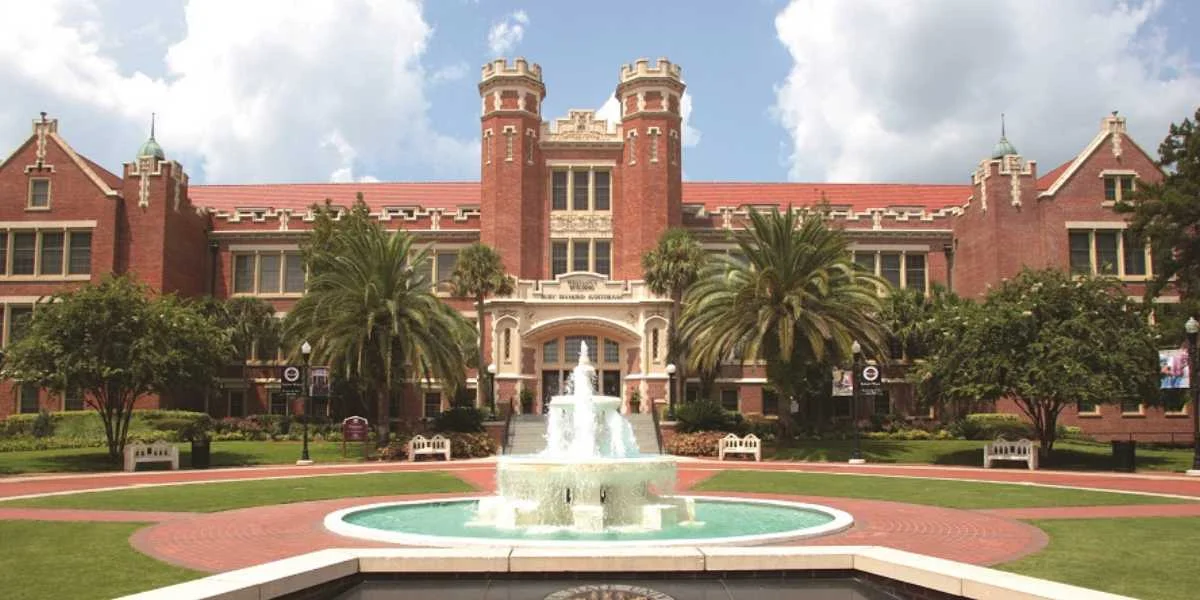
Florida State University is home to 11 undergraduate colleges and 16 graduate schools. The university is known for its outstanding achievements in academic research and athletics. As a public university, it emphasizes community service and global impact. It has leading scientific research programs in fields such as aerospace, biomedical sciences, engineering, and business management. At the same time, Florida State University is widely praised for its diversity, inclusivity, and innovation.
About the university
School data is compiled from public sources and may change. Confirm current tuition, deadlines and requirements with the university before applying.
At a glance
Alumni starting salaries
Student body
Most popular majors
Graduate programs
Business Analytics
Business Analytics
Program Overview
The Business Analytics program at Florida State University focuses on teaching students to manage and leverage big data. The program is STEM-designated. The curriculum is rigorous and builds a strong foundation in machine learning, programming, and optimization. Students entering the program should be committed to further developing their mathematical/statistical and programming skills. This training prepares students to become leaders in the analytics field or to apply to related doctoral programs. Courses in the program use a variety of mathematical, statistical, and programming tools.
Degree Type
Master of Science in Business Analytics (MS-BA)
Program Length
1 year
Source: Florida State University MSBA
Application Requirements
English Language Proficiency
English language proficiency scores are a requirement at Florida State University for international applicants whose native language is not English or who have not completed a bachelor's or graduate degree at a U.S. institution or another institution where English is the required language of instruction; this requirement cannot be waived. The code for sending TOEFL scores to Florida State University is 5219. The College of Business accepts all of the following tests taken within the past two (2) years:
TOEFL: at least 600 on the paper-based test and at least 100 on the internet-based test
International English Language Testing System (Academic IELTS): at least 7
Pearson Test of English (PTE): minimum score of 66
Duolingo: at least 120
Cambridge C1 Advanced: at least 180
Michigan Language Assessment: minimum 55
Admission Background
College coursework should provide students with a solid mathematical, statistical, and computing background. This includes (1) at least one college-level calculus course; (2) at least one college-level probability and statistics course; and (3) at least one college-level course in computer programming using a high-level language such as Python, R, or C++. Applicants are not required to have previously taken business courses, but all applicants are expected to have general knowledge of economics, finance, accounting, statistics, calculus, and principles of management.
In addition to the program-specific admission requirements above, the complete application requirements can be found in the corresponding Application Requirements section of our website
Source: Florida State University MSBA Application Requirements
Graduation Requirements
Credit Requirements
Students must complete 33 credits of coursework, including 27 credits of core courses, 3 credits of elective courses, and 1 hour of professional development coursework each semester (summer, fall, and spring).
Internship Requirement
Students may choose an internship elective
Source: Florida State University MSBA Graduation Requirements
Curriculum
Students must complete 11 courses, including:
9 core courses
1 elective course
1 hour of professional development coursework GEM 5932 each semester (summer, fall, and spring)
Core Courses
Course | Course Number | Credits
Probabilistic Optimization for Analytics | QMB5616 | 3
Programming for Analytics | ISM 5644 | 3
Quantitative Methods in Business Analytics I | QMB 5755 | 3
Data Analytics and Mining for Business | ISM5136 | 3
Data Management in Business Analytics | ISM5560 | 3
Foundational Concepts for Business Analytics | ISM5565 | 3
Fundamentals of Data Visualization | ISM5419 | 3
Business Analytics Capstone | ISM5569 | 3
Forecasting, Revenue Management & Pricing | ISM5566 | 3
Elective Courses
Course | Course Number | Credits
Business Analytics for Competitive Advantage | ISM 5564 | 3
HR Analytics | MAN 5373 | 3
Marketing Analytics | MAR 5675 | 3
Data Analytics in Risk Management and Insurance | RMI 5257 | 3
Graduate Internship | GEB 5944 | 3
Source: Florida State University MSBA Curriculum
Career Development
The Center for Professional Success provides personalized career coaching services to College of Business students, helping them succeed at any stage of their career path. The center's coaching model is action-oriented, student-led, and co-creative. Career coaching appointments emphasize accountability and follow-through. Common discussion topics include:
How should I live my life?
How do I find a job I love?
How do I build professional connections?
How do I make myself attractive to future employers?
Source: Florida State University MSBA Career Development
Finance
Finance
Program Overview
The Finance program at Florida State University is designed to develop and expand students' understanding of concepts and analytical tools, including financial modeling for business decisions. MSF students benefit from hands-on experience managing an investment fund of more than $5 million. Over the course of one year on campus, students strengthen their overall quantitative, communication, and presentation skills and learn to interpret statistical evidence in an economically meaningful way. MSF students may choose one of two program tracks: the standard MSF or the MSF Real Estate Specialization.
Degree Type
Master of Science in Finance (MSF)
Program Length
1 year
Source: Florida State University MSF
Application Requirements
English language proficiency scores are a requirement at Florida State University for international applicants whose native language is not English or who have not completed a bachelor's or graduate degree at a U.S. institution or another institution where English is the required language of instruction; this requirement cannot be waived. The code for sending TOEFL scores to Florida State University is 5219. The College of Business accepts all of the following tests taken within the past two (2) years:
TOEFL: at least 600 on the paper-based test and at least 100 on the internet-based test
International English Language Testing System (Academic IELTS): at least 7
Pearson Test of English (PTE): minimum score of 66
Duolingo: at least 120
Cambridge C1 Advanced: at least 180
Michigan Language Assessment: minimum 55
Admission Background
All applicants must complete the following four business foundation courses before enrolling in the MSF program:
Financial Accounting (ACG 2021 or equivalent)
Financial Management (FIN 3403 or equivalent; a grade of at least B- is required)
Investments (FIN 4504 or equivalent)
Problems in Financial Management (FIN 4424 or equivalent)
The Master of Science in Finance program is primarily intended for students who have completed an undergraduate degree in finance before enrollment. Students with undergraduate degrees in related fields such as mathematics, statistics, accounting, economics, actuarial science, and other business disciplines will be considered for admission if they demonstrate a high level of ability in their chosen field of study and in the admission prerequisite requirements. All students without business experience are strongly encouraged to complete an internship.
In addition to the program-specific admission requirements above, the complete application requirements can be found in the corresponding Application Requirements section of our website
Source: Florida State University MSF Application Requirements
Graduation Requirements
Credit Requirements
Students must complete 36 credits of coursework, including 10 finance courses (3 credits each); the Student Investment Fund and the final program assessment (1 credit each in the fall and spring semesters); and a non-credit professional development series running throughout the program.
Source: Florida State University MSF Graduation Requirements
Curriculum
Students must complete 36 credits of coursework, including 10 finance courses (3 credits each); the Student Investment Fund and the final program assessment (1 credit each in the fall and spring semesters); and a non-credit professional development series running throughout the program. The standard program and the Real Estate Specialization differ by 2 courses.
Common Courses
Course | Course Number | Credits
Applied Econometrics | FIN5840 | 3
Computer Skills for Financial Analysis | FIN5935 | 3
Financial Data Analytics | FIN5455 | 3
Investment Management and Analysis | FIN5515 | 3
Student Investment Fund | FIN5917 | 1
Business Conditions Analysis | MAN5716 | 3
Derivatives and Risk Management | FIN5537 | 3
Program Assessment | FIN5917 | 1
Problems in Financial Management | FIN5425 | 3
Real Estate Finance | REE5205 | 3
Standard Program
Course | Course Number | Credits
Multinational Financial Management | FIN5605 | 3
Fixed Income Securities | FIN5545 | 3
Real Estate Specialization Track
Course | Course Number | Credits
Real Estate Investment | REE5305 | 3
Advanced Real Estate Finance and Investment | REE5209 | 3
Source: Florida State University MSF
Career Development
The Center for Professional Success provides personalized career coaching services to College of Business students, helping them succeed at any stage of their career path. The center's coaching model is action-oriented, student-led, and co-creative. Career coaching appointments emphasize accountability and follow-through. Common discussion topics include:
How should I live my life?
How do I find a job I love?
How do I build professional connections?
How do I make myself attractive to future employers?
Source: Florida State University MSF Career Development
Computer Science
Program Overview
The Computer Science program at Florida State University is designed for students who already hold a bachelor's degree in computer science and wish to pursue further study and research, so the program has strict requirements for the courses students take as undergraduates. The program offers three options—thesis, project, and course-based—and students may choose the one that best fits their needs to complete the degree. Students must take at least one course in each of three core areas: software, systems, and theory.
Degree Type
MS in Computer Science
Source: Florida State University MSCS
Application Requirements
English Proficiency
The minimum TOEFL scores are 550 on the paper-based test and 80 on the internet-based test. If you are a permanent resident, you do not need the TOEFL. However, if you need a visa to remain in the country and you do not hold a bachelor's degree from the United States or another English-speaking country, the TOEFL is required.
GRE
Students must submit GRE scores. Some departments do review all scores, but the GRE total score is based only on the verbal and quantitative sections. The minimum scores are 145 verbal and 150 quantitative.
Statement of Purpose
The statement should provide detailed information that cannot be obtained from transcripts or a resume. You should explain your interests and why you wish to attend Florida State University. You should also describe the research areas you may wish to pursue during your graduate studies and your experience in those areas to date.
Admission Background
A cumulative average of 3.0 is required. Students who do not hold a bachelor's degree in computer science must complete the following courses, or equivalent courses at another institution, before being awarded a PhD or MS in Computer Science. Please note that if a student earned a bachelor's degree in computer science at another institution (not FSU), we may require the student to take one or more courses that were not required at their institution. These courses must be taken before graduation. An undergraduate prerequisite is considered complete if the undergraduate course was passed with a grade of B- or higher, or if an S was earned in a co-listed CGS 5xxx graduate course.
CS General Computer Science MS Prerequisite Courses:
COP 4530 Data Structures, Algorithms, and Generic Programming (3)
CDA 3100 Computer Organization I (3)
COP 4610 Operating Systems (3)
COT 4420 Theory of Computation (3)
In addition to the program-specific admission requirements above, complete application requirements can be found in the corresponding [Application Requirements] section on our official website.
Sources:
Florida State University MSCS Admission Background
Florida State University MSCS Application Requirements
Graduation Requirements
Credit Requirements
Students must complete 30 semester hours of computer science courses at the 5000 level or above.
Grade Requirements
Students in the course-based option must earn a grade of B+ or higher in at least 6 of the 10 courses.
Thesis Requirements
Students in the thesis option must propose and create an individual thesis topic with appropriate focus, scope, and complexity, and write a thesis discussing it. The thesis proposal must be approved by the supervisory committee. The thesis must be written according to university standards. Upon completion, the thesis must be successfully defended in a public forum in the department and receive unanimous approval from the major professor and the supervisory committee. An electronic copy of the thesis must be submitted to the university, the CS webmaster, and the CS graduate coordinator.
Project Requirements
Students in the project option must propose and create an individual project with appropriate focus, scope, and complexity, and write a document discussing it. The project proposal must be approved by the major professor and the supervisory committee. The project document should be written under the guidance of the major professor and the supervisory committee, following the master's project description. Upon completion, both the project and the document must be successfully defended in a public forum in the department and receive unanimous approval from the major professor and the supervisory committee. An electronic copy of the project must be submitted to the CS webmaster and the CS graduate coordinator.
Source: Florida State University MSCS Graduation Requirements
Course Information
Students must choose one of three options—thesis, project, or course-based—to complete the degree. Each option has a specific number of required courses and other requirements, as follows:
Thesis Option
Students in the thesis option must take 7 courses at the 5000 level or above (21 credit hours), plus at least 9 credit hours of CIS 5970r "Thesis." A maximum of 9 credit hours of CIS 5970r may count toward the 30 credit hours required for the master's degree. The 7 courses must include at least one course in each of the areas listed above. Approved CIS 5930/6930 special topics courses may count toward the 7 courses but may not count as supervised teaching, supervised research, seminar, DIS, or CIS 5915 (project hours). Thesis defense requires registration in CIS 8976 Master's Thesis Defense (0).
Project Option
Students in the project option must take 8 courses at the 5000 level or above (24 credit hours), plus at least 6 credit hours of CIS 5915r Graduate Software Project. A maximum of 6 credit hours of CIS 5915 may count toward the 30 credit hours required for the master's degree. These 8 courses must include at least one course in each of the areas listed above. Approved CIS 5930/6930 special topics may count toward the 8 courses but may not count as supervised teaching, supervised research, seminar, DIS, or CIS 5970 (thesis hours). Students must also register for CIS 8974 (0) for the project defense.
Course-based Option
Students in the course-based option must take 10 courses at the 5000 level or above (30 credit hours), including at least one course in each of the three core areas listed above. Approved CIS 5930/6930 special topics may count toward these 10 courses, but supervised teaching, supervised research, seminar, DIS, CIS 5970, and CIS 5915 may not count. Students must also register for CIS 8966, Master's Comprehensive Examination (0), in the semester of graduation (effective Spring 2005).
For the Computer Science program, students must take at least one course in each of the following three core areas to satisfy the area requirement:
Core Courses
Software
Course | Course Number | Credits
Concurrent, Parallel, and Distributed Programming | COP 5570 | 3
Compiler Construction | COP 5621 | 3
Database Systems | COP 5765 | 3
Systems
Course | Course Number | Credits
Computer Architecture | CDA 5155 | 3
Data and Computer Communications | CNT 5505 | 3
Advanced Operating Systems | COP 5611 | 3
Theory
Course | Course Number | Credits
Theory of Automata and Formal Languages | COT5310 | 3
Advanced Algorithms | COT5405 | 3
Analytical Methods | COT5507 | 3
Elective Courses
Course | Course Number | Credits
Principles and Algorithms of Computer Vision | CAP5415 | 3
Artificial Intelligence | CAP5605 | 3
Pattern Recognition | CAP5638 | 3
Introduction to Computer Graphics | CAP5726 | 3
Parallel and Distributed Systems | CDA5125 | 3
For more information, please read the Florida State University and Computer Science program course catalogs.
Source: Florida State University MSCS Course Information
Career Development
After completing the Computer Science program at Florida State University, students will have a wide range of employment opportunities and career prospects. The job market in computer science has consistently shown strong growth, and graduates can find opportunities in a variety of industries and fields. They may choose positions such as software development engineer, data scientist, systems architect, network engineer, and artificial intelligence engineer, which often offer generous compensation and broad room for advancement.
In addition, as technology continues to develop and innovate, computer science graduates also have opportunities to build careers in emerging fields such as the Internet of Things (IoT), blockchain, machine learning, and artificial intelligence. Through continuous learning and skill development in their professional field, students can continually expand their career paths and achieve further accomplishments and success in the future.
Interdisciplinary Data Science Program
Interdisciplinary data science
Program Overview
The interdisciplinary data science program at Florida State University spans four areas—computer science, mathematics, scientific computing, and statistics—and students can choose a specialization based on their interests. Its curriculum emphasizes core mathematics, machine learning, statistics, data ethics, and databases, giving students practical data science skills. Faculty in the program conduct data science research, and students shape an individualized specialization through core and elective courses. Graduates will possess the professional skills required in the era of big data, benefiting industries including finance, epidemiology, and real estate.
Degree Type
MS degree in interdisciplinary data science
Program Length
16 months
Source: Florida State University Applied Science
Application Requirements
An English language proficiency score is a requirement at Florida State University for international applicants whose native language is not English or who have not completed a bachelor's or graduate degree at a U.S. institution or another institution where English is the required language of instruction, and therefore cannot be waived. The code for sending TOEFL scores to Florida State University is 5219. The business school accepts all of the following tests taken within the past two (2) years:
TOEFL: no less than 600 on the paper-based test and no less than 100 on the internet-based test
International English Language Testing System (Academic IELTS): at least 7
Pearson Test of English (PTE): minimum score of 66
Duolingo: no less than 120
Cambridge C1 Advanced: at least 180
Michigan Language Assessment: minimum 55
Personal Statement
A 1-3 page personal statement describing your background, achievements, and goals.
Admission Background
A minimum overall grade point average of 3.0. Students choosing the statistics specialization must complete Calculus 1 and 2, a probability and mathematical statistics course, and an applied statistics course (STA 2122 or equivalent).
In addition to the program-specific admission requirements above, the complete application requirements can be found in the corresponding [Application Requirements] section of our website
Source: Florida State University Applied Science Application Requirements
Graduation Requirements
Credit Requirements
Students must complete a minimum of 30 credits of coursework
Source: Florida State University Applied Science Graduation Requirements
Course Information
Students must complete a minimum of 30 credits of coursework, of which the elective courses are selected by the student together with their advisory committee and will determine the student's specific specialization among the four areas (computer science, mathematics, scientific computing, or statistics).
Students in the statistics specialization must complete 7 core courses and 4 elective courses.
Core Courses
Course | Course Number | Credits: Mathematics for Data Science | MAD XXXX | 3; Introduction to Data Science | COP 5XXX | 3; Applied Regression Methods | STA 5207 | 3; Professional Development | STA 5XXX | 1; Machine Learning | STA 5635 | 3; Data Mining | CAP 5771 | 3; Data Ethics | PHI 5XXX | 2. Elective Courses
Course | Course Number | Credits: Data Management and Analysis with SAS | STA 5066 | 3; Advanced Data Management and Analysis with SAS | STA 5067 | 3; Computational Methods in Statistics I | STA 5106 | 3; Computational Methods in Statistics II | STA 5107 | 3; Introduction to Applied Statistics | STA 5126 | 3. For more information, you can read the course catalog for the Florida State University Applied Science program.
Source: Florida State University Applied Science Course Information
Career Development
After graduating from the interdisciplinary data science program at Florida State University, graduates will possess the professional skills and knowledge required in the era of big data, laying a solid foundation for employment opportunities in industries such as finance and real estate. They will have extensive data science experience and practical ability and will be able to work in areas such as data analysis, machine learning, and data mining. In addition, the school offers extensive internship and job opportunities to help graduates enter the workplace smoothly and succeed in their career development.
The school provides detailed lists of internship opportunities and job opportunities; for specific information, please read Internship Opportunities and Job Opportunities.
Source:
Florida State University Applied Science Internship Opportunities
Florida State University Applied Science Job Opportunities
Campus life
Transportation
Nearby Airport
Tallahassee International Airport
Distance from campus: 5.6 miles
Campus-to-airport travel:
By car/rideshare:
Typically about 10 minutes. It may take longer during heavy traffic.
Public transportation:
There is currently no public transportation available to the airport.
Nearby Train Station
Tallahassee Station
Campus-to-station travel:
By car/rideshare:
Typically 3 minutes. However, it may take longer during heavy traffic.
Public transportation:
No public transportation is needed to reach the train station; you can walk there in about 14 minutes.
City Public Transportation
Florida State University is located in Tallahassee, Florida, and offers a variety of nearby public transportation options, mainly including:
StarMetro (the City of Tallahassee's publicly operated bus system): StarMetro provides bus service within Tallahassee, including multiple routes serving the Florida State University campus. Students can use StarMetro buses to reach campus, downtown, and other areas.
Seminoles Express (transportation service within the Florida State University campus): Florida State University offers an internal campus bus service called Seminoles Express. These buses cover major locations on campus, making it easy for students to get around.
Bicycles: Tallahassee is a bike-friendly city, so bicycles are a popular transportation option. Florida State University may offer bicycle rental services, or students can choose to rent bicycles locally.
Safety
University housing and the Florida State University Police Department (FSUPD) provide students with safety resources, including ongoing educational programs, safety-related policies, educational sanctions for those who violate these policies, and staff assistance and emergency response for handling safety issues.
Residence Hall Staff:
Residence coordinators, assistant coordinators, residence hall directors, facilities directors, resident assistants (RAs), night staff, and front desk receptionists work within the residence halls. Report all safety concerns to them immediately.
Florida State University Police Department (FSUPD)
These are sworn law enforcement officers responsible for responding to emergencies. They also provide safety programs for students.
Adopt-AC.OPP:
The Florida State University Police Department also provides liaisons to the residence hall community, known as Adopt-AC.OPP. These officers participate in staff functions and spend extra time conducting safety patrols in the halls and interacting with students.
Crime Prevention Unit:
FSUPD also has a unit specifically dedicated to educating members of the university community about preventing, reducing, and raising awareness of criminal activity. Members of the Crime Prevention Unit design, implement, and deliver educational programs so that all members of the university community—students, faculty, staff, and visitors—know what they can and should do to prevent becoming a victim. Successful programs include Adopt-AC.OPP, Rape Aggression Defense (RAD) training, residence hall safety consultations, and auto theft prevention campaigns. They also issue crime alerts to campus when crimes occur.
FSU Alert System:
If any major emergency occurs on campus, the university will use the FSU ALERT emergency notification system to warn everyone. In an emergency, FSU can use up to 22 methods to alert the campus community, including outdoor sirens, blue lights, email, text messages, or NOAA weather radio. If one or more of these systems is activated, seek shelter in the nearest building and try to obtain more information.
For more information, please read Campus Safety.
Housing
The university offers more than 10 residence halls to meet students' on-campus housing needs.
Residence Halls
Azalea Hall
Broward Hall
Bryan Hall
Cawthon Hall
DeGraff Hall
For more information, please read the residence hall list.
On-Campus Housing Application Steps
Freshman/Transfer/Graduate Student Application
Complete the online application and contract signing
Your contract number serves as your "place in line" for on-campus housing and determines your priority for room/hall preferences. The earlier you submit your contract, the more options will be available to you when assignments are made. If you are under 18 on the date you submit your fall/spring housing contract, you will need to complete the fall/spring parent/guardian contract consent form.
Hall and Room Type Preferences
Within the designated dates, you may submit/update your hall and room type preferences multiple times. Most students should be assigned to a shared bedroom space with one shared bathroom adjacent to another shared bedroom. If you have a designated roommate, you should ensure that you and your designated roommate have the same hall/room type preferences in the same order. When you select hall and room type preferences, the system will ask you to rank several different halls/complexes and room types. Some similar halls are grouped together.
Current Student Application
Complete the online housing contract
Add roommate information before the set date
Room Selection
After completing Steps 1 and 2 by the specified deadline, you will be able to select a room online. Room selection windows will first be assigned in order based on total completed credit hours. As room selection progresses, you may not be able to find a double vacancy for you and your requested roommate. If you cannot find a double vacancy in any available hall, you may need to select a space on your own. If there are no vacancies at the start of your room selection time: you should check all residence halls, not just your preferred hall.
Dining
The university offers a variety of dining options, including dining halls, convenience stores, and cafés.
On-Campus Restaurants
Suwannee Rooms
Suwannee Rooms offers meal options for everyone, including low-calorie dishes, vegetarian recipes, and barbecue.
Seminole Café
Seminole Café offers pasta, made-to-order burritos, and sandwiches.
4 Rivers Smokehouse
4 Rivers Smokehouse focuses on traditional favorites such as 18-hour smoked brisket and homemade Southern sides, as well as bold, innovative flavor and ingredient combinations in sandwiches. These proteins include signature Angus brisket, Southern pulled pork, smoked chicken, turkey, Texas sausage, wings, and St. Louis-style ribs. From cornbread salad to smoked jalapeños, you can pair them with up to 16 sides.
For more information, please read the restaurant list.
Meal Plan
Meal plans provide delicious meals, coffee, snacks, and more at more than 30 locations on campus! Your meal plan includes meal swipes, cash equivalency meal swipes, guest meal swipes, a reusable Ozzi takeout container, and Dining Dollars. Just swipe your FSU card to use everything—no need to carry extra cards or cash!
Meal Swipes: With a meal swipe, you can enter the dining hall, Suwannee Room, and Seminole Café. As part of the university's efforts to provide variety, flexibility, and convenience, you can also exchange one meal swipe per day for an equivalent cash swipe at designated retail locations on campus.
Dining Dollars: Accepted at multiple convenience stores. Any unused Dining Dollars roll over each semester until graduation or departure from the university.
Cash Equivalency Swipe: The cash equivalency dining option gives students an opportunity to add variety to their daily meals by exchanging one meal card swipe per day for up to $7.00 worth of food at any location.
Meal PlanMealsDining DollarsCash Equivalency SwipeGuest MealsCost100 Renegade100/semester450/semester1/day3/semester1610/semesterBuild Your Own - 7 Day Open AccessUnlimited0/semester1/day3/semester2708/semesterWeekly 1010/week350/semester1/day3/semester2164/semesterWeekly 1414/week250/semester1/day3/semester2603/semester
Admissions
Admissions data
Application requirements
Application checklist
Application deadlines
Transfer requirements

Transfer checklist
Transfer deadlines
Similar universities
Admissions FAQ
What is the acceptance rate at Florida State University?
The reported acceptance rate is 25%. Acceptance rates vary by applicant pool and application cycle; confirm the current figure with Florida State University.
What SAT scores does Florida State University expect?
The reported SAT range is 1240-1390. Test-optional and score-reporting policies can change by application cycle; check the university's official admissions page before applying.
When is the application deadline at Florida State University?
The listed Regular Decision deadline is March 1. Deadlines can vary by program and application cycle; confirm the exact date with the university.
How much does Florida State University cost?
The listed tuition and fee figure is $13,474. Costs vary by residency, programme and academic year; confirm current costs with the university.
Where is Florida State University located?
Florida State University is located at 222 S. Copeland Street, Tallahassee, FL, 32306-1037.
Planning your application?
Build a school list around your profile.
Ivy Elite advisors help students compare programs, plan coursework and prepare applications for U.S. universities.